As has been well publicized, tomorrow is the Pi Day of the Century (3/14/15). I actually know someone who intentionally planned her wedding for tomorrow morning at 9:26 am.
The North Branch of the Denton library will be holding a Pi Day event from 9:26 am until 5:35 pm, and I’ll be making four presentations (two for grade school children and two for teens/adults). You’re welcome to bring the family and enjoy as your schedule permits.
March 14, 2015 has been labeled the Pi Day of the Century because of the way this day is abbreviated, at least in America: 3/14/15.
I was recently asked an interesting question: did any of our ancestors observe Pi Day about 400 years ago on 3/14/1592? The answer is, I highly doubt it.
My first thought was that may not have been known to that many decimal places in 1592. However, a quick check on Wikipedia (see also here), as well as the book “ Unleashed,” verifies that my initial thought was wrong. In China, 7 places of accuracy were obtained by the 5th century. By the 14th century, was known to 13 decimal places in India. In the 15th century, was calculated to 16 decimal places in Persia.
It’s highly doubtful that the mathematicians in these ancient cultures actually talked to each other, given the state of global communications at the time. Furthermore, I don’t think any of these cultures used either the Julian calendar or the Gregorian calendar (which is in near universal use today) in 1592. (An historical sidebar: the Gregorian calendar was first introduced in 1582, but different countries adopted it in different years or even centuries. America and England, for example, did not make the switch until the 18th century.) So in China, India, and Persia, there would have been nothing particularly special about the day that Europeans called March 14, 1592.
However, in Europe (specifically, France), Francois Viete derived an infinite product for and obtained the first 10 digits of . According to Wikipedia, Viete obtained the first 9 digits in 1579, and so Pi Day hypothetically could have been observed in 1592. (Although Unleashed says this happened in 1593, or one year too late).
There’s a second problem: the way that dates are numerically abbreviated. For example, in England, this Saturday is abbreviated as 14/3/15, which doesn’t lend itself to Pi Day. (Unfortunately, since April has only 30 days, there’s no 31/4/15 for England to mark Pi Day.) See also xkcd’s take on this. So numerologically minded people of the 16th century may not have considered anything special about March 14, 1592.
The biggest obstacle, however, may be the historical fact that the ratio of a circle’s circumference and diameter wasn’t called until the 18th century. Therefore, both serious and recreational mathematicians would not have called any day Pi Day in 1592.
In my capstone class for future secondary math teachers, I ask my students to come up with ideas for engaging their students with different topics in the secondary mathematics curriculum. In other words, the point of the assignment was not to devise a full-blown lesson plan on this topic. Instead, I asked my students to think about three different ways of getting their students interested in the topic in the first place.
I plan to share some of the best of these ideas on this blog (after asking my students’ permission, of course).
This student submission comes from my former student Nada Al-Ghussain. Her topic, from Geometry: using a straightedge and compass to find the incenter of a triangle.
What interesting things can you say about the people who contributed to the discovery and/or the development of this topic?
Sitting down one day pondering, Greco-Roman mathematician Euclid had a light-bulb moment and Eureka, the Elements was created! Right? Well not quite. Back in the day, 440B.C to be exact, a merchant named Hippocrates of Chios, chased after pirates to Athens to recover his stolen property. Unsuccessful, he attended math lectures and compiled the first known work of elements in geometry. Later on, around 350 B.C in the Academy, mathematician Theudius’s textbook was used by non- other than Aristotle. Then came our man Euclid in 300 BC and presented to us the pivotal textbooks, the Elements, which was used in universities until the 20th century. Euclid had compiled previous mathematical work into his Elements although he alone contrived the design and construction of different parts. Euclid’s Elements consisted of 13 books that covered Euclidean geometry, elementary number theory, and etc. For example, in book 4 (IV) Proposition 4, Euclid gives directions to inscribe a circle in a given triangle using a straightedge and compass.
How could you as a teacher create an activity or project that involves your topic?
I would set up a Founding Geometry explore activity before telling students anything over Euclidean geometry. In this activity I would want individual work but allow students to discuss in groups. Each person would get an equilateral triangle image, a compass, and a straightedge, not a ruler! First I would instruct the students to find the incenter, middle point of the triangle using only those two tools. This would get the students to think and go through trial and error as they work individually and together. Next I would ask them to write down their steps and discuss with each other. Then I would open class discussion asking the students the steps they took to get the incenter. I would ask thee students if they see anything else with all the lines they drew. Hoping they would describe the angle bisectors. Then I would ask the class if all triangle incenter’s could be found the same way. I would give each student a different shaped and sized triangle and give them time to discover the answer on their own. Once students finished, I would discuss the class the key steps and definitions learned. I would then tell me that they all are founders of Geometry, and tell them about Euclid’s role in geometry. This activity could be easily changed to any parts like how to construct a triangle or even to help prove and understand the Pythagorean theorem.
How can technology be used to effectively engage students with this topic?
When constructing geometry, trial and error tends to occur. Whether it is an instructor or a student. Graphical Ruler and Compass Editor, GRACE is a great site that allows the user to construct using only a straightedge and compass. By simply producing points and picking from Line, Line Segment, Ray, Circle, Perpendicular Bisector, and Intersection. This could be given to students as they work in class or at home as to not waste paper. It has special features that allow you to zoom in and out doing multiple constructions on one page. It also allows you to create and test axioms. This is tool is great for middle school all the way to university level students. It’s a quick visual that can be manipulated easily. From experience, many times when constructing certain propositions from Euclid’s Elements, I tended to waste time erasing so much and making perfect circles. Plus hand drawings can be tedious for some students. This is easier to use and engage all students including some special education students.
In my capstone class for future secondary math teachers, I ask my students to come up with ideas for engaging their students with different topics in the secondary mathematics curriculum. In other words, the point of the assignment was not to devise a full-blown lesson plan on this topic. Instead, I asked my students to think about three different ways of getting their students interested in the topic in the first place.
I plan to share some of the best of these ideas on this blog (after asking my students’ permission, of course).
This student submission comes from my former student Kristin Ambrose. Her topic, from Geometry: introducing the terms parallelogram, rhombus, trapezoid, and kite.
How could you as a teacher create an activity or project that involves your topic?
An activity I could do with my students is to have my students sort the different shapes into their own categories. Without letting them know the terms for these shapes, I could give my students several cut-outs of different parallelograms, rhombi, trapezoids, and kites, and have them sort these into four categories. Then the students could discuss how they grouped the shapes, and with the teachers guidance the students would come up with a list of the key characteristics each group of shapes had. Only at the end would the teacher reveal the official terms (parallelogram, rhombus, trapezoid, and kite) for these categories, and by this point the students would already know the characteristics for each shape since they previously listed the characteristics before they knew the official terms. I believe this would make the process of learning about these shapes more meaningful and interesting since the students would have discovered the characteristics of these shapes on their own.
How has this topic appeared in high culture (art, classical music, theatre, etc.)?
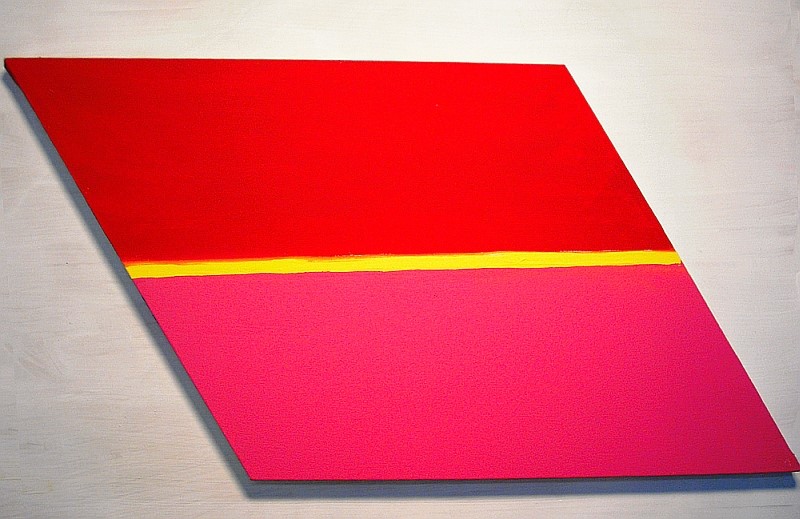
Geometry often appears in art, and therefore shapes like parallelograms, rhombi, trapezoids and kites can be found in pieces of artwork. I was able to find a website (http://fineartamerica.com/art/all/geometric/all) where they sell geometric artwork. On this site I was able to find a few pieces that contained parallelograms, rhombi, trapezoids, and kites. Here are a few pictures of artwork that contains these geometric shapes:
These shapes can also be found in other forms of art like jewelry, like this trapezoid necklace and kite earrings:
Students may find it interesting to see how geometric shapes can be used in different forms of art, and it may even inspire them to create their own forms of geometric artwork or crafts.
How can technology be used to effectively engage students with this topic?
On YouTube, the channel Vi Hart has a video where they create geometric shaped cookies. Here is the link to the video:
During the first two minutes of the video they create √2 rhombus cookies. Then they are able to create other cookie shapes using the rhombi cookie dough. It’s interesting to see the different ways they cook with the geometric shapes, and it could even inspire my students to create their own geometric-shaped cookies. After viewing the video, I could discuss with my students what characteristics they noticed about the rhombus-shaped cookies and this could open up a discussion about what the definition of a rhombus is. After discussing rhombi, we could move on to discussing other kinds of geometric shapes like parallelograms, trapezoids, and kites. We could also discuss the similarities between these kinds of shapes, and how they connect to each other.
In my capstone class for future secondary math teachers, I ask my students to come up with ideas for engaging their students with different topics in the secondary mathematics curriculum. In other words, the point of the assignment was not to devise a full-blown lesson plan on this topic. Instead, I asked my students to think about three different ways of getting their students interested in the topic in the first place.
I plan to share some of the best of these ideas on this blog (after asking my students’ permission, of course).
This student submission comes from my former student Kelley Nguyen. Her topic, from Geometry: translation, rotation, and reflection of figures.
How could you as a teacher create an activity or project that involves your topic?
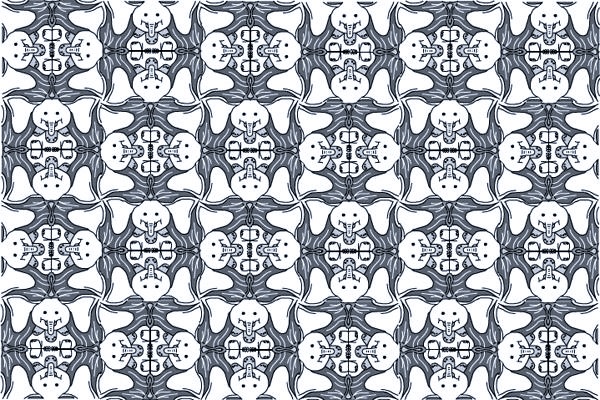
With this topic, I would definitely do an art activity, where students will construct tessellations of their choice. I would ask the students to print out a picture of their favorite animal, sport, pattern, etc. In class the following day, we would begin our drawings and the students will take the assignment home and finish it as a project. I would start them off in the top left corner, making a reflection of the original image. Then, we’ll turn the image 90 degrees, making a rotation of the original image. We’ll repeat this process until the entire page is complete. In this case, using an 8.5” x 11” sheet of computer paper may be the best choice so not too much time is spent on the art of the subject rather than the concepts behind it. If teachers wanted to make it an extra credit assignment, using a poster board can be a good idea and can be hung outside the classroom.
Once the students are complete with the project, we will all reflect on what they see. They’ll be able to point out the turns and flips of the tessellation, which will lead us into the topic of transformations.
How has this topic appeared in high culture (art, classical music, theatre, etc.)?
Translations, rotations, and reflections all appear in the art of dance. Being a dancer involves a lot of movement, including turns, flips, slides, etc. These types of movements are all connected to geometry.
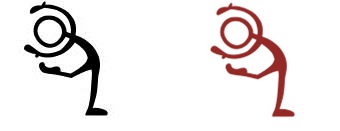
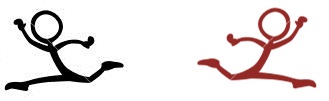
If a dancer spends an eight-count sliding from one space to another, this form of movement is considered a translation in mathematics. For example, in the picture below, the black character slides into the position of the red character. That is a form of translation with movement in dance.
Mathematically, a translation will look like the image below, where the black triangle translates one unit down and five units to the right.
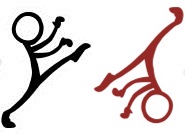
Now, if a dancer decides to throw a handstand into their routine, this is a form of reflection on the original position.
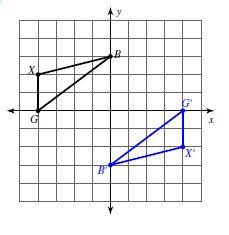
Mathematically, a rotation is done by a particular degree. The example below displays an object being rotated 180 degrees about the origin.
Lastly, let’s say two dancers perform a duet for an upcoming show. Most of their routine contains the same exact movements but in some point of their dance, both dancers reflect each other moves against each other. This form of movement is considered a reflection. For example, in the picture below, both dancers are reflected each other’s leaps away from each other, making a symmetric line down the middle.
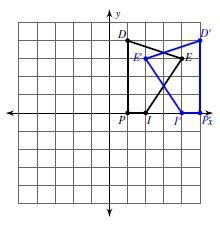
Mathematically, a reflection is a flipped image across the axis of symmetry. In the example below, the black figure is reflected across x = 3 to create the blue figure.
The examples provided are just some ways translations, rotations, and reflections are used in art of dance. Most people won’t pick up on the idea of mathematics being used when creating routines, but it’s definitely connected in many ways, movement being one.
How have different cultures throughout time used this topic in their society?
Transformations can be seen all over the world on streets, in museums, at parks, and downtown as works of art, architecture, crafts, and quilting.
Many transformational designs are found in rugs, quilts, buildings, and pottery from numerous different cultures. These designs gave note to where and to whom these unique pieces belongs to.
Most can agree that the use of transformations is important to art. These geometric designs showed a culture’s appeal of art and architecture. For example, historical buildings are well constructed and decorated to display religious beliefs or honor someone important in the community. These buildings often contain geometric shapes and patterns as an appeal to the population. Specifically, the Alhambra Palace in Spain portrays beautiful tessellation designs throughout its windows and ceilings. The designs are symbols of dynasty and wealth in their society.
Crafts and pottery also play a big role in the importance of transformations within cultures. When studying this form of art, researchers can identify which cultures interacted with other cultures. Each culture alone had their own unique designs that identify them as a whole, which portrayed their way of living and track the journey they took.
Lastly, thinking more modern, we could find that the United States Capitol building located in Washington, D.C. was built on the basis of symmetry. If you’ve ever been inside, you’ll notice that the building contains a lot of interior art work, including tessellations and symbols representing important historical people and events. References
In my capstone class for future secondary math teachers, I ask my students to come up with ideas for engaging their students with different topics in the secondary mathematics curriculum. In other words, the point of the assignment was not to devise a full-blown lesson plan on this topic. Instead, I asked my students to think about three different ways of getting their students interested in the topic in the first place.
I plan to share some of the best of these ideas on this blog (after asking my students’ permission, of course).
This student submission comes from my former student Donna House. Her topic, from Geometry: deriving the distance formula.
What interesting word problems using this topic can your students do now?
Start with a story:
Two guys (Cyniscus and Protogenes, but they usually went by their nicknames, Cy and Skippy) were hanging out on a Saturday afternoon in ancient Greece. Cy wanted to go to McDolops and get a Filet-O-Squid, but Skippy wanted to go to Athens Fried Pheasant. While they were discussing this, their buddy, Pythagoras, walked by.
Cy: Hey, P-Thag! What up? (This is from the original Greek.)
Pythagoras: Dude! Just gonna grab a bite somewhere. What up with y’all? (Greece is in the south.)
Cy and Skippy told P-Thag about trying to decide where to go. Pythagoras did not want to go to either place — McDolops or Athens Fried Pheasant — because he was a vegetarian. (Pythagoras was also morally opposed to beans. No one knows exactly why. Some say it was because he believed eating beans was akin to eating people. Others think it was because — well, you know what eating beans does.)
So, Pythagoras suggested they go to What-a-carrot and, since they served pomegranates and pancakes, Cy and Skippy thought that was a great idea. But how would they get there?
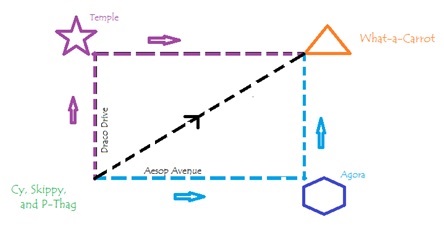
Cy wanted to walk east down Aesop Avenue to the agora, turn left, and walk to What-a-carrot.
Skippy wanted to walk north up Draco Drive to the temple, turn right, and walk to What-a-carrot.
Pythagoras had more common-sense (or was just lazy) and wanted to find a shorter route. So, he came up with a useful theorem on the spot! (Really – that is just how it happened.) P-Thag wanted to walk straight to What-a-carrot. (Euclid wrote an axiom for this: “Given two points there is one straight line that joins them.” Euclid’s axiom didn’t help on this day – Euclid lived about 300 years later!)
If Aesop Avenue is 4 stadia long and Draco Drive is 3 stadia long, how far would they walk using Cy’s route? How far would they walk using Skippy’s route? How far would they walk using P-Thag’s route?
It is late and you are sitting at your desk and in the middle of planning your new tower project or antenna support [you are a ham-radio operator] and you’re getting all of the materials, parts, accessories list, etc. together so you can dig deep into your bank account for the needed money to purchase all of the needed supplies.
In your excitement you realize you just can’t wait to get that antenna support mast or that tower you just acquired high in the air so your signal will travel the earth and beyond.
In your planning stage you have looked over your proposed tower or mast site and found the ideal place in which to “plant” it in the ground and you know how high it will be when it is installed.
Now you ask yourself where to put the guy wires for it on the ground…you walk around the area and pick some good locations for each of them hopefully conforming to recommended safe installation procedures. In your observations, you realize that each guy wire will have to be a different length due to obstructions and Murphy’s Law getting in the way. It never fails, Murphy is always looking over our shoulders and picking on us as ham radio operators!
Ok now, stand back Murphy…each guy wire has to go in a specific location whether “Murphy” likes it or not and you know how high the tower or support mast, pole, etc. is so then it hits you… and you ask yourself….how long will the guys [wires] have to be for the locations I have picked out? I don’t want to have to buy more guy wire than I need. After all, my wife says I am cheap!
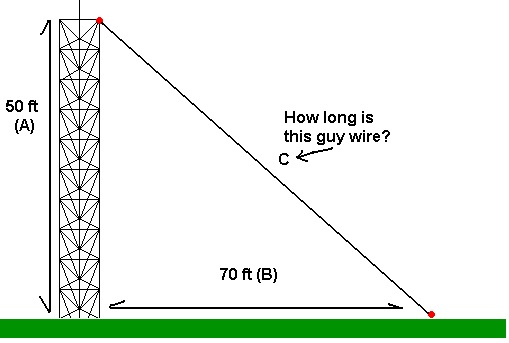
You look at the tower, pole, mast etc. and your location for the guy wire at ground level and say….well the mast is 50 feet tall, so the length at the location of my first guy has to be at least as long as the mast is high but a bit longer…but how much longer will it have to be due to the angle of the guy coming off of the tower if it is 70 feet away? See the example drawing below for our proposed setup and to get the answer to our question in our fictitious installation.
In our example above, the tower is 50 feet from the base to the top guy
attachment point and the distance to the first guy is 70 feet…how long is the guy wire!
How could you as a teacher create an activity or project that involves your topic?
Math can become boring and tedious for some students (shocking! – I know.) An activity that will help them learn while having fun will help them remember the lesson. One such activity is useful in learning the distance formula.
If your classroom is not large enough, arrange to have your lesson outdoors or in the gym (at least this portion of the lesson.) Divide the students into two teams and have each team line up in an “L” shape. For example, if you have 10 students on a team, have six or seven line up in a straight line and the remaining students form a line at a right angle to the end of the first line. The number of students in each line is not important as long as the lines form a right angle and each team is lined up the same way.
Give the two students at one end of each team a ball and tell them to pass the ball from one student to the next until the ball reaches the end of the line. The goal is to pass the ball from one side of the team to the other. The team who passes the ball fastest wins the match.
Repeat this game until someone figures out to throw the ball from one end of the line to the other. (You may need to say, “Think about how you can get the ball to the other end faster.”) This will complete your right triangle!
Now you can have a discussion about how going from one end to the other directly is faster than having to go around the corner. (The shortest distance between two points . . .) Someone will probably mention the Pythagorean Theorem and that will give you the perfect opportunity to guide them through the derivation of the distance formula!
Begin by asking, “How can not knowing math cost you money?” Pause to give the students a moment to think about the question, then say, “Let’s see what happened to a contestant on Who Wants to be a Millionaire?”
Pause the video between 1:00 and 1:05 (before the audience’s answers are revealed) and have the class vote for the answer they think is correct. Don’t give the students too much time to think – you should simulate the time the contestant has to answer (about a minute.) Tally the votes on the board (and find the percentages) so the class can see the results. Compare the class percentages with the audience percentages. Now resume the video.
Stop the video at 2:18 so the correct answer is given, but the smaller squares are not yet revealed. Say, “Would you have lost $15,000 on this question like this contestant did? How do we know that 25 is the correct answer?” Help the students set up the problem.
25 (which is a square) is equal to (something squared) + (something squared)
So, 25 = x2 +y2
So, 52 = x2 +y2
“What formula is this?” [a circle]
“What does 52 represent?” [radius squared]
At this point you can draw the circle and the radius, then discuss how to find x2 and y2. This will lead to the formula for the Distance Formula!
In my capstone class for future secondary math teachers, I ask my students to come up with ideas for engaging their students with different topics in the secondary mathematics curriculum. In other words, the point of the assignment was not to devise a full-blown lesson plan on this topic. Instead, I asked my students to think about three different ways of getting their students interested in the topic in the first place.
I plan to share some of the best of these ideas on this blog (after asking my students’ permission, of course).
This student submission comes from my former student Chais Price. His topic, from Geometry: finding the circumference of a circle.
What interesting things can you say about the people who contributed to the discovery and/or the development of this topic? (You might want to consult Math Through The Ages.)
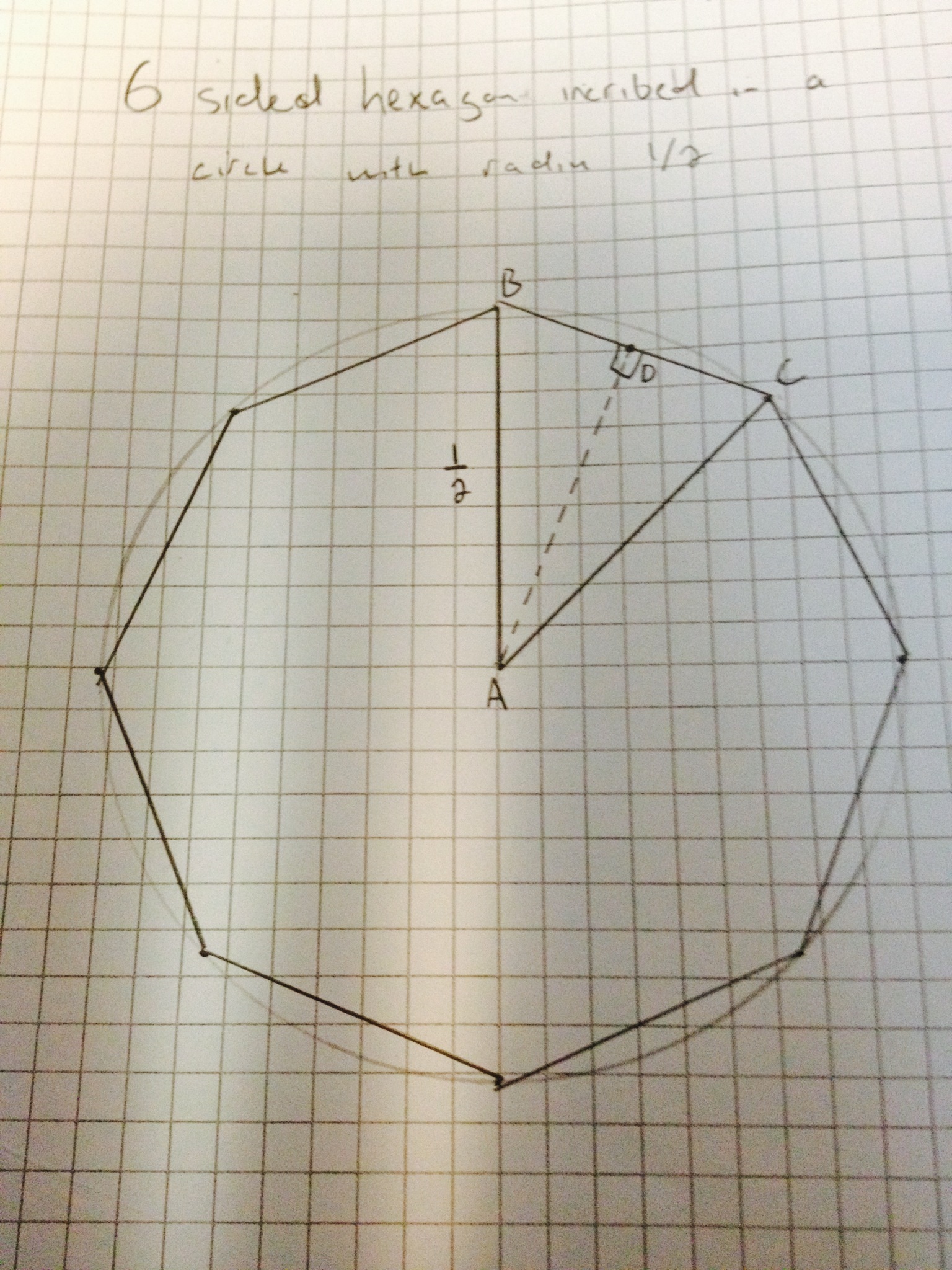
We are familiar with the formula for the circumference of a circle as C=2πr. But where does this come from? What is unique about this formula? The formula for finding the area of a circle is similar. What do the formulas for finding the circumference and area or a circle have in common? It turns out that the number pi is included in both of these formulas and makes it unique. Why is it unique you aks? Because of what pi represents. Pi is an irrational number that is seen throughout various math classes. Since pi is irrational, our calculations for circumference and area of a circle are approximations. So how did this symbol end up in these formulas for a circle? It turns out that there has been a long history of pi beginning with the Ancient Babylonians. These ancient tablets are dated somewhere between 1900-1680 BC. The babylonians used a base 60 system and had no place value. Based on these tablets the circumference is 3 and the ratio is 45/60. By using this ratio = to the area we have 45/60=9/4 pi which places a value of 3 on the number pi.
Now lets shift forward about 1650 years to the time period of the famous mathematician Archimedes of Syracuse ( 287-212 BC). What Archimedes discovered was that there was a ratio relationship that existed amongst circles and circular objects. This ratio was uncovered through a tedious and time consuming process of inscribing and circumscribing regular polygons by hand. Then he found the area of the polygons and concluded that since the circle lies between the polygons, the area would be an approximation. He doubled the sided of his polygons all the way up to 96 sides. It turns out that this number known as pi is the ratio of the circumference of a circle and its diameter. This lesson is not on pi but it is important to understand the formula for the circumference and area of a circle and where it comes from.
This is actually an octagon and not a hexagon. But as you can imagine, the more sides you add, the more the regular polygon resembles a circle. I actually inscribed a 96 sided polygon inside a circle and you could not even tell from the naked eye that it had any straight edges. It looked just like a circle. So the idea is that the more sides you use in a calculation involving pi, the more accurate the solution will be. We can conclude with the notion that pi = the ratio of the circumference and the diameter of a circle.
How could you as a teacher create an activity or project that involves your topic?
For this lesson we are going to use several circular objects that the teacher brings in. These objects can include things such as tape, frisbee, can, etc. Along with these objects the students will be given string and have access to a ruler, markers, or anything else useful for this activity. I will also have a handout which includes a table to write in the objects measured as well as the measurements themselves. The students are to measure the objects circumference and diameter and then fill in the table. This lesson is designed to have the student discover pi as the ratio between the circumference and diameter of an object where pi= c/d. Then solving for c which is the circumference, we get the circumference formula: c=d*pi or c=2*pi*r.
How has this topic appeared in pop culture (movies, TV, current music, video games, etc.)?
This video acts as an engagement for students relating a pretty accurate approximation to the circumference of the Earth.
In my capstone class for future secondary math teachers, I ask my students to come up with ideas for engaging their students with different topics in the secondary mathematics curriculum. In other words, the point of the assignment was not to devise a full-blown lesson plan on this topic. Instead, I asked my students to think about three different ways of getting their students interested in the topic in the first place.
I plan to share some of the best of these ideas on this blog (after asking my students’ permission, of course).
This student submission comes from my former student Tracy Leeper. Her topic, from Geometry:finding the area of a square or rectangle.
How could you as a teacher create an activity of project that involves your topic?
I would start off my lesson by allowing the students to use block manipulatives, and worksheets with different squares and rectangles printed on them, and ask the students to find out how many blocks each square or rectangle takes to fill the space. I would then tell them the space covered by the blocks is called the area, and see if they could find the relationship of . By having the students use the blocks, they can easily see that a square would use 9 blocks. The “hidden” block in the middle of the square would become visible. By doing this, I would allow the students to discover the algorithm for the area of a rectangle / square on their own. This would enable them to remember it better. Using the blocks would also give them a better visual memory of the activity, so later, it should be easier for the students to recall the appropriate formula. Using various sizes of rectangles and squares would also illustrate that the algorithm works every time, regardless of the size of the rectangle or square.
How can technology be used to effectively engage students with this topic.
LearnZillion.com has a great lesson on finding the area of a rectangle. The video starts out by reviewing what a perimeter is, and uses scaffolding to build to finding the area. After the area has been determined to be , the video then goes on to ask questions for finding area on a different rectangle, and then shows that given the area, and one side, by using inverse operations, we can solve for the missing side. The next question is, given a rectangle with a perimeter of 24, what might the area be? Again, the video not only reinforces using the inverse operation, but continues to show the importance of the word “might” by showing that there are multiple solutions. After teaching what mathematical reasoning should be used for this problem, the video then moves to applying the knowledge to a word problem. The video uses proper mathematical terminology, and demonstrates how to apply prior knowledge to help in gaining new knowledge. The video does seem a little dry, and the students might want something flashier to catch their attention, but I feel this video would be a very good tool to use, to reinforce new concepts for students.
1n 2006, the San Alfonso del Mar resort in Algarrobo, Chile opened the “world’s largest swimming pool” as dubbed by Guinness World Records. It is measured to cover approximately 20 acres, which is 871,200. I would use this as a lead in to an activity for my students. I would show them a picture of the pool and challenge them to find out how many Olympic size pools it would take to cover the same surface area. Since this lesson is on area and not volume, I would give them the measurements of an Olympic Size pool, which are 164 ft. in length and 82 ft. in width. The students would then have to find the total surface area of one Olympic-size pool, which is 13,448. Then the students would have to divide to find out how many Olympic-size pools it would take to cover the same surface area of the San Alfonso del Mar resort pool, which calculates to be approximately 65 Olympic-size pools. I think this would be a good elaborate for the lesson on area of a rectangle or square.
In my capstone class for future secondary math teachers, I ask my students to come up with ideas for engaging their students with different topics in the secondary mathematics curriculum. In other words, the point of the assignment was not to devise a full-blown lesson plan on this topic. Instead, I asked my students to think about three different ways of getting their students interested in the topic in the first place.
I plan to share some of the best of these ideas on this blog (after asking my students’ permission, of course).
This student submission comes from my former student Belle Duran. Her topic, from Geometry: deriving the Pythagorean theorem.
How can technology be used to effectively engage students with this topic?
Using the video in which the scarecrow from The Wizard of Oz “explains” the Pythagorean theorem, I can get the students to review what the definition of it is. Since the scarecrow’s definition was wrong, I can ask the students what was wrong with his phrasing (he said isosceles, when the Pythagorean theorem pertains to right triangles). Thus, I can ask why it only relates to right triangles, starting the proof for the Pythagorean theorem.
What interesting things can you say about the people who contributed to the discovery and/or the development of this topic?
While Pythagoras is an important figure in the development of mathematics, little is truly known about him since he was the leader of a half religious, half scientific cult-like society who followed a code of secrecy and often presented Pythagoras as a god-like figure. These Pythagoreans believed that “number rules the universe” and thus gave numerical values to many objects and ideas; these numerical values were endowed with mystical and spiritual qualities. Numbers were an obsession for these people, so much so that they put to death a member of the cult who founded the idea of irrational numbers through finding that if we take the legs of measure 1 of an isosceles right triangle, then the hypotenuse would be equal to sqrt(2). The most interesting of all, is the manner in which Pythagoras died. It all roots back to Pythagoras’ vegetarian diet. He had a strong belief in the transmigration of souls after death, so he obliged to become a vegetarian to avoid the chance of eating a relative or a friend. However, not only did he abstain from eating meat, but also beans since he believed that humans and beans were spawned from the same source, hence the human fetal shape of the bean. In a nutshell, he refused access to the Pythagorean Brotherhood to a wealthy man who grew vengeful and thus, unleashed a mob to go after the Brotherhood. Most of the members were killed, save for a few including Pythagoras (his followers created a human bridge to help him out of a burning building). He was meters ahead from the mob, and was about to run into safety when he froze, for before him stretched a vast bean field. Refusing to trample over a single bean, his pursuers caught up and immediately ended his life.
How has this topic appeared in the news?
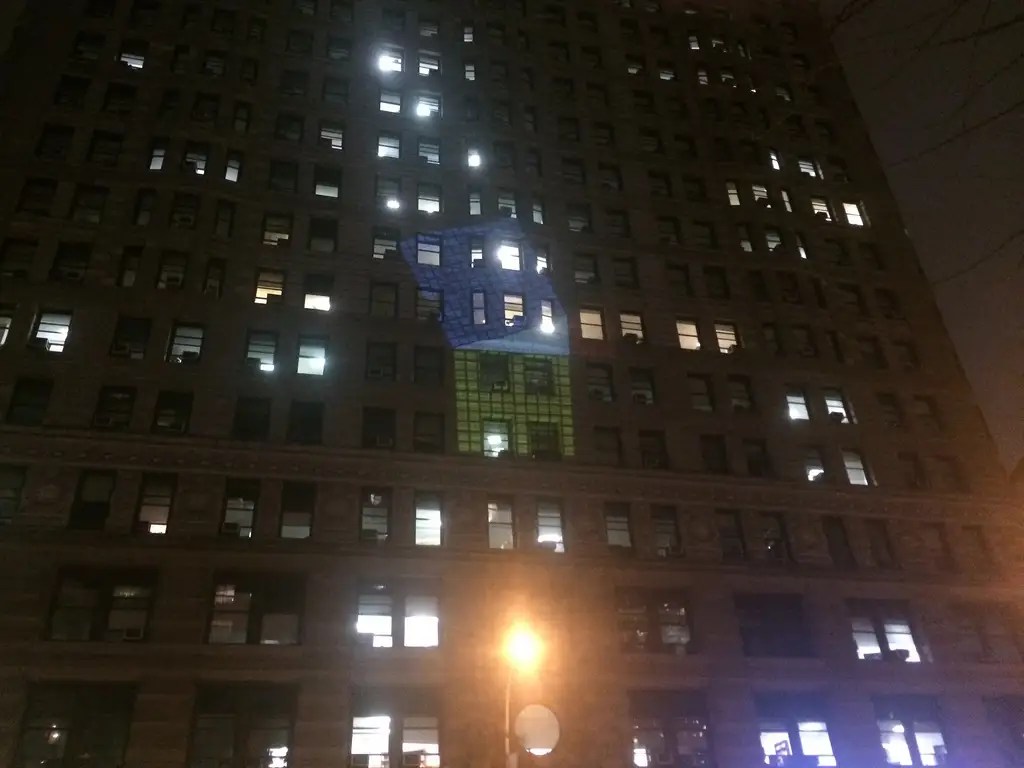
Dallas Cowboys coach, Jason Garrett recently made it mandatory for his players to know the Pythagorean theorem. He wants his players to understand that “’if you’re running straight from the line of scrimmage, six yards deep…it takes you a certain amount of time…If you’re doing it from ten yards inside and running to that same six yards, that’s the hypotenuse of the right triangle’” (NBC Sports). Also, recently the Museum of Mathematics (MoMath) and about 500 participants recently proved that New York’s iconic Flatiron building is indeed a right triangle. They measured the sides of the building by first handing out glow sticks for the participants to hold from end to end, then by counting while handing out the glow sticks, MoMath was able to estimate the length of the building in terms of glow sticks.
The lengths came out to be 75^2 + 180^2 = 38,025. After showing their Pythagorean relationship, MoMath projected geometric proofs on the side of the Flatiron building.
In my capstone class for future secondary math teachers, I ask my students to come up with ideas for engaging their students with different topics in the secondary mathematics curriculum. In other words, the point of the assignment was not to devise a full-blown lesson plan on this topic. Instead, I asked my students to think about three different ways of getting their students interested in the topic in the first place.
I plan to share some of the best of these ideas on this blog (after asking my students’ permission, of course).
This student submission comes from my former student Banner Tuerck. His topic, from Geometry: finding the area of a circle.
How could you as a teacher create an activity or project that involves your topic?
There are many fun and exciting activities one may present to a class in order to initiate a lesson over calculating the area of a circle. An example would be to allow students to graph various size circles on a grid with squares of one unit and then have them count the number of squares contained within each circle. Obviously the students will have to deal with adding partial squares, thus resulting in an estimated area for the individual circle. Once students have calculated a few diverse areas, the instructor could then ask students to try to find a relationship between the radius of each circle and their corresponding area. Having circles of various sizes will allow student to get closer to deriving a more universal formula. For example, some students may realize that the area, when divided by the radius, is close to the radius times a number slightly greater than three, but less than four. Furthermore, if students are able to see that dividing the area by the radius leaves a remaining radius times a number greater than three , then some individuals in the class may go as far as to say that the area is three times the radius times itself. Although, this engagement activity would work fine, it may be wiser to give the students an even greater physical demonstration of where the area formula comes from. Therefore, I would recommend the specific activity provided by this link… http://illuminations.nctm.org/Lesson.aspx?id=1852
The above link leads one to a very hands-on and visual activity for students. It centers around students cutting out a specially marked circle that when folded and cut further as instructed eventually facilitates the students comprehension of the area formula as a direct relationship as seen with shapes like the square or rectangle (i.e. Area = Base * Height) except, with respect to the circle, the base and the height are now the radius (base) and the product of the radius times pi (height) or vice versa. Either of these activities along with the appropriate guidance should aid in getting students to become enthusiastic about the topic before attempting to apply the formal formula to given problems. Nevertheless, as stated earlier, it is my opinion that the illuminations activity may provide a more direct approach to a solid understanding and acceptance of the formula for the area of a circle.
How has this topic appeared in high culture (art, classical music, theatre, etc.)?
In relation to the area formula for a circle appearing in high culture, one could look at many architectural designs. However, I would like to briefly review the architectural design of a rather popular city structure that is the Logan Circle. The Logan Circle is a historical district in Northwest Washington, D.C. that remains one of the only circularly designed downtown districts occupied solely by residents instead of businesses. Furthermore, in relation to geometry, this historical landmark has a total area of .17 square miles. Architectural structures and designs such as the Logan Circle are a great way to get students involved in applying what can sometimes be considered dry mathematical formulas to real world situations. For example, an instructor could easily make the Logan Circle’s area the basis for an elaboration activity requiring students to work backwards in finding a potential radius one could realistically measure.
What are the contributions of various cultures to this topic?
Many ancient cultures contributed to facilitating the official area formula we use today. For example, before pi was even established or discovered as a constant representing the ratio of the circumference to the diameter of a circle, Euclid had already derived that the area was a product of the radius squared times a constant. However, it was not until Archimedes’ proof, which used the preexisting geometric properties of other shapes, did we arrive to our current formula (with an exception being made for the Archimedes notation of pi). Nevertheless, without straying from the topic of calculating the area of a circle, it should be noted that many cultures contributed to furthering the area formula by furthering their approximations and formulas for the mathematical constant pi. An example of one culture, as opposed to the more commonly referenced Greek mathematicians, would be ancient Chinese mathematicians such as Lui Hui, Zhang Heng, and Wan Fran. Each of these individuals had opposing views on the true value of pi. It is my belief that these opposing views occurred globally throughout history and led to the continuing examination of the ratio that is pi. Therefore, furthering the development of the area formula.


 may not have been known to that many decimal places in 1592. However, a quick check on




 . By having the students use the blocks, they can easily see that a square would use 9 blocks. The “hidden” block in the middle of the square would become visible. By doing this, I would allow the students to discover the algorithm for the area of a rectangle / square on their own. This would enable them to remember it better. Using the blocks would also give them a better visual memory of the activity, so later, it should be easier for the students to recall the appropriate formula. Using various sizes of rectangles and squares would also illustrate that the algorithm works every time, regardless of the size of the rectangle or square.

 Mean Green Math