Engaging students: Standard Deviation

In my capstone class for future secondary math teachers, I ask my students to come up with ideas for engaging their students with different topics in the secondary mathematics curriculum. In other words, the point of the assignment was not to devise a full-blown lesson plan on this topic. Instead, I asked my students to think about three different ways of getting their students interested in the topic in the first place.

I plan to share some of the best of these ideas on this blog (after asking my students’ permission, of course).

This student submission comes from my former student Jillian Greene. Her topic, from statistics: standard deviations.

green line

How could you as a teacher create an activity or project that involves your topic?


An activity that I’ve seen presented to introduce the idea of standard deviation requires students to explore the information given to them before actually being taught the math behind standard deviation. As the students settle into their seats, prompt them to work with their shoulder partner and help to measure the width of their left thumbnail (or length of their pointer finger, width of their hand, etc.) and write it on a sticky note. Once the data is collected, the students will calculate the mean of all of the measurements. The mean is then written on the board in the center, and the students are asked to go and stack their post-it notes in either the center if they are perfectly the mean, or on the right or left if it’s bigger or smaller, respectively. Have them find the mean of the distances of each measurement from the mean. When they discover this should be zero, have them discuss with each other and then in the big group what that means. If time provides, it might even be fun to ask deeper understanding questions like what would happen if everyone last half of their thumbnail, or what if just Student A’s thumbnail tripled in size. This will provide a meaningful sequitur into the sometimes confusing world of standard deviation and distances from the mean.


green line

How has this topic appeared in pop culture (movies, TV, current music, video games, etc.)?

http://www.dailymotion.com/video/x3lc0rx

This is a full episode of Everybody Loves Raymond but the clip in reference starts at about 8:45 and lasts a minute or so.


This clip shows a scenario where the couple, Ray and Deborah, is comparing their scores on an IQ test (a very common use for standard deviation). Deborah comments on how her score is very close to Ray’s, being only 15 points higher. The brother that proctored the exam corrected her by saying that 15 points is a standard deviation higher and puts her in a “whole new class” of genius. Have students discuss and explain what it means for Deborah to be one standard deviation higher. Use the information given in the episode (100 is average, 115 is one standard deviation higher) to construct the bell curve for IQ scores. Then use the bell curve to introduce percentiles. Since Ray is the average, center-of-the-bell score, then he is in the 50th percentile. The students can then attempt to discover on their own (or with a group) what percentile Deborah’s score puts her in.


green line

How can this topic be used in your students’ future courses in mathematics or science?


Standard deviation is a topic that pervades almost all sciences. In biology classes, students are asked to student the weather and climate of various habitats. In differentiating between the two, one must look at the overall picture. If the student is presented with the information that place A and place B both have average temperatures of 60 degrees, this information might not be good to take as face value. Place A might have a range from 40 to 80 degrees throughout the year while place B might range from 0 to 100 and then have one or two extremely hot outliers that even the average out to 60. Looking at not only the skew of the bell curve, but also what the standard deviation is for each place, might save a student from forgetting to bring a fan to hypothetical place B, or writing that that the climate of that place is cool year round.  In addition to biology, standard deviation is a very necessary operation in psychology, which is a very statistics-based science. This can easily be seen in representing IQ scores how we found earlier!


Engaging students: Introducing proportions

In my capstone class for future secondary math teachers, I ask my students to come up with ideas for engaging their students with different topics in the secondary mathematics curriculum. In other words, the point of the assignment was not to devise a full-blown lesson plan on this topic. Instead, I asked my students to think about three different ways of getting their students interested in the topic in the first place.

I plan to share some of the best of these ideas on this blog (after asking my students’ permission, of course).

This student submission again comes from my former student Deborah Duddy. Her topic, from Pre-Algebra: introducing proportions.

green line

How can this topic be used in your students’ future courses in mathematics or science?


Proportions, in the form a/b = c/d, is a middle school math topic. The introduction of proportions builds upon the students’ understanding of fractions and ability to solve simple equations. This topic is used in the students’ future Geometry and Statistics courses. The use of proportions is used in Geometry to identify similar polygons which are defined as having congruent corresponding angles and proportional corresponding sides. The use of similar triangles and proportions are used to perform indirect measurements. In Statistics, proportions are used throughout measures of central tendency. Additionally, statistics uses sampling proportions including the proportion of successes.


The ability to use proportions for indirect measurements is also included in the study of Physics, Chemistry and Biology.  Chemistry uses proportions to determine based upon the chemical structure of a compound, the number of atoms pertaining to each element of the compound.  The study of Anatomy also uses many proportions including leg length/stature or the sitting height ratio (sitting heigh/stature x 100).


green line

How has this topic appeared in high culture (art, classical music, theatre, etc.)?


In art, proportions are expressed in terms of scale and proportion.  Scale is the proportion of 2 different size objects and proportion is the relative size of parts within the whole.  An example of proportion is Michelangelo’s David.  The proportions within the body are based on an ancient Greek mathematical system which is meant to define perfection in the human body.  Da Vinci’s  Vitruvian Man is also an example of art based upon proportions or constant rates of fractal expansion.  The music of Debussy has been studied to show that several piano pieces are built precisely and intricately around proportions and the two ratios of Golden Section and bisection so that the music is organized in various geometrical patterns which contribute substantially to its expansive and dramatic impact.

The use of proportions is also a constant within Greek and Roman classical architecture.  Many classical architecture buildings such as the Parthenon illustrate the use of proportions through the building.  Additionally, classical architecture uses specific proportions to determine roof height and length plus the placement of columns.


green line

How has this topic appeared in the news?

Proportions are constantly in the news even though they may not be presented in a/b=c/d format.  However, the concept of proportion is used throughout news reporting and even advertising.  The current news topic is the upcoming Presidential election.  Daily, we are provided with new and different poll results.  These results are derived via a proportion.  For example, 100 people are polled, these results are then derived via proportional concepts to provide a percentage voting for each candidate.  Percentage is a specific type of the  a/b = c/d proportion.  Daily news uses proportions when reporting growth trends for national debt, crime and even new housing starts in DFW.   Today, proportions were used when discussing the new Samsung Note7 and its ability to explode.  During the winter, proportions are used to tell us how many inches of rain would result from 2 inches of snow. Sports broadcasters also use proportions when discussing the potential of athletes.  If the athlete can hit 10 homeruns in 20 games, then he will potentially hit 50 homeruns in 100 games.  Proportions even appear in advertising for new medicines detailing the data associated with the medicine trial.


References:

Debussy in Proportion: A Musical Analysis, Dr Roy Howat


Michelangelo’s David


Click to access MOEFranklin.pdf


http://www.brightstorm.com


Geometry and Halloween Costumes

From a friend’s Facebook post (shared with her permission):

For every time a geometry student asks, “When am I ever going to use this in real life?” Well, if your child ever asks you to make her a Harley Quinn costume, and there is no pattern, so you have to draft your own, you will need to find the sides of a square using the measurement of the diagonal…

[I]f you need to have a square patchwork of different colored fabrics which line up on diagonal points for a specific measurement so that you have four colored diagonal squares from the shoulder to just below the waist, you would need to find the measurement of the four equal sides of each square. Then you would add seam allowances so you could cut the squares out of the different colored fabrics and sew them together in exact lines to line up just right so you could make a top that looks like the top the character wears. And since this character is only a cartoon character who has been made into a little doll, not many people out there in the world have yet attempted an actual costume to be worn by a real live girl. Of course, a person could just take a pencil and a ruler and draw squares, but without using math, that person could not put together a patchwork of colored fabric squares with this result.

The finished product:


A Visual Proof of a Remarkable Trig Identity

Strange but true (try it on a calculator):

\displaystyle \cos \left( \frac{\pi}{9} \right) \cos \left( \frac{2\pi}{9} \right) \cos \left( \frac{4\pi}{9} \right) = \displaystyle \frac{1}{8}.

Richard Feynman learned this from a friend when he was young, and it stuck with him his whole life.

Recently, the American Mathematical Monthly published a visual proof of this identity using a regular 9-gon:

Feynman identity

Source: https://www.facebook.com/AmerMathMonthly/photos/a.250425975006394.53155.241224542593204/1045091252206525/?type=3&theater

This same argument would work for any 2^n+1-gon. For example, a regular pentagon can be used to show that
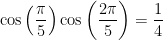
\displaystyle \cos \left( \frac{\pi}{5} \right)  \cos \left( \frac{2\pi}{5} \right) = \displaystyle \frac{1}{4},

and a regular 17-gon can be used to show that

\displaystyle \cos \left( \frac{\pi}{17} \right) \cos \left( \frac{2\pi}{17} \right) \cos \left( \frac{4\pi}{17} \right) \cos \left( \frac{8\pi}{17} \right) = \displaystyle \frac{1}{16}.

A natural function with discontinuities (Part 3)

This post concludes this series about a curious function:

discontinuousIn the previous post, I derived three of the four parts of this function. Today, I’ll consider the last part (90^\circ \le \theta \le 180^\circ).

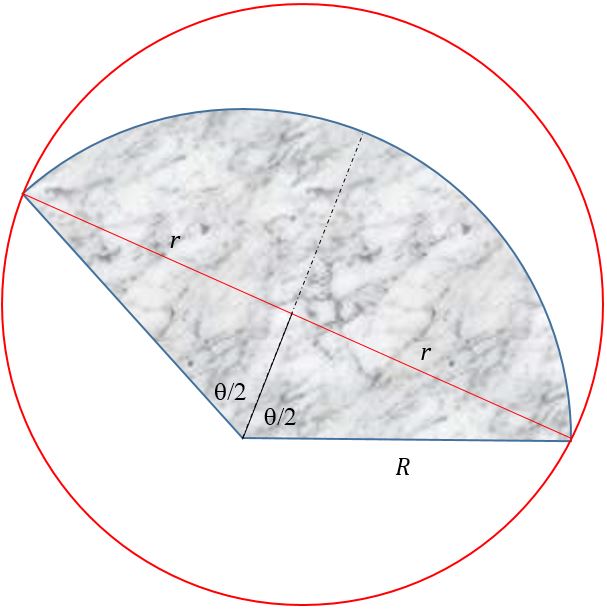
obtuseangleThe circle that encloses the grey region must have the points (R,0) and (R\cos \theta, R \sin \theta) on its circumference; the distance between these points will be 2r, where r is the radius of the enclosing circle. Unlike the case of \theta < 90^\circ, we no longer have to worry about the origin, which will be safely inside the enclosing circle.

Furthermore, this line segment will be perpendicular to the angle bisector (the dashed line above), and the center of the enclosing circle must be on the angle bisector. Using trigonometry,

\sin \displaystyle \frac{\theta}{2} = \frac{r}{R},

or

r = R \sin \displaystyle \frac{\theta}{2}.

We see from this derivation the unfortunate typo in the above Monthly article.

A natural function with discontinuities (Part 2)

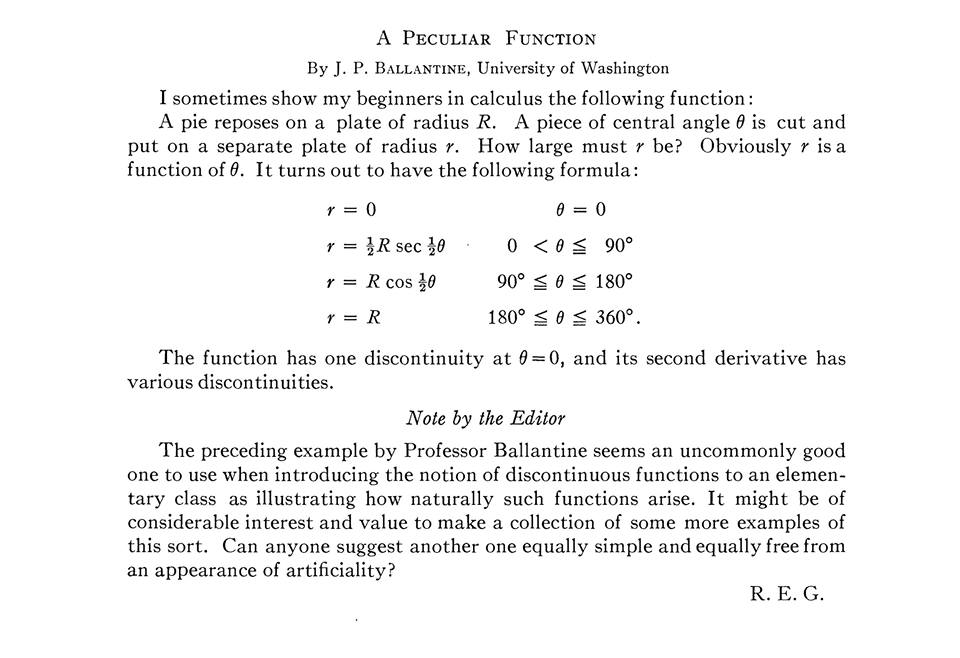
Yesterday, I began a short series motivated by the following article from the American Mathematical Monthly.

discontinuous

Today, I’d like to talk about the how this function was obtained.

If 180^\circ \le latex \theta \le 360^\circ, then clearly r = R. The original circle of radius R clearly works. Furthermore, any circle that inscribes the grey circular region (centered at the origin) must include the points (-R,0) and (R,0), and the distance between these two points is 2R. Therefore, the diameter of any circle that works must be at least 2R, so a smaller circle can’t work.
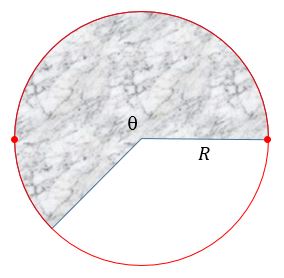
reflexangle

The other extreme is also easy: if \theta =0^\circ, then the “circular region” is really just a single point.

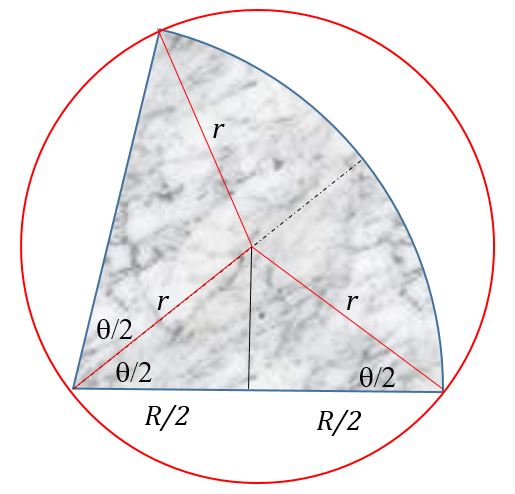
Let’s now take a look at the case 0 < \theta \le 90^\circ. The smallest circle that encloses the grey region must have the points (0,0), (R,0), and (R \cos \theta, R \sin \theta) on its circumference, and so the center of the circle will be equidistant from these three points.
acuteangle

The center must be on the angle bisector (the dashed line depicted in the figure) since the bisector is the locus of points equidistant from (R,0) and (R \cos \theta, R \sin \theta). Therefore, we must find the point on the bisector that is equidistant from (0,0) and (R,0). This point forms an isosceles triangle, and so the distance r can be found using trigonometry:

\cos \displaystyle \frac{\theta}{2} = \displaystyle \frac{R/2}{r},

or

r = \displaystyle \frac{R}{2} \sec \frac{\theta}{2}.

This logic works up until \theta = 90^\circ, when the isosceles triangle will be a 45-45-90 triangle. However, when \theta > 90^\circ, a different picture will be needed. I’ll consider this in tomorrow’s post.
Engaging students: Radius, Diameter, and Circumference of a Circle

In my capstone class for future secondary math teachers, I ask my students to come up with ideas for engaging their students with different topics in the secondary mathematics curriculum. In other words, the point of the assignment was not to devise a full-blown lesson plan on this topic. Instead, I asked my students to think about three different ways of getting their students interested in the topic in the first place.

I plan to share some of the best of these ideas on this blog (after asking my students’ permission, of course).

This student submission comes from my former student Zacquiri Rutledge. His topic, from Geometry: radius, diameter, and circumference of a circle.

green line

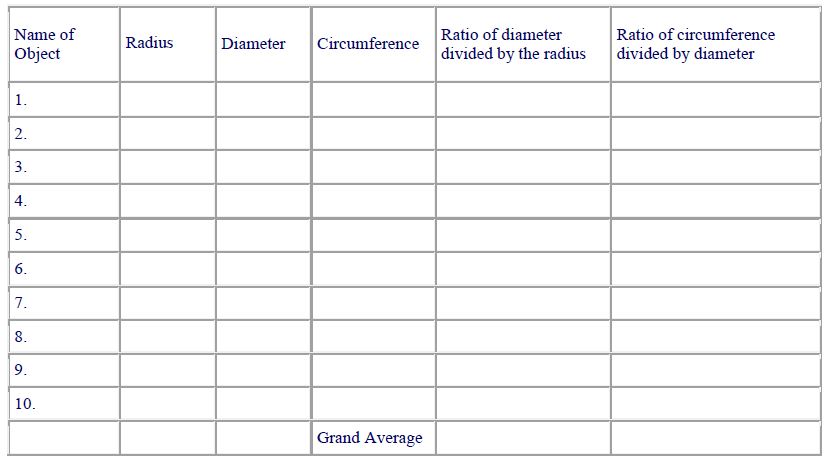
There are many ideas about how to introduce students and have them study the relationships between the radius, diameter and circumference of a circle. However, one of my favorites has always been the month long project assigned to students at the beginning of class. On the very first day of class, the teacher is to assign the students their project. The instructions of this project are for each of the students to find and measure ten different round or circular objects around their home. The students will need to measure the length around the object (the circumference) using a piece of string and a ruler (the teacher might explain to the students or give an example so they know how to do this), the length from one side of the object to the other side passing through the middle (diameter), and the length from the center of the object to the outside (radius). If the students already know what these terms are called that is okay. However, the teacher should avoid explaining these terms until later.

Then a month later, the students are to bring their findings to class. At this point during the class the teacher will have begun her segment of lessons about circles and the various properties of circles. By now the students should have a good idea what the terms radius, diameter, and circumference mean. So the day the students bring in their work, they will be given the following chart, originally designed by the University of Illinois. From here students will slowly begin to fill in their charts with the information they gathered. Once completed students will then begin finding the ratios between diameter-radius and circumference-diameter and recording them. Finally at the bottom, students will find the average of their ratios from the last two columns. Once all of this data is completed, the students should have found that the diameter and radius share a ratio of 2-1 since the diameter is twice the radius. The last column should have produced something close to an average of 3.14159265359 or better known as pi (). Not only will this help students understand that pi is not just a number, but it will also help them to know where it comes from and its importance. From here the teacher would be able to lead into a lesson about some of the other uses of pi and how they all relate back to the relationships between radius, diameter and circumference.

pichart


green line

Radius, diameter, and circumference are very important in many topics beyond their definitions. For instance, later on in the geometry course students will talk about the area of circles. Even though the students might have learned how to find the area of simple polygons such as triangles and quadrilaterals, finding the area of a circle is different because of the use of pi. To find the area of a circle, students have to recall the relationships between the radius, diameter, and circumference in order to understand how the area of a circle uses those relationships. Another example of how they are used is in pre-calculus. In pre-calculus students will talk about the unit circle, a circle with a fixed radius of 1 unit. Using the fixed radius of 1, students will discover that the length around (circumference) the unit circle is 2π. This 2π is important because it can be broken into pieces, called radians, and used to help measure Sine, Cosine, and Tangent at certain radians around the circle. Learning about sine, cosine, and tangent opens up even more things for the students, such as trigonometry and calculus. However, no matter how advanced the mathematics become, they always relate back to the simple concepts of the radius, diameter and circumference of a circle and their relationships.


green line

Radius, diameter, and circumference is a topic that has been talked about and used dating back to 2000 B.C. But, what has it actually been used for all this time? How about architecture? Think about massive constructs such as the Theatre of Ephesus in Rome, Italy. Even though the theatre is not a full circle, look at how each of the seats are evenly placed from the stage. This is because when it was designed, the architect likely used the radius and circumference to accurately plot how far each seat needed to be placed in order to be the same exact distance from the stage as everyone else in their row. Even though only half a circle was used for this theatre, the circumference and radius would have been used to find the ratio pi in order to get the area of how much space was allowed for seating.

Another great example of circumference being used is in the invention of the clock. The clock originated as a sun dial, which would use the sun to cast a shadow, which would tell the time of day. These sun dials date back as early as 3500 B.C. However, in 1583 Galileo found a way to use a pendulum to create a clock that always followed the same length of time (Clock). This is important because not long after the first clock was born, so was the circular face of a clock. The face of a clock has the numbers 1-12 on it, each one evenly spaced around the edge of the clock. By using the circumference of any size of circle, the person building the clock would know just how far to space out each of the numbers, giving each hour the same amount of time between them. If even one of the numbers were off on the clock, the time would be off. Also, it can be seen that on modern clocks, the minute hand always stretches the radius of the clock. By stretching out the minute hand on the clock, the designer of the clock can create evenly spaced notches on the face using the circumference, in order to have the minute hand indicate the minute of the hour.

One final example is the use of radius in war, or more specifically the invention of the radar. Radar was originally being experimented with by German physicist Heinrich Hertz in 1887. He had discovered that certain materials allowed radio waves to pass through them, while others reflected them. In 1890, Nikola Tesla realized that large objects could reflect large enough radio waves to be detected. By harnessing this idea, pulse radar would come to be introduced into United States in 1925, and later used in the British Air Force to defend against German air raids during WWII (Science). The reason radar works, however, is because the system has a set radius in which it can detect radio waves. Once the radar system sends out a radio wave, if it does not reflect back within the radius of the detection system, then the radar will not pick up on anything. The system measures the distance by measuring how long it takes for the radio wave to return to the system after it is sent out and comparing that time to radius of detection. This allowed not only military to defend against air attacks, but it was commonly used during naval combat to defend against submarines as Germany used their U-Boats to attack several American and British naval ships during WWII, as well as WWI before the invention of radar.


References:

“Circumference and Pi.” Circumference and Pi. N.p., n.d. Web. 08 Oct. 2015.

“Clock a History – Timekeepers.” Clock a History – Timekeepers. N.p., n.d. Web. 08 Oct. 2015.

“Science Explorations: Journey Into Space: Radar and Sonar | Scholastic.com.” Science Explorations: Journey Into Space: Radar and Sonar | Scholastic.com. N.p., n.d. Web. 08 Oct. 2015.