
No joke, a textbook publisher sent me this image on Valentine’s Day.
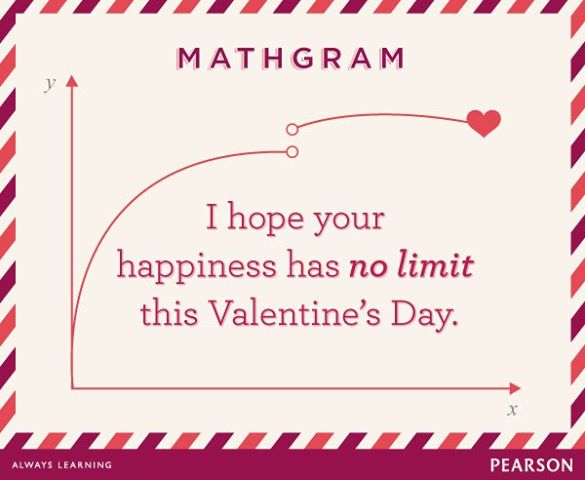
No joke, a textbook publisher sent me this image on Valentine’s Day.
Using a simultaneously falling softball as a stopwatch, the terminal velocity of a whiffle ball can be obtained to surprisingly high accuracy with only common household equipment. In the January 2013 issue of College Mathematics Monthly, we describe an classroom activity that engages students in this apparently daunting task that nevertheless is tractable, using a simple model and mathematical techniques at their disposal.
Dan Meyer spliced together scenes from various movies where knowledge of mathematics is denigrated. Since a big part of my job is instilling confidence in my students that they can indeed succeed in my classes, it’s a little depressing to see that I have a big opponent in popular culture.
This video has the occasional PG language and innuendo, while I prefer to keep my classes rated G to every extent possible. Some time ago, Dan was kind enough to post the original movie sources for this clip, and someday I might edit down this clip to something that I would be comfortable showing in class.
Chemical bonds
 The Atom
Under the category “Weird but True”: In today’s junk mail, I learned that Lands’ End has an entire line of clothing 
Years ago, when I taught calculus, I’d usually include the following extra credit question on the first exam: “In the small box, write a good value for 
Most students volunteered something like 

Also getting 5 points that year was the best answer of the class: “Let 

Here’s a great typo that I saw on a paper submitted by one of my former students who aspires to be a secondary math teacher. Instead of writing “engaging one’s students,” she accidentally wrote “encaging one’s students.”
A quote from George Will, from the extended commentary of Ken Burns’ excellent series on the Civil War.
How the common men and women of [the Civil War era] used the English language at that time is worth pondering. I think the normally literate 19th century American had as his entertainment popular novels: Balzac, Dickens, George Eliot. They didn’t turn on the television; they weren’t in that passive receiving mode. They were in the active mode, which reading is, and popular entertainment then was popular novels. Dickens: not bad. Also, they didn’t pick up the phone when they wanted to communicate. They wrote letters. They had the discipline of expressing themselves in complete sentences and rounded paragraphs. And that’s something we’ve lost.
I found this magic trick in a set of Christmas crackers a couple years ago which is completely based on binary arithmetic. The link above does a good job of explaining why the trick works — and how a new trick can be generated using base-3 arithmetic.
I like showing this to my students around Valentine’s Day. The singers were math grad students at Northwestern.

