Engaging students: Finding points on the coordinate plane

In my capstone class for future secondary math teachers, I ask my students to come up with ideas for engaging their students with different topics in the secondary mathematics curriculum. In other words, the point of the assignment was not to devise a full-blown lesson plan on this topic. Instead, I asked my students to think about three different ways of getting their students interested in the topic in the first place.

I plan to share some of the best of these ideas on this blog (after asking my students’ permission, of course).

This student submission comes from my former student Morgan Mayfield. His topic, from Pre-Algebra: finding points on the coordinate plane.

green line

C2: How has this topic appeared in high culture (art, classical music, theatre, etc.)?

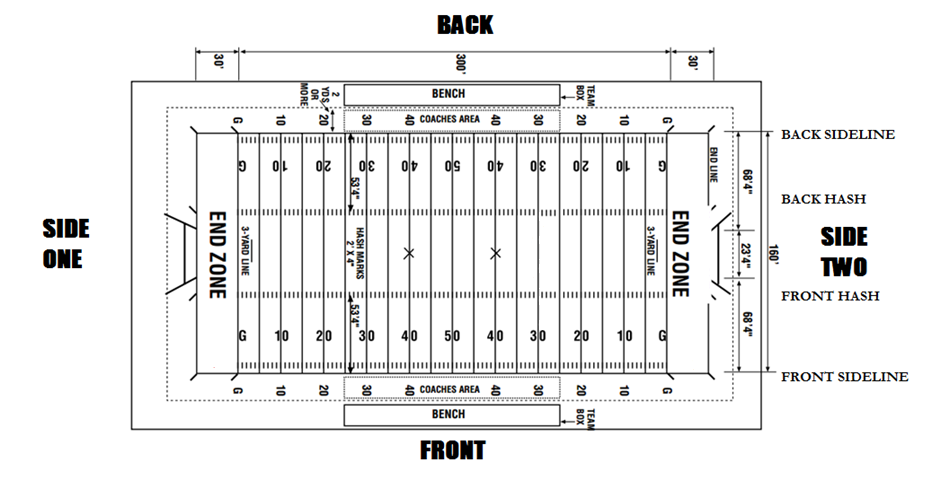
One popular art/sport high school students may take part in is marching band. I did four years of marching band in high school and I loved it. One has to wonder: “how does each performer know where they should be?” I’ve included a link from bandtek.com that describes the coordinate system marching bands use. It isn’t quite the same as the coordinate plane in a math class. When starting marching band, you learn how to take appropriately sized “8 to 5” steps, which simply means 8 equally spaced steps for every 5 yards on a football field. Each member will receive little cards that have “sets” on them. A set is a specific point on the field where the performer must be at a specific time of the show. Usually, performers will take straight paths from set to set in a specific amount of 8-5 steps. Looking at a bird eye’s view of the football field, one can see a rough coordinate plane. Like a coordinate plane has 4 quadrants, a football field has a rough 4 quadrant system where a performer is assigned to stand a specified amount of 8-5 steps from a specified yard line either on side 1 or 2 for their horizontal position and a specified amount of 8-5 steps from the front/back hash for vertical position facing the home sideline. Side 1 refers to the left side of the field from the home side perspective, Side 2 refers to the right side of the field from the home side perspective, and the front/back hash refers to the line of dashes that cut through the middle of the field horizontally from the home side perspective.

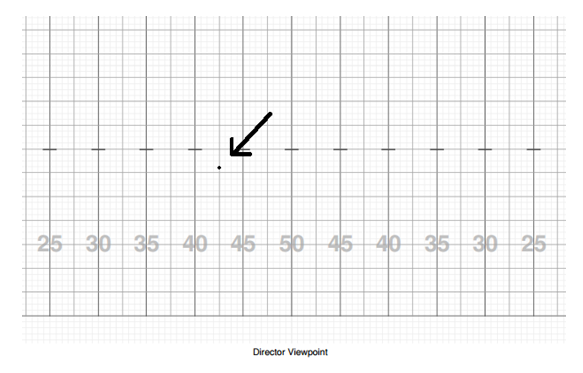
An example bandtek.com uses is, “4 outside the side 1 45, 3 in front of the front hash” which would mean the following position:

green line

D1: What interesting things can you say about the people who contributed to the discovery and/or the development of this topic?

René Descartes was a 17th century (1600’s) French mathematician and philosopher. Many people study his work in modern day math and philosophy classes. Some may know him as the man who wrote “cogito, ergo sum” or “I think, therefore I am”. Well, there is a legend about his discovery of the Coordinate Plane. Descartes was often sick as a kid, way before modern medication and technology. He would often have to stay in bed at his boarding school until noon because of his illnesses. This gave him quite a bit of downtime to be observant of his environment. Laying on his bed, he could see a fly crawl around on his ceiling. He thought of ways to describe the location of the fly as it scuttled about the ceiling. Imagine telling a friend where the location of the fly was, “A little to the left of the right wall and a little down from the top wall”. This just isn’t precise enough, nor an easy way to communicate information. However, Descartes realized he could quantify the precise location of the fly from using the distance from a pair of perpendicular walls. Descartes then translated this idea onto a graph where the perpendicular “walls” continued infinitely in both directions and became “axes”. “Flies” then became “points” or “coordinate pairs”. Thus, the coordinate plane was born, and so was a way to describe points in space. Just a little bit of imagination, self-questioning, and observation lead to a fundamental change in Mathematics, a way to tie Algebra and Geometry together.


green line

E1: How can technology (YouTube, Khan Academy [khanacademy.org], Vi Hart, Geometers Sketchpad, graphing calculators, etc.) be used to effectively engage students with this topic? Note: It’s not enough to say “such-and-such is a great website”; you need to explain in some detail why it’s a great website.


I believe that https://www.chess.com/vision could be an effective website to engage students on finding points on the coordinate plane in a class that is being introduced to the idea for the first time. Many students won’t know how a chessboard is setup or even know how to play chess. The cool things are that they don’t need to know the fundamentals of chess and that the chessboard is essentially Quadrant I of a coordinate plane (where a1 is in the bottom left corner). The above website tests the player to locate as many squares (points) on a chessboard (coordinate plane) as they can in 30 seconds, given random chess coordinates. There is a way to toggle settings to also test yourself on moves and squares. In a classroom, I would only toggle the setting to list random “black and white squares” where the board is set with a1 at the bottom left corner. Students could start the day with this website as a precursor to formalizing the idea of finding points on a coordinate plane. This website is engaging (with an exclamation point)! The game can be made into a fun little competition amongst students. The time limit and game-y feeling to it encourages active participation. The game takes minimal explanation from the teacher for students to get the hang of it (no chess skills required). The fact that chessboards have one axis in letters and the other axis in numbers aids students in reading the coordinate plane x-axis first, then y-axis like the chess coordinates. I would only have the students run the game for a few rounds, making the activity in total 7 minutes or less.


References:

http://bandtek.com/how-to-read-a-drill-chart/

https://www.chess.com/vision

https://wild.maths.org/ren%C3%A9-descartes-and-fly-ceiling

Have you ever followed a Fly?

Engaging students: Making and interpreting bar charts, frequency charts, pie charts, and histograms

In my capstone class for future secondary math teachers, I ask my students to come up with ideas for engaging their students with different topics in the secondary mathematics curriculum. In other words, the point of the assignment was not to devise a full-blown lesson plan on this topic. Instead, I asked my students to think about three different ways of getting their students interested in the topic in the first place.

I plan to share some of the best of these ideas on this blog (after asking my students’ permission, of course).

This student submission comes from my former student Taylor Bigelow. Her topic, from Pre-Algebra: making and interpreting bar charts, frequency charts, pie charts, and histograms.

green line

How could you as a teacher create an activity or project that involves your topic?

Charts allow for a lot of fun class activities. For example, we can have them take their own data for a table and create charts from that data. For my activity, I will give them all dice, which they should be very familiar with, and have them roll the dice 20 times and keep track of how many times it lands on each number in a table. From that table, they will make their own bar charts, frequency charts, and pie charts. After they roll their dice and make their charts, they will then answer questions interpreting the charts. This tests their ability to understand data and make all the different types of charts.

green line

How has this topic appeared in the news?

Charts are all over in the news, especially recently. There were pie charts and frequency charts all over during the election cycle, and with covid, all we see is bar charts of covid data. An easy engage for this topic would be to make observations about these types of graphs that they’ll probably see all the time during election seasons and might even be familiar with. First, we will ask the students what news can benefit from graphs, and what news they have seen graphs in recently. I expect answers similar to elections, covid, and economics. Then we can look at some of the graphs that usually show up around election cycles. We will take a minute as a class to discuss what they notice about the graphs and what they mean. Questions like “what type of graph is this”, “what are the variables in this graph”, and “what information do you get from this graph”. This will show the students that being able to read these graphs has real life applications, and it also teaches them what important things to look for in the graphs during class time and homework.

green line

How can technology be used to effectively engage students with this topic?

Technology is very useful for making graphs and being able to make and manipulate graphs can help them understand how to interpret the information given in graphs. Google sheets or excel can both be used to make and manipulate graphs. For this activity we would give the students some sample data and have them enter it into an online spreadsheet, and then make an appropriate graph to show this data. They then would answer questions about this graph, like “Why did you choose this type of graph to represent the data?”, “what is the independent variable and what is the dependent variable”, “What observations can you make about this graph?”, and “What would happen if you changed X to be # instead? Or if you added more information?” and other questions, especially about graphs with multiple variables. This helps students see how different information can be represented and lets them experiment with the information on their own, while also answering questions that steer them in the direction that the teacher wants them to know.

Engaging students: Finding the area of regular polygons

In my capstone class for future secondary math teachers, I ask my students to come up with ideas for engaging their students with different topics in the secondary mathematics curriculum. In other words, the point of the assignment was not to devise a full-blown lesson plan on this topic. Instead, I asked my students to think about three different ways of getting their students interested in the topic in the first place.

I plan to share some of the best of these ideas on this blog (after asking my students’ permission, of course).

This student submission comes from my former student Conner Dunn. His topic, from Geometry: finding the area of regular polygons.

green line

How can technology be used to effectively engage students with this topic? Note:  It’s not enough to say “such-and-such is a great website”; you need to explain in some detail why it’s a great website.

A good way to get students into the concept and see it’s real life use is to be given a realistic problem. The natural world doesn’t typically give you perfectly regular polygons, but we certainly like making them ourselves. Better yet, we can make regular polygons of a certain area knowing the methodology behind computing their areas. Using GeoGebra, I can challenge students to construct a regular polygon of an exact area using what they know about the use of equilateral triangles to compute area.

For example, let’s say I ask for a hexagon with an area of 12√3 square units. While there’s a few strategies of constructing a regular hexagon that Geometry students may know of, the strategy to shoot for here is to recognize this means we want a hexagon with a side length of 2 then construct the triangles. GeoGebra allows for students to use line segments and give them certain lengths, as well as construct angles using a virtual compass tool. Below is the solution to this example by constructing 6 equilateral triangles (each with an area of 2√3 square units) to form the regular hexagon.

This image has an empty alt attribute; its file name is geogebra-hexagon.png

green line

How does this topic extend what your students should have learned in previous courses?

By the end of the unit, students will have learned the formula for finding the area of a polygon (A = (1/2) * a * p, with a being the apothem, and p being the perimeter). But a big part of this unit is how we derive the formula from the process in which we solve the area using this equilateral triangle method. From many previous courses, students will have learned both the order of operations and properties of equality in equations, and we use this previous knowledge to connect a geometric understanding of area to an algebraic one. For example, when we have the idea of multiplying the area of an equilateral triangle by the number of sides, n, in the polygon, we have A = (1/2) b * h * n. It is by the use of communitive property that students can rearrange the variables like this: A = (1/2)h*b * n. And then we conclude that the b*n reveals that the perimeter of the polygon plays a role in our equation. This may seem subtle, but students being fluent in this knowledge helps them work in their geometric understandings much easier.

green line

How has this topic appeared in high culture (art, classical music, theatre, etc.)?

A big part of the method for understanding area of polygons is seeing how we can perfectly fit equilateral triangles inside of our polygons of choice. Perfectly fitting shapes into and around other shapes is something you see in mosaic art everywhere, particularly in Islamic architecture.

While mosaic artists are not necessarily calculating the areas of their art pieces (they might but I doubt it), a big part what makes these buildings so nice to look at is how the shapes fit with one another so nicely. This is an art that’s very intentional in its aesthetically pleasing aroma. This is something I think Geometry students can take to heart when confronting Geometry problems (a just as well with future courses). It’s the overlooked skill of literally connecting pieces together in order to get something we want. In the case of the Islamic architect, what we want is a pleasing building to look at, but math, of course, brings in more possible things to shoot for and equips us with plenty of pieces to (literally) connect together.

Engaging students: Finding the area of a circle

In my capstone class for future secondary math teachers, I ask my students to come up with ideas for engaging their students with different topics in the secondary mathematics curriculum. In other words, the point of the assignment was not to devise a full-blown lesson plan on this topic. Instead, I asked my students to think about three different ways of getting their students interested in the topic in the first place.

I plan to share some of the best of these ideas on this blog (after asking my students’ permission, of course).

This student submission comes from my former student Brendan Gunnoe. His topic, from Geometry: finding the area of a circle.

green line

History: Squaring the circle

The ancient Greeks and other groups at the time had a fascination with geometry. These cultures tended to like thinking in terms of simpler geometric shapes, such as circles, equilateral triangles and squares. One of the classic problems proposed by these ancient peoples was “Can you create a square with the same area as a circle with finitely many steps only using a compass and straightedge?”. This problem stood for thousands of years, stumping even the most brilliant of mathematicians that attempted to show it true. Eventually, in the year 1882, it was finally proven impossible because of a property of the number π. It’s not too hard to show that π isn’t an integer, nor is it rational. What was left to show is whether π was algebraic or transcendental. The proof from 1882 showed that π is in fact transcendental, proving that it cannot be made using the rules set out by the original question. If a number is algebraic, then it is a solution to a polynomial with rational coefficients.

green line

Curriculum: Using limit of triangular approximations to get the integral

The teacher starts off class by drawing a circle with an inscribed triangle, another with a square, and so on until a hexagon is inscribed. The teacher then draws isosceles triangles that originate at the circles center and extend to the corners of the polygons. The teacher could ask questions like “What do you notice about the total area of the triangles and the area of the circle as we keep adding sides to the polygon?” and “What do you notice about the triangles we made and the little wedges of the circle, what’s the same and what’s different about them?”. Then the teacher could arrange both the triangles and wedges in an alternating up and down fashion, almost like two zippers, to line up the triangles and wedges. The teacher could ask “What’s the length of the top of the triangles? What about the tops of the wedges, what’s their length?”.

Finally, the teacher asks “What happens when we let the number of pieces gets REALLY big? What happens to difference between the area of the triangles and wedges? What about the tops of the triangles and the tops of the wedges?”. In the limit, the upper edge converges to half of the circumference of the circle and the height of the triangles converges to the radius of the circle. Using this line of thinking, the teacher guides the students into seeing how you can derive the equation for the area of a circle by using approximating it with triangles, and then looking at what happens in the limit.

green line

Application

A telescope’s lens is what’s used to control how much light gets into the eye piece. Suppose you’re an astronomer and want to take a photo of the full Moon on a clear night, which gives off 0.25 lumens/s-m2. Suppose your camera needs to get a total of at least 3 lumens to produce a good photo and 5 lumens to get an amazing photo. What’s the radius of a lens (in centimeters) that can take a good photo in 10 minutes? What’s the radius of a lens that can take an amazing photo in 10 minutes?

Now suppose you’re working with the Hubble space telescope in low Earth orbit trying to get photos of a nearby star system. The radius of the main telescope is 120cm and the star system you want to observe is giving off light at a rate of 10-5 lumens/s-m2. How long will it take to get a good photo with Hubble? What about a great photo?

https://en.wikipedia.org/wiki/Hubble_Space_Telescope

https://en.wikipedia.org/wiki/Squaring_the_circle

Engaging students: Computing the determinant of a matrix

In my capstone class for future secondary math teachers, I ask my students to come up with ideas for engaging their students with different topics in the secondary mathematics curriculum. In other words, the point of the assignment was not to devise a full-blown lesson plan on this topic. Instead, I asked my students to think about three different ways of getting their students interested in the topic in the first place.

I plan to share some of the best of these ideas on this blog (after asking my students’ permission, of course).

This student submission again comes from my former student Brendan Gunnoe. His topic: computing the determinant of a matrix.

green line

How can this topic be used in your students’ future courses in mathematics or science?

When students learn about the determinant of a matrix, they only learn about computing it and don’t learn about the applications of the determinant or what they signify. One interesting use of the determinant is finding the eigenvectors of a matrix. A visual understanding of what an eigenvector is can be done by showing what a matrix does to the any generic vector, and what it does to the eigenvectors. For a generic vector that is different from an eigenvector, the matrix knocks the vector off the span of the original vector. What makes an eigenvector special is the fact that the matrix transformation keeps the eigenvector on its span but rescales said eigenvector by its eigenvalue. For example, take the matrix

\left[ \begin{array}{cc} 5 & 3 \\ 3 & 5 \end{array} \right].

This matrix’s eigenvectors are \left[ \begin{array}{c} 1 \\ 1 \end{array} \right] and \left[ \begin{array}{c} 1 \\ -1 \end{array} \right] with eigenvalues 8 and 2 respectively. That is,

\left[ \begin{array}{cc} 5 & 3 \\ 3 & 5 \end{array} \right] \left[ \begin{array}{c} 1 \\ 1 \end{array} \right] = \left[ \begin{array}{c} 8 \\ 8 \end{array} \right] = 8 \left[ \begin{array}{c} 1 \\ 1 \end{array} \right]

and

\left[ \begin{array}{cc} 5 & 3 \\ 3 & 5 \end{array} \right] \left[ \begin{array}{c} 1 \\ -1 \end{array} \right] = \left[ \begin{array}{c} 2 \\ -2 \end{array} \right] = 2 \left[ \begin{array}{c} 1 \\ -1 \end{array} \right].

Eigenvectors have many useful applications in future math and science classes including electronics, linear algebra, differential equations and mechanical engineering.

green line

How can technology (YouTube, Khan Academy [khanacademy.org], Vi Hart, Geometers Sketchpad, graphing calculators, etc.) be used to effectively engage students with this topic? Note: It’s not enough to say “such-and-such is a great website”; you need to explain in some detail why it’s a great website.

The YouTube channel 3Blue1Brown has a fantastic video on determinates and linear transformations. Grant, the channel owner, uses animations to visualize what a matrix transformation does to the plane . He starts by showing what a transformation does to a single square then shows why the change of change of that one area shows what happens to the area of any region. He also gives multiple explanations for what a negative determinate means in terms of orientation of the axes. Then he explains what happens when the determinate is 0. All of this is already extremely useful for understanding what a 2×2 matrix does, but Grant continues and extends all the same things for 3×3 transformations. Lastly, Grant gives a few explanations on why the formula for the determinate is what it is and poses a small puzzle for the viewer to contemplate. This video explains what and why we use determinates and how they can be useful all while showing pleasing visual examples and other explanations.

green line

What interesting word problems using this topic can your students do now?

Using determinates to see if a set of vectors is a basis.

The determinant can tell you when a matrix squishes space into a lower dimensional space like a line or a plane. Thus, taking the determinate of a matrix composed of a set of vectors tells you if those vectors are a basis for the matrix’s dimension.

Part 1. A 3D printer’s axes are set up in such a way that the print head can only travel in the direction \left[ \begin{array}{c} 1 \\ 1 \end{array} \right] and \left[ \begin{array}{c} -1 \\ 1 \end{array} \right]. Assume that the place where the print head is right now is the origin \left[ \begin{array}{c} 0 \\ 0 \end{array} \right]. Can you move the print head to the location \left[ \begin{array}{c} x \\ y \end{array} \right] and \left[ \begin{array}{c} 1 \\ -1 \end{array} \right] by only moving in the directions of \left[ \begin{array}{c} 1 \\ 1 \end{array} \right] and \left[ \begin{array}{c} -1 \\ 1 \end{array} \right]?

Hint: Try to solve \left[ \begin{array}{cc} 1 & -1 \\ 1 & 1 \end{array} \right] \left[ \begin{array}{c} a \\ b \end{array} \right] = \left[ \begin{array}{c} x \\ y \end{array} \right] . Does this always have a solution \left[ \begin{array}{c} a \\ b \end{array} \right]?

Part 2. Next time you turn on your 3D printer, one of the motor’s broke and now the print head can only move in the direction of \left[ \begin{array}{c} 1 \\ 0 \end{array} \right]. Assume that the place where the print head is right now is the origin \left[ \begin{array}{c} 0 \\ 0 \end{array} \right]. Can you move the print head to the location  by only moving in the direction of \left[ \begin{array}{c} 1 \\ 0 \end{array} \right]?

Hint: Try to solve \left[ \begin{array}{cc} 1 & 0 \\ 0 & 0 \end{array} \right] \left[ \begin{array}{c} a \\ b \end{array} \right] = \left[ \begin{array}{c} x \\ y \end{array} \right] . Does this always have a solution \left[ \begin{array}{c} a \\ b \end{array} \right]?

Part 3. You buy a new 3D printer that it can move in all three directions: up/down, left/right, forward/backwards. When you test out the movement of the print head, you see that each axis moves in the directions of \left[ \begin{array}{c} 1 \\ 0 \\ 0 \end{array} \right], \left[ \begin{array}{c} 0 \\ 1 \\ 0 \end{array} \right], and \left[ \begin{array}{c} 0 \\ 0 \\ 1 \end{array} \right]. Can you use your new 3D printer to go to any location \left[ \begin{array}{c} x \\ y \\ z \end{array} \right], inside the printing space?

Hint: Think about solving \left[ \begin{array}{ccc} 1 & 0 & 0 \\ 0 & 1 & 0 \\ 0 & 0 & 1 \end{array} \right] \left[ \begin{array}{c} a \\ b \\ c \end{array} \right] = \left[ \begin{array}{c} x \\ y \\ z \end{array} \right] . Does this always have a solution \left[ \begin{array}{c} a \\ b \\ c \end{array} \right]? How do you know?

Part 4. Your little sibling messed around with your new 3D printer and now it moves in the directions \left[ \begin{array}{c} 1 \\ 0 \\ 1 \end{array} \right], \left[ \begin{array}{c} 1 \\ 1 \\ 0 \end{array} \right], and \left[ \begin{array}{c} 2 \\ 1 \\ 1 \end{array} \right]. Is your 3D printer able to get to some point \left[ \begin{array}{c} x \\ y \\ z \end{array} \right] inside the printing space as is, or do you need to fix your printer?

Hint: Think about solving \left[ \begin{array}{ccc} 1 & 1 & 2 \\ 0 & 1 & 1 \\ 1 & 0 & 1 \end{array} \right] \left[ \begin{array}{c} a \\ b \\ c \end{array} \right] = \left[ \begin{array}{c} x \\ y \\ z \end{array} \right]. Does this always have a solution \left[ \begin{array}{c} a \\ b \\ c \end{array} \right]? How do you know?

Engaging students: Finding the equation of a circle

In my capstone class for future secondary math teachers, I ask my students to come up with ideas for engaging their students with different topics in the secondary mathematics curriculum. In other words, the point of the assignment was not to devise a full-blown lesson plan on this topic. Instead, I asked my students to think about three different ways of getting their students interested in the topic in the first place.

I plan to share some of the best of these ideas on this blog (after asking my students’ permission, of course).

This student submission comes from my former student Noah Mena. His topic, from Precalculus: finding the equation of a circle.

green line

The equation of a circle relies on knowing the definition of a circle, knowing the radius and deciding where the circle is centered at. All of these come into play when a student has to find the equation of a circle. It takes basic understanding of the cartesian grid and understanding the coordinate system.  The equation of a circle also builds on students being able to manipulate the equation to get it into standard form and identifying the equation of a circle when it is expanded out. The shape of a circle should also be known, which means with the equation of a circle, students should be able to construct the perfect circle according to the given specifications in the equation.

green line

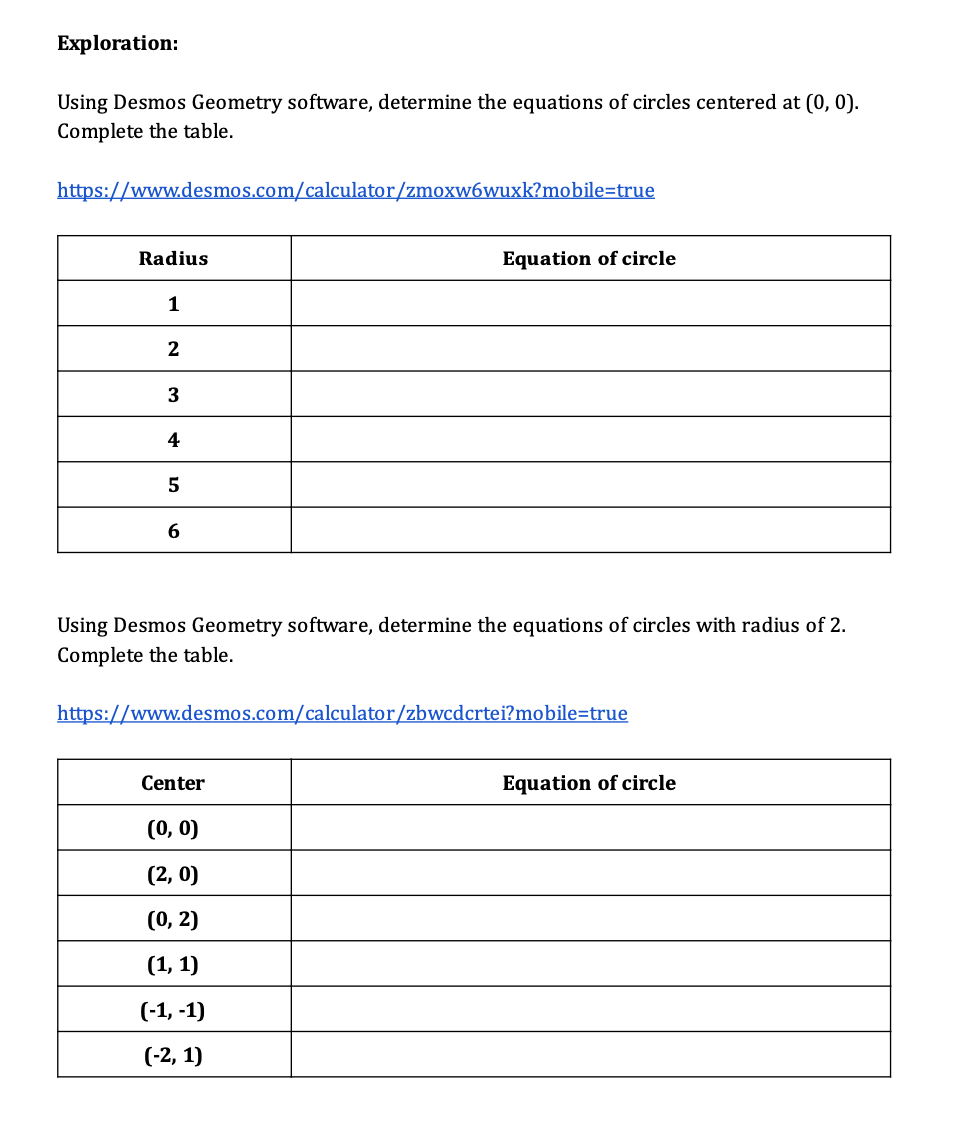
Learning to write the equation of a circle can be difficult. For one of my teaches last semester my mentor teacher suggested the use of a desmos paired with a worksheet to allow the students to explore what changes the standard equation of a circle. The worksheet had the students enter certain coordinates into the graphing calculator and write down what they thought was the equation of a circle. The next part of the assignment was student driven by having them share their conclusions on what the equation for a circle would be when it is centered at the origin vs. centered at (h,k). The worksheet shows that the students drove their own learning and came to their own conclusions which enhanced engagement through the lesson.

green line

This topic can come up again in trigonometry, upper level calculus and in math modeling. In my TNTX math modeling course, we took a closer look at the derivation of this equation and the subtleties of the standard form. This topic may also be used in physics calculations or in general, science labs.  For a physics word problem, it may ask you to calculate the net force and acceleration of a moving object around a circle. In this instance, it would suffice to just know the definition and general shape of a circle to complete these calculations. The definition of a circle is also needed to calculate centripetal force.

Engaging students: Solving exponential equations

In my capstone class for future secondary math teachers, I ask my students to come up with ideas for engaging their students with different topics in the secondary mathematics curriculum. In other words, the point of the assignment was not to devise a full-blown lesson plan on this topic. Instead, I asked my students to think about three different ways of getting their students interested in the topic in the first place.

I plan to share some of the best of these ideas on this blog (after asking my students’ permission, of course).

This student submission comes from my former student Austin Stone. His topic, from Precalculus: solving exponential equations.

green line

What interesting (i.e., uncontrived) word problems using this topic can your students do now?

Exponential equations can be used in lots of different kinds of word problems. One that is pretty common but is very useful for students involves interest rate. “Megan has $20,000 to invest for 5 years and she found an interest rate of 5%. How much money will she have at the end of 5 years if the interest rate compounds monthly?” I would give them the formula A=P(1+r/n)rt. It is pretty easy to convince students that this is a real-world problem and would get the students engaged about exponential equations. You can also reword the problem to ask for how much Megan started with, what the rate is, or how much time the money was in there. That way students get used to solving equations when the variable is in the exponent and when it is not. This also can lead into or us prior knowledge of natural log to solve for the variable in the exponent.

green line

How could you as a teacher create an activity or project that involves your topic?

Using the basis of the problem I mentioned above, a teacher could create a Project Based Instruction lesson using this idea. The teacher can set up a scenario where, over the course of a week or two, the students would have to decide which bank to make an investment in by calculating how much money they would profit at each bank. The students would have to research different banks and their interest rate. The teacher could also give each group different scenarios where some groups have more money to invest. Students would have to figure out how long they would like to invest. The teacher would give Do It Yourselves and Workshops that deal with solving exponential equations and also getting used to natural log. They would then make a presentation explaining what bank they have chosen and why. They would also have to explain the math that they would have used.

green line

How has this topic appeared in the news?

To say that exponential equations have been in the news lately would be an understatement. It has virtually been the news this year. COVID-19 is a virus and viruses spread exponentially. This would get students engaged immediately because the topic would be relatable to their own lives. Doctors and scientists try to figure out different ways to “flatten the curve”, which essentially means to make the spread of the virus not exponential anymore. We have all heard people on the news telling the public how to stop the virus from spreading and how not make people around you at risk of contracting it (contributing the exponential spread). We all have most likely seen a doctor or scientist show a graph of the virus’s spread and their predictions on how it will look in the upcoming weeks. This would give students a chance to see that what they are learning can be applied to very crucial things going on in the world around them.

References

Exponential Functions

Engaging students: Compound interest

In my capstone class for future secondary math teachers, I ask my students to come up with ideas for engaging their students with different topics in the secondary mathematics curriculum. In other words, the point of the assignment was not to devise a full-blown lesson plan on this topic. Instead, I asked my students to think about three different ways of getting their students interested in the topic in the first place.

I plan to share some of the best of these ideas on this blog (after asking my students’ permission, of course).

This student submission comes from my former student Mason Maynard. His topic, from Precalculus: compound interest.

green line

What interesting (i.e., uncontrived) word problems using this topic can your students do now? (You may find resources such as http://www.spacemath.nasa.gov to be very helpful in this regard; feel free to suggest others.)

  • A deposit of $3000 earns 2% interest compounded semiannually. How much money is in the bank after for 4 years?
  • A deposit of $2150 earns 6% interest compounded quarterly. How much money is in the bank after for 6 years?
  • A deposit of $495 earns 3% interest compounded annually. How much money is in the bank after for 3 years?

These word problems are some of the basic compound interest problems that your students learn how to do where you just plug in the correct values for their corresponding variables.

  • If you invested $1,000 in an account paying an annual percentage rate (quoted rate) compounded daily (based on a bank year of 360 days) and you wanted to have $2,500 in your account at the end of your investment time, what interest rate would you need if the investment time were 1 year, 10 years, 20 years, 100 years?
  • If you invested $500 in an account paying an annual percentage rate compounded quarterly , and you wanted to have $2,500 in your account at the end of your investment time, what interest rate would you need if the investment time were 1 year, 10 years, 20 years, 100 years?

These are the types of problems that get more difficult for the students. You want them to use compound interest to solve but then they must incorporate logs into their solutions because they are looking for time instead of interest.

green line

How does this topic extend what your students should have learned in previous courses?

With compound interest, students first learn about the simple interest formula. The only main difference is that you start to include exponents with compound interests. Then when you introduce your students to compound interest, you start to get into some more complicated problems. After they learn about compound interest and its basic problems, then you transition into logs with your students. This is used in compound interest and instead of just looking for the interest that will be accumulated after a specific amount of time, you then shift the variable around that you are looking for. The most coming type of problem that refers to this is they give you all of the information except for the amount time it takes to get a certain amount of interest. The last thing that leads up to compound interest in Calculus is when you transition from calculating the amount of interested over specific time intervals and a specific amount of times you compound it to calculating it with compounding it continuously over a specific time interval.

green line

How have different cultures throughout time used this topic in their society?

Interest is something you have to pay on a load. Depending on what side you are and how thinks go, you are either getting some more money back that what you invested or you are paying off a massive debt. Some think that the idea behind charging loans on interest came from the early days of neighbors loaning there cattle to one another. What is really unique about this is that the words in the Egyptian, ancient Greek and Sumerian languages is connected to cattle and their offspring. This leads some to believe that interest came about due to the natural increase of the herd that occurred when you loaned out your cattle.

The first evidence that comes of a compound interest problem dates back to 2000-1700 B.C. in Babylon. A clay tablet was found and the unique thing is that the interest rate use to solve it was not written. Some researchers assume that the rate was 20% due to that mainly all the other compound interest problems dating back closer to this used it. What is really crazy is that 20% worked to solve the problem. The only thing that was wrong was that the time was corresponding to the Babylon calendar of 360 days instead of our 365 days.

In 50 B.C. Cicero writes to a friend in Rome. The letter tells that he would not normally recognize more than 12 percent interest on a loan, even though a decree was passed which required money lenders to charge no more than 12 percent. Cicero would then write a few days later that they will pay back the loan in 6 years will 12 percent interest and more money will be added each year.

Resources:

Compound Interest History:

https://www.cambridge.org/core/services/aop-cambridge-core/content/view/799CB1D40CDD46F3010767BFC60F24DB/S1357321719000254a.pdf/emergence_of_compound_interest.pdf

Word Problems:

https://www.basic-mathematics.com/compound-interest-word-problems.html

http://www.sosmath.com/algebra/logs/log5/log51/log51.html

Engaging students: Infinite geometric series

In my capstone class for future secondary math teachers, I ask my students to come up with ideas for engaging their students with different topics in the secondary mathematics curriculum. In other words, the point of the assignment was not to devise a full-blown lesson plan on this topic. Instead, I asked my students to think about three different ways of getting their students interested in the topic in the first place.

I plan to share some of the best of these ideas on this blog (after asking my students’ permission, of course).

This student submission comes from my former student Brendan Gunnoe. His topic, from Precalculus: infinite geometric series.

green line

Curriculum:

Students can use the formula for an infinite geometric series to discover the formula for a finite geometric series. The teacher would start by posing the question “Can we use the infinite geometric series to come up with a formula for the finite version?” and writing out a series like so

\displaystyle \sum_{i=0}^\infty ar^i = ar^0 + ar^1 + ar^2 + \dots + ar^{n-1} + ar^n + ar^{n+1} + \dots

Next, the instructor could ask questions like “If we’re looking for the sum up to the nth term, where do we need to chop off the terms to get what we want?,” “Does the ending part look familiar?”, and “How can we rewrite the chopped off part so that it looks like what we already know?”. The teacher guides the students into manipulating the formula to get this result

\displaystyle \sum_{i=0}^\infty ar^i = ar^0 + ar^1 + ar^2 + \dots + ar^{n-1} + ar^n + ar^{n+1} + \dots

\displaystyle \sum_{i=0}^\infty ar^i = ar^0 + ar^1 + ar^2 + \dots + ar^{n-1} + ar^n +  \sum_{j=n+1}^\infty ar^j

 ar^0 + ar^1 + ar^2 + \dots + ar^{n-1} + ar^n = \displaystyle \sum_{i=0}^\infty ar^i - \sum_{j=n+1}^\infty ar^j

The teacher notes that the last sum can be simplified to make it easier to see by doing a substitution of k = j -n-1. Adjusting the bounds and substituting in the new index, we get

 ar^0 + ar^1 + ar^2 + \dots + ar^{n-1} + ar^n = \displaystyle \sum_{i=0}^\infty ar^i - \sum_{k=0}^\infty ar^{n+1+k}

 = \displaystyle \sum_{i=0}^\infty ar^i - \sum_{k=0}^\infty ar^{n+1}r^k

 = \displaystyle \sum_{i=0}^\infty ar^i - r^{n+1} \sum_{k=0}^\infty ar^k

Note that the two sums are identical, besides the index name, so we can factor and get

 ar^0 + ar^1 + ar^2 + \dots + ar^{n-1} + ar^n = a(1-r^{n+1}) \displaystyle \sum_{i=0}^\infty r^i

Lastly, we utilize our formula for an infinite geometric series and get

ar^0 + ar^1 + ar^2 + \dots + ar^{n-1} + ar^n = a(1-r^{n+1}) \displaystyle \frac{1}{1-r}

ar^0 + ar^1 + ar^2 + \dots + ar^{n-1} + ar^n = \displaystyle a\frac{1-r^{n+1}}{1-r}

ar^0 + ar^1 + ar^2 + \dots + ar^{n-1} + ar^n = \displaystyle a\frac{r^{n+1}-1}{r-1}

Although the infinite series requires |r|<1 , the finite version works for all real r. Although the formal proof that this is the correct formula might be beyond the scope of the intended class, it can easily be done with induction.

green line

Technology:

https://www.khanacademy.org/math/geometry-home/geometry-volume-surface-area/koch-snowflake/v/area-of-koch-snowflake-part-1-advanced

Sal Khan, one of recent history’s most well-known STEM educators, has a fantastic video that shows the relationship between a fractal known as the Koch snowflake and the geometric series. Khan works through the derivation of the formulas for the perimeter and area of an the nth­ iteration of the Koch snowflake. It turns out that both the area and perimeters for each iteration can be expressed using a geometric series, but the perimeter diverges to infinity while the area converges. Such a result makes sense intuitively since you can fit every iteration inside of a finite box that is slightly larger than the snowflake, and thus bounding the area, yet it would require an infinitely long wire to go around the perimeter of the limiting shape. Since fractals are not normally included in the math curriculum, showing how math can be used in interesting and different ways to solve problem can be very engaging for students.

green line

Culture:

There is a strong connection between geometric series, fractals, and self-similarity, all with a relatively simple nature. Fractals have been used in architecture and art for a very long time. Examples of self-similarity seen in ancient cultures include Hindu temples, with their structure being composed of self-similar units, and Islamic geometric art found in the domes of mosques.

Since the invention of the computer in the mid-20th century, more detailed and intricate digital art has been made popular. Although not exactly a geometric series, the Mandelbrot set acts very much like a fractal and was among the first of the uses of a computer to investigate the properties of fractals. It has been used in many ways to make animations, photos and other digital arts.

Another link between fractals and art can be found in the Legend of Zelda games. One of the iconic symbols of the game is called the triforce, which is an equilateral triangle that’s been cut into 4 smaller triangles with the middle piece removed. Such a shape is the first iteration of a fractal known as the Sierpinski triangle. As you can see, fractals can be found in all kinds of art, coming in many different forms.

https://en.wikipedia.org/wiki/Fractal_art

Engaging students: Computing trigonometric functions using a unit circle

In my capstone class for future secondary math teachers, I ask my students to come up with ideas for engaging their students with different topics in the secondary mathematics curriculum. In other words, the point of the assignment was not to devise a full-blown lesson plan on this topic. Instead, I asked my students to think about three different ways of getting their students interested in the topic in the first place.

I plan to share some of the best of these ideas on this blog (after asking my students’ permission, of course).

This student submission comes from my former student Alizee Garcia. Her topic, from Precalculus: computing trigonometric functions using a unit circle.

green line

How can this topic be used in your students’ future courses in mathematics or science?

Being able to compute trig functions using a unit circle will be the base of knowledge for all further calculus classes, as well as others. Being able to understand and use a unit circle will also allow students to start to memorize the trigonometric functions. One of the most important things from pre-calculus to all other calculus classes was being able to solve trig functions and having the unit circle memorized was very useful. Although there are trig functions and values outside of the unit circle, the unit circle almost is like the foundation for trigonometry. Most, if not all, calculus classes after pre-calculus will expect students to have the unit circle memorized. Although it can be solved using a calculator, this will allow equations and problems to be solves easier with less thought when a student knows the unit circle. Even outside of calculus classes, the unit circle is one of many important aspects in math classes.

green line

How does this topic extend what your students should have learned in previous courses?

Before students learn how to compute trigonometric functions using a unit circle, they learn about the trig functions by themselves. This usually starts in high school geometry where students learn sine, cosine, and tangent, yet they do not use them in the way a unit circle does. Most schools only teach the students how to use the calculator to compute the functions to solve sides or angles for triangles. As students enter pre-calculus, they use what they have learned about the trig functions in order to apply them to the unit circle. This will allow students to see that using trig functions can still be used to solve triangles, but it can also be used to solve many other things. Once they learn the unit circle, they will see more examples in which they will apply the functions and make connections to real-world scenarios that they can also be applied to.

green line

How can technology (YouTube, Khan Academy [khanacademy.org], Vi Hart, Geometers Sketchpad, graphing calculators, etc.) be used to effectively engage students with this topic?

There are probably many simulations and websites that can help students compute trig functions using the unit circle, but I think something that will engage the students is a Kahoot or Quizziz that will help the students memorize the unit circle. Giving students an opportunity to apply what they learned into a friendly competition not only gives them practice but will also let them be engaged. Other technology resources such as videos or a website that is teaching the lesson does not really allow the students to apply what they know rather than just being lectured. Although some websites and technology can be useful, I personally, enjoy giving students the opportunity to work out problems as well as being engaged. Also, using calculators could be helpful to check answers but if they have a unit circle it might not be necessary unless they do not have the unit circle in front of them.