Let be the statement “She is a woman to me at time ,” and let be the set of all times. Translate the logical statement
.
This matches the chorus of “She’s Always a Woman” by Billy Joel.
Context: Part of the discrete mathematics course includes an introduction to predicate and propositional logic for our math majors. As you can probably guess from their names, students tend to think these concepts are dry and uninteresting even though they’re very important for their development as math majors.
In an effort to making these topics more appealing, I spent a few days mining the depths of popular culture in a (likely futile) attempt to make these ideas more interesting to my students. In this series, I’d like to share what I found. Naturally, the sources that I found have varying levels of complexity, which is appropriate for students who are first learning prepositional and predicate logic.
When I actually presented these in class, I either presented the logical statement and had my class guess the statement in actual English, or I gave my students the famous quote and them translate it into predicate logic. However, for the purposes of this series, I’ll just present the statement in predicate logic first.
In my capstone class for future secondary math teachers, I ask my students to come up with ideas for engaging their students with different topics in the secondary mathematics curriculum. In other words, the point of the assignment was not to devise a full-blown lesson plan on this topic. Instead, I asked my students to think about three different ways of getting their students interested in the topic in the first place.
I plan to share some of the best of these ideas on this blog (after asking my students’ permission, of course).
This student submission comes from my former student Brendan Gunnoe. His topic, from Pre-Algebra: finding prime factorizations.
How can prime factorization be used in curriculum?
The teacher starts the class by asking students how they would find the least common multiple and greatest common divisor for two numbers. For the LCM, the most basic answer is listing the multiples of both denominators until they share a common multiple. For GCD, the most basic answer is listing out the factors of both numerator and denominator and finding the largest one in common.
Both processes can be made faster when using prime factorization, especially for larger numbers. First, do the process of prime factorization for both numbers. Then, for each prime, take the highest power on the lists and multiply everything together.
For example, take 12 and 45.
The process for finding the GCF is similar. Start off by doing the prime factorization for both numbers. Then, for each shared prime factor, take the smallest power and multiply everything together.
For example, take 12 and 30.
This process generalizes very easily for any amount of input numbers.
GCF and LCM are incredibly important when working with fractions and are used when reducing and adding fractions. Because fractions have loads of misconceptions associated with them, giving students another way to understand fractions can be very beneficial.
Technology
Have you ever wondered why we use 60 seconds in a minute and 60 minutes in an hour? Or why there is 24 hours in a day? What about why there is 360 degrees in a circle? One explanation is because these numbers can be divided evenly by loads of smaller numbers that we use often. In other words, these numbers have lots of factors in them. These kinds of numbers are called highly composite numbers.
A great video showcasing highly composite numbers is Numberphile’s video “5040 and other Anti-Prime Numbers,” hosted by Dr. James Grimes. This video is extremely dense with informative as Dr. Grimes explains what a highly composite number is, shows properties of these numbers, explains why they have these properties, and gives examples of how highly composite numbers are used both in math and in real life. Dr. Grimes also gives a few historical uses of highly composite numbers, which answer some of the questions listed above.
Prime factorization is the foundation of highly composite numbers. Highly composite numbers can be an interesting and exciting application of prime factorization.
Application
Semiprime numbers were also used in the making of the Arecibo message. Because the message is composed of 1679 bits, there is only four ways of decomposing the message into a rectangle. All possible decompositions of 1679 into a rectangle are 1×1679, 73×23, 23×73 and 1679×1. If decoded correctly, then the message forms a picture which contains loads of information about the solar system and life on Earth.
For a way to make semiprime numbers into an engaging activity for students, the teacher could have students create their own mini version of the Arecibo message and show them off in class. Students can be made into groups and each group get assigned a certain semiprime. Then, each group gets to decide what information goes in their mini message and draw their message onto a sheet of poster paper with a grid on it. Finally, they present their message to the class, representing the students sending their message off into space for extraterrestrial life to decode.
Let be the statement “ lies to me,” and let be the set of all people. Translate the logical statement
.
This matches a line from the song (and the title of the song) “Everyone Lies to Me” by Knuckle Puck.
Context: Part of the discrete mathematics course includes an introduction to predicate and propositional logic for our math majors. As you can probably guess from their names, students tend to think these concepts are dry and uninteresting even though they’re very important for their development as math majors.
In an effort to making these topics more appealing, I spent a few days mining the depths of popular culture in a (likely futile) attempt to make these ideas more interesting to my students. In this series, I’d like to share what I found. Naturally, the sources that I found have varying levels of complexity, which is appropriate for students who are first learning prepositional and predicate logic.
When I actually presented these in class, I either presented the logical statement and had my class guess the statement in actual English, or I gave my students the famous quote and them translate it into predicate logic. However, for the purposes of this series, I’ll just present the statement in predicate logic first.
In my capstone class for future secondary math teachers, I ask my students to come up with ideas for engaging their students with different topics in the secondary mathematics curriculum. In other words, the point of the assignment was not to devise a full-blown lesson plan on this topic. Instead, I asked my students to think about three different ways of getting their students interested in the topic in the first place.
I plan to share some of the best of these ideas on this blog (after asking my students’ permission, of course).
This student submission again comes from my former student Angelica Albarracin. Her topic, from Pre-Algebra: probability and odds.
How can this topic be used in your students’ future courses in mathematics or science?
Probability is a topic that commonly appears in biology in the study of sexual reproduction. Both in freshman and college level biology, students are required to learn how to create and use Punnett squares. Punnett Squares are used to determine the likelihood certain alleles will appear in the offspring of 2 organisms. These alleles can do anything from determining eye color, to determining whether or not an organism will have a hereditary disease such as hemophilia.
Though statistics is not a required mathematics class for high schoolers in the state of Texas, many students will end up encountering this class in high school and/or college as it pertains directly to many fields of study such as math, biology, chemistry, and physics. One of the most important concepts in statistics is the idea of statistical significance. Using the scientific method and other techniques for conducting a survey or experiment, it is easy to analyze, and record data. However, a major component of statistics is being able to interpret the implications of any given data. One of the biggest indicators that an experiment or survey that was conducted holds real implications is its statistical significance, which is essentially a measure of the probability of observing results as extreme as what was observed.
How has this topic appeared in pop culture (movies, TV, current music, video games, etc.)?
Speed running is a category of gaming that has become hugely popular over the years in which highly skilled and knowledgeable players compete amongst each other to complete a game as fast as possible. One of the most popular of these games in this scene is Minecraft and due to Minecraft’s popularity, speed runners of this game often come within seconds of world records, meaning every small optimization could be the difference between 1st and 2nd place on the leaderboards.
Minecraft is a highly open and adventurous game primarily because each “world” is randomly generated, meaning that no two playthroughs are alike. This randomness not only encompasses world generation, but also factors into the availability of resources in the form of animals, enemies, and even ores used for building and crafting items. The most notorious section of the game where random generation plays a huge role in the speed run is in the collection of an essential item known as the ender pearl. In order to reach the final stage of the game, a minimum of 12 ender pearls are required, which can only be obtained from Endermen, a type of enemy in the game. Though ender pearls are considered an essential item for the completion of the game, it is theoretically possible to complete the game in its entirety without ever obtaining a single pearl. This is due to a unique mechanic the game uses to allow the player into its final stages.
Ender pearls are used in combination with a material called Blaze Powder to make a new item known as an Eye of Ender. Eyes of Ender are used to both locate a special portal to allow players into the “End” and to activate said portal. This portal (known as the End Portal) can only be activated with 12 eyes, but this is where the game’s inherent randomness plays an important factor. For each of the 12 slots in the portal dedicated to the placement of the eyes, there is a 10% chance that there will already be one inside, meaning the player would not need to provide one of their own. It is also important to note that while Eyes of Ender are used to locate this portal, it is completely possible to find this portal on your own, it is simply faster to use the Eye of Ender as a guide (and being faster is in the interest of speed runners). With this being said, the probability a player can complete the game without the usage of a single ender pearl is about 1 in 1 trillion!
So, what’s the big deal? Speed runners can simply obtain the required pearls and ignore this possibility, right? Normally this would be the easy answer, but it becomes a bit more complex when we consider the nature of ender pearls. As mentioned earlier, ender pearls can only be obtained from endermen, and while their exact spawn rates are unknown, they are considered to be uncommon. In addition, each endermen has only a 50% chance of dropping an ender pearl upon defeat. If you consider this with the fact that enemies primarily spawn during the night cycle of the game, it is easy to see how obtaining these pearls can take a lot of time, something a speed runner wants to avoid at all costs. Consequently, runners are often put into a scenario in which they must balance their risk and reward. Though the probability a runner will encounter an End portal with all 12 eyes built in is near impossible, the likelihood that 2 or even 3 eyes would be there is not so low. Should a speed runner devote more time to finding ender pearls, though some of their effort maybe be for nothing, or should a runner find most of the pearls, and hope the rest are at the portal waiting? In a category of gaming where every second counts, probability can be used to figure out the most optimal answer to this question, and lead hopefuls to new world records.
How can technology (YouTube, Khan Academy [khanacademy.org], Vi Hart, Geometers Sketchpad, graphing calculators, etc.) be used to effectively engage students with this topic?
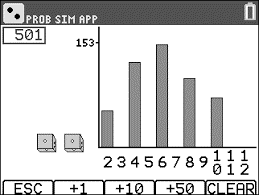
An important concept in probability is the Law of Large Numbers which states that “the relative frequency of an outcome approaches the actual probability of that outcome, as the number of repetitions gets larger” (see link below). This law can be easily observed through repeatedly tossing a coin or rolling a die, however, as the law suggests, this must be done a large amount of times. Tossing a coin 500 times in the classroom, while helpful to demonstrate this law in action, is time consuming and tedious. As a remedy to this, Texas Instruments developed an app for TI-84 graphing calculators called Probability Simulation.
In this free app, students can choose from a variety of actions to simulate such as tossing coins, rolling dice, picking marbles, and drawing cards. In the image above, the calculator is simulating the results of rolling two die. There are many useful features and settings within this app but two of the best ones are the ability to perform an action 50 at a time (indicated by +50) and a graph to keep track of the results of all previous actions. Having the ability to perform each action quickly and in large quantity makes this a much less time consuming and material intensive activity. In addition, having a graph documenting each result from previous actions also helps tremendously in demonstrating the Law of Large Numbers as it acts as a visual aid. In the picture above, the rough formation of a bell curve can be seen after 501 rolls.
References:
https://education.ti.com/en/building-concepts/activities/statistics/sequence1/law-of-large-numbershttps://www.minecraftseeds.co/stronghold-with-end-portal/https://www.speedrun.com/mc/full_game#Any_Glitchless
Let be the statement “ can keep me safe,” and let be the set of all people. Translate the logical statement
.
This matches a line from the song “On My Way.”
Context: Part of the discrete mathematics course includes an introduction to predicate and propositional logic for our math majors. As you can probably guess from their names, students tend to think these concepts are dry and uninteresting even though they’re very important for their development as math majors.
In an effort to making these topics more appealing, I spent a few days mining the depths of popular culture in a (likely futile) attempt to make these ideas more interesting to my students. In this series, I’d like to share what I found. Naturally, the sources that I found have varying levels of complexity, which is appropriate for students who are first learning prepositional and predicate logic.
When I actually presented these in class, I either presented the logical statement and had my class guess the statement in actual English, or I gave my students the famous quote and them translate it into predicate logic. However, for the purposes of this series, I’ll just present the statement in predicate logic first.
In my capstone class for future secondary math teachers, I ask my students to come up with ideas for engaging their students with different topics in the secondary mathematics curriculum. In other words, the point of the assignment was not to devise a full-blown lesson plan on this topic. Instead, I asked my students to think about three different ways of getting their students interested in the topic in the first place.
I plan to share some of the best of these ideas on this blog (after asking my students’ permission, of course).
This student submission comes from my former student Jesus Alanis. His topic, from Pre-Algebra: the Laws of Exponents (with integer exponents).
How could you as a teacher create an activity or project that involves your topic?
I would create a project where the students would have to create a “poster”. First, you would give each student a strip that contains one of the laws of the exponent. On the strip, there will be 3 expressions for them to solve that involves one of the laws and have a blank space for the student to create a “rule” for their law. This is where you will let your students find out what law they got. Once they figured out their law they will create a poster that will have the name of the law, the rule of the law (by the rule I mean just using variables, for example, the Product of Powers it would be ), a complete sentence which explains the rule in their own words, and an example of the law which can be one of the expressions from the strip. For the poster, you would want students to use color and decorate the way they want. This will let the student’s inner artist out and creativity shine. You can have your students present their law, or you can have a gallery walk so they can look at all the different laws.
The purpose of the project is for the student to play with the expressions causing them to question which law they received and letting them create a rule that makes them understand how the law works. The sentence on the poster will demonstrate if the student understood the law. This is a project that can be used to let students find out for themselves or this could be a project to help students remember what they learned.
Something extra but you can also make this a relay race by using the strip or the whole paper where the students must at least do one expression from each of the laws of the exponent. In the end, each student in the group has at least done all three laws that were on the page. With the page from TEA, there are only three laws on there, but you could add the rest on there to make the race a little longer. The goal is to have each student have practice with each law that is on the page, they are in a group so they can help each other and familiarize themselves with the laws and peers.
How can this topic be used in your students’ future courses in mathematics or science?
The way students can use the Law of Exponents in the future is that it will help write or type very large numbers towards using fewer numbers. This will not cause the value of the number to change but will be less to write. For example,
.
The law of exponents will also help with loan interest rates that can be used to predict how much you will have to pay in a certain time frame. Exponents are used to determining the pH level of substances, see the growth of bacteria, see the population of a city, and how much has it increased or decreased, and many more.
How has this topic appeared in pop culture?
I did not really find where it appeared in pop culture, but I did find a connection of how you can use the clip of SpongeBob to the Law of Exponents. The way you can connect them is that SpongeBob says all the specific rules to blow a bubble. This is to engage students and make sure to activate their prior knowledge that goes with the rules like the way we do with the area of a rectangle we first have to find the length of the sides and then place them in the formula to be multiplied. The small clip is a demonstration that with the Law of Exponents we must “obey” the math operations so that our results are as perfect as the duck bubbles. Also, we must make the connection between rules and laws which are very similar.
Let be the statement “I am superstitious,” and let be the statement “I am a little stitious.” Translate the logical statement
.
This matches a quote from the popular TV show “The Office.”
Context: Part of the discrete mathematics course includes an introduction to predicate and propositional logic for our math majors. As you can probably guess from their names, students tend to think these concepts are dry and uninteresting even though they’re very important for their development as math majors.
In an effort to making these topics more appealing, I spent a few days mining the depths of popular culture in a (likely futile) attempt to make these ideas more interesting to my students. In this series, I’d like to share what I found. Naturally, the sources that I found have varying levels of complexity, which is appropriate for students who are first learning prepositional and predicate logic.
When I actually presented these in class, I either presented the logical statement and had my class guess the statement in actual English, or I gave my students the famous quote and them translate it into predicate logic. However, for the purposes of this series, I’ll just present the statement in predicate logic first.
Let be the statement “I run away at time ,” let be the statement “I go make on my word at time ,” and let be the set of all times. Translate the logical statement
.
This matches a quote from the main character Naruto in Masashi Kishimoto’s anime (also named Naruto).
Context: Part of the discrete mathematics course includes an introduction to predicate and propositional logic for our math majors. As you can probably guess from their names, students tend to think these concepts are dry and uninteresting even though they’re very important for their development as math majors.
In an effort to making these topics more appealing, I spent a few days mining the depths of popular culture in a (likely futile) attempt to make these ideas more interesting to my students. In this series, I’d like to share what I found. Naturally, the sources that I found have varying levels of complexity, which is appropriate for students who are first learning prepositional and predicate logic.
When I actually presented these in class, I either presented the logical statement and had my class guess the statement in actual English, or I gave my students the famous quote and them translate it into predicate logic. However, for the purposes of this series, I’ll just present the statement in predicate logic first.
In my capstone class for future secondary math teachers, I ask my students to come up with ideas for engaging their students with different topics in the secondary mathematics curriculum. In other words, the point of the assignment was not to devise a full-blown lesson plan on this topic. Instead, I asked my students to think about three different ways of getting their students interested in the topic in the first place.
I plan to share some of the best of these ideas on this blog (after asking my students’ permission, of course).
This student submission again comes from my former student Alizee Garcia. Her topic, from Algebra: solving one-step algebra problems.
How can this topic be used in your students’ future courses in mathematics or science?
As stated in the topic, one-step algebra problems can also lead up to two-step, three-step, and so on and so forth. Being said, as students’ move on to future courses, the knowledge they have over one-step problems is what will get them through more complex equations. Throughout algebra courses, the basis of problems will be to solve an unknown variable. Without the understanding of the base of algebra, things will not be smooth. Also, solving one-step algebra problems will help students’ even in science classes. For example, chemistry classes contain a lot of variables and unknowns and it is up to the student to solve for them. The amount of solution a student has to put into another solution may need to be figured out by a simple one-step algebra problem and without this knowledge, it can lead to a ruined lab or maybe even an explosion. Solving one-step problems and understanding how to will help students tremendously from the time they learn it to the end of time.
How does this topic extend what your students should have learned in previous courses?
When solving any algebra problem, or solving for an unknown, it allows students to incorporate order of operations. As for just one-step algebra problems, it gives students the opportunity to practice addition, subtraction, multiplication, and division. It also gives them to opportunity to practice setting up an equation when solving for the unknown. There are many things that one-step algebra problems extends for students but as they have more practice, they should not have to think about it much. Furthermore, when solving algebra problems one of the most important things is doing the same application on both sides of the equality. Sometimes students may have done one-step algebra problems in the past but have not set it up in an equation. This also will extend the topic of addition, subtraction, multiplication, and division. Although the students may already have a lot of experience with those applications, it gives them more practice to decide what application to use when solving a one-step algebra problem.
How can technology (YouTube, Khan Academy [khanacademy.org], Vi Hart, Geometers Sketchpad, graphing calculators, etc.) be used to effectively engage students with this topic?
Recently, I have discovered that when appropriate, using websites such as Quizziz, Kahoot, and online games as such helps students engage in the topic. Especially for one-step algebra problems that can be done mentally or quickly on paper, it lets students become more active in the lesson. Students will want to be their peers high score and get the questions right. Using such technology will enable students to have more practice and wanting to do it correctly as well. Making topics a friendly competition for students will make things more exciting for them. Also, these website will allow for an untimed quiz so they do not feel rush and are able to accurately solve problems. Although this can be tricky for some math topics, with simpler things such as one-step algebra problems, it definitely will be a very good opportunity for students to learn material and have fun with it as well.
Context: Part of the discrete mathematics course includes an introduction to predicate and propositional logic for our math majors. As you can probably guess from their names, students tend to think these concepts are dry and uninteresting even though they’re very important for their development as math majors.
In an effort to making these topics more appealing, I spent a few days mining the depths of popular culture in a (likely futile) attempt to make these ideas more interesting to my students. In this series, I’d like to share what I found. Naturally, the sources that I found have varying levels of complexity, which is appropriate for students who are first learning prepositional and predicate logic.
When I actually presented these in class, I either presented the logical statement and had my class guess the statement in actual English, or I gave my students the famous quote and them translate it into predicate logic. However, for the purposes of this series, I’ll just present the statement in predicate logic first.

be the statement “She is a woman to me at time
,” and let
be the set of all times. Translate the logical statement
.





 be the statement “
 lies to me,” and let
  be the set of all people. Translate the logical statement
 .
.
 be the statement “
 .
. ), a complete sentence which explains the rule in their own words, and an example of the law which can be one of the expressions from the strip. For the poster, you would want students to use color and decorate the way they want. This will let the student’s inner artist out and creativity shine. You can have your students present their law, or you can have a gallery walk so they can look at all the different laws.
 .
. be the statement “I am superstitious,” and let
  be the statement “I am a little stitious.” Translate the logical statement
 .
. be the statement “I run away at time
  be the statement “I go make on my word at time
  .
.
 .
. Mean Green Math