
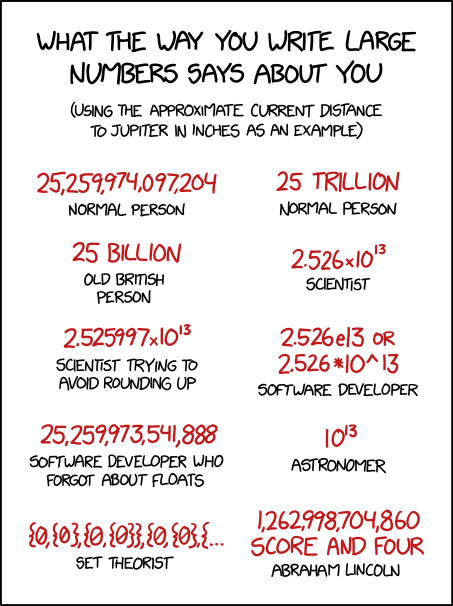
A great explanation of the comic can be found at https://www.explainxkcd.com/wiki/index.php/2319:_Large_Number_Formats.
A great explanation of the comic can be found at https://www.explainxkcd.com/wiki/index.php/2319:_Large_Number_Formats.
From the YouTube description:
Mathematics is everywhere, and the golf course is no exception. Many aspects of the game of golf can be illuminated or improved through mathematical modeling and analysis. We will discuss a few examples, employing mathematics ranging from simple high school algebra to computational techniques at the frontiers of contemporary research.
This made me laugh…

…though I would have laughed harder if the band was called 1023 Megabytes.
I recently read about a simple but clever logic puzzle, known as the “Wason selection task,” which is often claimed to be “the single most investigated experimental paradigm in the psychology of reasoning.” More than 90% of Wason’s subjects got the answer wrong when Wason first studied this problem back in the 1960s, and this result has been repeated time over time by psychologists ever since.
Here’s the puzzle: You are shown four different cards, showing a 5, an 8, a blue card, and a green card. You are told that each card has a number on one side and a color on the other side. You are asked to test the truth of the following statement:
If a card has an even number on one side, then its opposite side is blue.
Question: Which card (or cards) must you turn over to test the truth of this statement?
Interestingly, in the 1980s, a pair of psychologists slightly reworded the Wason selection puzzle in a form that’s logically equivalent, but this rewording caused a much higher rate of correct responses. Here was the rewording:
On this task imagine you are a police officer on duty. It is your job to make sure that people conform to certain rules. The cards in front of you have information about four people sitting at a table. On one side of the card is a person’s age and on the other side of the card is what the person is drinking. Here is a rule: “If a person is drinking beer, then the person must be over 19 years of age.” Select the card or cards that you definitely must turn over to determine whether or not the people are violating the rule.
Four cards are presented:
- Drinking a beer
- Drinking a Coke
- 16 years of age
- 22 years of age
In this experiment, 29 out of 40 respondents answered correctly. However, when presented with the same task using more abstract language, none of the 40 respondents answered correctly… even though the two puzzles are logically equivalent. Quoting from the above article:
Seventy-five percent of subjects nailed the puzzle when it was presented in this way—revealing what researchers now call a “content effect.” How you dress up the task, in other words, determines its difficulty, despite the fact that it involves the same basic challenge: to see if a rule—if P then Q—has been violated. But why should words matter when it’s the same logical structure that’s always underlying them?
This little study has harrowing implications for those of us that teach mathematical proofs and propositional logic. It’s very easy for people to get some logic questions correct but other logic questions incorrect, even if the puzzles look identical to the mathematician/logician who is posing the questions. Pedagogically, this means that it’s a good idea to use familiar contexts (like rules for underage drinking) to introduce propositional logic. But this comes with a warning, since students who answer questions arising from a familiar context correctly may not really understand propositional logic at all when the question is posed more abstract (like in a mathematical proof).
I recently read about a simple but clever logic puzzle, known as the “Wason selection task,” which is often claimed to be “the single most investigated experimental paradigm in the psychology of reasoning.”
Here’s the puzzle: You are shown four different cards, showing a 5, an 8, a blue card, and a green card. You are told that each card has a number on one side and a color on the other side. You are asked to test the truth of the following statement:
If a card has an even number on one side, then its opposite side is blue.
Question: Which card (or cards) must you turn over to test the truth of this statement?
The answer is: You must turn over the 8 card and the green card. The following video explains why:
Briefly:

If you got this wrong, you’re in good company. More than 90% of Wason’s subjects got the answer wrong when Wason first studied this problem back in the 1960s, and this result has been repeated time over time by psychologists ever since.
Speaking for myself, I must admit that I blew it too when I first came across this problem. In the haze of the early morning when I first read this article, I erroneously thought that the 8 card and the blue card had to be turned.
I recently read about a simple but clever logic puzzle, known as the “Wason selection task,” which is often claimed to be “the single most investigated experimental paradigm in the psychology of reasoning,” in the words of one textbook author.
Here’s the puzzle: You are shown four different cards, showing a 5, an 8, a blue card, and a green card. You are asked to test the truth of the following statement:
If a card has an even number on one side, then its opposite side is blue.
Question: Which card (or cards) must you turn over to test the truth of this statement?
I’ll start discussing the answer to this puzzle in tomorrow’s post. If you’re impatient, you can click through the interactive video above or else read the article where I first learned about this puzzle: http://m.nautil.us/blog/the-simple-logical-puzzle-that-shows-how-illogical-people-are (I got the opening sentence of this post from this article).

Here in north Texas, we’re recovering from our third winter storm in two weeks, so I thought it’s timely to share this article about how mathematics can be used to efficiently plow the snow off the streets (apologies for the mild profanity):
http://www.wired.com/2015/02/mathematics-behind-getting-damned-snow-street/

Source: http://www.xkcd.com/571/
This probably requires a little explanation with the nuances of how integers are stored in computers. A 16-bit signed integer simulates binary digits with 16 digits, where the first digit represents either positive (

For starters,




For the next number, 


Because of this nuance, the following C computer program will result in the unexpected answer of 
main()
{
short x = 32767;
printf(“%d \n”, x + 1);
}
For more details, see http://en.wikipedia.org/wiki/Integer_%28computer_science%29
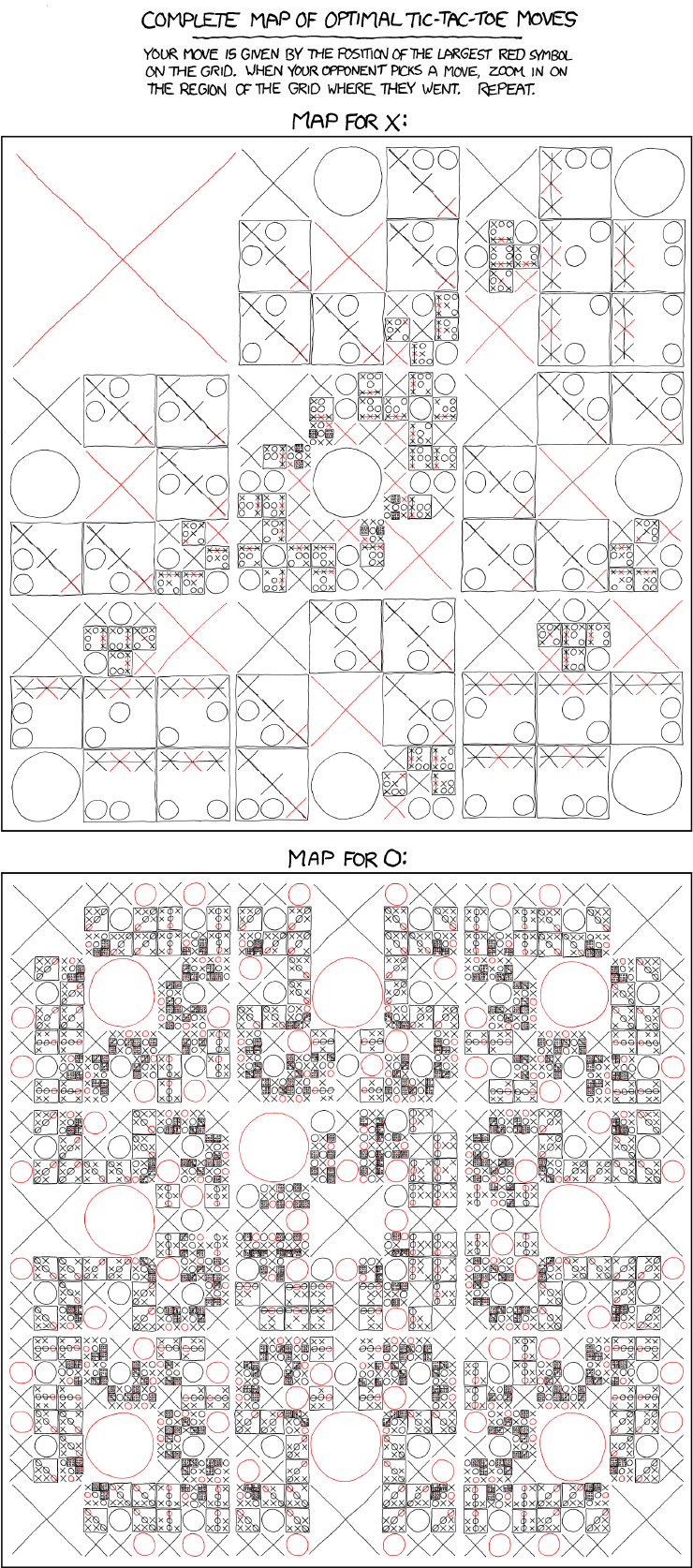
Source: http://www.xkcd.com/832_large/
Algorithms for sorting a list, like Bubble Sort, Quick Sort, etc., often require some sort of visual interpretation to make dry algorithms more accessible to students. Here are some YouTube videos that brilliant do this via the medium of folk dancing.
Quick Sort
Merge Sort
Insert Sort
Select Sort
Shell Sort
Bubble Sort







 Mean Green Math