This antiderivative has arguable the highest ratio of “really hard to compute” to “really easy to write”:

So far, I’ve shown that the denominator can be factored over the real numbers:
 ,
,
so that the technique of partial fractions can be applied. Since both quadratics in the denominator are irreducible (and the degree of the numerator is less than the degree of the denominator), the partial fractions decomposition has the form

Clearing out the denominators, I get

or

or

Matching coefficients yields the following system of four equations in four unknowns:




Ordinarily, four-by-four systems of linear equations are somewhat painful to solve, but this system isn’t too bad. Since from the first equation, the third equation becomes
 , or
, or  .
.
From the fourth equation, I can conclude that  and
and  . The second and third equations then become

 ,
,
or
 ,
,
.
Adding the two equations yields  , so that
  and
and  .
.
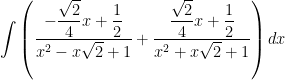
Therefore, the integral can be rewritten as
I’ll start evaluating this integral in tomorrow’s post.


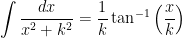


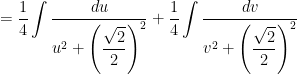

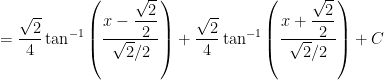




 . However,
  , and so this substitution can’t be used cleanly. So, let me force the numerator to have this form, at least in part:

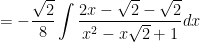




 .
. is an irreducible quadratic and hence is never equal to zero for any real number
  .
. to the second integral:






 .
.



 .
. ,
, .
. since the roots will be complex. The four roots of this quartic equation can be found with De Moivre’s Theorem by writing
 ,
, is a real number, and
 .
. and
and 
 and
and 
 .
.![z = 1 \left[ \cos \displaystyle \frac{\pi}{4} + i \sin \frac{\pi}{4} \right] = \displaystyle \frac{\sqrt{2}}{2} + i \frac{\sqrt{2}}{2}](https://s0.wp.com/latex.php?latex=z+%3D+1+%5Cleft%5B+%5Ccos+%5Cdisplaystyle+%5Cfrac%7B%5Cpi%7D%7B4%7D+%2B+i+%5Csin+%5Cfrac%7B%5Cpi%7D%7B4%7D+%5Cright%5D+%3D+%5Cdisplaystyle+%5Cfrac%7B%5Csqrt%7B2%7D%7D%7B2%7D+%2B+i+%5Cfrac%7B%5Csqrt%7B2%7D%7D%7B2%7D&bg=ffffff&fg=000000&s=0&c=20201002)
![z = 1 \left[ \cos \displaystyle \frac{3\pi}{4} + i \sin \frac{3\pi}{4} \right] = -\displaystyle \frac{\sqrt{2}}{2} + i \frac{\sqrt{2}}{2}](https://s0.wp.com/latex.php?latex=z+%3D+1+%5Cleft%5B+%5Ccos+%5Cdisplaystyle+%5Cfrac%7B3%5Cpi%7D%7B4%7D+%2B+i+%5Csin+%5Cfrac%7B3%5Cpi%7D%7B4%7D+%5Cright%5D+%3D+-%5Cdisplaystyle+%5Cfrac%7B%5Csqrt%7B2%7D%7D%7B2%7D+%2B+i+%5Cfrac%7B%5Csqrt%7B2%7D%7D%7B2%7D&bg=ffffff&fg=000000&s=0&c=20201002)
![z = 1 \left[ \cos \displaystyle \frac{5\pi}{4} + i \sin \frac{5\pi}{4} \right] = -\displaystyle \frac{\sqrt{2}}{2} - i \frac{\sqrt{2}}{2}](https://s0.wp.com/latex.php?latex=z+%3D+1+%5Cleft%5B+%5Ccos+%5Cdisplaystyle+%5Cfrac%7B5%5Cpi%7D%7B4%7D+%2B+i+%5Csin+%5Cfrac%7B5%5Cpi%7D%7B4%7D+%5Cright%5D+%3D+-%5Cdisplaystyle+%5Cfrac%7B%5Csqrt%7B2%7D%7D%7B2%7D+-+i+%5Cfrac%7B%5Csqrt%7B2%7D%7D%7B2%7D&bg=ffffff&fg=000000&s=0&c=20201002)
![z = 1 \left[ \cos \displaystyle \frac{7\pi}{4} + i \sin \frac{7\pi}{4} \right] = \displaystyle \frac{\sqrt{2}}{2} - i \frac{\sqrt{2}}{2}](https://s0.wp.com/latex.php?latex=z+%3D+1+%5Cleft%5B+%5Ccos+%5Cdisplaystyle+%5Cfrac%7B7%5Cpi%7D%7B4%7D+%2B+i+%5Csin+%5Cfrac%7B7%5Cpi%7D%7B4%7D+%5Cright%5D+%3D+%5Cdisplaystyle+%5Cfrac%7B%5Csqrt%7B2%7D%7D%7B2%7D+-+i+%5Cfrac%7B%5Csqrt%7B2%7D%7D%7B2%7D&bg=ffffff&fg=000000&s=0&c=20201002)
 can be written as the following product of linear factors over the complex plane:
![\displaystyle \left(x - \left[ \displaystyle \frac{\sqrt{2}}{2} + i \frac{\sqrt{2}}{2} \right] \right)\left(x - \left[ \displaystyle \frac{\sqrt{2}}{2} - i \frac{\sqrt{2}}{2} \right] \right) \left(x - \left[ -\displaystyle \frac{\sqrt{2}}{2} + i \frac{\sqrt{2}}{2} \right] \right) \left(x - \left[ - \displaystyle \frac{\sqrt{2}}{2} - i \frac{\sqrt{2}}{2} \right] \right)](https://s0.wp.com/latex.php?latex=%5Cdisplaystyle+%5Cleft%28x+-+%5Cleft%5B+%5Cdisplaystyle+%5Cfrac%7B%5Csqrt%7B2%7D%7D%7B2%7D+%2B+i+%5Cfrac%7B%5Csqrt%7B2%7D%7D%7B2%7D+%5Cright%5D+%5Cright%29%5Cleft%28x+-+%5Cleft%5B+%5Cdisplaystyle+%5Cfrac%7B%5Csqrt%7B2%7D%7D%7B2%7D+-+i+%5Cfrac%7B%5Csqrt%7B2%7D%7D%7B2%7D+%5Cright%5D+%5Cright%29+%5Cleft%28x+-+%5Cleft%5B+-%5Cdisplaystyle+%5Cfrac%7B%5Csqrt%7B2%7D%7D%7B2%7D+%2B+i+%5Cfrac%7B%5Csqrt%7B2%7D%7D%7B2%7D+%5Cright%5D+%5Cright%29+%5Cleft%28x+-+%5Cleft%5B+-+%5Cdisplaystyle+%5Cfrac%7B%5Csqrt%7B2%7D%7D%7B2%7D+-+i+%5Cfrac%7B%5Csqrt%7B2%7D%7D%7B2%7D+%5Cright%5D+%5Cright%29&bg=ffffff&fg=000000&s=0&c=20201002)
![\displaystyle \left(\left[x - \displaystyle \frac{\sqrt{2}}{2} \right] - i \frac{\sqrt{2}}{2} \right)\left( \left[ x - \displaystyle \frac{\sqrt{2}}{2} \right] + i \frac{\sqrt{2}}{2} \right) \left( \left[ x + \displaystyle \frac{\sqrt{2}}{2} \right] - i \frac{\sqrt{2}}{2} \right) \left( \left[ x + \displaystyle \frac{\sqrt{2}}{2} \right] + i \frac{\sqrt{2}}{2} \right)](https://s0.wp.com/latex.php?latex=%5Cdisplaystyle+%5Cleft%28%5Cleft%5Bx+-+%5Cdisplaystyle+%5Cfrac%7B%5Csqrt%7B2%7D%7D%7B2%7D+%5Cright%5D+-+i+%5Cfrac%7B%5Csqrt%7B2%7D%7D%7B2%7D+%5Cright%29%5Cleft%28+%5Cleft%5B+x+-+%5Cdisplaystyle+%5Cfrac%7B%5Csqrt%7B2%7D%7D%7B2%7D+%5Cright%5D+%2B+i+%5Cfrac%7B%5Csqrt%7B2%7D%7D%7B2%7D+%5Cright%29+%5Cleft%28+%5Cleft%5B+x+%2B+%5Cdisplaystyle+%5Cfrac%7B%5Csqrt%7B2%7D%7D%7B2%7D+%5Cright%5D+-+i+%5Cfrac%7B%5Csqrt%7B2%7D%7D%7B2%7D+%5Cright%29+%5Cleft%28+%5Cleft%5B+x+%2B+%5Cdisplaystyle+%5Cfrac%7B%5Csqrt%7B2%7D%7D%7B2%7D+%5Cright%5D+%2B+i+%5Cfrac%7B%5Csqrt%7B2%7D%7D%7B2%7D+%5Cright%29&bg=ffffff&fg=000000&s=0&c=20201002)
![\displaystyle \left(\left[x - \displaystyle \frac{\sqrt{2}}{2} \right]^2 - \left[ i \frac{\sqrt{2}}{2} \right]^2 \right) \left( \left[ x + \displaystyle \frac{\sqrt{2}}{2} \right]^2 - \left[i \frac{\sqrt{2}}{2} \right]^2 \right)](https://s0.wp.com/latex.php?latex=%5Cdisplaystyle+%5Cleft%28%5Cleft%5Bx+-+%5Cdisplaystyle+%5Cfrac%7B%5Csqrt%7B2%7D%7D%7B2%7D+%5Cright%5D%5E2+-+%5Cleft%5B+i+%5Cfrac%7B%5Csqrt%7B2%7D%7D%7B2%7D+%5Cright%5D%5E2+%5Cright%29+%5Cleft%28+%5Cleft%5B+x+%2B+%5Cdisplaystyle+%5Cfrac%7B%5Csqrt%7B2%7D%7D%7B2%7D+%5Cright%5D%5E2+-+%5Cleft%5Bi+%5Cfrac%7B%5Csqrt%7B2%7D%7D%7B2%7D+%5Cright%5D%5E2+%5Cright%29&bg=ffffff&fg=000000&s=0&c=20201002)

 .
.

 can be viewed as two sides of a right triangle with legs
  and
and  ,
,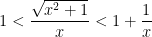 .
. and
and  . Therefore, by the Sandwich Theorem, we can conclude that
 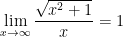 .
. . So let’s use this here. Also, since
  , we can change the limit to be
  :
:


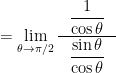

 .
. , and so I can differentiate the top and the bottom with respect to

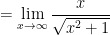 .
. , then I’ve just shown that
  (assuming that the limit exists in the first place, of course). That means that
  or
or  . Well, clearly the limit of this nonnegative function can’t be negative, and so we conclude that the limit is equal to
  Mean Green Math