Engaging students: Deriving the distance formula

In my capstone class for future secondary math teachers, I ask my students to come up with ideas for engaging their students with different topics in the secondary mathematics curriculum. In other words, the point of the assignment was not to devise a full-blown lesson plan on this topic. Instead, I asked my students to think about three different ways of getting their students interested in the topic in the first place.

I plan to share some of the best of these ideas on this blog (after asking my students’ permission, of course).

This student submission comes from my former student Michelle McKay. Her topic, from Algebra II: deriving the distance formula.

green line

C. How has this topic appeared in pop culture?

Numb3rs is a relatively popular TV show that revolves around the character Dr. Charlie Eppes, a mathematician. The show’s plot is primarily centralized around Dr. Eppes’ ability to help the FBI solve various crimes by applying mathematics.
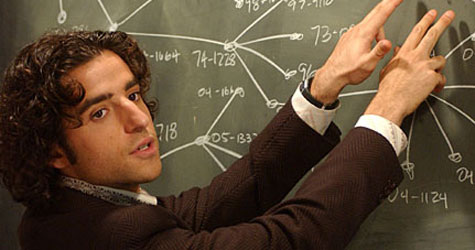
Numb3rs

In the pilot episode, Dr. Eppes uses Rossmo’s Formula to help narrow down the current residence of a criminal to a neighborhood. Rossmo’s Formula is a very interesting in that it predicts the probability that a criminal might live in various areas. In the Numb3rs episode, Charlie manipulates the formula and projects the results onto a map to show the hot spot, or rather, the location where the criminal is most likely to be living in.

Rossmo’s Formula, however, would not be complete without including what we know as a Manhattan distance formula, which is just a derivation of the Euclidian distance formula.

green line

From the distance formula we can derive…

The distance formula is a byproduct of Pythagorean’s Theorem. By examining any two points on a two dimensional plane, x and y components could be observed and used to calculate the distance between the points by forming a right triangle and solving for the hypotenuse. Later in time, the distance formula has been adapted to fit many different situations. To name a few, there is distance in Euclidean space and its variations (Euclidean distance, Manhattan or taxicab distance, Chebyshev distance, etc.), distance between objects in more than two dimensions, and distances between a point and a set.

green line

E. Technology

The best way for students to really understand the distance formula is to allow them to make it their discovery. We can handle this in many ways. One of the more obvious explorations is to give them a piece of graph paper and have them plot points. However, this is an instance where technology can serve a great purpose in the classroom.  There are vast amounts of apps online that will allow students to manipulate two points on a grid. After looking at several different apps, I find the one I have listed in the sources to be great for a few reasons. First, students can move two points around a virtual grid. This is a “green” activity and saves paper. Second, while students move the points, a right triangle is automatically drawn for them. Depending on the level of the class, students can make connections between the Pythagorean Theorem and how it leads to the distance formula. Third, above the grid is an interactive equation. It automatically plugs in the values of the points on the grid and finds the distance between them. What is even more impressive is that it solves the equation in steps.

Are complex numbers complex?

It’s an unfortunate fact of history that numbers of the form a+bi are called complex numbers. In modern English, of course, the word complex is usually associated with phrases like difficult, inscrutable, time-consuming, hard to solve, and other negative connotations that teachers would prefer to not introduce into a math class.

However, my understanding is that the other meaning of the word complex was in mind when the term complex numbers was coined. After all, in modern English, we still refer to a group of buildings as an apartment complex or maybe an office complex. In this sense, complex means two (or more) things that are joined together to form a single unit, which is precisely what happens as the real part a and the imaginary part $bi$ are joined to form a + bi. Indeed, my understanding is that complex was chosen to be the opposite of simplex, or a single unit (like a real number).

Anyway, hopefully this bit of history can make complex numbers less mystifying for students.

While I’m on the topic, the word imaginary was another unfortunate choice of words by our ancestors, but — like complex — we’re just stuck with it.

Also while I’m on the topic, this is a good chance to review a great piece of showmanship about teaching complex numbers:

Engaging students: Solving linear systems of equations by either substitution or graphing

In my capstone class for future secondary math teachers, I ask my students to come up with ideas for engaging their students with different topics in the secondary mathematics curriculum. In other words, the point of the assignment was not to devise a full-blown lesson plan on this topic. Instead, I asked my students to think about three different ways of getting their students interested in the topic in the first place.

I plan to share some of the best of these ideas on this blog (after asking my students’ permission, of course).

This student submission comes from my former student Angel Pacheco. His topic, from Algebra II: solving linear systems of equations by either substitution or graphing.

green lineHow has this topic appeared in pop culture (movies, TV, current music, video games, etc.)?

Westerville South High School (WSHS) is located in Westerville, Ohio. In 2010, the math department of WSHS worked together with their students to create parodies of popular rap songs about particular mathematical topics. They have made a Facebook page as well as their own account for YouTube. This is a great idea because it uses websites that are popular among the students. In one of their recent videos, it is called All I Do is Solve, which is the parody of ‘All I Do is Win’ by DJ Khaled. This video has been constructed really well. It contains three ways to solve systems of equations, which are graphing, substitution, and elimination.

This video will be a great tool for an Engagement as well as right before the Evaluation. The sound of it being a famous rap song will certainly grab the interest of all students. I, personally, am not a big fan of rap but when I saw this video I could not stop watching it. It was really entertaining. A lot of teachers can gain a lot of ideas from this type of teaching.

green line

What interesting things can you say about the people who contributed to the discovery and/or the development of this topic?

There are a lot things to say. There are a lot of different cultures that had their own procedure or different perspective to this topic. I found a website called History of Math. In early 200 BC, there are sections in an ancient China text called the ‘Jiuzhang suanshu’ that contains examples of linear equations. This is a selection from the text:

One pint of good wine costs 50 gold pieces, while one pint of poor wine costs 10. Two pints of wine are bought for 30 gold pieces. How much of each kind of wine was bought?

The solution of this problem is used by using systems of linear equations. I can use this example as well as other examples from the different cultures. I will primarily use this as an Engagement. I will begin to ask the class, “Do any of you know how long solving systems of equations has been around?” “Do you know who discovered this concept?” Using these questions to get them interested, I will use the website to inform the different contributions that each culture made.

Source(s): http://hom.wikidot.com/cramer-s-method-and-cramer-s-paradox


green lineHow could you as a teacher create an activity or project that involves your topic?

I will create a project based activity that requires the students to work in groups of 3-4. The students will each have their own role: Gate Keeper, Focus Keeper, Analyst, and Encourager. The link below will be to the website that describes the same roles and the same project. Each students will have to learn the material to complete the project on their own, but they will not do it by themselves. The group complete it by itself.

The project consists of the real life scenario that their parent(s) have decided not to pay for their cell phone bill so they have a $50 limit per month so they must research the different options they have with different service providers. They will create a system of linear equations and they must be able to solve the systems of linear equations by the three methods: graphing, substitution, and elimination. This will allow for students to work together as well by themselves on an activity that is exciting. The students will be required to present their results at the end of the project. The project will turn to be an interdisciplinary lesson with systems of equations.

Source(s): The image below is a copy of the layout of the roles and project.

systemproject

A surprising appearance of e

Here’s a simple probability problem that should be accessible to high school students who have learned the Multiplication Rule:

Suppose that you play the lottery every day for about 20 years. Each time you play, the chance that you win is 1 chance in 1000. What is the probability that, after playing  1000 times, you never win?

This is a straightforward application of the Multiplication Rule from probability. The chance of not winning on any one play is 0.999. Therefore, the chance of not winning 1000 consecutive times is (0.999)^{1000}, which we can approximate with a calculator.
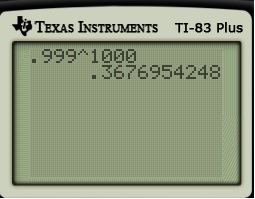
TIlottery1

Well, that was easy enough. Now, just for the fun of it, let’s find the reciprocal of this answer.

TIlottery2

Hmmm. Two point seven one. Where have I seen that before? Hmmm… Nah, it couldn’t be that.

What if we changed the number 1000 in the above problem to 1,000,000? Then the probability would be (0.999999)^{1000000}.

TIlottery3

There’s no denying it now… it looks like the reciprocal is approximately e, so that the probability of never winning for both problems is approximately 1/e.

Why is this happening? I offer a thought bubble if you’d like to think about this before proceeding to the answer.

green_speech_bubbleThe above calculations are numerical examples that demonstrate the limit

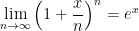
\displaystyle \lim_{n \to \infty} \left(1 + \frac{x}{n}\right)^n = e^x

In particular, for the special case when n = -1, we find

\displaystyle \lim_{n \to \infty} \left(1 - \frac{1}{n}\right)^n = e^{-1} = \displaystyle \frac{1}{e}

The first limit can be proved using L’Hopital’s Rule. By continuity of the function f(x) = \ln x, we have

\ln \left[ \displaystyle \lim_{n \to \infty} \left(1 + \frac{x}{n}\right)^n \right] = \displaystyle \lim_{n \to \infty} \ln \left[ \left(1 + \frac{x}{n}\right)^n \right]

\ln \left[ \displaystyle \lim_{n \to \infty} \left(1 + \frac{x}{n}\right)^n \right] = \displaystyle \lim_{n \to \infty} n \ln \left(1 + \frac{x}{n}\right)

\ln \left[ \displaystyle \lim_{n \to \infty} \left(1 + \frac{x}{n}\right)^n \right] = \displaystyle \lim_{n \to \infty} \frac{ \displaystyle \ln \left(1 + \frac{x}{n}\right)}{\displaystyle \frac{1}{n}}

The right-hand side has the form \infty/\infty as n \to \infty, and so we may use L’Hopital’s rule, differentiating both the numerator and the denominator with respect to n.

\ln \left[ \displaystyle \lim_{n \to \infty} \left(1 + \frac{x}{n}\right)^n \right] = \displaystyle \lim_{n \to \infty} \frac{ \displaystyle \frac{1}{1 + \frac{x}{n}} \cdot \frac{-x}{n^2} }{\displaystyle \frac{-1}{n^2}}

\ln \left[ \displaystyle \lim_{n \to \infty} \left(1 + \frac{x}{n}\right)^n \right] = \displaystyle \lim_{n \to \infty} \displaystyle \frac{x}{1 + \frac{x}{n}}

\ln \left[ \displaystyle \lim_{n \to \infty} \left(1 + \frac{x}{n}\right)^n \right] = \displaystyle \frac{x}{1 + 0}

\ln \left[ \displaystyle \lim_{n \to \infty} \left(1 + \frac{x}{n}\right)^n \right] = x

Applying the exponential function to both sides, we conclude that

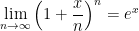
\displaystyle \lim_{n \to \infty} \left(1 + \frac{x}{n}\right)^n= e^x

green lineIn an undergraduate probability class, the problem can be viewed as a special case of a Poisson distribution approximating a binomial distribution if there’s a large number of trials and a small probability of success.

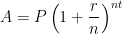
The above calculation also justifies (in Algebra II and Precalculus) how the formula for continuous compound interest A = Pe^{rt} can be derived from the formula for discrete compound interest A = P \displaystyle \left( 1 + \frac{r}{n} \right)^{nt}
All this to say, Euler knew what he was doing when he decided that e was so important that it deserved to be named.

Engaging students: Polynomials and non-linear functions

In my capstone class for future secondary math teachers, I ask my students to come up with ideas for engaging their students with different topics in the secondary mathematics curriculum. In other words, the point of the assignment was not to devise a full-blown lesson plan on this topic. Instead, I asked my students to think about three different ways of getting their students interested in the topic in the first place.

I plan to share some of the best of these ideas on this blog (after asking my students’ permission, of course).

This student submission comes from my former student Roderick Motes. His topic, from Algebra II: polynomials and non-linear functions.

green line

How can this topic be used in your students future math and science courses?

Polynomials are used extensively throughout math and science, and nonlinear functions have a place in math, science, and even business.

Consider a problem that is fundamental in both physics and calculus. How can we effectively model motion? To talk about motion we have to have a basic understanding of linear functions (these model constant acceleration problems well,) but we also need an understanding of polynomials if we are to gain a real appreciation for how acceleration is related to position; even the simplest kinematic problems will often require us to deal with polynomials.

Within business consider investing money at a bank. Your returns on investments made aren’t linear, they’re a function of the total amount you have at any given moment. The basic formula:

A = P \displaystyle \left ( 1 + \frac{r}{n} \right)^{nt}

has a very funny setup, that is actually related in rather interesting ways to some fundamental concepts you will discuss in courses that have nonlinear functions as a topic.

compoundinterest

The website http://zebu.uoregon.edu/~probs/mech.html has a great deal of physics problems, most of which are not novel, that demonstrate the need for nonlinear functions even within basic mechanics.

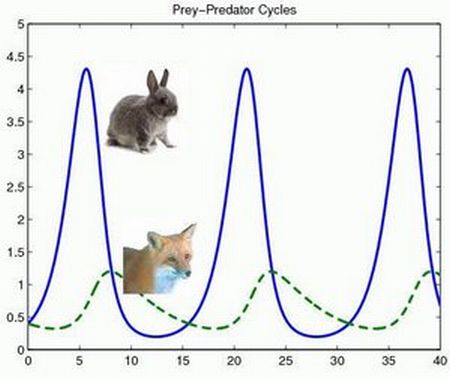
predatorprey

green line

How does this topic extend what your students have learned in previous courses?

Linear change is often among the first topics we discuss in algebra. We use the same concept in geometry when talking about slope. It’s very easy to see applications of this. Weight as a function of a person’s height, and the very accessible choice of which cell phone plan is best for your family both use linear functions to model the real world.

But, as discussed above, what happens when things don’t quite work out in a linear fashion? Animal populations in the wild are bound by some particularly interesting equations. Bacterial growth is modeled by exponential increase. Motion in physics is generally described with polynomials of degree at least two. Supply and Demand, while easy to understand as linear functions, are rarely so easily described in the real world.

At a more basic level nonlinear functions are tied to concepts of multiplication, division, and graphs. All of these are concepts students should be familiar with by late primary school. We describe multiplication, in one way, as repeated addition. So what happens when we repeat multiplication? Exponentiation. Exponents are at the heart of the study of nonlinear equations. Questions like this which students may have thought at some point or another are finally discussed and implemented within the context of nonlinear equations.


green line

How can technology be used to effectively engage students?

Technology and modeling of functions go hand in hand, and any topic you can think of can be approached using technology.

To grab student attention you might discuss this wonderful Vi Hart video

The video discusses how frequency and pitch are related, and you’ll notice that sound is simply sine waves (a type of nonlinear function!) You can discuss this idea with students who are particularly engaged by music, and discuss how mathematics and nonlinear functions can, as Ms. Hart points out in the video, be used to explain why cultures so different still developed similar musical structures.

For students who are more into computers and programming you might be able to capture their attention with game design. As outlined at http://www.ehow.com/how-does_5296037_math-involved-designing-video-games.html, math and physics are used in the creation of physics engines like the Source Engine, or the Quake Engine for video games. To effectively model real situations you have to be able to understand nonlinear equations and be able to create convincing models for the computer to display. At my high school the computer science teacher was trying to make a great push to have computer science students and math students’ team up to actually create interesting things, while learning new material in an engaging way. Depending on your school, this could be an interesting approach that is also multidisciplinary.


A curious square root (Part 1)

Here’s a square root that looks like a total mess:

\sqrt{5 - \sqrt{6} + \sqrt{22+8\sqrt{6}}}

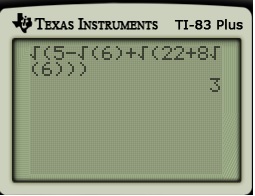
Just look at this monstrosity, which has a triply-embedded square root! But then look what happens when I plug into a calculator:

TImessysquareroot

Hmmm. How is that possible?!?!

I’ll give the answer after the thought bubble, if you’d like to think about it before seeing the answer.

green_speech_bubble

Let’s start from the premise that \sqrt{5 - \sqrt{6} + \sqrt{22+8\sqrt{6}}} = 3 and work backwards. This isn’t the best of logic — since we’re assuming the thing that we’re trying to prove in the first place — but it’s a helpful exercise to see exactly how this happened.

\sqrt{5 - \sqrt{6} + \sqrt{22+8\sqrt{6}}} = 3

5 - \sqrt{6} + \sqrt{22+8\sqrt{6}} = 9

\sqrt{22+8\sqrt{6}} = 4 + \sqrt{6}

22 + 8 \sqrt{6} = (4 + \sqrt{6})^2

This last line is correct, using the formula (a+b)^2 = a^2 + 2ab + b^2. So, running the logic from bottom to top (and keeping in mind that all of the terms are positive), we obtain the top equation.

green lineThis suggests a general method for constructing such hairy square roots. To begin, start with any similar expression, such as

(2 - \sqrt{3})^2 = 4 - 4\sqrt{3} + 3

(2 - \sqrt{3})^2 = 7 - 4\sqrt{3}

Then we create a nested square root:

2 - \sqrt{3} = \sqrt{7 - 4\sqrt{3}}

Then I get rid of the square root on the left hand side:

2 = \sqrt{3} + \sqrt{7 - 4\sqrt{3}}

Then I add or subtract something so that the left-hand side becomes a perfect square.

25 = 23 + \sqrt{3} + \sqrt{7 - 4 \sqrt{3}}

Finally, I take the square root of both sides:

5 = \sqrt{23 + \sqrt{3} + \sqrt{7 - 4 \sqrt{3}}}

Then I show the right-hand side to my students, ask them to plug into their calculators, and ask them to figure out what happened.

Engaging students: Computing the determinant of a matrix

In my capstone class for future secondary math teachers, I ask my students to come up with ideas for engaging their students with different topics in the secondary mathematics curriculum. In other words, the point of the assignment was not to devise a full-blown lesson plan on this topic. Instead, I asked my students to think about three different ways of getting their students interested in the topic in the first place.

I plan to share some of the best of these ideas on this blog (after asking my students’ permission, of course).

This student submission again comes from my former student Caitlin Kirk. Her topic: computing the determinant of a matrix.

green line

B. Curriculum: How does this topic extend what your students should have learned in previous courses?

 Students learn early in their mathematical careers how to calculate the area of simple polygons such as triangles and parallelograms. They learn by memorizing formulas and plugging given values into the formulas. Matrices, and more specifically the determinant of a matrix, can be used to do the same thing.

For example, consider a triangle with vertices (1,2), (3, -4), and (-2,3). The traditional method for finding the area of this circle would be to use the distance formula to find the length of each side and the height before plugging and chugging with the formula A = \frac{1}{2} bh. Matrices can be used to compute the same area in fewer steps using the fact that the area of a triangle the absolute value of one-half times the determinant of a matrix containing the vertices of the triangle as shown below.

First, put the vertices of the triangle into a matrix using the x-values as the first column and the corresponding y-values as the second column. Then fill the third column with 1’s as shown:

caitlin1

Next, compute the determinant of the matrix and multiply it by ½ (because the traditional area formula for a triangle calls for multiplying by ½ to account for the fact that a triangle is half of a rectangle, it is necessary to keep the ½ here also) as shown:

caitlin2Obviously, the area of a triangle cannot be negative. Therefore it is necessary to take the absolute value of the final answer. In this case |-8| = 8, making the area positive eight instead of negative eight.

The same idea can be applied to extend students knowledge of the area of other polygons such as a parallelogram, rectangle, or square. Determinants of matrices are a great extension of the basic mathematical concept of area that students will have learned in previous courses.

green line

D. History: What are the contributions of various cultures to this topic?

The history of matrices can be traced to four different cultures. First, Babylonians as early as 300 BC began attempting to solve simultaneous linear equations like the following:

There are two fields whose total area is eighteen hundred square yards. One produces grain at the rate of two-thirds of a bushel per square yard while the other produces grain at the rate of on-half a bushel per square yard. If the total yield is eleven hundred bushels, what is the size of each field?

While the Babylonians at this time did not actually set up matrices or calculate any determinants, they laid the framework for later cultures to do so by creating systems of linear equations.

The Chinese, between 200 BC and 100 BC, worked with similar systems and began to solve them using columns of numbers that resemble matrices. One such problem that they worked with is given below:

There are three types of corn, of which three bundles of the first, two of the second, and one of the third make 39 measures. Two of the first, three of the second and one of the third make 34 measures. And one of the first, two of the second and three of the third make 26 measures. How many measures of corn are contained of one bundle of each type?

Unlike the Babylonians, the Chinese answered this question using their version of matrices, called a counting board. The counting board functions the same way as modern matrices but is turned on its side. Modern matrices write a single equation in a row and the next equation in the next row and so forth. Chinese counting boards write the equations in columns. The counting board below corresponds to the question above:

1   2   3

2   3   2

3   1   1

26  34  39

They then used what we know as Gaussian elimination and back substitution to solve the system by performing operations on the columns until all but the bottom row contains only zeros and ones. Gaussian elimination with back substitution did not become a well known method until the early 19th century, however.

Next, in 1683, the Japanese and Europeans simultaneously saw the discovery and use of a determinant, though the Japanese published it first. Seki, in Japan, wrote Method of Solving the Dissimulated Problems which contains tables written in the same manner as the Chinese counting board. Without having a word to correspond to his calculations, Seki calculated the determinant and introduced a general method for calculating it based on examples. Using his methods, Seki was able to find the determinants of 2×2, 3×3, 4×4, and 5×5 matrices.

In the same year in Europe, Leibniz wrote that the system of equations below:

10+11x+12y=0

20+21x+22y=0

30+31x+32y=0

has a solution because

(10 \times 21 \times 32)+(11 \times 22 \times 30)+(12 \times 20 \times 31)=(10 \times 22 \times 31)+(11 \times 20 \times 32)+(12 \times 21 \times 30).

This is the exact condition under which the matrix representing the system has a determinant of zero. Leibniz was the first to apply the determinant to finding a solution to a linear system. Later, other European mathematicians such as Cramer, Bezout, Vandermond, and Maclaurin, refined the use of determinants and published rules for how and when to use them.

Source: http://www-history.mcs.st-and.ac.uk/HistTopics/Matrices_and_determinants.html

green line

B. Curriculum: How can this topic be used in you students’ future courses in mathematics or science?

Calculating the determinant is used in many lessons in future mathematics courses, mainly in algebra II and pre-calculus. The determinant is the basis for Cramer’s rule that allows a student to solve a system of linear equations. This leads to other methods of solving linear systems using matrices such as Gaussian elimination and back substitution.  It can also be used in determining the invertibility of matrices.  A matrix whose determinant is zero does not have an inverse. Invertibility of matrices determines what other properties of matrix theory a given matrix will follow. If students were to continue pursuing math after high school, understanding determinants is essential to linear algebra.

Engaging students: Equation of a circle

In my capstone class for future secondary math teachers, I ask my students to come up with ideas for engaging their students with different topics in the secondary mathematics curriculum. In other words, the point of the assignment was not to devise a full-blown lesson plan on this topic. Instead, I asked my students to think about three different ways of getting their students interested in the topic in the first place.

I plan to share some of the best of these ideas on this blog (after asking my students’ permission, of course).

This student submission comes from my former student Alyssa Dalling. Her topic, from Precalculus: the equation of a circle.

green line

A. How could you as a teacher create an activity or project that involves your topic?

A fun way to engage students and also introduce the standard form of an equation of a circle is the following:

  • Start by separating the class into groups of 2 or 3
  • Pass each group a specific amount of flashcards. (Each group will have the same flashcards)
  • Each flashcard has a picture of a graphed circle and the equation of that circle in standard form
  • The students will work together to figure out how the pictures of the circle relate to the equation

This will help students understand how different aspects of a circle relate to its standard form equation. The following is an example of a flashcard that could be passed out.

equationofcircle

Source: http://www.mathwarehouse.com/geometry/circle/equation-of-a-circle.php

green line

C. How has this topic appeared in high culture (art, classical music, theatre, etc.)?

Circles have been used through history in many different works of art. One such type is called a tessellation. The word Tessellate means to cover a plane with a pattern in such a way as to leave no region uncovered. So, a tessellation is created when a shape or shapes are repeated over and over again. The pictures above show just a few examples of how circles are used in different types of art. A good way to engage students would be to show them a few examples of tessellations using circles.

Source: http://mathforum.org/sum95/suzanne/whattess.html

equationofcircle4equationofcircle2equationofcircle3

green line

E. How can technology be used to effectively engage students with this topic?

Khan Academy has a really fun resource for using equations to graph circles. At the beginning of class, the teacher could allow students to play around with this program. It allows students to see an equation of a circle in standard form then they would graph the circle. It gives hints as well as the answer when students are ready. The good thing about this is that even if a student goes straight to the answer, they are still trying to identify the connection between the equation of the circle and the answer Khan Academy shows.

http://www.khanacademy.org/math/trigonometry/conics_precalc/circles-tutorial-precalc/e/graphing_circles

Square roots and logarithms without a calculator (Part 9)

This post is not really about finding square roots but continues Part 8 of this series. Continuing the theme of this series, let’s go back in time to when scientific calculators were not invented… say, 1850.

This is a favorite activity that I use when teaching logarithms to precalculus students. I begin by writing the following on the board, in three or four columns:

\log_{10} 1

\log_{10} 2 \approx 0.301

\log_{10} 3 \approx 0.477

\log_{10} 4

\log_{10} 5

\log_{10} 6

\log_{10} 7

\log_{10} 8

\log_{10} 9

\log_{10} 10

\log_{10} 11

\log_{10} 12

\log_{10} 13

\log_{10} 14

\log_{10} 15

\log_{10} 16

\log_{10} 17

\log_{10} 18

\log_{10} 19

\log_{10} 20

\log_{10} 30

\log_{10} 40

\log_{10} 50

\log_{10} 60

\log_{10} 70

\log_{10} 80

\log_{10} 90

\log_{10} 100

In other words, I tell the answer to only \log_{10} 2 and \log_{10} 3. The challenge: fill in the rest without a calculator.

In my classes, we found these logarithms by large-group discussion. However, there’s no reason why this couldn’t be done by dividing a class into small groups and letting the groups collaborate. Indeed, I suggested this idea to a former student who was struggling to come up with an engaging activity involving logarithms for an Algebra II class that she was about to teach. She took this idea and ran with it, and she told me it was a big hit with her students.

I provide a thought bubble if you’d like to think about it before I give the answers.

green_speech_bubbleStep 1. Three of these values — 1, 10, and 100 — can be found exactly since they’re powers of 10.

Step 2. Most of the others can be found by using the laws of logarithms for products, quotients, and powers involving 2, 3, and 10. For example,

\log_{10} 9 = \log_{10} 3^2 = 2 \log_{10} 3 \approx 2 \times 0.477 = 0.954

\log_{10} 20 = \log_{10} 2 + \log_{10} 10 = 1.301

\log_{10} 5 = \log_{10} 10 - \log_{10} 2 = 0.699.

Of this group, usually \log_{10} 5 is the hardest for students to recognize.

Step 3 (optional). A few of the logarithms, like \log_{10} 7, cannot be determined in terms of \log_{10} 2 and \log_{10} 3. But they can be approximated to reasonable accuracy with a little creativity. For example,

\log_{10} 7 = \log_{10} \sqrt{49} = \frac{1}{2} \log_{10} 49 \approx \frac{1}{2} \log_{10} 50 = \frac{1}{2} (1.699) = 0.850.

For a really good approximation, we use the fact that 7^4 = 2401 \approx 2400.

\log_{10} 7 = \frac{1}{4} \log_{10} 2401 \approx \frac{1}{4} \log_{10} 2400 = \frac{1}{4} (3 \log_{10} 2 + \log_{10} 3 + \log_{10} 100) = 0.845.

To approximate \log_{10} 17, we could use the fact that (16-1) \times (16 + 1) = 16^2-1, or 15 \times 17 = 255 \approx 2^8. So

\log_{10} 17 \approx 8 \log_{10} 2 - \log_{10} 15 = 8 \log_{10} 2 - \log_{10} 3 - \log_{10} 5 = 1.232

Naturally, any and all of the above results can be confirmed with a scientific calculator.

green lineIn my opinion, here are some of the pedagogical benefits of the above activity.

1. This activity solidifies students’ knowledge about the laws of logarithms. The laws of logarithms become less abstract, changing from \log_{10} xy = \log_{10} x + \log_{10} y into something more tangible and comfortable, like positive integers.

2. Hopefully the activity will demystify for students the curious decimal expansions when a calculator returns logarithms. In other words, hopefully the above activity will help

3. The activity should promote some understanding of the values of base-10 logarithms. For example, 0 \le \log_{10} x < 1 for 1 \le x < 10 and 1 \le \log_{10} x < 2  for 10 \le x < 100.

4. Students should see that, for large x, \log_{10}(x+1) is not much larger than \log_{10} x. This is another way of saying that the graph of y = \log_{10} x increases very slowly as x increases. So this should provide some future intuition for the graphs of logarithmic functions.

5. The values of \log_{10} 2, \log_{10} 3, \dots, \log_{10} 9 are used to construct the unevenly-spaced lines and/or tick marks in log-log graphs and log-linear graphs (which are standard plotting options on many scientific calculators).

Advertising for slide rules, from 1940

I’m about to begin a series of posts concerning how previous generations did complex mathematical calculations without the aid of scientific calculators.

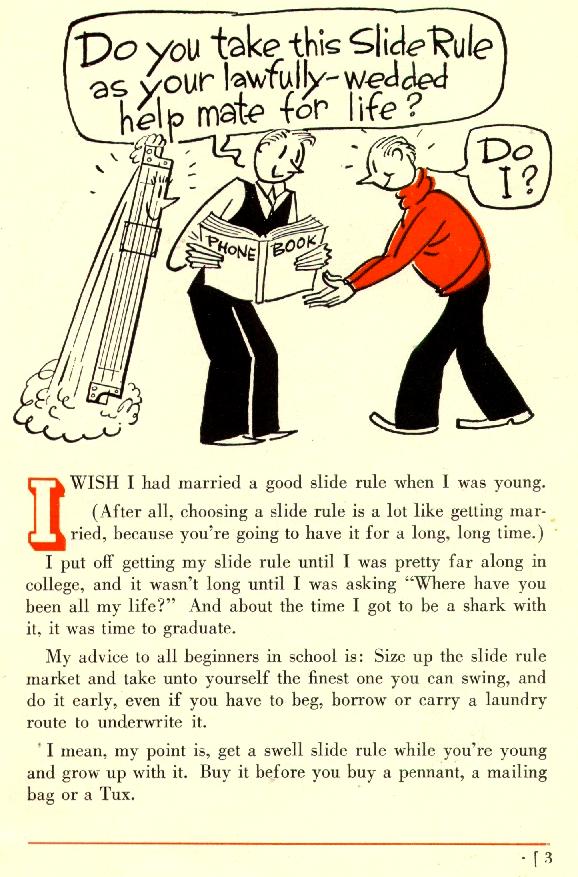
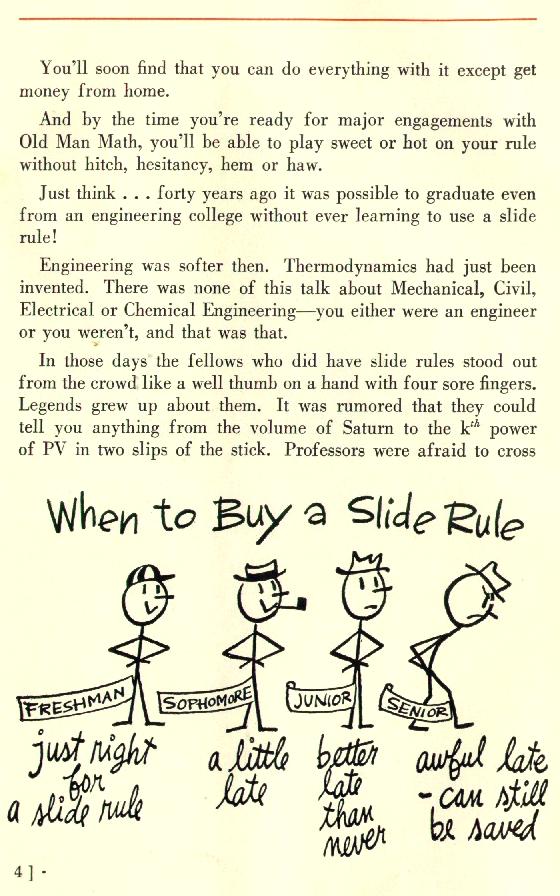
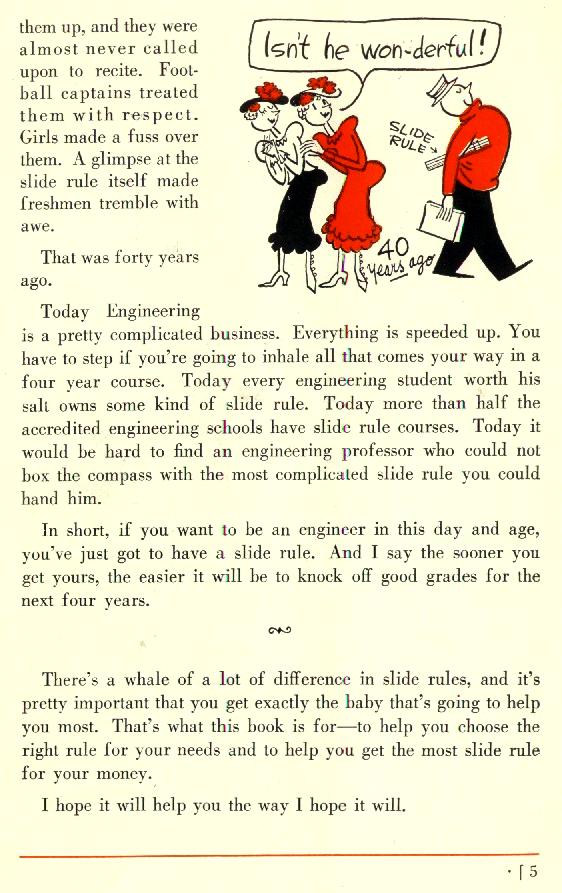
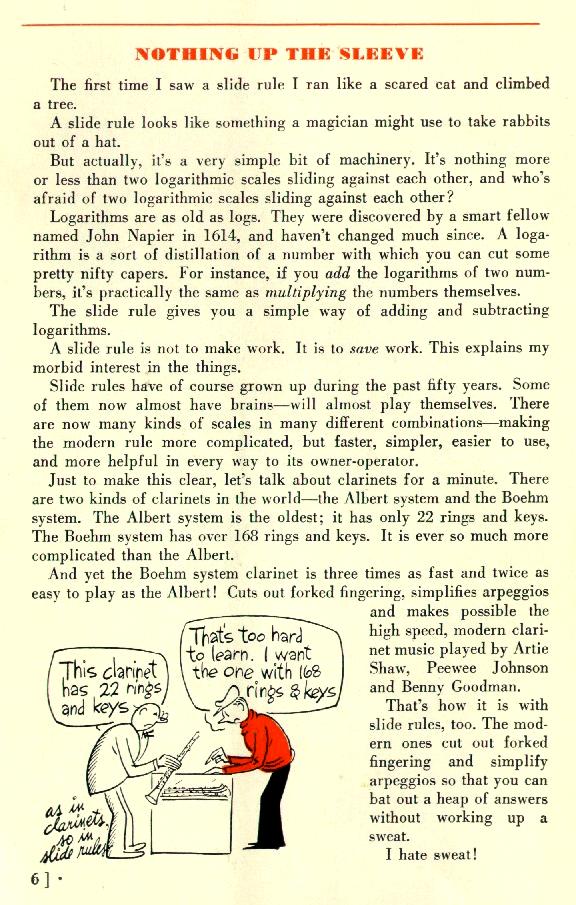
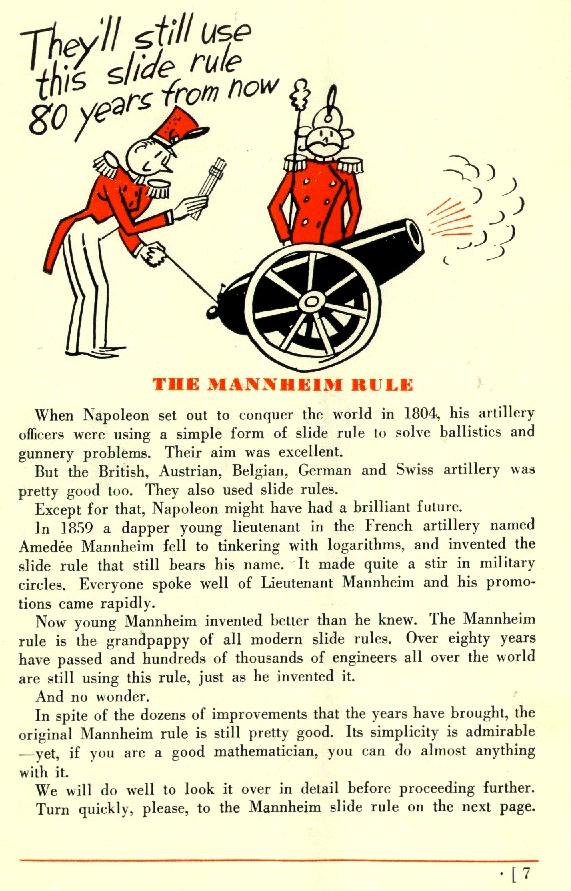
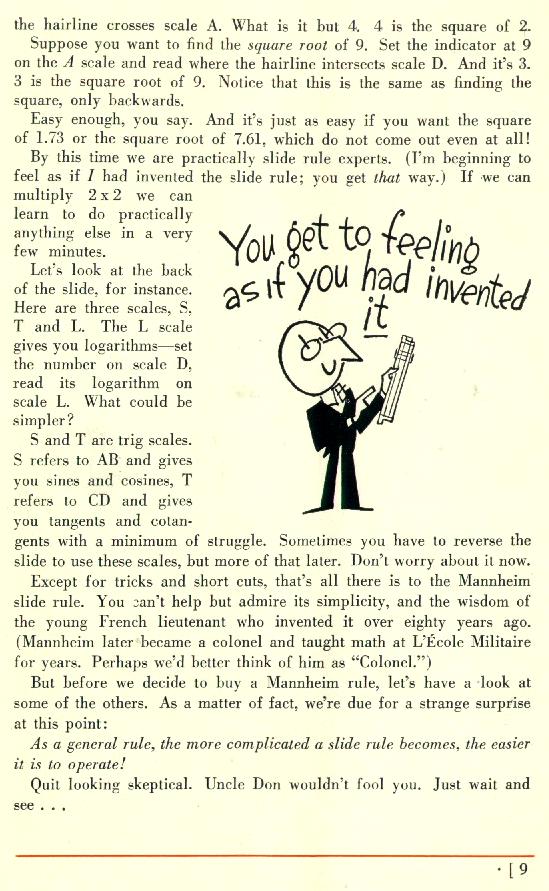
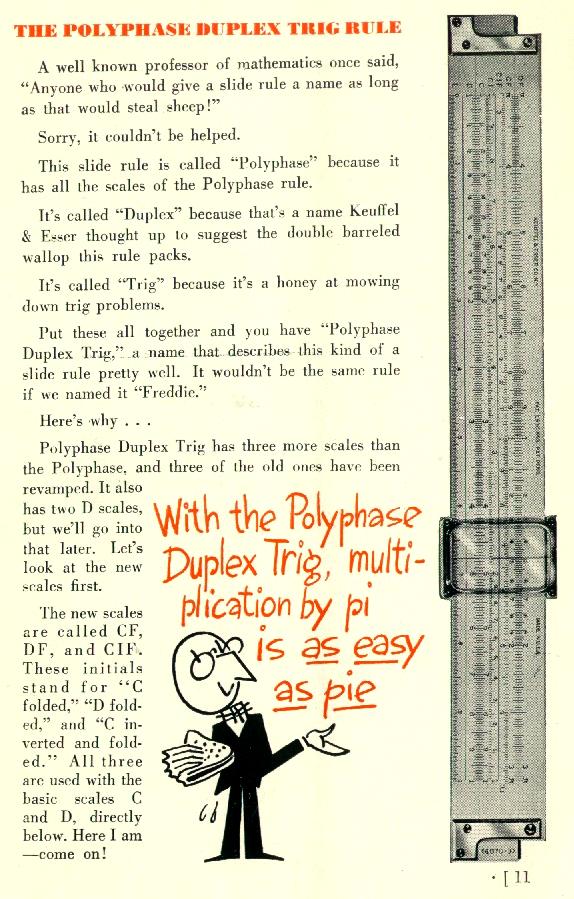
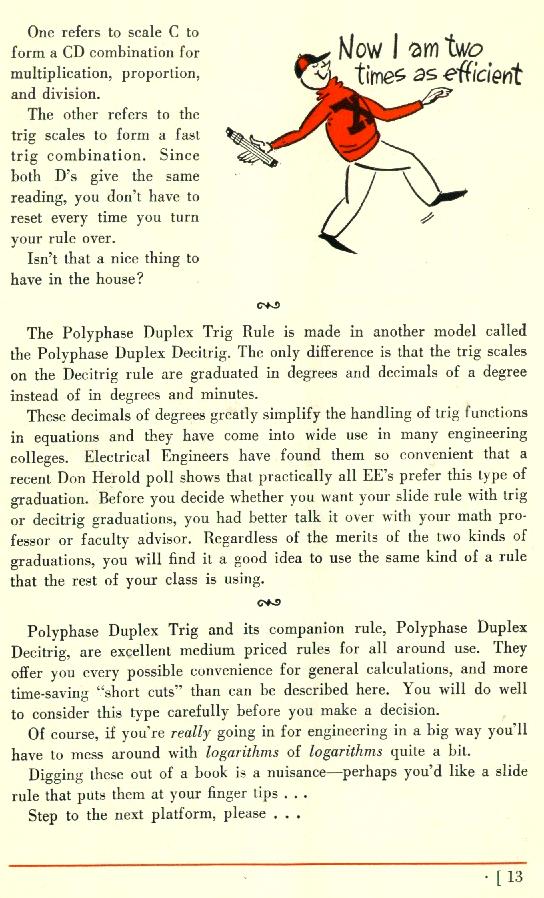
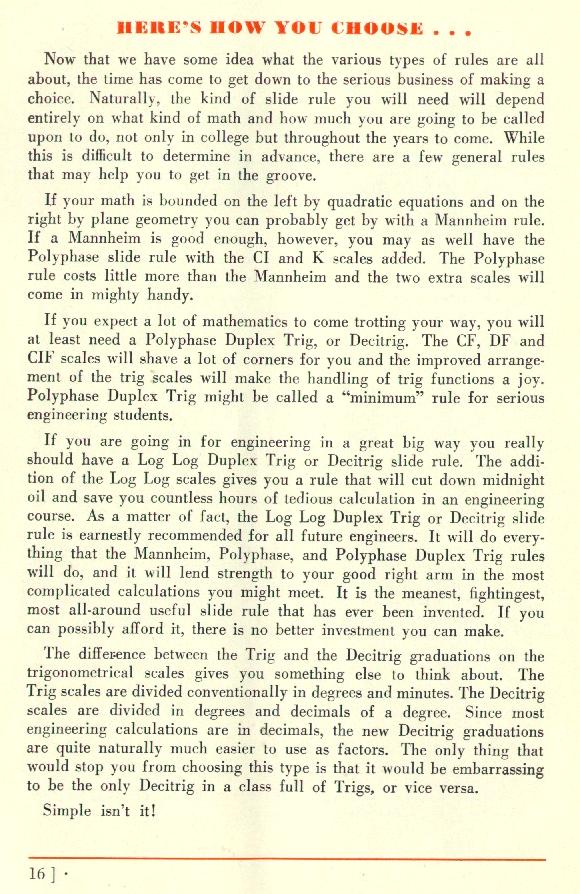
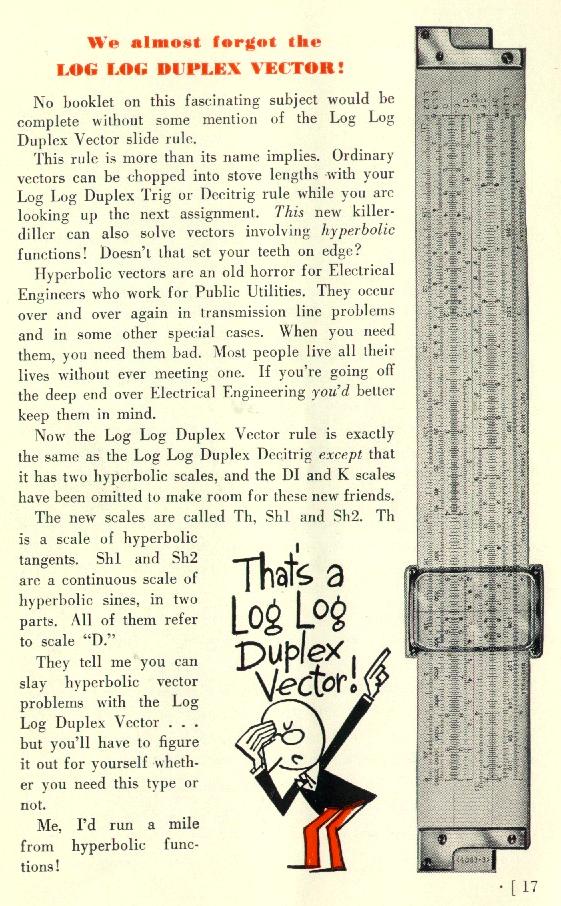
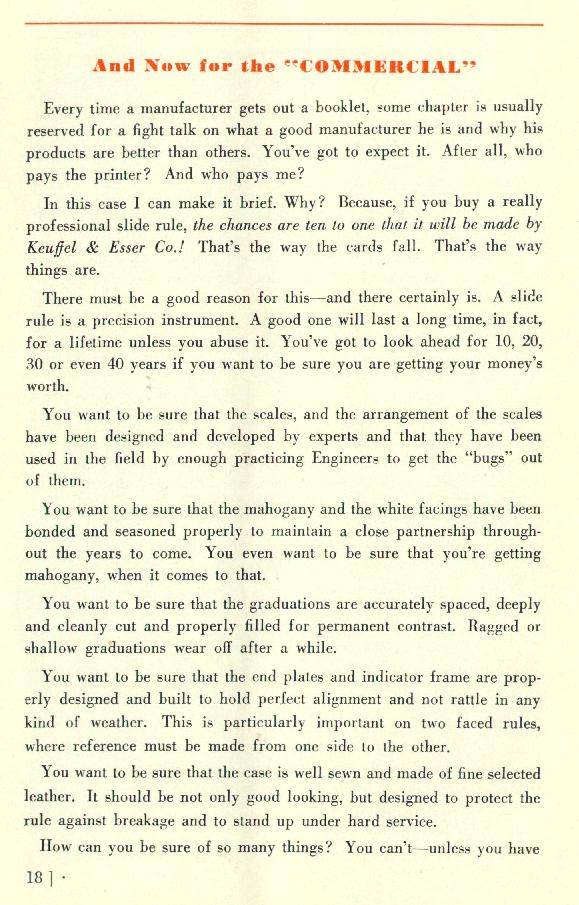
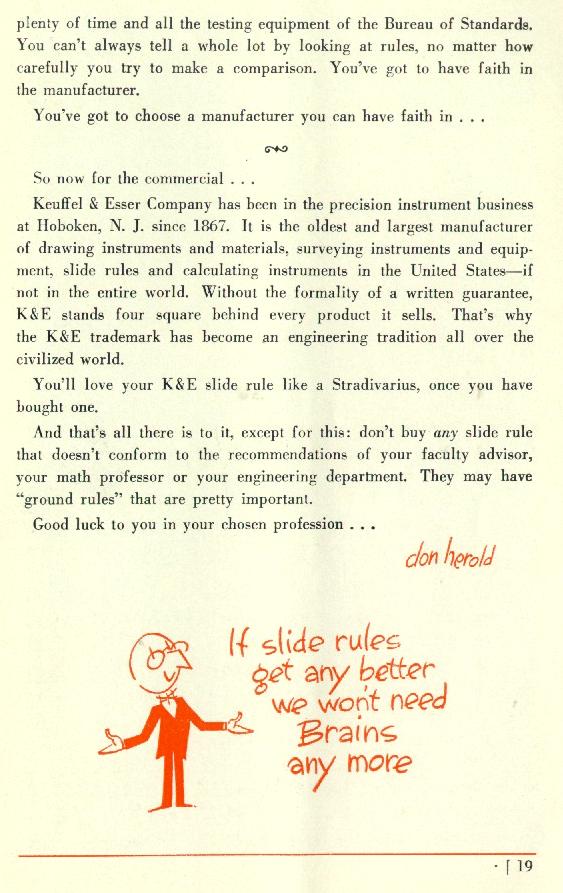
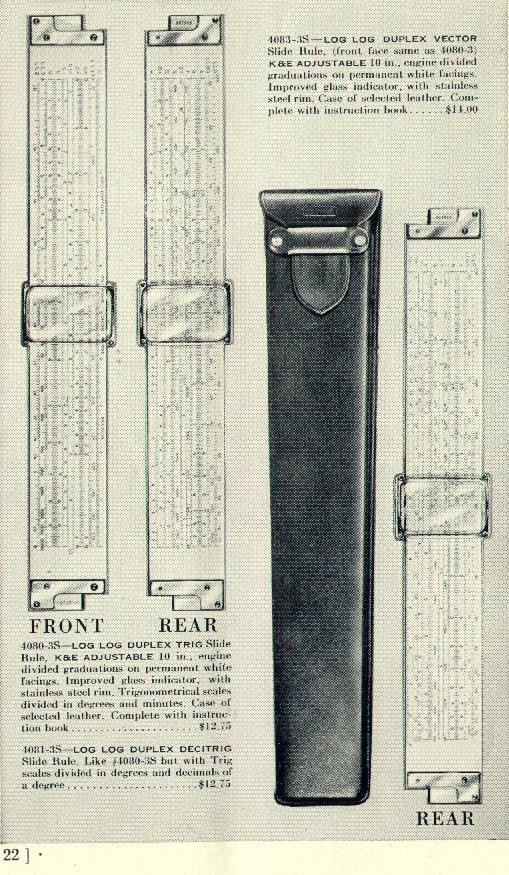
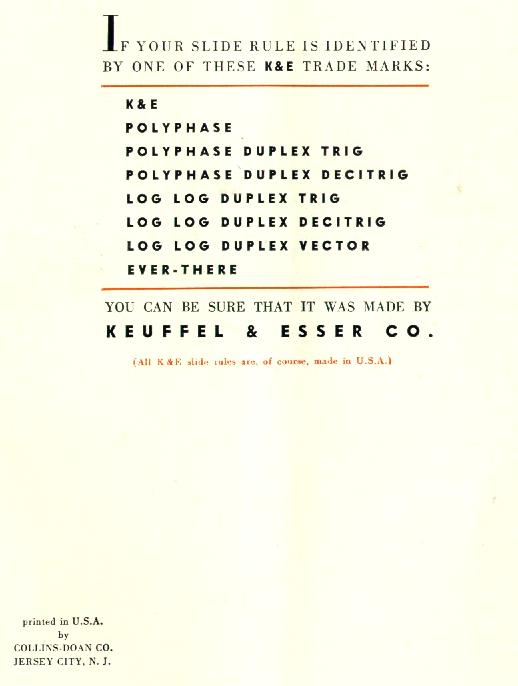
Courtesy of Slide Rule Universe, here’s an advertisement for slide rules from 1940. This is a favorite engagement activity of mine when teaching precalculus (as an application of logarithms) as well as my capstone class for future high school math teachers. I have shown this to hundreds of college students over the years (usually reading out loud the advertising through page 5 and then skimming through the remaining pictures), and this always gets a great laugh. Enjoy.

coverp3p4p5p6p7p8p9p10p11p12p13p14p15p16p17p18p19p20p21p22p23

test