My “history” of solving cubic, quartic and quintic equations

When I teach Algebra II or Precalculus (or train my  future high school teachers to teach these subjects), we eventually land on the Rational Root Test and Descartes’ Rule of Signs as an aid for finding the roots of cubic equations or higher. Before I get too deep into this subject, however, I like to give a 10-15 minute pseudohistory about the discovery of how polynomial equations can be solved. Historians of mathematics will certain take issue with some of this “history.” However, the main purpose of the story is not complete accuracy but engaging students with the history of mathematics. I think the story I tell engages students while remaining reasonably accurate… and I always refer students to various resources if they want to get the real history.

To begin, I write down the easiest two equations to solve (in all cases, a \ne 0:

ax + b = 0 \qquad and \qquad ax^2 + bx + c = 0

These are pretty easy to solve, with solutions well known to students:

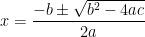
x = -\displaystyle \frac{b}{a} \qquad and \qquad x = \displaystyle \frac{-b \pm \sqrt{b^2-4ac}}{2a}

In other words, there are formulas that you can just stick in the coefficients and get the answer out without thinking too hard. Sure, there are alternate ways of solving for x that could be easier, like factoring, but the worst-case scenario is just plugging into the formula.

These formulas were known to Babylonian mathematicians around 2000 B.C. (When I teach this in class, I write the date, and all other dates and discoverers, next to the equations for dramatic pedagogical effect.) Though not written in these modern terms, basically every ancient culture on the globe that did mathematics had some version of these formulas: for example, the ancient Egyptians, Greeks, Chinese, and Mayans.

Naturally, this leads to a simple question: is there a formula for the cubic:

ax^3 + bx^2 + cx + d = 0

Is there some formula that we can just plug a, b, c, and d to just get the answer?  The answer is, Yes, there is a formula. But it’s nasty. The formula was not discovered until 1535 A.D., and it was discovered by a man named Tartaglia. During the 1500s, the study of mathematics was less about the dispassionate pursuit of truth and more about exercising machismo. One mathematician would challenge another: “Here’s my cubic equation; I bet you can’t solve it. Nyah-nyah-nyah-nyah-nyah.” Then the second mathematician would solve it and challenge the first: “Here’s my cubic equation; I bet you can’t solve it. Nyah-nyah-nyah-nyah-nyah.” And so on. Well, Tartaglia came up with a formula that would solve every cubic equation. By plugging in a, b, c, and d, you get the answer out.

Tartaglia’s discovery was arguably the first triumph of the European Renaissance. The solution of the cubic was perhaps the first thing known to European mathematicians in the Middle Ages that was unknown to the ancient Greeks.

In 1535, Tartaglia was a relatively unknown mathematician, and so he told a more famous mathematician, Cardano, about his formula. Cardano told Tartaglia, why yes, that is very interesting, and then published the formula under his own name, taking credit without mention of Tartaglia. To this day, the formula is called Cardano’s formula.

So there is a formula. But it would take an entire chalkboard to write down the formula. That’s why we typically don’t make students learn this formula in high school; it’s out there, but it’s simply too complicated to expect students to memorize and use.

This leads to the next natural question: what about quartic equations?

ax^4 + bx^3 + cx^2 + dx + e = 0

The solution of the quartic was discovered less than five years later by an Italian mathematician named Ferrari. Ferrari found out that there is a formula that you can just plug in a, b, c, d, and e, turn the crank, and get the answers out. Writing out this formula would take two chalkboards. So there is a formula, but it’s also very, very complicated.

Of course, Ferrari had some famous descendants in the automotive industry.

So now we move onto my favorite equation, the quintic. (If you don’t understand why it’s my favorite, think about my last name.)

ax^5 + bx^4 + cx^3 + dx^2 + ex + f = 0

After solving the cubic and quartic in rapid succession, surely there should also be a formula for the quintic. So they tried, and they tried, and they tried, and they got nowhere fast. Finally, the problem was solved nearly 300 years later, in 1832 (for the sake telling a good story, I don’t mention Abel) by a French kid named Evariste Galois. Galois showed that there is no formula. That takes some real moxie. There is no formula. No matter how hard you try, you will not find a formula that can work for every quintic. Sure, there are some quintics that can be solved, like x^5 = 0. But there is no formula that will work for every single quintic.

Galois made this discovery when he was 19 years old… in other words, approximately the same age as my students. In fact, we know when wrote down his discovery, because it happened the night before he died. You see, he was living in France in 1832. What was going on in France in 1832? I ask my class, have they seen Les Miserables?

France was torn upside-down in 1832 in the aftermath of the French Revolution, and young Galois got into a heated argument with someone over politics; Galois was a republican, while the other guy was a royalist. More importantly, both men were competing for the hand of the same young woman. So they decided to settle their differences like honorable Frenchmen, with a duel. So Galois wrote up his mathematical notes one night, and the next day, he fought the duel, he lost the duel, and he died.

Thus giving complete and total proof that tremendous mathematical genius does not prevent somebody from being a complete idiot.

For the present, there are formulas for cubic and quartic equations, but they’re long and impractical. And for quintic equations and higher, there is no formula. So that’s why we teach these indirect methods like the Rational Root Test and Descartes’ Rule of Signs, as they give tools to use to guess at the roots of higher-order polynomials without using something like the quadratic formula.

green lineReal references:

http://mathworld.wolfram.com/QuadraticEquation.html

http://mathworld.wolfram.com/CubicFormula.html

http://mathworld.wolfram.com/QuarticEquation.html

http://mathworld.wolfram.com/AbelsImpossibilityTheorem.html

http://mathworld.wolfram.com/QuinticEquation.html

http://library.wolfram.com/examples/quintic/

http://library.wolfram.com/examples/quintic/timeline.html

Engaging students: the difference of two squares

In my capstone class for future secondary math teachers, I ask my students to come up with ideas for engaging their students with different topics in the secondary mathematics curriculum. In other words, the point of the assignment was not to devise a full-blown lesson plan on this topic. Instead, I asked my students to think about three different ways of getting their students interested in the topic in the first place.

I plan to share some of the best of these ideas on this blog (after asking my students’ permission, of course).

This student submission comes from my former student Dale Montgomery. His topic, from Algebra II: the difference of two squares.

green line

Application/Future Curriculum (science)-

You can use difference of squares to find a basic formula to be used in any problem where you drop an object and want to find what time it will take to land. This physics concept will be of interest to your students considering any mechanical science and a useful tool to introduce problem solving by manipulating equations.

Take any height h. If you were to drop an object from this height then it could be modeled with a distance over time graph using the equation

(h- 9.8/2) t^2.

By applying difference of squares you get the expression

[\sqrt{h}+\sqrt{4.9}] t) \times ( [\sqrt{h} - \sqrt{4.9}] t).

Then by setting this expression equal to 0 and manipulating you would get that
t = \pm \displaystyle \frac{\sqrt{h}}{\sqrt{4.9}}.

I like a situation like this because it allows you to give them linking knowledge about quadratic equations. Most students may not have been exposed to this type of physics yet.  However, it is a requirement, and having this knowledge will help them in that class. On top of that it helps with equation manipulation and answering the question, “Does my answer make sense.” This question needs to be asked since it is possible for a student to get an answer of negative time. All of these skills combined with the new topic of difference of squares make for a multifaceted problem. This would probably not be great for day 1 of difference of squares, but I could see it as an engage for the continuance of the lesson.

green line

Curriculum:

You can use the idea of graphing to show that difference of squares works. This is a good way to give visual representation to your students who need it. If you compare the factoring of x^2-9 to the graph of y=x^2-9 and finding the roots of that graph, you can show that they have the same solutions. It is not that novel, but this visual can just help the idea click into students’ minds.

ParabolaGraph

green line

Manipulative

A manipulative that I got the idea for from http://www.gbbservices.com/math/squarediff.html is using squares to show the difference of squares. This is done quite easily as shown in the picture below. This could be done along a lesson on difference of squares. Maybe this would follow easily from a factoring using algebra tiles. The image below is fairly self explanatory and would really help if made into a hands-on manipulative that kinesthetic learners could make great use of.
DifferenceOfTwoSquares

Engaging students: Multiplying and dividing rational expressions

In my capstone class for future secondary math teachers, I ask my students to come up with ideas for engaging their students with different topics in the secondary mathematics curriculum. In other words, the point of the assignment was not to devise a full-blown lesson plan on this topic. Instead, I asked my students to think about three different ways of getting their students interested in the topic in the first place.

I plan to share some of the best of these ideas on this blog (after asking my students’ permission, of course).

This student submission comes from my former student Kayla (Koenig) Lambert. Her topic, from Pre-Algebra: solving proportions.

green line

B) Curriculum: How does this topic extend what your students have learned in previous courses?

Multiplying and dividing rational expressions extends so many topics because the students have to use what they have learned up to multiplying and dividing the rational expressions. For example, this topic extends multiplying and dividing fractions. For multiplying and dividing fractions the students need to multiply across the numerators and multiply across the denominators and then simplify when possible (Multiplying Rational Expressions). Students also use factoring, which they should have learned before getting to this topic. When factoring, the students should remember different ways to factor. Some different ways are finding the greatest common factor, factoring by grouping, and finding the perfect square. They should also remember how to factor polynomials of different degrees.

The students also need to remember how to divide numerical fractions because they use the same method when dividing rational expressions; multiplying by the reciprocal. Another topic students should have previously learned is how to simplify rational expressions and how to multiply polynomials. Lastly, the students should also remember what a term, coefficient, constant, degree of a term, degree of a polynomial and should remember different types of polynomials (monomial, binomial, etc.). I could keep going with what topics are used when multiplying and dividing rational expressions all the way down to counting, addition, and subtraction. There are obviously so many different topics students have learned in the past that are extended when multiplying and dividing rational expressions.

green line

D) History: What are the contributions of various cultures to this topic?

We can break multiplying and dividing rational expressions into many different mathematical subjects. In order to accomplish multiplying and dividing rational expressions, basic algebra and other basic mathematics had to come first. Methods of multiplication were documented by ancient Egyptian, Greek, and Chinese civilizations (Multiplication-Wikipedia). Around 1800 BC, Egyptians were the first known to use fractions. In 1600 BC, the Babylonians already knew solutions to quadratic equations and also solutions to equations to the third and fourth degree (Mathematics History). Egyptians used papyrus to make papers and used these to “calculate fractions” (Mathematics History).

The word polynomial comes from the Greek work “poly” meaning “many” and from the Latin word “binomium” meaning “binomial” and was introduced in Latin by a French mathematician, Franciscus Vieta (Polynomial-Wikipedia). The history of algebra goes back to ancient Egypt and Babylon where people learned to solve linear and quadratic equations. Also, Islamic mathematicians were able to multiply, divide and find the square root of polynomials.  The Hindu-Arabic numerical system was first described by Brahmagupta who gave rules for addition, subtraction, multiplication and division. In orient mathematics, algebra “ultimately evolved from arithmetic” (Mathematics History). Nicole Oresme, from Normandy, was the first person to use fraction and exponents. Many cultures have contributed to multiplying and dividing rational expressions, but I would have to say that the Egyptians, Babylonians, Chinese, and Arabic have contributed the most.

green line

E) Technology: How can technology (YouTube, Geometers Sketchpad, graphing calculator, etc.) be used to efficiently engage students with this topic?

Rational functions are used for many things including:

  • Fields and forces in physics
  • Spectroscopy in chemistry
  • Enzyme kinetics in biochemistry
  • Electronic circuitry
  • Aerodynamics
  • Medicine concentration
  • Wave functions for atoms and molecules
  • Optics and photography to improve image resolution
  • Acoustics and sound

Since the above topics are a little too advanced, I could show the student a video on YouTube to introduce the topic and to show them what multiplying and dividing rational functions are used for in the real world. After this, I would explain to the students that many other careers use rational functions like architects, foresters, and chemists. After talking about the topic, I could them give them a problem like the one below and ask them to graph the rational function with their calculator and can use their calculator to set up tables of values for their rational function. This will make it easy for them to see the maximum and minimum of the function and to see how the function behaves.

Example 9 from PreCalculus:

A rectangular page is designed to contain 48 square inches of print. The margins at the top and bottom of the page are 1 inch deep. The margins on each side are 1 ½ inches wide. What should the dimensions of the page be so the least amount of paper is used?

Works Cited

Larson, Ron, and David C. Falvo. “Precalculus – Ron Larson, David C. Falvo – Google Books.” 7 Feb. 2012. http://books.google.com/books?id=JRzhE6yqeFcC&pg=PA125&dq=what+are+rational+functions+used+for&hl=en&sa=X&ei=1lo1T9zDN-GusQLcrpyuAg&ved=0CFwQ6AEwBQ#v=onepage&q=what%20are%20rational%20functions%20used%20for&f=false.

“Mathematics History.” ThinkQuest : Library. 7 Feb. 2012. http://library.thinkquest.org/22584.

“Multiplication – Wikipedia, the free encyclopedia.” Wikipedia, the free encyclopedia. 7 Feb. 2012. <http://en.wikipedia.org/wiki/Multiplication&gt;.

“Multiplying Rational Expressions.” Purplemath. 7 Feb. 2012. http://purplemath.com/modules/rtnlmult.htm.

“Polynomial – Wikipedia, the free encyclopedia.” Wikipedia, the free encyclopedia. 7 Feb. 2012. http://en.wikipedia.org/wiki/Polynomial_Functions#Polynomial_functions.

“Who Created Fractions | Ask Kids Answers.” AskKids Answers | AskKids.com. 7 Feb. 2012. http://answers.askkids.com/Math/who_created_fractions.

Engaging students: Powers and exponents

In my capstone class for future secondary math teachers, I ask my students to come up with ideas for engaging their students with different topics in the secondary mathematics curriculum. In other words, the point of the assignment was not to devise a full-blown lesson plan on this topic. Instead, I asked my students to think about three different ways of getting their students interested in the topic in the first place.

I plan to share some of the best of these ideas on this blog (after asking my students’ permission, of course).

This student submission comes from my former student Kayla (Koenig) Lambert. Her topic, from Pre-Algebra: powers and exponents.

green line

A) Applications: What interesting word problems using this topic can your students do now?


I chose the problem below from http://www.purplemath.com because I think that solving a problem that deals with disease would be interesting to my students. People have to deal with sickness and disease everyday and I think that solving a real world problem would entice the students into wanting to learn more.

A biologist is researching a newly-discovered species of bacteria. At time t = 0 hours, he puts one hundred bacteria into what he has determined to be a favorable growth medium. Six hours later, he measures 450 bacteria. Assuming exponential growth, what is the growth constant “k” for the bacteria? (Round k to two decimal places.)

For this exercise, the units on time t will be hours, because the growth is being measured in terms of hours. The beginning amount P is the amount at time t = 0, so, for this problem, P = 100. The ending amount is A = 450 at t = 6. The only variable I don’t have a value for is the growth constant k, which also happens to be what I’m looking for. So I’ll plug in all the known values, and then solve for the growth constant:

A = Pe^{kt}

450 = 100 e^{6k}

4.5 = e^{6k}

\ln(4.5) = 6k

k = \displaystyle \frac{\ln(4.5)}{6} = 0.250679566129\dots

The growth constant is 0.25/hour.

I think this kind of problem would be beneficial to students because it would help them understand how bacteria grows and how easily they can get catch something and get sick.


green line

C) Culture: How has this topic appeared in pop culture?

Exponents and powers are everywhere around us without the students knowledge. Many movies and video games have ideas related to powers and exponents. Take, for example, the movie Contagion that was released in September 2011. This movie is about “the threat posed by a deadly disease and an international team of doctors contracted by the CDC to deal with the outbreak” (http://www.imdb.com/title/tt1598778). In this movie, there is a scene where the doctors are using mathematical equations with exponents to find out how fast the disease spreads and how much time they have left to save the majority of the population. There are many movies like this that involve powers and exponents, Contagion is just one example. There are also popular video games that deal with the spread of disease. For example, in the video game Call Of Duty: World At War the player is a soldier in WWII and his mission is to kill zombies, and zombie populations grow exponentially. Now, my brother plays this game and I know for a fact that he doesn’t think about the mathematics behind it, but I think talking about pop culture while teaching would really bring some excitement to the classroom and get the students thinking.


green line

D) History: Who were some of the people who contributed to the discovery of this topic?

Exponents and powers have been among humans since the time of the Babylonians in Egypt. “Babylonians already knew the solution to quadratic equations and equations of the second degree with two unknowns and could also handle equations to the third and fourth degree” (Mathematics History). The Egyptians also had a good idea about powers and exponents around 3400 BC. They used their “hieroglyphic numeral system” which was based on the scale of 10. When using their system, the Egyptians expressed any number using their symbols, with each symbol being “repeated the required number of times” (Mathematics History). However, the first actual recorded use of powers and exponents was in a book called “Artihmetica Integra” written by English author and Mathematician Michael Stifel in 1544 (History of Exponents). In the 14th century Nicole Oresme used “numbers to indicate powering”(Jeff Miller Pages). Also, James Hume used Roman Numerals as exponents in the book L’Algebre de Viete d’vne Methode Novelle in 1636. Exponents were used in modern notation be Rene Descartes in 1637. Also, negative integers as exponents were “first used in modern notation” by Issac Newton in 1676 (Jeff Miller Pages).


Works Cited

Ayers, Chuck. “The History of Exponents | eHow.com.” eHow | How to Videos, Articles & More – Discover the expert in you. | eHow.com. N.p., n.d. Web. 25 Jan. 2012. http://www.ehow.com/about_5134780_history-exponents.html.

“Contagion (2011) – IMDb.” The Internet Movie Database (IMDb). N.p., n.d. Web. 25 Jan. 2012. http://www.imdb.com/title/tt1598778/.

“Exponential Word Problems.” Purplemath. N.p., n.d. Web. 25 Jan. 2012. http://www.purplemath.com/modules/expoprob2.htm.

“Mathematics History.” ThinkQuest : Library. N.p., n.d. Web. 25 Jan. 2012. http://library.thinkquest.org/22584/.

juxtaposition.. “Earliest Uses of Symbols of Operation.” Jeff Miller Pages. N.p., n.d. Web. 25 Jan. 2012. http://jeff560.tripod.com/operation.html.


Engaging students: Solving quadratic equations

In my capstone class for future secondary math teachers, I ask my students to come up with ideas for engaging their students with different topics in the secondary mathematics curriculum. In other words, the point of the assignment was not to devise a full-blown lesson plan on this topic. Instead, I asked my students to think about three different ways of getting their students interested in the topic in the first place.

I plan to share some of the best of these ideas on this blog (after asking my students’ permission, of course).

This student submission comes from my former student Elizabeth (Markham) Atkins. Her topic, from Algebra II: solving quadratic equations.

green line

D. History: Who were some of the people who contributed to the discovery of this topic?

Factoring quadratic polynomials is a useful trick in mathematics. Mathematics started long ago. http://www.ucs.louisiana.edu/~sxw8045/history.htm stated that the Babylonians “had a general procedure equivalent to solving quadratic equations”. They taught only through examples and did not explain the process or steps to the students. http://www.mytutoronline.com/history-of-quadratic-equation states that the Babylonians solved the quadratic equations on clay tablets. Baudhayana, an Indian mathematician, began by using the equation ax^2+bx=c. He provided ways to solve the equations. Both the Babylonians and Chinese were the first to use completing the square method which states you take the equation ax^2+bx+c. You take b and divide it by two. After you divide by two you square that number and add it to ax^2+bx and subtract it from c.  Even doing it this way the Babylonians and Chinese only found positive roots. Brahmadupta, another Indian mathematician, was the first to find negative solutions. Finally after all these mathematicians found ways of solving quadratic equations Shridhara, an Indian mathematician, wrote a general rule for solving a quadratic equation.

green line

C. Culture: How has this topic appeared in the news?

USA today (http://www.usatoday.com/news/education/2007-03-04-teacher-parabola-side_N.htm) had a news article that talks about students who used quadratic equations to cook marshmallows. A teacher had students in teams choose a quadratic equation. The teams then used the quadratic equation choosen to build a device to “harness solar heat and cook marshmallows”. http://www.kveo.com/news/quadratic-equations-no-problem talks about a 6 year old who learned to solve quadratic equations. Borland Educational News (http://benewsviews.blogspot.com/2007/03/memorize-quadratic-formula-in-seconds_3620.html) talks about someone who came up with a song for the quadratic formula, which is a way to solve a quadratic equation. They sing the following words to the tune of Pop Goes the Weasel: “X is equal to negative B plus or minus the square root of B squared minus 4AC All over 2A.” It may be an elementary way to solve the equation, but it sure does work. Mathematics is all around us. It is in our everyday lives. We use it without even knowing it sometimes!

green line

A. Applications: How could you as a teacher create an activity or project that involves your topic?

Lesson Corner (http://www.lessoncorner.com/Math/Algebra/Quadratic_Equations) is an excellent resource for finding lesson plans and activities for quadratic equations. One lesson (http://distance-ed.math.tamu.edu/peic/lesson_plans/factoring_quadratics.pdf) talking about engaging the students with a game called “Guess the Numbers”. The students are given two columns, a sum column and a product column. They are then to guess the two numbers that will add to get the sum and multiply to get the product. This is an excellent game because it gets the students going and it is like a puzzle to solve. Learn (http://www.learnnc.org/lp/pages/2981) has a lesson plan for a review of quadratic equations.  The students are engaged by playing “Chutes and Ladders”. The teacher transformed it. The procedures are as follows:

  1. Draw a card.
  2. Roll the dice.
  3. If you roll a 1 or a 6, then solve your quadratic equation by completing the square.
  4. If you roll a 2 or 5, then solve your quadratic equation by using the quadratic formula.
  5. If you roll a 3, then solve your quadratic equation by graphing.
  6. If you roll a 4, then solve your quadratic equation by factoring if possible. If not, then solve it another way.
  7. If you solve your equation correctly, then you may move on the board the number of spaces that corresponds to your roll of the die.
  8. If you answer the question incorrectly, then the person to your left has the opportunity to answer your question and move your roll of the die.
  9. The first person to reach the end of the board first wins the game!
  10. Good luck!!

I think this is an excellent idea because it brings back a little of the students’ childhood!

Engaging students: Solving linear systems of equations with matrices

In my capstone class for future secondary math teachers, I ask my students to come up with ideas for engaging their students with different topics in the secondary mathematics curriculum. In other words, the point of the assignment was not to devise a full-blown lesson plan on this topic. Instead, I asked my students to think about three different ways of getting their students interested in the topic in the first place.

I plan to share some of the best of these ideas on this blog (after asking my students’ permission, of course).

This student submission comes from my former student Alyssa Dalling. Her topic, from Algebra II: finding the area of a square or rectangle.

green line

A. What interesting (i.e., uncontrived) word problems using this topic can your students do now?

A fun way to engage students on the topic of solving systems of equations using matrices is by using real world problems they can actually understand. Below are some such problems that students can relate to and understand a purpose in finding the result.

  • The owner of Campbell Florist is assembling flower arrangements for Valentine’s Day. This morning, she assembled one large flower arrangement and found it took her 8 minutes. After lunch, she arranged 2 small arrangements and 15 large arrangements which took 130 minutes. She wants to know how long it takes her to complete each type of arrangement.

(Idea and solution on http://www.ixl.com/math/algebra-1/solve-a-system-of-equations-using-augmented-matrices-word-problems )

  • The Lakers scored a total of 80 points in a basketball game against the Bulls. The Lakers made a total of 37 two-point  and three-point baskets. How many two-point shots did the Lakers make? How many three-point shots did the Lakers make?

(Idea and solution on http://www.algebra-class.com/system-of-equations-word-problems.html )

green line

A. How could you as a teacher create an activity or project that involves your topic?

  • For this topic, creating a fun activity would be one of the best ways to help students learn and explore solving systems of equations using matrices. One way in which this could be done is by creating a fun engaging activity that allows the students to use matrices while completing a fun task. The type of activity I would create would be a sort of “treasure hunt.” Students would have a question they are trying to find the solution for using matrices. They would solve the system of equations and use that solution to count to the letter in the alphabet that corresponds to the number they found. In the end, the solution would create different blocks of letters that the student would have to unscramble.

For Example: The top of the page would start a joke such as “What did the Zero say to the Eight?…

Solve x+y=26 and 4x+12y=90 using matrices.

To solve this, the student would put this information into a matrix and find the solution came out to be x=12 and y=14. They would count in the alphabet and see that the 12th letter was L and the 14th letter was N. Then at the bottom of their page, they would find where it said to write the letters for x and y such as below-

N  __  __  __     __  __    L  __! (Nice Belt!)

x     a    c    z       d    z     y    w

green line

E. How can technology be used to effectively engage students with this topic?

This activity would be used after students have learned the basics of putting a matrix into their calculator to solve. The class would be separated into small groups (>5 or more if possible with 2-3 kids per group) The rules are as follows: a group can work together to set up the equation, but each individual in the group had to come up to the board and write out their groups matrices and solution. The teacher would hand out a paper of 8-12 problems and tell the students they can begin. The first group to finish all the problems correctly on the board wins. There would be problems ranging from 2 variables to 4.

Ex: One of the problems could be  and . The groups would have to first solve this on their paper using their calculator then the first person would come up to the board to write how they solved it-

Written on the board:

Alyssa_system

The technology of calculators allows this to be a fun and fast paced game. It will allow students to understand how to use their calculator better while allowing them to have fun while learning.

Engaging students: Computing inverse functions

In my capstone class for future secondary math teachers, I ask my students to come up with ideas for engaging their students with different topics in the secondary mathematics curriculum. In other words, the point of the assignment was not to devise a full-blown lesson plan on this topic. Instead, I asked my students to think about three different ways of getting their students interested in the topic in the first place.

I plan to share some of the best of these ideas on this blog (after asking my students’ permission, of course).

This student submission comes from my former student Derek Skipworth. His topic, from Algebra II: computing inverse functions.

green line

B. How can this topic be used in your students’ future courses in mathematics or science?

In essence, an inverse function is supposed to “undo” what the original function did to the original input.  Knowing how to properly create inverse functions gives you the ultimate tool for checking your work, something valuable for any math course.  Another example is Integrals in Calculus.  This is an example of an inverse operation on an existing derivative.  A stronger example of using actual inverse functions is directly applied to Abstract Algebra when inverse matrices are needed to be found.


green line

C. How has this topic appeared in high culture?

The idea of inverse functions can be found in many electronics.  My hobby is 2-channel stereo.  Everyone has stereos, but it is viewed as a “higher culture” hobby when you get into the depths that I have reached at this point.  One thing commonly found is Chinese electronics.  How does this correlate to my topic?  Well, the strength of the Chinese is that they are able to offer very similar products comparable to high-end, high-dollar products at a fraction of the costs.  While it is true that they do skimp on some parts, the biggest reason they are able to do this is because of their reverse engineering.  Through reverse engineering, they do not suffer the massive overhead of R&D that the “respectable” companies have.  Lower overhead means lower cost to the consumer.  Because of the idea of working in reverse, “better” products are available to the masses at cheaper prices, thus improving the opportunity for upgrades in 2-channel.


green line

E. How can technology be used to effectively engage students with this topic?

A few years ago, there was a game released on Xbox 360 arcade called Braid.  It was a commercial and critical success.  The gameplay was designed around a character who could reverse time.  The trick was that there were certain obstacles in each level that prevented the character from reversing certain actions.  To tie technology into a lesson plan, I would choose a slightly challenging level and have the class direct me through the level.  This would tie into a group activity where the students are required to calculate inverse functions to reverse their steps (like Braid) and eventually solve a “master” problem that would complete the activity.  This activity could be loosely based off a second level that could wrap up the class based off the results that each group produced from the activity.

http://braid-game.com/


Engaging students: Factoring quadratic polynomials

In my capstone class for future secondary math teachers, I ask my students to come up with ideas for engaging their students with different topics in the secondary mathematics curriculum. In other words, the point of the assignment was not to devise a full-blown lesson plan on this topic. Instead, I asked my students to think about three different ways of getting their students interested in the topic in the first place.

I plan to share some of the best of these ideas on this blog (after asking my students’ permission, of course).

This student submission comes from my former student Kelsie Teague. Her topic, from Algebra I and II: factoring quadratic polynomials.

green line

What interesting things can you say about the people who contributed to the discovery and/or the development of the topic?

In Renaissance times, polynomial factoring was a royal sport. Kings sponsored contests and the best mathematicians in Europe traveled from court to court to demonstrate their skills. Polynomial factoring techniques were closely guarded secrets.

http://www.ehow.com/info_8651462_history-polynomial-factoring.html

When reading this article, I found the fact that this topic was considered a royal sport very interesting. Students would also find that interesting because it would get their attention with the fact that kings thought this was very important. We could even have our own royal game for it. I think we could start off with a scavenger hunt to work on factoring just basic integers. Also, I think we could use the same idea to start the explore except to do it backwards and give them the polynomial already factored and have them FOIL it and get their polynomial. I want to see if they can see how to do it the other way around without being taught how. This game could show them that factoring is just the reverse of foiling.

green line

How can technology (YouTube, Khan Academy [khanacademy.org], Vi Hart, Geometers Sketchpad, graphing calculators, etc.) be used to effectively engage students with this topic?

I looked up factoring quadratic polynomials on Khan Academy and I found some really great videos. They have videos that show detail steps and also after a few videos they have parts where you can practice what you just watched and see if you understand it.  This website is great for at home practice or in class practice because with the practice sections it tells you if you are correct or not and will also give you hints if you don’t know where to start. Also, if you don’t have a clue how to do the problem given, you can hit “show me solution” and it will redirect you to a similar problem in a video to help out. I think this website is a great tool to let students know about to learn and practice.

Also I found a great video on YouTube it’s a rap about factoring that would certainly get gets engaged.

green line

Curriculum

Students first learn about the basic idea of factoring in elementary school and continue to learn and use this topic all the way through college. You need to factor polynomials in many different contexts in mathematics. It’s a fundamental skill for math in general and can make other calculations much easier. You use factoring for finding solutions of various equations, and such equations can come up in calculus when find maxima, minima, inflection points, solving improper integrals, limits, and partial fractions.  Students will need to know factoring all the way up in to their higher-level math classes in college, and also be able to use it in a career that is related to engineering, physics, chemistry and computer science.


Matrix transform

matrix_transform

Source: http://www.xkcd.com/184/

P.S. In case you don’t get the joke… and are wondering why the answer isn’t [a_2, -a_1]^T…  the matrix is an example of a rotation matrix. This concept appears quite frequently in linear algebra (not to mention video games and computer graphics). In the secondary mathematics curriculum, this device is often used to determine how to graph conic sections of the form

Ax^2 + Bxy + Cy^2 + Dx + Ey + F = 0,

where B \ne 0. I’ll refer to the MathWorld and Wikipedia pages for more information.