Different definitions of logarithm (Part 1)

There are two apparently different definitions of a logarithm that appear in the secondary mathematics curriculum:

  1. From Algebra II and Precalculus: If b > 0 and b \ne 1, then f(x) = \log_b x is the inverse function of g(x) = b^x.
  2. From Calculus: for x > 0, we define \ln x = \displaystyle \int_1^x \frac{1}{t} dt.

On the surface, these two ways of viewing logarithms are completely separate from each other, and so even advanced math majors are surprised that these two ways of viewing logarithms are logically interrelated. In the words of Tom Apostol (Calculus, Vol. 1, 2nd edition, 1967, page 227):

The logarithm is an example of a mathematical concept that can be defined in many different ways. When a mathematician tries to formulate a definition of a concept, such as the logarithm, he usually has in mind a number of properties he wants this concept to have. By examining these properties, he is often led to a simple formula or process that might serve as a definition from which all the desired properties spring forth as logical deductions.

In this series of posts, we examine the interrelationship between these two different approaches to logarithms. This is a standard topic in my class for future teachers of secondary mathematics as a way of deepening their understanding of a topic that they think they know quite well.


Functions that commute

At the bottom of this post is a one-liner that I use in my classes the first time I present a theorem where two functions are permitted to commute. At many layers of the mathematics curriculum, students learn about that various functions can essentially commute with each other. In other words, the order in which the operations is performed doesn’t affect the final answer. Here’s a partial list off the top of my head:

  1. Arithmetic/Algebra: a \cdot (b + c) = a \cdot b + a \cdot c. This of course is commonly called the distributive property (and not the commutative property), but the essential idea is that the same answer is obtained whether the multiplications are performed first or if the addition is performed first.
  2. Algebra: If a,b > 0, then \sqrt{ab} = \sqrt{a} \sqrt{b}.
  3. Algebra: If a,b > 0 and x is any real number, then (ab)^x = a^x b^x.
  4. Precalculus: \displaystyle \sum_{i=1}^n (a_i+b_i) = \displaystyle \sum_{i=1}^n a_i + \sum_{i=1}^n b_i.
  5. Precalculus: \displaystyle \sum_{i=1}^n c a_i = c \displaystyle \sum_{i=1}^n a_i.
  6. Calculus: If f is continuous at an interior point c, then \displaystyle \lim_{x \to c} f(x) = f(c).
  7. Calculus: If f and g are differentiable, then (f+g)' = f' + g'.
  8. Calculus: If f is differentiable and c is a constant, then (cf)' = cf'.
  9. Calculus: If f and g are integrable, then \int (f+g) = \int f + \int g.
  10. Calculus: If f is integrable and c is a constant, then \int cf = c \int f.
  11. Calculus: If f: \mathbb{R}^2 \to \mathbb{R} is integrable, \iint f(x,y) dx dy = \iint f(x,y) dy dx.
  12. Calculus: For most differentiable function f: \mathbb{R}^2 \to \mathbb{R} that arise in practice, \displaystyle \frac{\partial^2 f}{\partial x \partial y} = \displaystyle \frac{\partial^2 f}{\partial y \partial x}.
  13. Probability: If X and Y are random variables, then E(X+Y) = E(X) + E(Y).
  14. Probability: If X is a random variable and c is a constant, then E(cX) = c E(X).
  15. Probability: If X and Y are independent random variables, then E(XY) = E(X) E(Y).
  16. Probability: If X and Y are independent random variables, then \hbox{Var}(X+Y) = \hbox{Var}(X) + \hbox{Var}(Y).
  17. Set theory: If A, B, and C are sets, then A \cup (B \cap C) = (A \cup B) \cap (A \cup C).
  18. Set theory: If A, B, and C are sets, then A \cap (B \cup C) = (A \cap B) \cup (A \cap C).

However, there are plenty of instances when two functions do not commute. Most of these, of course, are common mistakes that students make when they first encounter these concepts. Here’s a partial list off the top of my head. (For all of these, the inequality sign means that the two sides do not have to be equal… though there may be special cases when equality happens to happen.)

  1. Algebra: (a+b)^x \ne a^x + b^x if x \ne 1. Important special cases are x = 2, x = 1/2, and x = -1.
  2. Algebra/Precalculus: \log_b(x+y) = \log_b x + \log_b y. I call this the third classic blunder.
  3. Precalculus: (f \circ g)(x) \ne (g \circ f)(x).
  4. Precalculus: \sin(x+y) \ne \sin x + \sin y, \cos(x+y) \ne \cos x + \cos y, etc.
  5. Precalculus: \displaystyle \sum_{i=1}^n (a_i b_i) \ne \displaystyle \left(\sum_{i=1}^n a_i \right) \left( \sum_{i=1}^n b_i \right).
  6. Calculus: (fg)' \ne f' \cdot g'.
  7. Calculus \left( \displaystyle \frac{f}{g} \right)' \ne \displaystyle \frac{f'}{g'}
  8. Calculus: \int fg \ne \left( \int f \right) \left( \int g \right).
  9. Probability: If X and Y are dependent random variables, then E(XY) \ne E(X) E(Y).
  10. Probability: If X and Y are dependent random variables, then \hbox{Var}(X+Y) \ne \hbox{Var}(X) + \hbox{Var}(Y).

All this to say, it’s a big deal when two functions commute, because this doesn’t happen all the time.

green lineI wish I could remember the speaker’s name, but I heard the following one-liner at a state mathematics conference many years ago, and I’ve used it to great effect in my classes ever since. Whenever I present a property where two functions commute, I’ll say, “In other words, the order of operations does not matter. This is a big deal, because, in real life, the order of operations usually is important. For example, this morning, you probably got dressed and then went outside. The order was important.”


Fun with combinatorics

I found the following videos through UpWorthy: http://www.upworthy.com/see-this-teachers-amazing-response-to-the-question-but-when-are-we-gonna-have-to-use-this. Hats off to this wonderful middle school math teacher for engaging his students in some surprisingly rich problems.

Part 1 (be sure to read the comments in the original YouTube video to see why the answer isn’t 2^{10} \cdot 10!):

Part 2:

Engaging students: The quadratic formula

In my capstone class for future secondary math teachers, I ask my students to come up with ideas for engaging their students with different topics in the secondary mathematics curriculum. In other words, the point of the assignment was not to devise a full-blown lesson plan on this topic. Instead, I asked my students to think about three different ways of getting their students interested in the topic in the first place.

I plan to share some of the best of these ideas on this blog (after asking my students’ permission, of course).

This student submission again comes from my former student Daniel Littleton. His topic, from Algebra II: the quadratic formula.

green line

A1: What interesting word problems using this topic can your students do now?

The quadratic equation is a formula used to find the solutions of second order polynomials. Meaning, that if f(x) is a polynomial with the highest power of x being two the quadratic equation may be used to find the solution set of the function. This solution set describes the values at which the function crosses the x-axis, resulting in a solution set of (x_1, 0), (x_2, 0). These points on the graph of the function are often referred to as the zeroes of the function.

With this knowledge regarding the information that is derived from the quadratic equation, a student could be asked the following word problem.

“Congratulations, your motorcycle stunt career is really taking off. Now it is time for you to get ready for your next jump off of a ramp. Your team has determined that in the arena you will be performing in it will be safe for your jump to follow the path of the following function, f(x) = -10/87x^2 + 11/29x + 5, where x is measured in meters. They determined this from setting the middle of the arena to the origin of the graph, (0, 0); and from the knowledge that the total length of the arena is 24 meters. In order to ensure your safety, you need to inspect the set-up of the stunt and ensure everything was done correctly. At what points on the graph will you take off into your jump, and land from your jump? Also, how many meters of open arena will you have behind you at the beginning of your jump and in front of you after your landing?”

The solution set of this equation are the points at which the motorcycle rider would leave the ground for the jump, and fall back to the ground for the landing. It can be easily determined that factoring this quadratic equation is not a feasible option to find the solution set. Therefore, the student would use the quadratic formula with a=(-10/87), b=(11/29) and c=5. After using the quadratic formula the student will arrive at the solution set of (-5.15, 0) and (8.45, 0). The student would interpret this data to mean that the jump begins 5.15 meters back from the center of the arena and ends 8.45 meters ahead of the center of the arena. The rider would also have 6.85 meters of clearance behind him at the start of the jump, and 3.55 meters of clearance in front of him at the end of the jump. These solutions are determined from the knowledge that the total length of the arena is 24 meters and the center of the arena is the origin of the graph.

This is one stimulating example of a word problem that a student could complete in order to engage their interest in the quadratic formula. Word problems following this could vary in complexity and application.


green line

B1: How can this topic be used in your students’ future courses in mathematics or science?

The quadratic equation has multiple applications in solving polynomial equations of the second degree. In future mathematics courses, most likely at the Pre-Calculus level, students will be asked to solve for variables within trigonometric equations. These equations can also be solved using the quadratic equation when the options of using linear interpretations, factoring, or trigonometric identities is not feasible.

For example, a student could be asked to find all solutions of the formula cot x(cot x + 3) = 1. After factoring the equation and setting the answer equal to zero we derive a standard quadratic form of the equation, cot ^2 x + 3 cot x – 1 = 0. The quadratic equation can be utilized in this situation by setting a=1, b=3, c= (-1) and cot x as the variable. After using the quadratic formula we determine the solutions of cot x = (-3.302775638) or (.3027756377). As a calculator cannot be used to find the inverse of cotangent, we use the fact that cot x = 1/tan x and take the reciprocals of the solutions to find that tan x= (-.3027756377) or (3.302775638). By finding the inverse tangent of these values we conclude that x = (-.2940013018) or (1.276795025).

I would like to take this opportunity to note that this is only one set of the solutions to the value of x. In order to express all solutions we need to add integer multiples of the period of the tangent, π, to each of the expressed solutions. Resulting in the final solutions of

x = (-.2940013018) + nπ or (1.276795025) + nπ where n ϵ integers.

This is one example of an occasion when a student would need to apply the quadratic equation in order to derive a solution to an advanced trigonometric formula.

green line

D1: What interesting things can you say about the people who contributed to the discovery and/or development of this topic?

The first efforts to discover a general formula to solve quadratic equations can be traced back to the efforts of Pythagoras and Euclid. Pythagoras and his followers are the ones responsible for the development of the Pythagorean Theorem. Euclid was the individual responsible for the development of the subject of Geometry as it is still used today. The efforts of these two individuals took a strictly geometric approach to the problem; however Pythagoras first noted that the ratios between the area of a square and the length of the side were not always an integer. Euclid built upon the efforts of Pythagoras by concluding that this proportion might not be rational and irrational numbers exist. The works of Euclid and Pythagoras traveled from ancient Greece to India where Hindu mathematicians were using the decimal system that is still in use today. Around 700 A.D. the general solution for the quadratic equation, using the number system, was developed by the mathematician Brahmagupta. Brahmagupta used irrational numbers in his analysis of the quadratic equation and also recognized the existence of two roots in the solution.

By the year 820 A.D. the advancements made by Brahmagupta had traveled to Persia, where a mathematician by the name of Al-Khwarizmi completed further work on the derivation of the quadratic equation. Al-Khwarizmi is the Islamic mathematician given the greatest amount of credit for the development of Algebra as it is known today. However, Al-Khwarizmi rejected the possibility of negative solution. The works of Al-Khwarizmi were brought to Europe by Jewish mathematician Abraham bar Hiyya. It was in the Renaissance Era of Europe, around 1500 A.D., that the quadratic equation in use today was formulated. By 1545 A.D. Girolamo Cardano, a Renaissance scientist, compiled the works of Al-Khwarizmi and Euclid and completed work upon the quadratic equation allowing for the existence of complex numbers. After the development of a universally accepted system of symbols for mathematicians, this form of the quadratic formula was published and distributed throughout the mathematical and scientific community.

This information was collected from the web page http://www.bbc.co.uk/dna/place-london/plain/A2982567


An unorthodox way of solving quadratic equations

This post concerns an unorthodox but logically correct technique for solving a quadratic equation via factoring. I showed this to some senior math majors as well as graduate students in mathematics; none of them had ever seen this before. Suppose that we want to solve

6x^2 - 13x - 5 = 0

without using the quadratic formula. Trying to solve this by factoring looks like a pain in the neck, as there are several possibilities:

(x + \underline{\quad})(6x - \underline{\quad}) = 0,

(x - \underline{\quad})(6x + \underline{\quad}) = 0,

(2x + \underline{\quad})(3x - \underline{\quad}) = 0,

or

(2x - \underline{\quad})(3x + \underline{\quad}) = 0.

So instead, let’s replace the original equation with a new equation. I’ll get rid of the leading coefficient and multiply the constant term by the leading coefficient:

t^2 - 13t - (5)(6) = 0, or

t^2 - 13t - 30 =0.

This is a lot easier to factor:

(t - 15)(t+ 2) = 0

t = 15 \quad \hbox{or} \quad t = -2

So, to solve for x, divide by the original leading coefficient, which was 6:

x = 15/6 = 5/2 \quad \hbox{or} \quad x = -2/6 = -1/3.

As you can check, those are indeed the roots of the original equation.

This technique always works if the quadratic polynomial has rational roots. But why does it work? I’ll give the answer after the thought bubble.

green_speech_bubbleThe original quadratic equation was

6x^2 - 13x - 5 = 0

Let’s make the substitution x = t/6:

6 \displaystyle \left( \frac{t}{6} \right)^2 - 13 \left( \frac{t}{6} \right) - 5 = 0

\displaystyle \frac{t^2}{6} - \frac{13t}{6} - 5 = 0

Multiply both sides by 6, and we get the transformed equation:

t^2 - 13t - 30 = 0

Although I personally love this technique, I have mixed feelings about the pedagogical usefulness of this trick… mostly because, to students, it probably feels like exactly that: a trick to follow without any conceptual understanding. Perhaps this trick is best reserved for talented students who could use an enrichment activity in Algebra II.

Engaging students: Inverse Functions

In my capstone class for future secondary math teachers, I ask my students to come up with ideas for engaging their students with different topics in the secondary mathematics curriculum. In other words, the point of the assignment was not to devise a full-blown lesson plan on this topic. Instead, I asked my students to think about three different ways of getting their students interested in the topic in the first place.

I plan to share some of the best of these ideas on this blog (after asking my students’ permission, of course).

This student submission again comes from my former student Brittney McCash. Her topic, from Algebra II: multiplying binomials.

green line

C3. How has this topic appeared in the news.

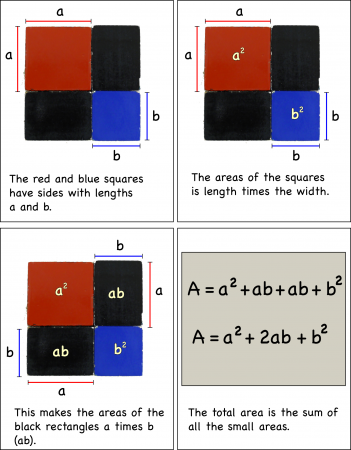
For the engagement on this aspect of my topic, I would bring a binomial cube with me. I would pose the question, “What do we do when we multiply two binomials together?” The students, of course would not know the answer. I would then say, “Well let’s what one man did that they even did a news article about him!” This in itself catches the students attention because they are piqued about what exactly I am talking about. I would then pass out a copy of this news article so that the students could read. After popcorn reading out loud, we would discuss the article and about how we could use the binomial cube. I would then take out my cube (If possible, put students in groups and give each group a binomial cube to work with) and ask the students, “How in the world did he use this cube to multiply those binomials (points to equation on board)?” I would give them the hint that they have to add up the sides of the square and solve for the perimeter, and see what they can come up with. This is a great engagement for the kids because not only is it hands on, but the article brings in outside aspects of what they’re learning so that they realize they are not the only ones having to learn the material. It’s also a great way to introduce multiplying binomials because it starts at the beginning of adding variables (which they already know how to do), and it’s a visual representation of concept that is sometimes hard to grasp. It’s also a great way to lead into the FOIL, Box, etc…methods to take it into a deeper explanation. For those that have not heard of the binomial cube, here are some pictures of what the students will be working out.

ARTICLE: News Article about Binomial Cube

multiplybinomial

green line<!–[if gte mso 9]>

B2. How does this topic extend what your students should have learned in previous courses?

            A great way to start off with this engagement would be to take the students back to sixth grade. Start off with asking students, “Who remembers when we had to learn how to add and subtract fractions?” Most, if not all, of the students should raise their hands. You can then ask, “Okay, good. So does anyone remember what the next step was after we learned how to add and subtract fractions? What did we learn how to do next?” The answer I am looking for here is multiplying and dividing. After that is established, you can lead in with, “Okay, so who can tell me what the next step would be with what we have previously been learning (adding and subtracting binomials)?” The answer is multiplication and division. Make sure to let them know that you will only be focusing on the multiplication aspect for now. Then you can pose some questions like, “What does multiplying binomials look like? How do we do it? Is there more than one way?” You can then go into a deeper exploration of multiplying binomials and the different ways you can do so. This is a good way to introduce multiplying binomials because not only did I bring in one concept students were already familiar with, I brought in two. I utilized something they already knew (even if subconsciously) back in middle school, and applied that same order to something more complex. It showed them that there was a purpose for learning what they did, and why there is a reason we go in the order that we do. Then you have the aspect of taking something they had been previously working on this semester and extending it further. This helps the students connect with what they are learning and realizing there is a purpose. Because multiplication is repeated addition, we are taking something they have previously learned, and extending it further. Another reason this is a good plan is because you start off with such a basic question, that every student knows the answer. This allows for immediate attention because all the students know what you are talking about, the more they understand, the more likely they are to participate in classroom discussion.

green line<!–[if gte mso 9]>

E1. How can technology be used to effectively engage students with this topic?

In multiplying binomials, technology is a wonderful thing. It can allow students the opportunity to learn in new and interesting ways. When thinking of an engage for this topic, I thought of the 9th grade Algebra 1 class I am currently teaching. High School students are sometimes the hardest to keep entertained, and I think I found the perfect video to help keep there attention. This video is a group of students who did a rap about the FOIL method. What better way to relate to students then students themselves! I would start class off by telling the class, “Today we are going to start of by watching a fun video over something we will be learning today.” Proceed to play the video, and observe how every student is watching. The video is fun while also informing. It describes the method, though not thoroughly, but it gives the students an idea of what will be coming. This video helps show that other students all over the state/world are learning the same thing, and are bringing a fun new aspect to the learning of the material. After the video is played, you might ask the class to try and guess at what exactly you will be covering today. It’s always good to see their minds work and try to figure it out. This question also allows them to connect the video back to the classroom environment and settle down. You can then begin your lesson on multiplying binomials. At the end of the lesson, I would bring up the video again, and ask the class if they can recall what FOIL stands for and to give me an example. I would probably make this their exit ticket for the day and have them write it down on a piece of paper. (This video runs a little long, and I would recommend editing some parts out for time sake. )

Resources:

http://www.youtube.com/watch?v=MG-c7NWFS8U

http://www.noozhawk.com/article/santa_barbara_montessori_school_open_house_binomial_cube_20140118

http://montessorimuddle.org/2012/02/02/using-the-binomial-cube-in-algebra/

Engaging students: Inverse Functions

In my capstone class for future secondary math teachers, I ask my students to come up with ideas for engaging their students with different topics in the secondary mathematics curriculum. In other words, the point of the assignment was not to devise a full-blown lesson plan on this topic. Instead, I asked my students to think about three different ways of getting their students interested in the topic in the first place.

I plan to share some of the best of these ideas on this blog (after asking my students’ permission, of course).

This student submission again comes from my former student Allison Myers. Her topic, from Algebra II: inverse functions.

green line

CURRICULUM

How can this topic be used in your students’ future courses in mathematics or science?

Functions are a composition of one or more actions that maps one object onto another (each input maps to one output). Inverse functions are a composition of reverse actions that “undo” the actions of the original function.

Inverse functions have real-world applications, but also students will use this concept in future math classes such as Pre-Calculus, where students will find inverse trigonometric functions. Inverse trigonometric functions have a whole new set of real-world applications, such as finding the angle of elevation of the sun, or anything which models harmonic motion.

Students will also see this concept again in Calculus, where they will differentiate inverse trigonometric functions to solve real-world applications involving rate of angular rotation or the rate of change of angular size.

green lineTECHNOLOGY

How can technology be used to effectively engage students with this topic?

In the past, I taught a lesson where the Explore portion of the lesson utilized dry erase markers and transparency sheets to allow students to discover what happens graphically when computing an inverse (trigonometric) function. My goal was for my students to understand why we compute inverses the way we do. To my horror, my theoretical 15-minute, super insightful Explore became messy, full of problems, and confusing to my students.

While reflecting after the lesson, I began to consider how using technology would have better served my students (in their understanding) and myself (in my goals for the lesson). I found Glencoe’s directions for using the TI-Nspire to compute inverse functions (see image below). Using the TI-Nspire, I would start the lesson with a real-world example and data and have my students complete Step 1. Next, I would explain our need to “undo/reverse” the data, and allow the students to come up with different ways to do so. After that, I would ask the students to make conjectures about possible formulas. Using the TI-Nspire would be less messy and time-consuming (as compared to my experience with markers and transparencies), and would also allow the teacher to be within the context of a real-world problem. I believe if we used this (or similar) technology, combined with the constructivist-style teaching, students would come away with not only a better understanding for computing inverse functions but also their real-world applications.

TIInspireSource: http://glencoe.com/sites/common_assets/mathematics/alg2_2010/other_cal_keystrokes/TI-Nspire/Nspire_423_424_C07L2B_888482.pdf

green lineCULTURE

How has this topic appeared in pop culture (movies, TV, current music, video games, etc.)?

Inverse functions are used every day in real life. For example, when a computer reads a number you type in, it converts the number to binary for internal storage, then it prints the number out again onto the screen that you see – it’s utilizing an inverse function. A basic example involves converting temperature from Fahrenheit to Celsius.

Another example, if one considers music notes on paper to be a function of the sound produced, then the software Sibelius can be considered the inverse function, as it takes a musician’s music and converts it back to music notes.