Engaging students: Completing the square

In my capstone class for future secondary math teachers, I ask my students to come up with ideas for engaging their students with different topics in the secondary mathematics curriculum. In other words, the point of the assignment was not to devise a full-blown lesson plan on this topic. Instead, I asked my students to think about three different ways of getting their students interested in the topic in the first place.

I plan to share some of the best of these ideas on this blog (after asking my students’ permission, of course).

This student submission again comes from my former student Tracy Leeper. Her topic, from Algebra: completing the square.

green line

What interesting things can you say about the people who contributed to the discovery and/or the development of this topic?

Muhammad ibn Musa al-Khwarizmi wrote a book called al-jabr in approximately 825 A.D. He was in Babylon and he worked as a scholar at the House of Wisdom. Al-Khwarizmi had already mastered Euclid’s Elements, which is the foundation for Geometry. So in his book he posed the challenge “What must be the square which, when increased by ten of its own roots; amounts to 39?” or in other words: how to solve he turned to geometry and drew a picture to figure out the answer. By doing so, al-Khwarizmi found out how to solve equations by completing the square. He also included instructions on how he solved the problem in words. His book al-jabr become the foundation for our modern day algebra. The Arabic word al-jabr was translated into Latin to give us algebra, and our word for algorithm came from al-Khwarizmi, if you can believe it. Later on, his work was used by other Arab and Renaissance Italian mathematicians to “complete the cube” for solving cubic equations.


green line

How does this topic extend what your students should have learned in previous courses?

In previous courses my students should have already been introduced to prime factorization, the quadratic formula, parabolas, coordinates graphs and other similar topics. Completing the square is another way for students to find the roots of a quadratic equation. The first way taught is by using nice numbers that will factor easily. Then the math progresses to using the quadratic equation for the numbers that don’t factor easily. Completing the square is just another way to solve a quadratic that does not easily factor. Some students prefer to go straight to the quadratic equation, whereas other students will favor completing the square after they learn how to do it. It gives the students another “tool” for their toolbox on how to solve equations, and will enable them to solve equations that previously were unsolvable, such as the quadratic . By giving students a variety of ways to solve a problem, they can pick whichever way they are most comfortable with, which in turn will boost their confidence in their ability to learn math.


green line

How could you as a teacher create an activity or project that involves your topic?

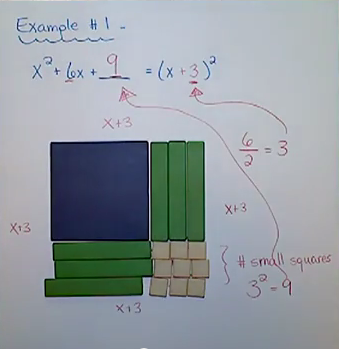
Usually the simplest way to learn something is to see something concrete of what you are trying to do. For completing the square, I can give the students the procedure to follow, but they probably won’t be able to fully understand why it works. In order to help them visualize it, I would use algebra tiles. One long tile is equal to x, since its length is x and its width is 1. The square is equal to since the length and the width are both equal to x. However, when you try to add to the square by a factor of x, you end up having a corner missing. This is the part that is missing from the initial equation. Then the students see that you don’t have a complete square, but by adding the same amount to both parts, we can get a complete square that can then be factored. Like so…
References:

http://bulldog2.redlands.edu/fac/beery/math115/m115_activ_complsq.htm

http://www.youtube.com/watch?v=JXrj5Dtgpss


Engaging students: Graphing parabolas

In my capstone class for future secondary math teachers, I ask my students to come up with ideas for engaging their students with different topics in the secondary mathematics curriculum. In other words, the point of the assignment was not to devise a full-blown lesson plan on this topic. Instead, I asked my students to think about three different ways of getting their students interested in the topic in the first place.

I plan to share some of the best of these ideas on this blog (after asking my students’ permission, of course).

This student submission again comes from my former student Tiffany Wilhoit. Her topic, from Algebra: graphing parabolas.

green line

How did people’s conception of this topic change over time?


The parabola has been around for a long time! Menaechmus (380 BC-320 BC) was likely the first person to have found the parabola. Therefore, the parabola has been around since the ancient Greek times. However, it wasn’t until around a century later that Apollonius gave the parabola its name. Pappus (290-350) is the mathematician who discovered the focus and directrix of the parabola, and their given relation. One of the most famous mathematicians to contribute to the study of parabolas was Galileo. He determined that objects falling due to gravity fall in parabolic pathways, since gravity has a constant acceleration. Later, in the 17th century, many mathematicians studied properties of the parabola. Gregory and Newton discovered that parabolas cause rays of light to meet at a focus. While Newton opted out of using parabolic mirrors for his first telescope, most modern reflecting telescopes use them. Mathematicians have been studying parabolas for thousands of years, and have discovered many interesting properties of the parabola.


green line

How could you as a teacher create an activity or project that involves your topic?


A fun activity to set up for your students will include several boxes and balls, for a smaller set up, you can use solo cups and ping pong balls. Divide the class into groups, and give each group a set of boxes and balls. First, have the students set up a tower(s) with the boxes. The students will now attempt to knock the boxes down using the balls. The students can map out the parabolic curve showing the path they want to take. By changing the distance from the student throwing the ball and the boxes, the students will be able to see how the curve changes. If students have the tendency to throw the ball straight instead of in the shape of a parabola, have a member of the group stand between the thrower and the boxes. This will force the ball to be thrown over the student’s head, resulting in the parabolic curve. The students can also see what happens to the curve depending on where the student stands between the thrower and boxes. In order for the students to make a positive parabolic curve, have them throw the ball underhanded. This activity will engage the students by getting them involved and active, plus they will have some fun too! (To start off with, you can show the video from part E1, since the students are playing a real life version of Angry Birds!)


green line

How can technology be used to effectively engage students with this topic?


A great video to show students before studying parabolas can be found on YouTube:

The video uses the popular game Angry Birds to introduce parabolic graphs. First, the video shows the bird flying a parabolic path, but the bird misses the pig. The video goes on to explain why the pig can’t be hit. It does a good job of explaining what a parabola is, why the first parabolic curve would not allow the bird to hit the pig, and how to change the curve to line up the path of the bird to the pig. This video would be interesting to the students, because a majority of the class (if not all) will know the game, and most have played the game! The video goes even further by encouraging students to look for parabolas in their lives. It even gives other examples such as arches and basketball. This will get the students thinking about parabolas outside of the classroom. (This video would be perfect to show before the students try their own version of Angry Birds discussed in part A2)


Resources:


Youtube.com/watch?v=bsYLPIXI7VQ

Parabolaonline.tripod.com/history.html

http://www-history.mcs.st-and.ac.uk/Curves/Parabola.html


Engaging students: Factoring quadratic polynomials

In my capstone class for future secondary math teachers, I ask my students to come up with ideas for engaging their students with different topics in the secondary mathematics curriculum. In other words, the point of the assignment was not to devise a full-blown lesson plan on this topic. Instead, I asked my students to think about three different ways of getting their students interested in the topic in the first place.

I plan to share some of the best of these ideas on this blog (after asking my students’ permission, of course).

This student submission again comes from my former student Kristin Ambrose. Her topic, from Algebra: factoring quadratic polynomials.

green line

In previous courses, students would have learned how to solve one-variable linear equations. These kinds of equations would involve variables to the power of one. Quadratic equations extend from this since they add a variable to the equation that is to the power of two. Since students learned how to solve linear equations, they may be curious as to how they can solve quadratic equations that extend from this. Factoring is a way for students to solve these kinds of equations.

Also, in previous courses students would have learned about the ‘factors’ of a number. When talking about numbers, the factors are the numbers you multiply to get another number. For example the positive factors of six are one and six, and two and three. Factoring quadratic polynomials follows this logic, except instead finding the factors of a number, students are finding the factors of an expression. For example, the factors of the expression x^2+4x+3 are (x+3) and (x+1). Just like how when we multiply two times three we get six, when we multiply (x+3) times (x+1) we get the expression x^2+4x+3.


green line

How has this topic appeared in pop culture (movies, TV, current music, video games, etc.)?


There is a popular video game called Angry Birds in which the user launches birds to try and knock down structures built by pigs. This game relates to factoring quadratics because if we were to plot the trajectory of the birds being launched on a graph, the result would be a parabola, in other words the graph of a quadratic function. Factoring quadratic polynomials is a way to find the solutions of a quadratic, and the solutions are where the parabola crosses the x-axis. In Angry Birds, we could set our x-axis to be the ground, and our solutions would correspond with where on the ground the bird would land, if nothing were to block its path. If students were given the quadratic equation for the parabola corresponding with the bird’s trajectory, students would be able to factor the equation to solve for where on the ground the bird would land.


green line

What are the contributions of various cultures to this topic?


Indian and Islamic cultures are two major cultures that have contributed to the topic of factoring quadratic polynomials. In Islamic culture, Al-Khwarizmi contributed to this topic by creating a way to solve quadratic equations by reducing the equations to one of six forms, which were then solvable. He described these forms in terms of squares, roots, and numbers, much like the terms we use today when factoring quadratic polynomials. The ‘squares’ related to what would today be our ‘x2’ term, the ‘roots’ related to the ‘x’ term, and the ‘numbers’ to the ‘c’ constant term. One of the forms he described was “squares and roots equal numbers,” in modern terms, “ax2 + bx = c.” Today, we factor quadratic polynomials of the form “ax2 + bx + c” which is similar to the form Al-Khwarizmi described. (Islamic Mathematics – Al-Khwarizmi)

In Indian culture, Brahmagupta contributed to the concept of factoring quadratics by introducing the idea that a number could be negative. This was significant because it meant a number like 9 could be factored into 32 or (-3)2. Since a number could have a negative factor, it followed that quadratic equations could have two possible solutions, since one solution could be negative. Factoring quadratic polynomials like we do today would be impossible without the knowledge that quadratic expressions can have two solutions. (Indian Mathematics – Brahmagupta)


References:


“Islamic Mathematics – Al-Khwarizmi.” The Story of Mathematics. 2010. Web. 17 Sept. 2014. <http://www.storyofmathematics.com/islamic_alkhwarizmi.html&gt;.


“Indian Mathematics – Brahmagupta.” The Story of Mathematics. 2010. Web. 17 Sept. 2014. <http://www.storyofmathematics.com/indian_brahmagupta.html&gt;.


Engaging students: Slope-intercept form of a line

In my capstone class for future secondary math teachers, I ask my students to come up with ideas for engaging their students with different topics in the secondary mathematics curriculum. In other words, the point of the assignment was not to devise a full-blown lesson plan on this topic. Instead, I asked my students to think about three different ways of getting their students interested in the topic in the first place.

I plan to share some of the best of these ideas on this blog (after asking my students’ permission, of course).

This student submission again comes from my former student Kelley Nguyen. Her topic, from Algebra: slope-intercept form of a line.

green line

How has this topic appeared in high culture (art, classical music, theatre, etc.)?


The slope-intercept form of a line is a linear function. Linear functions are dealt with in many ways in everyday life, some of which you probably don’t even notice.


One example where the slope-intercept form of a line appears in high culture is through music and arts. Suppose a band wants to book an auditorium for their upcoming concert. As most bands do, they meet with the manager of the location, book a date, and determine a payment. Let’s say it costs $1,500 to rent the building for 2 hours. In addition to this fee, the band earns 20% of each $30 ticket sold. Write an equation that determines whether the band made profit or lost money due to the number of tickets sold – the equation would be y = 0.2(30)x – 1500, where y is the amount gained or lost and x is the number of tickets sold that night. This can also help the band determine their goal on how many tickets to sell. If they want to make a profit of $2,000, they would have to sell x-many tickets to accomplish that.


In reality, most arts performances make a profit from their shows or concerts. Not only do mathematicians and scientists use slope-intercept of a line, but with this example, it shows up in many types of arts and real-world situations. Not only does the form work for calculating cost or profit, it can relate to the number of seats in a theatre, such as x rows of 30 seats and a VIP section of 20 seats. The equation to find how many seats are available in the theatre is y = 30x + 20, where x is the number of rows.


green line

How can technology be used to effectively engage students with this topic?


A great way to engage students when learning about slope-intercept form of a line is to use Geometer’s Sketchpad. After opening a graph with an x- and y-axis, use the tools to create a line. From there, you can drag the line up or down and notice that the slope increases as you move upward and decreases as you move downward. Students can also find the equation of the line by selecting the line, clicking “Measure” in the menu bar, and selecting “Equation” in the drop-down list. This gives the students an accurate equation of the line they selected in slope-intercept form. Geometer’s Sketchpad allows students to experiment and explore directions of lines, determine whether or not it has an increasing slope, and help create a visual image for positive and negative slopes.


Also, with this program, students can play a matching game with slope-intercept equations and lines. You will instruct the student to create five random lines that move in any direction. Next, they will select all of the lines, go to “Measure” in the menu bar, and click “Equation.” From there, it’ll give them the equation of each line. Then, the student will go back and select the lines once again, go to “Edit” on the menu bar, hover over “Action Buttons,” and select “Hide/Show.” Once a box comes up, they will click the “Label” tab and type Scramble Lines in the text line. Next, the lines will scramble and stop when clicked on. Once the lines are done scrambling, the student could then match the equations with their lines. This activity gives the students the chance to look at equations and determine whether the slope is increasing and decreasing and where the line hits the y-axis.


green line

How could you as a teacher create an activity or project that involves your topic?


With this topic, I could definitely do a project that consists of slope-intercept equations, their graphs, and word problems that involve computations. For example, growing up, some students had to earn money by doing chores around the house. Parents give allowance on daily duties that their children did.


The project will give the daily amount of allowance that each student earned. With that, say the student needed to reach a certain amount of money before purchasing the iPad Air. In part one of the project, the student will create an equation that reflects their daily allowing of $5 and the amount of money they have at the moment. In part two, the student will construct a graph that shows the rate of their earnings, supposing that they don’t skip a day of chores. In part three, the students will answer a series of questions, such as,

  • What will you earn after a week?
  • What is your total amount of money after that week?
  • When will you have enough money to buy that iPad Air at $540 after tax?


This would be a short project, but it’s definitely something that the students can do outside of class as a fun activity. It can also help them reach their goals of owning something they want and making a financial plan on how to accomplish that.


References


Engaging students: Word problems involving inequalities

In my capstone class for future secondary math teachers, I ask my students to come up with ideas for engaging their students with different topics in the secondary mathematics curriculum. In other words, the point of the assignment was not to devise a full-blown lesson plan on this topic. Instead, I asked my students to think about three different ways of getting their students interested in the topic in the first place.

I plan to share some of the best of these ideas on this blog (after asking my students’ permission, of course).

This student submission again comes from my former student Emily Bruce. Her topic, from Algebra: word problems involving inequalities.

green line

How could you as a teacher create an activity or project that involves your topic?

Everyone learns in different ways. There are three common learning types, which are auditory, visual, and kinesthetic. The best activities and lesson plans involve all three of these learning styles. A great way to involve all of these learning styles is to use objects that students can rearrange and manipulate with their hands. When learning about inequality word problems, I would have print large numbers and symbols on pieces of paper that they could tape to a whiteboard. In groups, they would be able to rearrange their numbers and inequality symbols as they are working through a word problem, until the figure out the correct inequality. Then as a class, we could discuss their answers. This addresses the auditory, by discussing, the visual, by them seeing the inequalities as they read them, and the kinesthetic learners, by being able to manipulate it using their hands.


green line

What are the contributions of various cultures to this topic?

The strict inequality symbols (less than and greater than) were originally seen in 1631, when used by British mathematician, Thomas Harriot. Some believe that his inspiration for these symbols came from a symbol that he saw on the arm of a Native American. The symbol he saw looked like the strict inequality symbols overlapping. The bars for the unstrict inequalities (less than or equal to and greater than or equal to) were not added until much later. It wasn’t until almost 40 years later, in 1670, that John Wallis started putting a line above the strict inequality symbols. Almost 65 years after that, in 1734, French mathematician, Pierre Bouguer, began writing a double line underneath the inequality symbols.


http://jeff560.tripod.com/relation.html

http://en.wikipedia.org/wiki/Table_of_mathematical_symbols_by_introduction_date


green line

How can technology be used to effectively engage students with this topic?

Quizlet.com is a website that can be used as a good review for many topics. When exploring the section on inequality word problems, I found many useful and engaging things that would help students review and study the material. There were flash cards with word problems on one side and the corresponding equations on the flip side. There was also a test that they could take after studying the material, in order to examine their progress. Lastly, the website had two games that involve solving inequality word problems. This is a great way for students to study and review material. The website is not only great for inequality word problems, but topics of all kinds, in all subjects.


Engaging students: Approximating data by a straight line

In my capstone class for future secondary math teachers, I ask my students to come up with ideas for engaging their students with different topics in the secondary mathematics curriculum. In other words, the point of the assignment was not to devise a full-blown lesson plan on this topic. Instead, I asked my students to think about three different ways of getting their students interested in the topic in the first place.

I plan to share some of the best of these ideas on this blog (after asking my students’ permission, of course).

This student submission again comes from my former student Delaina Bazaldua. Her topic, from Algebra: approximating data to a straight line.

green line

How has this topic appeared in pop culture (movies, TV, current music, video games, etc.)?

One of my favorite shows to watch is How I Met Your Mother. I specifically chose this topic for this class because of how it relates to an episode of the show. A piece of the episode that I’m referring to is shown in the YouTube video:

Barney, one of the main characters, describes the graph as the Crazy/Hot Scale. According to him, a girl cannot be crazier than hot which means she has to be above the diagonal straight line. This relates to the topic because one can approximate data by the straight line that Barney gives the viewer. I think the students will be able to relate to this and also find it humorous. Because this video has both of these characteristics, they will be able to remember the concept for upcoming homework and tests which is ultimately the most important part of math: understanding it and being able to recall it.


green line

How has this topic appeared in the news?

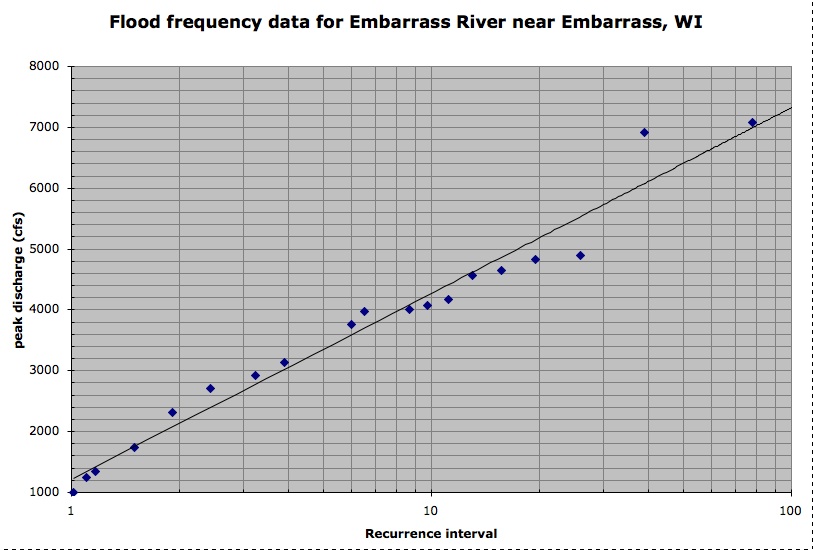
Most lines are drawn for the purpose of seeing if there is a relationship between the x and y axis and trying to figure out if you can approximate data from the straight line that is drawn. Graphs like this are found all over the news, and they often relate to natural disasters. For example, this linear regression, http://d32ogoqmya1dw8.cloudfront.net/images/quantskills/methods/quantlit/bestfit_line.v2.jpg, describes floods. In http://serc.carleton.edu/mathyouneed/graphing/bestfit.html, where the picture is found, describes more activities that can be used to create a linear regression which can be converted into a straight line. These examples of straight lines can be used to find more data that isn’t necessarily shown from the points that are plotted. The examples the website gave are: flood frequency curves, earthquake forecasting, meteorite impact prediction, earthquake frequency vs. magnitude, and climate change. This is beneficial for math because it allows students to realize that math isn’t abstract like it is often perceived to be, but rather, it is used for something very important and something that occurs several times a year such as natural disasters and weather.


green line

How can this topic be used in your students’ future courses in mathematics or science?

One of the purposes for teachers to teach is for students to learn what they should for the following year so they can be successful in the particular topic. When it comes to approximating data based on a straight line, the knowledge a student learns in algebra will carry them through statistics, physics, and other higher math and science classes. Linear regression is shown in statistics as one can see in this statistics website: http://onlinestatbook.com/2/regression/intro.html while physics is represented in the physics website: http://dev.physicslab.org/Document.aspx?doctype=3&filename=IntroductoryMathematics_DataAnalysisMethods.xml. A lot can be predicted from these straight lines which is why these graphs aren’t foreign to upper level math and science classes. As I stated before, a lot can be predicted from the graph where data points aren’t necessarily on the trend the data is setting which allows students to expect what would occur at a particular x or y value. A background in this area can help students through the rest of school and perhaps even the rest of their life in some cases.


References:

https://www.youtube.com/watch?v=uN_sSXKbzHk

http://serc.carleton.edu/mathyouneed/graphing/bestfit.html

http://onlinestatbook.com/2/regression/intro.html

http://dev.physicslab.org/Document.aspx?doctype=3&filename=IntroductoryMathematics_DataAnalysisMethods.xml


Engaging students: The quadratic formula

In my capstone class for future secondary math teachers, I ask my students to come up with ideas for engaging their students with different topics in the secondary mathematics curriculum. In other words, the point of the assignment was not to devise a full-blown lesson plan on this topic. Instead, I asked my students to think about three different ways of getting their students interested in the topic in the first place.

I plan to share some of the best of these ideas on this blog (after asking my students’ permission, of course).

This student submission again comes from my former student Chais Price. His topic, from Algebra: the quadratic formula.

green line

What interesting things can you say about the people who contributed to the discovery and/or the development of this topic?

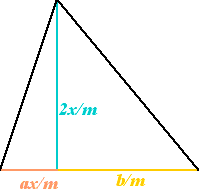
What is the quadratic formula you ask? It is basically a tool used to find roots of the quadratic equation. It all started around 3000 BC,when the Ancient Babylonians needed a method for calculating how much to pay the tax collector. Imagine that you are an Ancient Babylonian farmer with a square field that is placed in the middle of your farm. On this field you plan to plant some crops. After some experimenting you discover that if you double the length of each side of the square field, you end up with 4 times as many crops as before. This observation demonstrated the area of the field and the amount of crops that you can grow and the square of one of the side lengths are all proportional. From here we come up with the first quadratic equation. Let “x” represent the length of a side and “m” be the amount of crops you can grow on a square field of side length 1. Then we have “c” which is the entire area of crop that can be grown. Thus c= mx^2. It is now April 15 in Babylonia and the tax collector comes and says to give him “c” crops to pay your taxes. Now you ask yourself, how big does your square field need to be to grow that amount of crops? Well as it turns out, we just take x= (c/m)^1/2. The Babylonians however, did not have a way to solve square roots accurately. They were just estimations. This square field representation is just a basic representation. Let’s say that your field was not a square but a triangle divided into 2 right triangles where a and b are the amount of crops that you can grow in each field.

triangle

To calculate the amount of crops, you being a very intelligent Babylonian farmer, you come up with the equation

c= ax^2+bx.

The next step is to divide by “a” and then complete the square yielding

a \displaystyle \left(x + \frac{b}{2a} \right)^2 = x^2 + \displaystyle \frac{b}{a}x + \displaystyle \frac{b^2}{4a^2}

Now we substitute into the previous equation. We now have an equation of the form

a \displaystyle\left( x + \frac{b}{2a} \right)^2 = c + \displaystyle \frac{b^2}{4a^2}

Solving again for the tax collector, we need to solve for “x.” This gives us what we know as the quadratic formula:

x = \displaystyle \frac{-b \pm \sqrt{b^2 + 4ac}}{2a}

Something worth noting since you are an Ancient Babylonian farmer, is that all the roots you find are positive since negative numbers have not been discovered yet. In addition, the quadratic formula shown above is just an illustration broken down step by step. The Babylonians had no general formula for the quadratic formula, but there method for the quadratic formula can be closely associated with the method of completing the square.

green line

How has this topic appeared in the news?

There is a pretty interesting article I read which had to do with the quadratic equation. A teacher provided a list of quadratic equations that the students would pick from. This equation was to be to model for a parabolic device that the student was responsible for building. The student was instructed to spend no more than 12 dollars on this project. They would use the equation to calculate a positional focus which suspended a marshmallow which would cook slowly due to the rays of the sun reflected upon it. This lesson stretched using a quadratic equation to form a focus. Then the student would graph the data and calculate the rate of temperature increase. Student were also asked to make predictions on what temperature the marshmallow would get to. Once the experiment is complete, the student is anxious to see how accurate their model is to the actual equation they chose. This is a very good lesson that covers a pretty broad range of topics.

green line

So the concept of the quadratic formula would develop beyond what the Ancient Babylonians discovered. 1500 years after the Babylonians, the Egyptians came along with a different approach for similar type problems where the quadratic formula was used. The mathematics behind the calculations were known to be very complicated. However, they recorded these calculation on a table ( much like our multiplication tables) so that when a farmer or an engineer required some kind of proportion or dimensional measurement using the quadratic formula, rather than solving the problem again, they would just look it up on the table that had already been calculated. They reproduced this table and made it a master look up guide to follow for such solutions.

Then the Babylonians would reappear in time and discover the method of completing the square. This method still required somewhat of an educated guess. However, since the Babylonians had a 60 base numerical system ( which the Egyptians did not) addition and multiplication were easier to compute and check calculations. Even still there was not a general formula or equation established. Then Pythagoras and Euclid came along and developed a general formula to solve the quadratic equation. Pythagoras argued that the ratio of the area of a square and the length of a side does not always produce an integer and indeed can have a rational solution. Euclid advanced beyond Pythagoras and claimed you could have irrational results. These were logical claims made from a theoretical point of view because at that time there was no way to calculate the square root of a number by hand. Finally in 700 AD, a mathematician named Brahmagupta from India came up with a general solution to the quadratic equation using numbers. He also was on board with Euclid and his irrationals as well as an equation producing 2 roots. His work more than likely inspired another Hindu Mathematician named Baskhara who around 1100 AD formulated the complete solution we are familiar with today. He was also the first to acknowledge that any number greater than 0 has 2 square roots. It was around this same time in history that a Jewish mathematician Abraham bar Hiyya derived the quadratic formula and brought it to Europe. It wouldn’t be until another 500 years that the quadratic formula would be adopted into the formula we know today.


Works Cited


Budd, Chris, and Chris Sangwin. “101 Uses of the Quadratic Equation.” Plus Math. Plus Magazine… Living Mathematics , 01 Mar 2004. Web. 10 Sep 2014. http://plus.maths.org/content/101-uses-quadratic-equation

Tracey, Wong Briggs. “Students use quadratic equations to cook marshmallows.” USA Today. USA Today, 05 Mar 2007. Web. 10 Sep 2014. http://usatoday30.usatoday.com/news/education/2007-03-04-teacher-parabola-side_N.htm?csp=34

Hell, Dr. . “The History Behind the Quadratic Formula .” . BBC H2G2, 13 October 2004. Web. 10 Sep 2014. http://news.bbc.co.uk/dna/place-lancashire/plain/A2982567


Engaging students: Computing inverse functions

In my capstone class for future secondary math teachers, I ask my students to come up with ideas for engaging their students with different topics in the secondary mathematics curriculum. In other words, the point of the assignment was not to devise a full-blown lesson plan on this topic. Instead, I asked my students to think about three different ways of getting their students interested in the topic in the first place.

I plan to share some of the best of these ideas on this blog (after asking my students’ permission, of course).

This student submission again comes from my former student Carissa Birdsong. Her topic, from Algebra: computing inverse functions.

green line

How can this topic be used in your students’ future courses in mathematics or science?

When students are learning any algorithm in math, it helps keep their interest if they know what this can be possibly used for in the future. In pre-calculus, students need to find the inverse of cosine, sine, tangent, etc. to find certain angles. In order to grasp the students’ attention, the teacher can show videos of bottle rockets being shot off at different angles. Then the teacher will explain that in order to find most of these angles, one must use the inverse property. Then the teacher can go into depth of how to find the inverse of a function. But, the students must understand that using inverse to find angle measurements will not happen in this curriculum, but in future classes such as pre-calculus, trigonometry and physics.


green line

How could you as a teacher create an activity or project that involves your topic?


Human Representation of Inverse Function

  1. Move the desks to the sides of the room, making a big open space in the middle.
  2. Assign each student a partner.
  3. Have a strip of tape down the middle of the room prior to class. Have the students line up facing their partner with the strip of tape in between them.
  4. Have the side on the “right” be side A and the side on the “left” be side B. (The teacher will choose which side is the right or left, depending on where the front of the classroom is)
  5. Side A will pick a position to stand in (the teacher must monitor to make sure the students are being appropriate). The students are encouraged to change their face, arms, head, etc. to pick the most creative position possible.
  6. Now side B will mimic their specific partner on side A.
  7. Once the students have locked in their position, the teacher will point out that side B is reflective of side A. Therefore, side B is the inverse function of A.

*Make sure that the students understand that side B is not doing the exact same thing that side A is doing, but the opposite, the reflection. The inverse of a function “undoes” the function itself. If someone were to take away side A, and bring in a new crop of people to reflect side B, it should be EXACTLY what side A had done. The inverse of the inverse of a function must take you back to the original function.

*After the teacher teaches how to find the inverse of a function, and can elaborate on the graphing of each function, he or she can refer back to this activity and show that there is an invisible line between the function and the inverse function, making clear that they reflect each other, just as the students did.


green line

How has this topic appeared in pop culture (movies, TV, current music, video games, etc.)?

Even though most students probably haven’t seen Top Secret, they will probably appreciate watching any sort of movie or television during class. In the making of Top Secret, the actors film a scene walking backwards and saying lines in reverse order. In the movie, this scene is played in reverse, so they look like they were just speaking gibberish and walking forward. They did this so Val Kilmer can do cool tricks like throw a book on the top shelve and slide up a pole.

The teacher could show his or her class the original scene, straight from the movie.

Then ask, “How do you think the actors did this?” “What language are they speaking?” Hopefully a student will catch on fast and say that they just filmed it backwards. Then the teacher can show the scene played forwards.

These two scenes are inverse each other. Going from the beginning to the end of one takes you to the beginning of the other. And going from the beginning to the end of the other, takes you to the beginning of one. Most functions have an inverse function. This means there is a function that is reverse of its inverse. This does NOT mean that the inverse of a function is just the original backwards (i.e. y=3+x and x+3=y). The function of f has the input x and the output y, whereas the inverse of the function f has the input y and the output x.

Resources:

https://www.youtube.com/watch?v=jXlucE4iUDE

https://www.youtube.com/watch?v=2Mr_XAM8CMw


Engaging students: Finding the inverse of a matrix

In my capstone class for future secondary math teachers, I ask my students to come up with ideas for engaging their students with different topics in the secondary mathematics curriculum. In other words, the point of the assignment was not to devise a full-blown lesson plan on this topic. Instead, I asked my students to think about three different ways of getting their students interested in the topic in the first place.

I plan to share some of the best of these ideas on this blog (after asking my students’ permission, of course).

This student submission again comes from my former student Donna House. Her topic, from Algebra: finding the inverse of a matrix.

green line

How could you as a teacher create an activity or project that involves your topic?

Engage the students by asking them how they think our military (or a secret agent) sends and receives messages without the enemy knowing what message is being sent. Then the discussion can be guided by asking how math is used in encoding and de-coding secret messages. Since they already will have learned about matrices, tell them they are going to learn how to use matrices to create a secret message and de-code a secret message from a classmate.

First they need to learn to compute the inverse of a simple matrix A (provide this matrix to be certain it has an integer inverse.) I prefer a three-by-three, but this can also be done with any size matrix – even a two-by-two. Next, they create their own short message and code it using numbers to represent the letters of the alphabet (A=1, B=2, etc., with 0=space). This coded message should be written into a matrix form, filling in one row at a time (the number of columns MUST match the number of rows in matrix A.) If the secret message does not fill the last row add zeros for spaces. Now, multiply the message matrix by matrix A (with matrix A on the right.)


Message: 7 15 0 21 14 20 0 5 1 7 12 5 19

\displaystyle \left[ \begin{array}{ccc} 7 & 15 & 0 \\ 21 & 14 & 20 \\ 0 & 5 & 1 \\ 7 & 12 & 5 \\ 19 & 0 & 0 \end{array} \right] \left[ \begin{array}{ccc}3 & 1 & 3 \\ 7 & 10 & -3 \\ 8 & 5 & 5 \end{array} \right]

This will result in your encoded message:

\displaystyle \left[ \begin{array}{ccc} 126 & 157 & -24 \\ 321 & 261 & 121 \\ 43 & 55 & -10 \\ 145 & 152 & 10 \\ 57 & 19 & 57 \end{array} \right]

Now have each student pass this encoded message to another student. Each student must use the inverse of matrix A to de-code the message!

Have them multiply this message matrix by B A^{-1} with the inverse on the right. They will get the de-coded Message matrix. From this they can discover the message!


green line


How has this topic appeared in pop culture (movies, TV, current music, video games, etc.)?

            Written as an engage:

We are going to begin with a short video today!

(Published on Feb 21, 2013)

This video introduces the Computer Graphics chapter of the “Computer Science Field Guide”, an online interactive “textbook” about computer science, written for high school students. The guide is free, and is available from cosc.canterbury.ac.nz/csfieldguide/ . This video may be downloaded if you need to play it offline.)


What did you notice about the movement of the objects in the video? Does this movement – rotation, position, size – remind you of anything you have done in math class before? What happened to the graph of a function when we multiplied the x value? What about when we multiplied the y value? What happened when we added or subtracted a number to x or y? Do these transformations of functions move in a similar manner as the computer graphics in the video? (Of course, the video shows three-dimensional movement while our graphs only showed two-dimensional movement.)

So what kind of transformations do you think are used to create computer graphics? The graphics you see in your video games, in the movies, on TV, in flight simulators for training pilots, and in many other applications are all created with the transformations of matrices. Matrix multiplication is used in computer graphics to size and scale objects as well as rotate and translate them. Today we are going to learn to compute a special matrix transformation – the inverse of a matrix!


green line

How can technology be used to effectively engage students with this topic?

            After the students have learned how to calculate the inverse of a 3 x 3 matrix by hand, you could tell them they are now going to calculate the inverse of a 4 x 4 matrix. After they all roll their eyes and groan, you can ask if they would rather do the calculations by hand or on their graphing calculators.

Now you can introduce a method for entering the data into a calculator (such as the TI83 or TI84.) Since many graphing calculators can handle large matrices, the matrix and the identity matrix can be entered together as a 4 x 8 matrix. By using the “rref(” application, the inverse matrix will automatically be calculated. Another way to calculate the inverse is to enter the matrix then press the x-1 key.

However, you may want to wait before teaching this “short-cut” method. You may choose to have the students enter the 4 x 8 (matrix and identity matrix) and show them how to do the row operations on the calculator. This is useful in helping them see the steps involved in the calculation (and tortures them just a little.)


Engaging students: Finding the asymptotes of a rational function

In my capstone class for future secondary math teachers, I ask my students to come up with ideas for engaging their students with different topics in the secondary mathematics curriculum. In other words, the point of the assignment was not to devise a full-blown lesson plan on this topic. Instead, I asked my students to think about three different ways of getting their students interested in the topic in the first place.

I plan to share some of the best of these ideas on this blog (after asking my students’ permission, of course).

This student submission again comes from my former student Belle Duran. Her topic, from Algebra: finding the asymptotes of a rational function.

green line

How has this topic appeared in high culture?

Although the topic itself has not appeared in high culture, idea of asymptotes brings me the idea of the myth of Tantalus. In a nutshell, Tantalus was always committing crimes against the Gods of Olympus but always going unpunished. One day, he invites the Gods to his home for a feast in which he serves the Gods a rather vile dish. This ultimately angered the Gods to the point of punishing Tantalus by hanging him from a fruit tree amidst a lake, sentencing him to suffer eternal hunger and thirst. Tantalus was always so close to the water and fruits, yet they stayed beyond his reach. In the same way, when a graph has an asymptote then a part of the graph will approach that asymptote without ever touching it or being equal to it.


green line

What interesting things can you say about the people who contributed to the discovery and/or the development of this topic?

The word, “asymptote” derives from the Greek word, “asumptotos” which translates to “not falling together.” The term was first introduced by Apollonius of Perga in his work on conic sections, but used the term to represent a line that will not meet the curve in any finite point. Other achievements by Apollonius includes the introduction of eccentric and epicyclic motion to explain the motion of the planets as well as the hemicyclium which is a sundial with hour lines drawn on the surface of a conic section to give greater accuracy.


green line

How does this topic be used in your students’ future courses in mathematics or science?

One way finding asymptotes can be used in students’ future courses are to understand finding the limits of a function. When it comes to limits, it can be shown that vertical asymptotes are concerned with objectives in which the function is not usually defined and near which the function becomes large positively or negatively, or if a line x=a is called a vertical asymptote for the graph of a function of either the limit to positive infinity as x approaches positive a or negative a. Likewise, horizontal asymptotes are concerned with finite values approached by the function as the independent variable grows large positively or negatively. In other words, a line y=b is a horizontal asymptote for the graph is either the limit of the function is b as x approaches positive infinity or negative infinity.

References

The myth of Tantalus

http://www-history.mcs.st-and.ac.uk/Biographies/Apollonius.html

http://jwilson.coe.uga.edu/emat6680/greene/emat6000/greek%20geom/Apollonius/apollonius.html

http://www.education.com/study-help/article/horizontal-vertical-asymptotes/

http://oregonstate.edu/instruct/mth251/cq/Stage3/Lesson/asymptotes.html