Engaging students: Fitting data to a quadratic function

In my capstone class for future secondary math teachers, I ask my students to come up with ideas for engaging their students with different topics in the secondary mathematics curriculum. In other words, the point of the assignment was not to devise a full-blown lesson plan on this topic. Instead, I asked my students to think about three different ways of getting their students interested in the topic in the first place.

I plan to share some of the best of these ideas on this blog (after asking my students’ permission, of course).

This student submission again comes from my former student Loc Nguyen. His topic, from Algebra: fitting data to a quadratic function.

green line

A1. What interesting (i.e., uncontrived) word problems using this topic can your students do now?

To engage students on this topic, I will provide them the word problems in the real life so they can see the usefulness of quadratic regression in predictive purposes. The question to the problem is about the estimated numbers of AIDS cases that can be diagnosed in 2006. The data only show from 1999 to 2003. This will be students’ job to figure out the prediction. I will provide the instructions for this task and I will also walk them through the process of finding the best curve that fit the given data. The best fit to the curve will give us the estimation. Here is how the instruction looks like:

quadraticdata

In the end, students will be able to acquire the parabola curve which fit the given data. By letting students work through the real life problems, they will be able to understand why mathematics is important and see how this concept is useful in their lives.

green line

B2. How does this topic extend what your students should have learned in previous courses?

Before getting into this topic, the students should have eventually been familiar with the word “quadratic” such as quadratic function, quadratic equation. Students should have been taught when the curve concaves up or down. In the previous course, students would be given the quadratic functions and they would be asked to find the maxima, minima, or intercepts. Or they would be asked to solve the quadratic equation and find the roots. The universal properties of quadratic function never change. When students encountered the concept of quadratic regression, they would not be so overwhelmed with the topic. There is no new rule or properties. The process is just backward. The Instead of having the given function, in this case, students will have to find the function based on the given data so that the curve would fit the data. Their prior knowledge is really essential for this topic, and this would help them to understand the concept of quadratic regression easier.


green line

C1. How has this topic appeared in pop culture (movies, TV, current music, video games, etc.)?

At the beginning of the class, I would like to show students the short video of football incident.

This incident was really interesting. The Titans punt went so high so that it hit the scoreboard in Cowboys stadium. Surprisingly, this was Cowboy’s new stadium. There were many questions about what was going on when the architecture built this stadium. It was supposed to be great. This incident revealed the errors in predicting the height of the scoreboard. The data they collected in past year may have been incorrect. I want to incorporate this incident into the concept of quadratic regression. I will pose several questions such as:

Was Titan football punter really that powerful? What was really wrong in this situation?

When the architectures built this stadium, did they ever think that the ball would reach the ceiling?

How come did the architectures fail to measure the height of the ceiling? Did they just assume the height of the stadium tall enough?

What was the path of the ball?

Students will eagerly respond to these questions, and I will slowly bring in the important of quadratic regression. I will then explain how quadratic regression helps us to predict the height based on collected data from past years.


References:

https://www.youtube.com/watch?v=V4N3LEi5a1Q

http://www.algebralab.org/Word/Word.aspx?file=Algebra_QuadraticRegression.xml


Engaging students: Adding, subtracting, and multiplying matrices

In my capstone class for future secondary math teachers, I ask my students to come up with ideas for engaging their students with different topics in the secondary mathematics curriculum. In other words, the point of the assignment was not to devise a full-blown lesson plan on this topic. Instead, I asked my students to think about three different ways of getting their students interested in the topic in the first place.

I plan to share some of the best of these ideas on this blog (after asking my students’ permission, of course).

This student submission again comes from my former student Joe Wood. His topic, from Algebra: adding, subtracting, and multiplying matrices.

green line

A1. What interesting (i.e., uncontrived) word problems using this topic can your students do now?

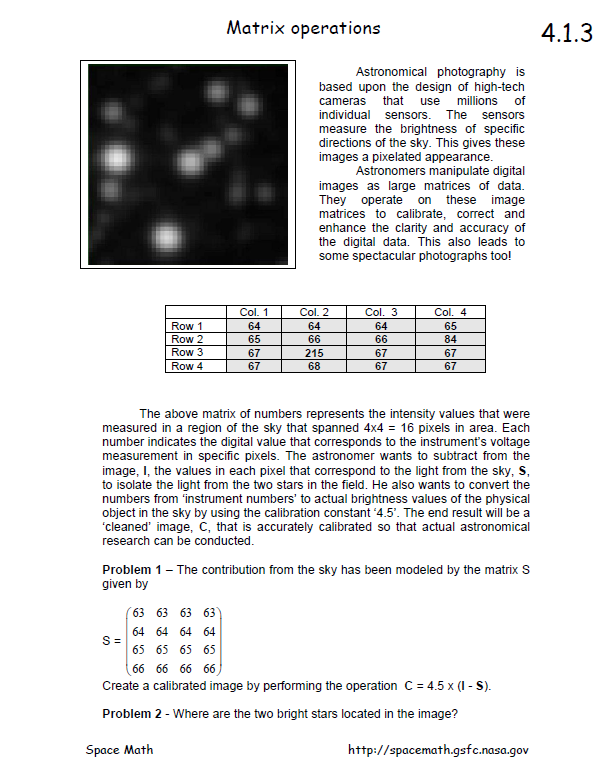
One interesting real world problem for matrix operations can be found in Chapter 4.1.3 at http://spacemath.gsfc.nasa.gov/algebra2.html. The problem deals with astronomical photography. It starts by explaining the process by which NASA gets its images and relates the process of taking the pictures from blurry to clear using matrices. The problem goes as follows:

spacemath

For a way to engage students who are not interested in astronomy, and to allow students to learn more on their own time of the uses, a homework assignment could be for them to find places other than NASA that this process could be used.

green line

D1. What interesting things can you say about the people who contributed to the discovery and/or the development of this topic? (You might want to consult Math Through The Ages.)

“Nine Chapters of the Mathematical Art”, an ancient book that dates between 300 BC and AD 200, gives the first documented use of matrices. Even though matrices were used as early as 300 BC, the term “matrix” was not used until 1850 by James Joseph Sylvester. The term matrix actually comes from a Latin word meaning “womb”.

Below is a list published on the Harvard website of important matrix concepts and the years they were introduced.

200 BC: Han dynasty, coefficients are written on a counting board [6]
1545 Cardan: Cramer rule for 2×2 matrices. [6]
1683 Seki and Leibnitz independently first appearance of Determinants [6]
1750 Cramer (1704-1752) rule for solving systems of linear equations using determinants [8]
1764 Bezout rule to determine determinants
1772 Laplace expansion of determinants
1801 Gauss first introduces determinants [6]
1812 Cauchy multiplication formula of determinant. Independent of Binet
1812 Binet (1796-1856) discovered the rule det(AB) = det(A) det(B) [1]
1826 Cauchy Uses term “tableau” for a matrix [6]
1844 Grassman, geometry in n dimensions [14], (50 years ahead of its epoch [14 p. 204-205]
1850 Sylvester first use of term “matrix” (matrice=pregnant animal in old french or matrix=womb in latin as it generates determinants)
1858 Cayley matrix algebra [7] but still in 3 dimensions [14]
1888 Giuseppe Peano (1858-1932) axioms of abstract vector space [12]


green line

B1. How can this topic be used in your students’ future courses in mathematics or science?

Matrices and matrix operations are used in many math classes from Algebra and Calculus, to Linear Algebra and beyond. So any student interested in studying any discipline of Engineering or mathematics should become very familiar with matrices since they are used in a wide variety of ways (one way is seen above). Matrices are also useful in other courses as well. In Chemistry, matrices can be used for balancing chemical equations. In Physics, matrices can be used to decompose forces. Even in ecology or biology classes, matrices can be crucial. A great example would be studying animal populations under given conditions.
One hope in giving so many brief examples is that a student who cares nothing about the topic of matrices would here about a topic they are interested in (say animals) and that would spark questions into how or why matrices are useful. And of course, when dealing with matrices, addition subtraction, and multiplication of matrices follows closely behind.


References:

“Common Topics Covered in Standard Algebra II Textbooks.” Space Math @ NASA. NASA, n.d. Web. 18 Sept. 2015.

Knill, Oliver. “When Was Matrix Multiplication Invented?” When Was Matrix Multiplication Invented?  Harvard, 24 July 2014. Web. 18 Sept. 2015.

Smoller, Laura. “The History of Matrices.” The History of Matrices. University of Arkansas at Little Rock, Apr. 2001. Web. 18 Sept. 2015.


Engaging students: Approximating data by a straight line

In my capstone class for future secondary math teachers, I ask my students to come up with ideas for engaging their students with different topics in the secondary mathematics curriculum. In other words, the point of the assignment was not to devise a full-blown lesson plan on this topic. Instead, I asked my students to think about three different ways of getting their students interested in the topic in the first place.

I plan to share some of the best of these ideas on this blog (after asking my students’ permission, of course).

This student submission again comes from my former student Esmerelda Sheran. Her topic, from Algebra: approximating data by a straight line.

green line

A.2) How could you as a teacher create an activity or project that involves your topic?


If I created an activity for my class over approximating data by using a straight line I would make sure the type of data, they use is something that is relevant or interesting in the student’s lives. I would have the students work in pairs and choose the data they would work with out of three sets of data I have chosen. Examples of the choices of data would be the relationships between interceptions and wins for NFL teams, car accidents and age, or attendance and GPA (in college/universities). Using the data they chose the students would first take an educated guess of how the graph would look like, draw the scatter plot associated with the data, and compare their guess to the actual graph. At that point the students would try to identify the parent function (xb+c, mx+b, ab, ln(x) etc.) that the data is most similar to or if the data even has correlation. They would then draw what they believed the best fit line would look like on the scatterplot which they would compare to the linear regression once they calculated it on a graphing calculator. I would hope that this activity would be interesting due to the data being real and relatable as well as it being a way to connect parent functions and statistical data.

green line

D.1) What interesting things can you say about the people who contributed to the discovery and/or the development of this topic?

Two of the main collaborators of linear regression are Sir Francis Galton and Karl Pearson. Galton was the discoverer of the linear regression and Pearson further elaborated on Galton’s ideas. Linear regression actually came to be because of sweet peas, Galton was studying heredity in sweet peas and formulated linear regression to aid him in studying the relations he found in his studies. Galton was much more than a hereditist, he was a geologist, meteorologist, tropical explorer, founder of differential psychology, inventor of fingerprint identifications, and an author. A few more interesting things about Galton is that he was knighted, he was accused of promoting eugenics, he was British and he was a half cousin of Charles Darwin. If you were wondering what “eugenics” is, it is the idea of planned breeding of humans through selectively breeding and sterilization. Galton once said, “… I object to pretensions of natural equality.” Being that Galton studied heredity it is no wonder that he felt that some physical/mental/emotional attributes where superior and that humans would benefit from having the “best” genes. Unfortunately for Galton eugenics was frowned upon and he was attacked for promoting it. I think that students would find Galton extremely interesting because of his wide variety of interests.

Karl Pearson, although not as complex as Galton had a few attributes that I feel would interest students. Pearson did not have a childhood that would be considered normal in modern day. Pearson was homeschooled up until he turned nine, and then he went to London alone to study at the University of College School. After he received his degrees and studied physics, metaphysics and Darwinism, Pearson developed his own view in social Darwinism. The social beliefs, he developed led him to changing his name from Carl to Karl.


green line

E.1) How can technology be used to effectively engage students with this topic?


Technology in the classroom has and always will be an effective way to engage students if used correctly. To engage my students to learn how to approximated data with a straight line I would use excel, a smartboard, or the khan academy website. Excel is a useful piece of technology that is underappreciated by the average Joe. With a set of data you can record the relationships and then use the tools to create a scatterplot and then find the linear regression line on the graph.

Using a smartboard in the classroom is effective because it is new technology that is very special and kind of rare. Using smartboard to graph the points of data and then drawing an approximated regression line is highly kinesthetic and gives hands-on experiences instead of just typing in number and getting a calculated result that required almost no brain power. Kinesthetically moving their arms up, down, or side to side helps the students get a feel for the variation and relations between the data and drawing a best fit line themselves help the student understand the data on a different level. The Khan Academy website is a great resource for being introduced and even mastering the concept of linear regression because of the different activities available. For visual and auditory learners, there are a series of videos that explain approximating data by linear regression as well as how to be the most accurate when approximating. Similarly, there is an activity for kinesthetic learners in which they can move a line around to see which line seems most like the best fit line. It is beneficial from an instructor to use this website to help students of all learning types.


References

http://www.mirror.co.uk/news/uk-news/elderly-priest-found-dead-after-5099110

https://www.dartmouth.edu/~matc/math5.geometry/unit2/unit2.html

http://geomhistory.com/home.html

http://www.americanegypt.com/feature/cities/chichenitza/castillo_shadow.htm

https://explorable.com/greek-geometry


Engaging students: Parallel and perpendicular lines

In my capstone class for future secondary math teachers, I ask my students to come up with ideas for engaging their students with different topics in the secondary mathematics curriculum. In other words, the point of the assignment was not to devise a full-blown lesson plan on this topic. Instead, I asked my students to think about three different ways of getting their students interested in the topic in the first place.

I plan to share some of the best of these ideas on this blog (after asking my students’ permission, of course).

This student submission again comes from my former student Emma Sivado. Her topic, from Algebra: parallel and perpendicular lines.

green line

D.1: What interesting things can you say about the people who contributed to the discovery and/or the development of this topic?

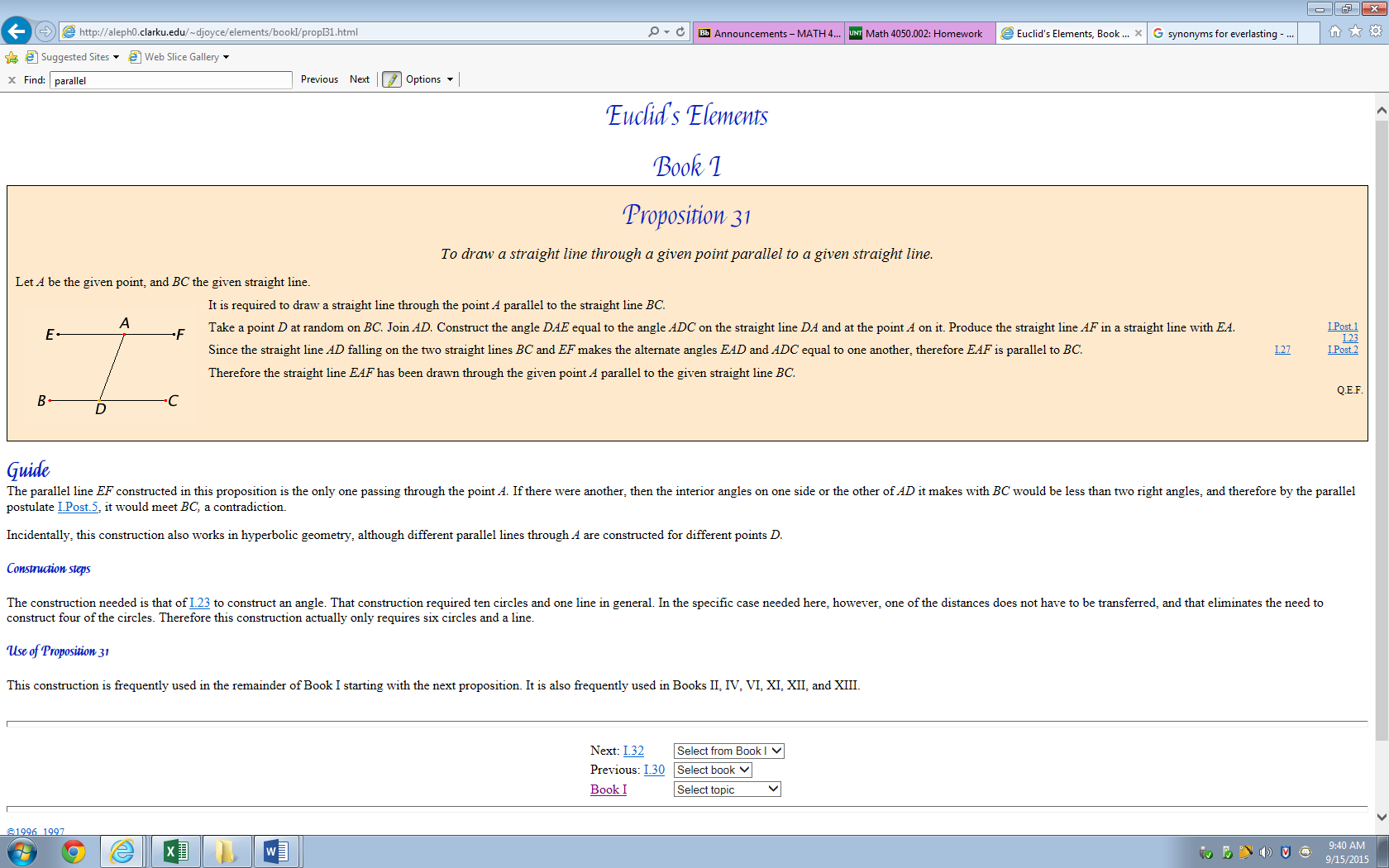
I would take my students back to the time of Euclid of Alexandria, around 300 B.C., and his great book The Elements. Little is known about Euclid except the book he left behind which is the foundation of geometry, algebra, and number theory, still to this day. Euclid wrote this book in an axiomatic way, this means that he assumes common notions, definitions, and postulates to be true and then bases all his propositions and axioms on these assumptions. Does this sound like the way that we do mathematics today? To understand how influential and enduring the Elements is I would present this incredible fact; other than the Bible, Euclid’s Elements is the most published, translated, and studied of all books in the world.

Now we would put on our Euclid caps and turn to Proposition 12 and Proposition 31. These propositions tell us how to draw parallel and perpendicular lines based only on the definitions, common notions, and axioms of Euclid. We would do the constructions step by step, straight out of Euclid’s Elements.

euclid1 euclid2


http://www.britannica.com/biography/Euclid-Greek-mathematician

http://aleph0.clarku.edu/~djoyce/elements/bookI/bookI.html


green line

A.2: How could you as a teacher create an activity or project that involves your topic?

To engage the students in the lesson on parallel and perpendicular lines, instead of sitting in class and listing real world examples of parallel and perpendicular lines, I would take the students out of the classroom and take a tour through the school like a bird watching group except our goal is to list all the parallel and perpendicular lines inside and around the school. We could go to the cafeteria, the gym, and walk around the outside of the building. When we got back to class we could create a long list of all the parallel and perpendicular lines that we see to hang on the wall during this unit. After we list the examples, I could ask some thought provoking questions:

“Why are these parallel and perpendicular lines important?”
“How would the world be different without parallel and perpendicular lines?”


green line

E.1: How can technology (YouTube, Khan Academy [khanacademy.org], Vi Hart, Geometers Sketchpad, graphing calculators, etc.) be used to effectively engage students with this topic?

A great activity I found on parallel and perpendicular lines involves using a graphing calculator to discover the similarities in slope between parallel and perpendicular lines. First, you give the students a list of equations to graph on their calculator. Next, you ask them to compare the graphs and identify which lines are parallel and which are perpendicular. Last, you ask them to compare the slopes of the parallel and perpendicular lines. Hopefully, they will discover that parallel lines have the same slope and perpendicular lines have the opposite reciprocal slope. This activity can be done easily because the students should already be familiar with graphing calculators, slope, and y-intercept. The activity would not take much time and can easily be differentiated based on the skill level of the students in your class. You can give some students difficult numbers or more lines to analyze if they finish the initial activity quickly. Also, you could take this one step further and give the students large sheets of graph paper and let them draw the lines and present their findings in front of the class.


Engaging students: Completing the square

In my capstone class for future secondary math teachers, I ask my students to come up with ideas for engaging their students with different topics in the secondary mathematics curriculum. In other words, the point of the assignment was not to devise a full-blown lesson plan on this topic. Instead, I asked my students to think about three different ways of getting their students interested in the topic in the first place.

I plan to share some of the best of these ideas on this blog (after asking my students’ permission, of course).

This student submission again comes from my former student Diana A’Lyssa Rodriguez. Her topic, from Algebra: completing the square.

green line

A2. How could you as a teacher create an activity or project that involves your topic?

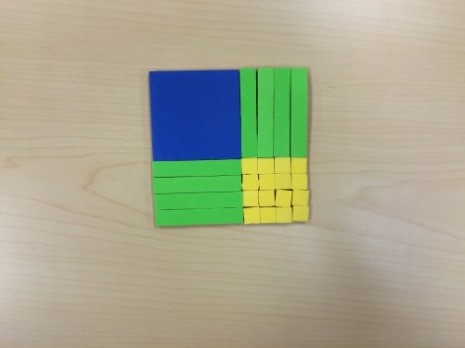
Using Algebra tiles is a great visual way for students to understand completing the square. The students start with the tiles that correspond to the given problem. The unit tiles are then flipped and moved to the other side of the equal sign. The remaining tiles are positioned into a square shape. The corner piece that appears to be missing will be filled unit tiles. What you do to one side, must be done to the other. Therefore the amount of unit tiles added to the square will also be added to the other side of the equation. Find the zero pairs and take them away. Then, find the corresponding tiles that will outline the square, so when multiplied together equals the equation.

Step 1:

square1

Step 2:

square2

Step 3:

square3

Step 4:

square4

Step 5:

square5

Step 6:

square6

Step 7:

square7

Step 8:

square8

green line

D1. What interesting things can you say about the people who contributed to the discovery and/or the development of this topic?

Around 815 – 850 AD, a mathematician Muhammad ibn Musa al-Khwarizmi was hard at work discovering algebra. He was actually the first person to write a text about algebra. His focus for a lot of the text was the dimensions of a square. At the time it was not called completing the square, but Muhammad was the one who came up with it because it is exactly what he did in order to solve the different equations he had at the time. Very similar to the process described using algebra tiles, Muhammad also saw the equations in terms of actual shapes. One of the original problems he tried to solve was x2+10x=39. He looked at x2 as a square with length x and width x. He then created a rectangle with length 10 and width x. The area would equal 10x. To make his theory work he broke up the 10x rectangle into two squares with length x and width 5. Muhammad combined the x2 square and the two 5x pieces into an L shape. This partial square must equal some square with the value of 39. So he came to the conclusion that he had to fill in what was left of the L shape to make it a square. But in order to do that he had to add that same value to the other side. In this case he added 25 (which is 5×5). Muhammad’s final answer was (x+5)2=64, x=3. This was his method but at the time he couldn’t prove that it always worked. So if and when students participate in the algebra tiles activity, they are partaking in a small piece of history.


green line

E1. How can technology be used to effectively engage students with this topic?

This video from Khan Academy is a great tool for completing the square. This video explains why we have to take half of the b value and square it (when looking at ax2+bx+c) to obtain the c value. When the students understand why we do something in math, they are more likely to be interested in the topic. The different colors that are used to write out the process allows the students to organize and understand completing the squares better. This particular video is also just long enough to capture the attention of the students but not so long as to lose it. Also, after hearing the same person explain math all the time, students may not understand it as well as they possibly could. So what is said in this video can easily be explained by the teacher but students sometimes need to hear a different voice explain a concept so they can gain a new perspective on the topic.

https://www.khanacademy.org/math/algebra/quadratics/completing_the_square/v/ex1-completing-the-square


Resources


Another poorly written word problem (Part 8)

Textbooks have included the occasional awful problem ever since Pebbles Flintstone and Bamm-Bamm Rubble chiseled their homework on slate tablets while attending Bedrock Elementary. But even with the understanding that there have been children have been doing awful homework problems since the dawn of time (and long before the advent of the Common Core), this one is a doozy.

There’s no sense having a debate about standards for elementary mathematics if textbook publishers can’t construct sentences that can be understood by students (or their parents).


badproblem3

On its face, problems 11 and 12 don’t look so bad. For #11, the appropriate inequality is

1400 + 243 + w \le 2000

1643 + w \le 2000

w \le 357

For #12, the inequality is

7 + g \le 15

g \le 8.

These indeed are the answers that the textbook is expecting. However, both answers are wrong because both w and g have to be positive. So the answers should be 0 \le w \le 357 and 0 \le g \le 8. Which would be no big deal — except that these problems appeared before compound inequalities were introduced. (Notice that problems 7 through 10 only contain a single inequality.)

So, in a nutshell, the correct answers for these problems require skills that students have not yet learned at the time that they would attempt these problems.

Another poorly written word problem (Part 6)

Textbooks have included the occasional awful problem ever since Pebbles Flintstone and Bamm-Bamm Rubble chiseled their homework on slate tablets while attending Bedrock Elementary. But even with the understanding that there have been children have been doing awful homework problems since the dawn of time (and long before the advent of the Common Core), this one is a doozy.

There’s no sense having a debate about standards for elementary mathematics if textbook publishers can’t construct sentences that can be understood by students (or their parents).


badproblem1

This one makes my blood boil. According to its advocates, the whole point of the Common Core standards was to increase the rigor in secondary mathematics. However, this one is SIMPLY WRONG.

The textbook does correctly note that the proper definition of a function is a set of ordered pairs. The “correct” answer, according to the textbook, is answer G — the plotted points do not match the ordered pairs.

However, answer H is also wrong. The textbook would have students believe that order is important when listing the elements of a set. However, order is not important — the domain of \{-3, 1, -1, 3\} is the same as \{-3, -1, 1, 3\} or latex \{3, -3, -1, 1\}$. This is standard mathematical notation — in an ordered pair (or ordered n-tuple), the order is important. For a set, the order is not important.

Specifying that the domain is \{-3,-1,1,3\} and the range is \{2,5,8,11\} does not uniquely determine the function. In fact, there are 24 different functions that have this domain and range (where we distinguish between the range of a function and its codomain).

In other words, in trying to be clever about properly defining a function and showing different representations of a function, the textbook promotes a misconception about sets… which makes me wonder if the textbook’s attempt at trying to be ultra-careful about the definition of a function is really worth it.

High-pointing a football?

Today is one of the high points of the American sports calendar: the AFC and NFC championship games to determine who plays in the Super Bowl.

A major pet peeve of mine while watching sports on TV: football announcers who “explain” that a receiver made a great reception because “he caught the ball at its highest point.”

Ignoring the effects of air resistance, the trajectory of a thrown football is parabolic, and the ball is the essentially the same height above the ground when it is either thrown or caught. (Yes, there might be a difference of at most three feet, but that’s negligible compared to the distance that a football is typically thrown.) Therefore, a football reaches the highest point of its trajectory approximately halfway between the quarterback and the receiver.

And anyone who can catch the ball that far above the ground should be immediately tested for steroids.

Diamond Rio and Proofs

Sometimes it’s pretty easy for students to push through a proof from beginning to end. For example, in my experience, math majors have little trouble with each step of the proof of the following theorem.

Theorem. If z, w \in \mathbb{C}, then \overline{z+w} = \overline{z} + \overline{w}.

Proof. Let z = a + bi, where a, b \in \mathbb{R}, and let w = c + di, where c, d \in \mathbb{R}. Then

\overline{z + w} = \overline{(a + bi) + (c + di)}

= \overline{(a+c) + (b+d) i}

= (a+c) - (b+d) i

= (a - bi) + (c - di)

= \overline{z} + \overline{w}

\square

For other theorems, it’s not so easy for students to start with the left-hand side and end with the right-hand side. For example:

Theorem. If z, w \in \mathbb{C}, then \overline{z \cdot w} = \overline{z} \cdot \overline{w}.

Proof. Let z = a + bi, where a, b \in \mathbb{R}, and let w = c + di, where c, d \in \mathbb{R}. Then

\overline{z \cdot w} = \overline{(a + bi) (c + di)}

= \overline{ac + adi + bci + bdi^2}

= \overline{ac - bd + (ad + bc)i}

= ac - bd - (ad + bc)i

= ac - bd - adi - bci.

A sharp math major can then provide the next few steps of the proof from here; however, it’s not uncommon for a student new to proofs to get stuck at this point. Inevitably, somebody asks if we can do the same thing to the right-hand side to get the same thing. I’ll say, “Sure, let’s try it”:

\overline{z} \cdot \overline{w} = \overline{(a + bi)} \cdot \overline{(c + di)}

= (a-bi)(c-di)

= ac -adi - bci + bdi^2

= ac - bd - adi - bci.

\square

I call working with both the left and right sides to end up at the same spot the Diamond Rio approach to proofs: “I’ll start walking your way; you start walking mine; we meet in the middle ‘neath that old Georgia pine.” Not surprisingly, labeling this with a catchy country song helps the idea stick in my students’ heads.

Though not the most elegant presentation, this is logically correct because the steps for the right-hand side can be reversed and appended to the steps for the left-hand side:

Proof (more elegant). Let z = a + bi, where a, b \in \mathbb{R}, and let w = c + di, where c, d \in \mathbb{R}. Then

\overline{z \cdot w} = \overline{(a + bi) (c + di)}

= \overline{ac + adi + bci + bdi^2}

= \overline{ac - bd + (ad + bc)i}

= ac - bd - (ad + bc)i

= ac - bd - adi - bci

= ac -adi - bci + bdi^2

= (a-bi)(c-di)

= \overline{(a + bi)} \cdot \overline{(c + di)}

\overline{z} \cdot \overline{w}.

\square