Inverse Functions: Solving Equations (Part 4)

Although disguised, inverse functions play an important role in the ordinary solution of equations. For example, consider the steps used to solve this simple algebra problem:

2x + 4 = 10

2x = 6

x = 3

To go from the first equation to the second equation, let X_1 = 2x+4 and X_2 = 10, and let $f(x) = x – 4$. This is an bijective function with inverse f^{-1}(x) = x +4. Therefore,

X_1 = X_2 \quad \Longleftrightarrow \quad f(X_1) = f(X_2)

Stated another way,

2x + 4 = 10 \quad \Longleftrightarrow 2x = 6

Again, let $X_3 = 2x$ and $X_4 = 6$, and let $g(x) = x/2$. This is also a bijective function with inverse function $g^{-1}(x) = 2x$. Therefore,

X_3= X_4 \quad \Longleftrightarrow \quad g(X_1) = g(X_2)

Stated another way,

$latex 2x + 4 = 10 \quad \Longleftrightarrow 2x = 6 \quad \Longleftrightarrow x = 3$

So we are guaranteed that x= 3 is the one and only one solution of this equation.

green lineIf the process of solving an equation requires the use of a function that isn’t a bijection, then funny things can happen. For example, consider the slightly more complicated equation

\sqrt{x} = x - 6

Let’s starting solving by squaring both sides:

x = (x-6)^2

x = x^2 - 12x + 36

0 = x^2 - 13x + 36

0 = (x-9)(x-4)

x - 9 = 0 \quad \hbox{or} \quad x - 4 = 0

x = 9 \quad \hbox{or} \quad x = 4

So there are two solutions, right? Well…

\sqrt{9} = 3 = 9 - 6,

but \sqrt{4} \ne 4 - 6!

So what happened? In other words, what is qualitatively different about this problem that didn’t happen in the first problem to produce an extraneous solution? The problem is the first step. Let X_1 = \sqrt{x} and X_2 = x-6. We applied the function f(x) = x^2 to both sides. Unfortuntely, f(x) = x^2 is not an invertible function when using the entire real line as the domain of f. In other words,

\sqrt{x} = x -6 \quad implies \quad x = (x-6)^2,

but x =(x-6)^2 \quad does not imply that \quad \sqrt{x} = x - 6.

 The practical upshot is that, when arriving at the final step of the solution, we can’t be certain that the “solutions” we obtain actually work. Instead, what we’ve really shown that anything other than the solutions can’t work, which is different than saying that these two solutions actually do work. So it remains to actually check that these potential solutions are actually solutions (or not).

Functions that commute

At the bottom of this post is a one-liner that I use in my classes the first time I present a theorem where two functions are permitted to commute. At many layers of the mathematics curriculum, students learn about that various functions can essentially commute with each other. In other words, the order in which the operations is performed doesn’t affect the final answer. Here’s a partial list off the top of my head:

  1. Arithmetic/Algebra: a \cdot (b + c) = a \cdot b + a \cdot c. This of course is commonly called the distributive property (and not the commutative property), but the essential idea is that the same answer is obtained whether the multiplications are performed first or if the addition is performed first.
  2. Algebra: If a,b > 0, then \sqrt{ab} = \sqrt{a} \sqrt{b}.
  3. Algebra: If a,b > 0 and x is any real number, then (ab)^x = a^x b^x.
  4. Precalculus: \displaystyle \sum_{i=1}^n (a_i+b_i) = \displaystyle \sum_{i=1}^n a_i + \sum_{i=1}^n b_i.
  5. Precalculus: \displaystyle \sum_{i=1}^n c a_i = c \displaystyle \sum_{i=1}^n a_i.
  6. Calculus: If f is continuous at an interior point c, then \displaystyle \lim_{x \to c} f(x) = f(c).
  7. Calculus: If f and g are differentiable, then (f+g)' = f' + g'.
  8. Calculus: If f is differentiable and c is a constant, then (cf)' = cf'.
  9. Calculus: If f and g are integrable, then \int (f+g) = \int f + \int g.
  10. Calculus: If f is integrable and c is a constant, then \int cf = c \int f.
  11. Calculus: If f: \mathbb{R}^2 \to \mathbb{R} is integrable, \iint f(x,y) dx dy = \iint f(x,y) dy dx.
  12. Calculus: For most differentiable function f: \mathbb{R}^2 \to \mathbb{R} that arise in practice, \displaystyle \frac{\partial^2 f}{\partial x \partial y} = \displaystyle \frac{\partial^2 f}{\partial y \partial x}.
  13. Probability: If X and Y are random variables, then E(X+Y) = E(X) + E(Y).
  14. Probability: If X is a random variable and c is a constant, then E(cX) = c E(X).
  15. Probability: If X and Y are independent random variables, then E(XY) = E(X) E(Y).
  16. Probability: If X and Y are independent random variables, then \hbox{Var}(X+Y) = \hbox{Var}(X) + \hbox{Var}(Y).
  17. Set theory: If A, B, and C are sets, then A \cup (B \cap C) = (A \cup B) \cap (A \cup C).
  18. Set theory: If A, B, and C are sets, then A \cap (B \cup C) = (A \cap B) \cup (A \cap C).

However, there are plenty of instances when two functions do not commute. Most of these, of course, are common mistakes that students make when they first encounter these concepts. Here’s a partial list off the top of my head. (For all of these, the inequality sign means that the two sides do not have to be equal… though there may be special cases when equality happens to happen.)

  1. Algebra: (a+b)^x \ne a^x + b^x if x \ne 1. Important special cases are x = 2, x = 1/2, and x = -1.
  2. Algebra/Precalculus: \log_b(x+y) = \log_b x + \log_b y. I call this the third classic blunder.
  3. Precalculus: (f \circ g)(x) \ne (g \circ f)(x).
  4. Precalculus: \sin(x+y) \ne \sin x + \sin y, \cos(x+y) \ne \cos x + \cos y, etc.
  5. Precalculus: \displaystyle \sum_{i=1}^n (a_i b_i) \ne \displaystyle \left(\sum_{i=1}^n a_i \right) \left( \sum_{i=1}^n b_i \right).
  6. Calculus: (fg)' \ne f' \cdot g'.
  7. Calculus \left( \displaystyle \frac{f}{g} \right)' \ne \displaystyle \frac{f'}{g'}
  8. Calculus: \int fg \ne \left( \int f \right) \left( \int g \right).
  9. Probability: If X and Y are dependent random variables, then E(XY) \ne E(X) E(Y).
  10. Probability: If X and Y are dependent random variables, then \hbox{Var}(X+Y) \ne \hbox{Var}(X) + \hbox{Var}(Y).

All this to say, it’s a big deal when two functions commute, because this doesn’t happen all the time.

green lineI wish I could remember the speaker’s name, but I heard the following one-liner at a state mathematics conference many years ago, and I’ve used it to great effect in my classes ever since. Whenever I present a property where two functions commute, I’ll say, “In other words, the order of operations does not matter. This is a big deal, because, in real life, the order of operations usually is important. For example, this morning, you probably got dressed and then went outside. The order was important.”


Fun with combinatorics

I found the following videos through UpWorthy: http://www.upworthy.com/see-this-teachers-amazing-response-to-the-question-but-when-are-we-gonna-have-to-use-this. Hats off to this wonderful middle school math teacher for engaging his students in some surprisingly rich problems.

Part 1 (be sure to read the comments in the original YouTube video to see why the answer isn’t 2^{10} \cdot 10!):

Part 2:

Finding the equation of a line between two points

Here’s a standard problem that could be found in any Algebra I textbook.

Find the equation of the line between (-1,-2) and (4,2).

The first step is clear: the slope of the line is

m = \displaystyle \frac{2-(-2)}{4-(-1)} = \frac{4}{5}

At this point, there are two reasonable approaches for finding the equation of the line.

Method #1. This is the method that was hammered into my head when I took Algebra I. We use the point-slope form of the line:

y - y_1 = m (x - x_1)

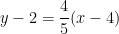
y - 2 = \displaystyle \frac{4}{5} (x-4)

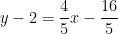
y - 2 = \displaystyle \frac{4}{5}x - \frac{16}{5}

y = \displaystyle \frac{4}{5}x - \frac{6}{5}

For what it’s worth, the point-slope form of the line relies on the fact that the slope between (x,y) and (x_1,y_1) is also equal to m.

Method #2. I can honestly say that I never saw this second method until I became a college professor and I saw it on my students’ homework. In fact, I was so taken aback that I almost marked the solution incorrect until I took a minute to think through the logic of my students’ solution. Let’s set up the slope-intercept form of a line:

y= \displaystyle \frac{4}{5}x + b

Then we plug in one of the points for x and y to solve for b.

2 = \displaystyle \frac{4}{5}(4) + b

\displaystyle -\frac{6}{5} = b

Therefore, the line is y = \displaystyle \frac{4}{5}x - \frac{6}{5}.

green lineMy experience is that most college students prefer Method #2, and I can’t say that I blame them. The slope-intercept form of a line is far easier to use than the point-slope form, and it’s one less formula to memorize.

Still, I’d like to point out that there are instances in courses above Algebra I that the point-slope form is really helpful, and so the point-slope form should continue to be taught in Algebra I so that students are prepared for these applications later in life.

Topic #1. In calculus, if f is differentiable, then the tangent line to the curve y=f(x) at the point (a,f(a)) has slope f'(a). Therefore, the equation of the tangent line (or the linearization) has the form

y = f(a) + f'(a) \cdot (x-a)

This linearization is immediately obtained from the point-slope form of a line. It also can be obtained using Method #2 above, so it takes a little bit of extra work.

This linearization is used to derive Newton’s method for approximating the roots of functions, and it is a precursor to Taylor series.

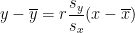
Topic #2. In statistics, a common topic is finding the least-squares fit to a set of points (x_1,y_1), (x_2,y_2), \dots, (x_n,y_n). The solution is called the regression line, which has the form

y - \overline{y} = r \displaystyle \frac{s_y}{s_x} (x - \overline{x})

In this equation,

  • \overline{x} and \overline{y} are the means of the x- and y-values, respectively.
  • s_x and s_y are the sample standard deviations of the x- and y-values, respectively.
  • r is the correlation coefficient between the x- and y-values.

The formula of the regression line is decidedly easier to write in point-slope form than in slope-intercept form. Also, the point-slope form makes the interpretation of the regression line clear: it must pass through the point of averages (\overline{x}, \overline{y}).

Engaging students: the difference of two squares

In my capstone class for future secondary math teachers, I ask my students to come up with ideas for engaging their students with different topics in the secondary mathematics curriculum. In other words, the point of the assignment was not to devise a full-blown lesson plan on this topic. Instead, I asked my students to think about three different ways of getting their students interested in the topic in the first place.

I plan to share some of the best of these ideas on this blog (after asking my students’ permission, of course).

This student submission comes from my former student Dale Montgomery. His topic, from Algebra II: the difference of two squares.

green line

Application/Future Curriculum (science)-

You can use difference of squares to find a basic formula to be used in any problem where you drop an object and want to find what time it will take to land. This physics concept will be of interest to your students considering any mechanical science and a useful tool to introduce problem solving by manipulating equations.

Take any height h. If you were to drop an object from this height then it could be modeled with a distance over time graph using the equation

(h- 9.8/2) t^2.

By applying difference of squares you get the expression

[\sqrt{h}+\sqrt{4.9}] t) \times ( [\sqrt{h} - \sqrt{4.9}] t).

Then by setting this expression equal to 0 and manipulating you would get that
t = \pm \displaystyle \frac{\sqrt{h}}{\sqrt{4.9}}.

I like a situation like this because it allows you to give them linking knowledge about quadratic equations. Most students may not have been exposed to this type of physics yet.  However, it is a requirement, and having this knowledge will help them in that class. On top of that it helps with equation manipulation and answering the question, “Does my answer make sense.” This question needs to be asked since it is possible for a student to get an answer of negative time. All of these skills combined with the new topic of difference of squares make for a multifaceted problem. This would probably not be great for day 1 of difference of squares, but I could see it as an engage for the continuance of the lesson.

green line

Curriculum:

You can use the idea of graphing to show that difference of squares works. This is a good way to give visual representation to your students who need it. If you compare the factoring of x^2-9 to the graph of y=x^2-9 and finding the roots of that graph, you can show that they have the same solutions. It is not that novel, but this visual can just help the idea click into students’ minds.

ParabolaGraph

green line

Manipulative

A manipulative that I got the idea for from http://www.gbbservices.com/math/squarediff.html is using squares to show the difference of squares. This is done quite easily as shown in the picture below. This could be done along a lesson on difference of squares. Maybe this would follow easily from a factoring using algebra tiles. The image below is fairly self explanatory and would really help if made into a hands-on manipulative that kinesthetic learners could make great use of.
DifferenceOfTwoSquares

Engaging students: Slope-intercept form of a line

In my capstone class for future secondary math teachers, I ask my students to come up with ideas for engaging their students with different topics in the secondary mathematics curriculum. In other words, the point of the assignment was not to devise a full-blown lesson plan on this topic. Instead, I asked my students to think about three different ways of getting their students interested in the topic in the first place.

I plan to share some of the best of these ideas on this blog (after asking my students’ permission, of course).

This student submission comes from my former student Theresa (Tress) Kringen. Her topic, from Algebra I: the point-slope intercept form of a line.

green line

What interesting word problem using this topic can your students do now?

When learning about slope-intercept from of a line, word problems would help my students engage and help process the information in a real world situation. I would present an equation for the speed of a ball that is thrown in a straight line up into the air. The equation given: v= 128-32t. I would explain that because we’re working with time and speed, height is not a variable in the equation. With v representing the speed or velocity of the ball in feet per second and t representing the time in seconds that has passed. I would include the following questions:

1. What is the slope of the given equation? Since the equation is given in slope intercept form, the students should be able to give the answer quickly if they understood the lesson. The answer is -32.

2. Without graphing the equation, which way would the line be headed, up and to the right or down and to the right? Because the students know that the slope is negative and given that they understood the lesson, they should be able to answer that the line is decreasing and is headed down and to the right.

http://www.purplemath.com/modules/slopyint.htm

green line

How can this topic be used in your students’ future courses in mathematics or science?

Students can use this topic for many math or science courses. When dealing with a linear equation, slope-intercept form of a line can help the student understand what the graph looks like without actually graphing it. This is useful when needing to find the y intercept (when x is equal to zero) and what the slope of the line is. This is also useful to know for understanding what slope is. When students understand that a slope of a particularly large number (a large whole number such as 1,000 or an improper fraction that equates to a large number such as 30,999/2) is rising quickly as opposed to a slope of a smaller number  (a smaller whole number such as two or a fraction that represents a very small portion of one such as 1/30,000) which is not rising quickly. It is helpful for the students to understand that a very large slope will look almost vertical and a small slope will look almost horizontal, with both depending on the degree of largeness or smallness.

green line

How can technology be used to effectively engage students with this topic?

When working with slope-intercept form, a student can actively be engaged through technology by attempting to make connections of how a graph looks on the graphing calculator and what the equation looks like in slope-intercept form. When allowing the students to make connections between them in small groups, they will have discovered the information form themselves. This will allow the students to more effectively program the information into their memories. To set this up, I would give each group a graphing calculator and a list of equations in slope-intercept form. On the paper with the list, I would have the students fill out information pertaining to the graph that they see. This information would include the slope and the y-intercept. I would split up the students into their cooperative learning groups two and ask them to draw a conclusion between where the line ends up compared to what the equation looks like. Once the students have typed their equation into the graphing calculator the students should fill out the paper provided. Once they have finished, I would ask them to see if they see any patterns between the equations and their answers.


Engaging students: Order of operations

In my capstone class for future secondary math teachers, I ask my students to come up with ideas for engaging their students with different topics in the secondary mathematics curriculum. In other words, the point of the assignment was not to devise a full-blown lesson plan on this topic. Instead, I asked my students to think about three different ways of getting their students interested in the topic in the first place.

I plan to share some of the best of these ideas on this blog (after asking my students’ permission, of course).

This student submission comes from my former student Theresa (Tress) Kringen. Her topic, from Pre-Algebra: order of operations.

green line

How can this topic be used in your students’ future courses in mathematics or science?

Order of operations is commonly used in most mathematics problem that involve more than one operation or when parenthesis are involved. It would be easy to show the students what the answer to a given problem, say 5+20/5, would be when using the proper order of operations, then solve the problem by solving left to right as you would read a book. It is clear, to a math major, that the answer is 9. For someone who does not know the order of operations, they most likely would come up with the answer of 5. The difference in the correct answer and the incorrect answer is only 4, but the problem is only working with numbers less than or equal to twenty. It would then be beneficial to point out that when dealing with more complex problems, that this answer may become even larger.  If the class was working on given problems, I would give them a few word problems to solve. Once they solved them on their own, I would show them that the difference between the correct way to answer the given problem and the incorrect way to answer the problem to help them connect the concept to why it is important to compute answers in the way.

green lineHow does this topic extend what your students should have learned in previous courses?

This topic extends what students should have previously learned by allowing them to use their skills of multiplication, division, exponents, addition, and subtraction to solve more complex problems. When learning how to solve problems more complicated than what they have been given in the past, they use this topic to guide them through to the next step. They must already be familiar with all of the operations by themselves prior to using the order of operations to solve a problem. Once they are accustomed to using the order of operations, the will be given more challenging problems and their math skills will build upon itself. It is clear that if a student is unable to solve a simple problem, such as an exponent problem or a more complicated division problem, they will not be able to use the order of operations for problems that contain what they have not learned.

green line

How did people’s conception of this topic change over time?

It is believed that the idea of using multiplication before addition became a concept adopted around the 1600s and was not disagreed about. The other operations took their place in the order over time, beginning in the 1600s. It seems that although it was not documented well, most mathematicians agreed upon the same order. It wasn’t until books stated being published that it was important to document the order of operations. The notation may have been different depending on who was writing on the subject, but the concept was the same. It seems that although it was not documented well, most mathematicians agreed upon the same order. Once books were being published, the order, PEMDAS (Parenthesis, Exponents, Multiplication, Division, Addition, and Subtraction), was put into print. Now, teachers use the phrase Please Excuse My Dear Aunt Sally as a way for students to remember the acronym and are able to put it to use.

http://jeff560.tripod.com/operation.html

http://mathforum.org/library/drmath/view/52582.html