Engaging students: Graphing parabolas

In my capstone class for future secondary math teachers, I ask my students to come up with ideas for engaging their students with different topics in the secondary mathematics curriculum. In other words, the point of the assignment was not to devise a full-blown lesson plan on this topic. Instead, I asked my students to think about three different ways of getting their students interested in the topic in the first place.

I plan to share some of the best of these ideas on this blog (after asking my students’ permission, of course).

This student submission again comes from my former student Irene Ogeto. Her topic, from Algebra: graphing parabolas.

green line

B2. How does this topic extend what your students should have learned in previous courses?

In previous courses, students should have learned about linear functions of the form y = mx + b. Parabolas are functions of the form y = a(x-h) + k. Graphing parabolas extends their thinking because it allows to students to see the graph of a function that is different from the graph of a line. Students can explore the similarities and differences between linear functions and quadratic functions. Students can apply the same logic they used when graphing linear functions by making a table and use the points to plot the graph. Students can use the graph of parabolas to determine the equation of the quadratic function. Students can apply transformations of graphs such as reflecting, stretching or compressing to parabolic functions as well. Graphing parabolas allows students to explore concepts they previously learned such as parent functions, y-intercepts, x-intercepts, and symmetry.

green line

C2. How has this topic appeared in high culture (art, classical music, theatre, etc.)?

Parabolic curves are all around us in buildings, churches, restaurants, homes, schools and other places. Parabolas are apparent in numerous places in architecture. One example where parabolic curves can be found in architecture is in suspension bridges such as the Brooklyn Bridge in New York, the Golden Gate Bridge in California, or the George Washington Bridge in New Jersey. Suspension bridges are mainly used to carry loads over a long distance and most suspension bridges are lengthy in distance. In suspension bridges, cables, ropes or chains are suspended throughout the road. The cables under tension form the parabolic curve. The towers and hangers are used to support the cables throughout the bridge. Seeing how parabolas appear in high culture will allow students to make a connection between math and the things that may see around them. Hopefully the students can see that math, specifically parabolas in this case are not only found in the classroom.


bridge1 bridge2


green line

E1. How can technology (YouTube, Khan Academy [khanacademy.org], VI Hart, Geometers Sketchpad, graphing calculators, etc.) be used to effectively engage students with this topic?

This YouTube video, “Water Slide Stunt,” is a great way to introduce students to graphing parabolas. It allows students to see the curve that parabolic functions make. In addition, it gives students an example of a real-world situation where projectile motion and parabolic functions can be seen. This video can be used at the beginning of a lesson on graphing parabolas. This video is engaging because it gets the students thinking about projectile motion and it shows how math can be related to different things in our society. In addition, students can also look up this video on YouTube on their own time and share with others.


References:

https://www.youtube.com/watch?v=3wAjpMP5eyo

http://science.howstuffworks.com/engineering/civil/bridge6.htm

Thoughts on the Accidental Fraction Brainbuster

I really enjoyed reading a recent article on Math With Bad Drawings centered on solving the following problem without a calculator:

I won’t repeat the whole post here, but it’s an excellent exercise in numeracy, or developing intuitive understanding of numbers without necessarily doing a ton of computations. It’s also a fun exercise to see how much we can figure out without resorting to plugging into a calculator. I highly recommend reading it.

When I saw this problem, my first reflex wasn’t the technique used in the post. Instead, I thought to try the logic that follows. I don’t claim that this is a better way of solving the problem than the original solution linked above. But I do think that this alternative solution, in its own way, also encourages numeracy as well as what we can quickly determine without using a calculator.

Let’s get a common denominator for the two fractions:

\displaystyle \frac{3997 \times 5001}{4001 \times 5001} \qquad and \displaystyle \qquad \frac{4001 \times 4996}{4001 \times 5001}.

Since the denominators are the same, there is no need to actually compute 4001 \times 5001. Instead, the larger fraction can be determined by figuring out which numerator is largest. At first glance, that looks like a lot of work without a calculator! However, the numerators can both be expanded by cleverly using the distributive law:

3997 \times 5001 = (4000-3)(5000+1) = 4000\times 5000 + 4000 - 3 \times 5000 - 3,

4001 \times 4996 = (4000+1)(5000-4) = 4000\times 5000 - 4 \times 4000 + 5000 - 4.

We can figure out which one is bigger without a calculator — or even directly figuring out each product.

  • Each contains 4000 \times 5000, so we can ignore this common term in both expressions.
  • Also, 4000 - 3\times 5000 and 5000 - 4 \times 4000 are both equal to -11,000, and so we can ignore the middle two terms of both expressions.
  • The only difference is that there’s a -3 on the top line and a -4 on the bottom line.

Therefore, the first numerator is the larger one, and so \displaystyle \frac{3997}{4001} is the larger fraction.

Once again, I really like the original question as a creative question that initially looks intractable that is nevertheless within the grasp of middle-school students. Also, I reiterate that I don’t claim that the above is a superior method, as I really like the method suggested in the original post. Instead, I humbly offer this alternate solution that encourages the development of numeracy.

Engaging students: Using the point-slope equation of a line

In my capstone class for future secondary math teachers, I ask my students to come up with ideas for engaging their students with different topics in the secondary mathematics curriculum. In other words, the point of the assignment was not to devise a full-blown lesson plan on this topic. Instead, I asked my students to think about three different ways of getting their students interested in the topic in the first place.

I plan to share some of the best of these ideas on this blog (after asking my students’ permission, of course).

This student submission again comes from my former student Tiffany Jones. Her topic, from Algebra: using the point-slope equation of a line.

green line


B1. How can this topic be used in your students’ future courses in mathematics or science?


The topic of using the point-slope equation of a line comes up in some of the early topics of Calculus 1 such as, how to find the equation of the tangent line of a curve at a given point. The slope, ­, of the tangent line of a curve at a given point, , is equal to the instantaneous rate of change or slope of the curve at that given point. The slope is calculated by evaluating the following limit:

\displaystyle m = \lim_{h \to 0} \frac{f(x_0+h)-f(x_0)}{h}

If the difference quotient has a limit as h approaches zero, then that limit is called the derivative of the function at . Then, values of  and  are substituted into the point-slope equation of a line to determine the equation of the tangent line of a curve at a given point.

y-y_0 = m(x-x_0)

green line

C1. How has this topic appeared in pop culture?

On December 31st 1965, Chuck Jones’ released an animated short titled “The Dot and The Line: A Romance in Low Mathematics”. This ten minute, Oscar-winning film explores the complex relationship between lines, dots, and disorganization. The Line as desperately in love with the Dot. Yet, the Dot is currently involved with a chaotic Squiggle. The Dot ignores the Line, disregarding him as boring and predictable. He lacks complexity. Through a montage following this rejection, the line teaches himself to create angles, form curves, and produce close-ended shapes as well. With this new confidence, he then reveals his newfound self to the Dot. The Dot sees that there is no method to the Squiggles madness.

While the topic of using the point slope equation of a line is not an explicit topic of the short, I feel that this video as an engage activity can be great conversation starter about the relationship between a point and a line. From there the lesson can go on to talk about the point-slope equation. Furthermore, this video can open discussions about the slope-intercept and the point-point forms of a line.

green line

E1. How can technology be used to effectively engage students with this topic?

Explore Learning offers a Gizmo and worksheet on the point-slope form of a line. The Gizmo is an interactive simulator that allows the student to physically move the point around the Cartesian plane or use the sliders to adjust the point values and the slope value. The Gizmo shows the resulting line. I think that the use of such a tool can reinforce the relationship of a particular slope and a particular point to give an equation of a line.

The Gizmo offers to the slope-intercept form of the equation. So this simulator can also be used for a lesson on the slope-intercept form. Also, the Gizmo can place a right triangle along the line with leg lengths to show how the rise and run values change with the overall slope value.

Additionally, I think that this simulator can be used to allow the students to explore the equation. For instance, the students can see why when the graph is shifted to the left 2 units, the resulting equation has (x+2).


References:

http://www.imdb.com/title/tt0059122/?ref_=ttawd_awd_tt

https://www.youtube.com/watch?v=OmSbdvzbOzY

https://www.explorelearning.com/index.cfm?ResourceID=16*4&method=cResource.dspDetail

https://s3.amazonaws.com/el-gizmos/materials/PointSlopeSE.pdf


Engaging students: Multiplying binomials

In my capstone class for future secondary math teachers, I ask my students to come up with ideas for engaging their students with different topics in the secondary mathematics curriculum. In other words, the point of the assignment was not to devise a full-blown lesson plan on this topic. Instead, I asked my students to think about three different ways of getting their students interested in the topic in the first place.

I plan to share some of the best of these ideas on this blog (after asking my students’ permission, of course).

This student submission again comes from my former student Perla Perez. Her topic, from Algebra: multiplying binomials.

green line

B1. How can this topic be used in your students’ future courses in mathematics or science?

As students progress through different levels of math, they will continue to utilize tools, such as multiplication of binomials. When I give students the solutions to a quadratic function and ask them to find the equation, I expect for them to know how to multiply the binomials. For example: find the quadratic equation with the solution x=-2,2. The students are to set up as: (x+2)(x-2) and go forth. The students can also be given a quadratic equation, x2+6x+8 and are to find the solutions in representation (x+2)(x+4). In order to arrive at the answer, the students will have to factor the original equation. To check their work, they can just multiply the answer that they get. Multiplying the binomials is a more complex form of the distributive property. It’s a building block for more challenging math concepts. Multiplying binomials essentially does the opposite of factorization, which students will learn later on in their algebra class. Binomials are also used in sciences, such as physics, biology, and computer science, so it helps for students to have a strong foundation on this topic.

green line

B2. How does this topic extend what your students should have learned in previous courses?


I’ve seen students panic when a new concept, equation, or definition is introduce. Before they begin thinking again that math is some sort of sorcery, showing them something familiar will help ease the students into a new topic that is an extension of what they previously learned. Students learn about distributive property in their pre-algebra course. In order for students to multiply binomials students need to understand distributive property. Distributive property is a building block that is needed for the multiplication of binomials. It works with singles terms being multiplied, where as binomial multiplication works with two. In a way it is like learning how to add single digits to double digits. In order to teach this, I would first reintroduce 4-5 problems they’ve seen in their previous class using distributive property with single terms such as 4(x+5). Once they begin to recognize and solve the problems, I will begin to introduce two terms rather than just one. When they compare their previous knowledge to this new idea they will see that it is not very different.


green line

A1. What interesting (i.e., uncontrived) word problems using this topic can your students do now? (You may find resources such as http://www.spacemath.nasa.gov to be very helpful in this regard; feel free to suggest others.)

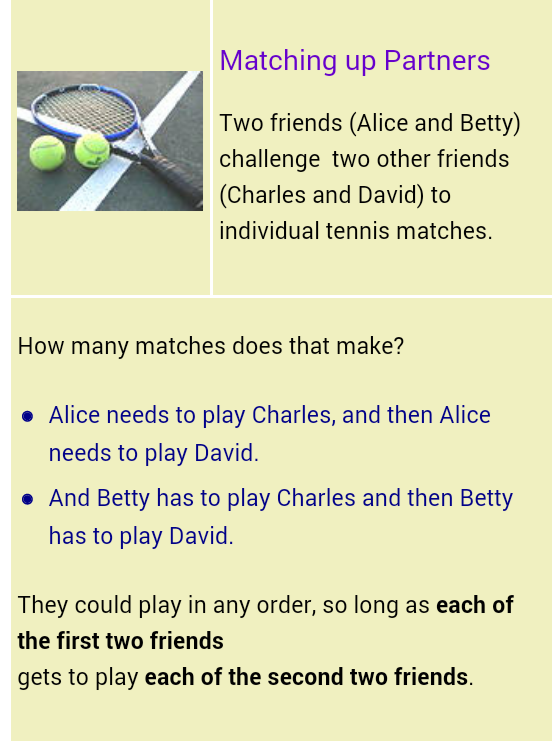
Students often find it difficult to understand why we use certain tools, such as the multiplication of binomials. Word problems are a good solution when introducing a new topic. There are many methods for multiplying binomials, such as the FOIL and the CLAW methods, and it is important that student learn them; however, students who struggle with the topic need new information to be presented in a different way. The website mathisfun.com has a great word problem for multiplying binomials.

tennis

I like this problem because it divides the topic into separate steps, making it easier for the student to understand what to do. With this particular word problem, the teacher can begin to see where the students are having difficulties. This allows the teacher to see what areas need to be revisited, such as order of operations, the multiplication of a negative or positive number etc. Word problems also help teachers evaluate the critical thinking skills of their students.

My References are:

https://www.mathsisfun.com/algebra/polynomials-multiplying.html

http://ritter.tea.state.tx.us/rules/tac/chapter111/ch111c.html


Engaging students: Approximating data by a straight line

In my capstone class for future secondary math teachers, I ask my students to come up with ideas for engaging their students with different topics in the secondary mathematics curriculum. In other words, the point of the assignment was not to devise a full-blown lesson plan on this topic. Instead, I asked my students to think about three different ways of getting their students interested in the topic in the first place.

I plan to share some of the best of these ideas on this blog (after asking my students’ permission, of course).

This student submission again comes from my former student Esmerelda Sheran. Her topic, from Algebra: approximating data by a straight line.

green line

A.2) How could you as a teacher create an activity or project that involves your topic?


If I created an activity for my class over approximating data by using a straight line I would make sure the type of data, they use is something that is relevant or interesting in the student’s lives. I would have the students work in pairs and choose the data they would work with out of three sets of data I have chosen. Examples of the choices of data would be the relationships between interceptions and wins for NFL teams, car accidents and age, or attendance and GPA (in college/universities). Using the data they chose the students would first take an educated guess of how the graph would look like, draw the scatter plot associated with the data, and compare their guess to the actual graph. At that point the students would try to identify the parent function (xb+c, mx+b, ab, ln(x) etc.) that the data is most similar to or if the data even has correlation. They would then draw what they believed the best fit line would look like on the scatterplot which they would compare to the linear regression once they calculated it on a graphing calculator. I would hope that this activity would be interesting due to the data being real and relatable as well as it being a way to connect parent functions and statistical data.

green line

D.1) What interesting things can you say about the people who contributed to the discovery and/or the development of this topic?

Two of the main collaborators of linear regression are Sir Francis Galton and Karl Pearson. Galton was the discoverer of the linear regression and Pearson further elaborated on Galton’s ideas. Linear regression actually came to be because of sweet peas, Galton was studying heredity in sweet peas and formulated linear regression to aid him in studying the relations he found in his studies. Galton was much more than a hereditist, he was a geologist, meteorologist, tropical explorer, founder of differential psychology, inventor of fingerprint identifications, and an author. A few more interesting things about Galton is that he was knighted, he was accused of promoting eugenics, he was British and he was a half cousin of Charles Darwin. If you were wondering what “eugenics” is, it is the idea of planned breeding of humans through selectively breeding and sterilization. Galton once said, “… I object to pretensions of natural equality.” Being that Galton studied heredity it is no wonder that he felt that some physical/mental/emotional attributes where superior and that humans would benefit from having the “best” genes. Unfortunately for Galton eugenics was frowned upon and he was attacked for promoting it. I think that students would find Galton extremely interesting because of his wide variety of interests.

Karl Pearson, although not as complex as Galton had a few attributes that I feel would interest students. Pearson did not have a childhood that would be considered normal in modern day. Pearson was homeschooled up until he turned nine, and then he went to London alone to study at the University of College School. After he received his degrees and studied physics, metaphysics and Darwinism, Pearson developed his own view in social Darwinism. The social beliefs, he developed led him to changing his name from Carl to Karl.


green line

E.1) How can technology be used to effectively engage students with this topic?


Technology in the classroom has and always will be an effective way to engage students if used correctly. To engage my students to learn how to approximated data with a straight line I would use excel, a smartboard, or the khan academy website. Excel is a useful piece of technology that is underappreciated by the average Joe. With a set of data you can record the relationships and then use the tools to create a scatterplot and then find the linear regression line on the graph.

Using a smartboard in the classroom is effective because it is new technology that is very special and kind of rare. Using smartboard to graph the points of data and then drawing an approximated regression line is highly kinesthetic and gives hands-on experiences instead of just typing in number and getting a calculated result that required almost no brain power. Kinesthetically moving their arms up, down, or side to side helps the students get a feel for the variation and relations between the data and drawing a best fit line themselves help the student understand the data on a different level. The Khan Academy website is a great resource for being introduced and even mastering the concept of linear regression because of the different activities available. For visual and auditory learners, there are a series of videos that explain approximating data by linear regression as well as how to be the most accurate when approximating. Similarly, there is an activity for kinesthetic learners in which they can move a line around to see which line seems most like the best fit line. It is beneficial from an instructor to use this website to help students of all learning types.


References

http://www.mirror.co.uk/news/uk-news/elderly-priest-found-dead-after-5099110

https://www.dartmouth.edu/~matc/math5.geometry/unit2/unit2.html

http://geomhistory.com/home.html

http://www.americanegypt.com/feature/cities/chichenitza/castillo_shadow.htm

https://explorable.com/greek-geometry


Engaging students: Parallel and perpendicular lines

In my capstone class for future secondary math teachers, I ask my students to come up with ideas for engaging their students with different topics in the secondary mathematics curriculum. In other words, the point of the assignment was not to devise a full-blown lesson plan on this topic. Instead, I asked my students to think about three different ways of getting their students interested in the topic in the first place.

I plan to share some of the best of these ideas on this blog (after asking my students’ permission, of course).

This student submission again comes from my former student Emma Sivado. Her topic, from Algebra: parallel and perpendicular lines.

green line

D.1: What interesting things can you say about the people who contributed to the discovery and/or the development of this topic?

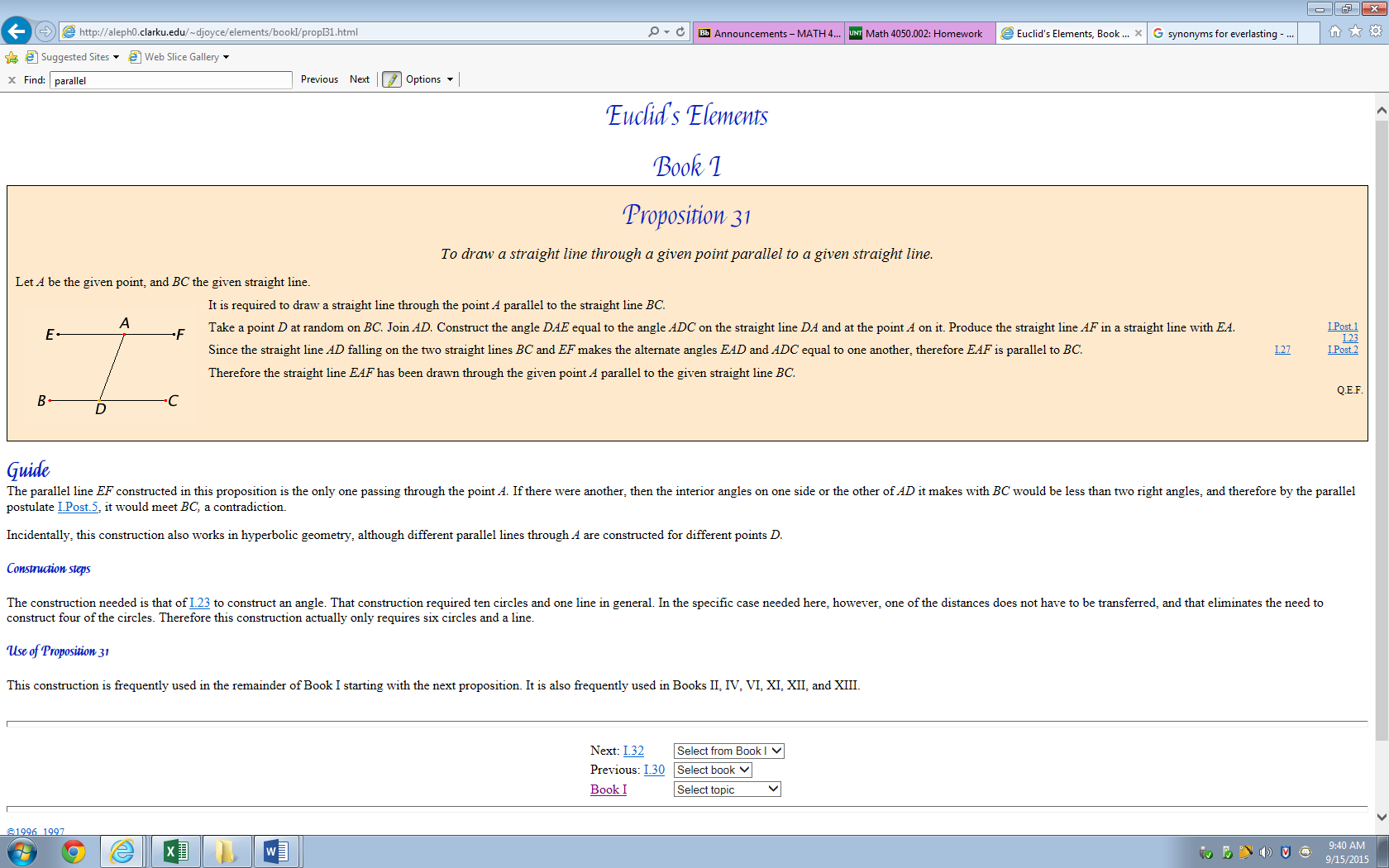
I would take my students back to the time of Euclid of Alexandria, around 300 B.C., and his great book The Elements. Little is known about Euclid except the book he left behind which is the foundation of geometry, algebra, and number theory, still to this day. Euclid wrote this book in an axiomatic way, this means that he assumes common notions, definitions, and postulates to be true and then bases all his propositions and axioms on these assumptions. Does this sound like the way that we do mathematics today? To understand how influential and enduring the Elements is I would present this incredible fact; other than the Bible, Euclid’s Elements is the most published, translated, and studied of all books in the world.

Now we would put on our Euclid caps and turn to Proposition 12 and Proposition 31. These propositions tell us how to draw parallel and perpendicular lines based only on the definitions, common notions, and axioms of Euclid. We would do the constructions step by step, straight out of Euclid’s Elements.

euclid1 euclid2


http://www.britannica.com/biography/Euclid-Greek-mathematician

http://aleph0.clarku.edu/~djoyce/elements/bookI/bookI.html


green line

A.2: How could you as a teacher create an activity or project that involves your topic?

To engage the students in the lesson on parallel and perpendicular lines, instead of sitting in class and listing real world examples of parallel and perpendicular lines, I would take the students out of the classroom and take a tour through the school like a bird watching group except our goal is to list all the parallel and perpendicular lines inside and around the school. We could go to the cafeteria, the gym, and walk around the outside of the building. When we got back to class we could create a long list of all the parallel and perpendicular lines that we see to hang on the wall during this unit. After we list the examples, I could ask some thought provoking questions:

“Why are these parallel and perpendicular lines important?”
“How would the world be different without parallel and perpendicular lines?”


green line

E.1: How can technology (YouTube, Khan Academy [khanacademy.org], Vi Hart, Geometers Sketchpad, graphing calculators, etc.) be used to effectively engage students with this topic?

A great activity I found on parallel and perpendicular lines involves using a graphing calculator to discover the similarities in slope between parallel and perpendicular lines. First, you give the students a list of equations to graph on their calculator. Next, you ask them to compare the graphs and identify which lines are parallel and which are perpendicular. Last, you ask them to compare the slopes of the parallel and perpendicular lines. Hopefully, they will discover that parallel lines have the same slope and perpendicular lines have the opposite reciprocal slope. This activity can be done easily because the students should already be familiar with graphing calculators, slope, and y-intercept. The activity would not take much time and can easily be differentiated based on the skill level of the students in your class. You can give some students difficult numbers or more lines to analyze if they finish the initial activity quickly. Also, you could take this one step further and give the students large sheets of graph paper and let them draw the lines and present their findings in front of the class.


Engaging students: Completing the square

In my capstone class for future secondary math teachers, I ask my students to come up with ideas for engaging their students with different topics in the secondary mathematics curriculum. In other words, the point of the assignment was not to devise a full-blown lesson plan on this topic. Instead, I asked my students to think about three different ways of getting their students interested in the topic in the first place.

I plan to share some of the best of these ideas on this blog (after asking my students’ permission, of course).

This student submission again comes from my former student Diana A’Lyssa Rodriguez. Her topic, from Algebra: completing the square.

green line

A2. How could you as a teacher create an activity or project that involves your topic?

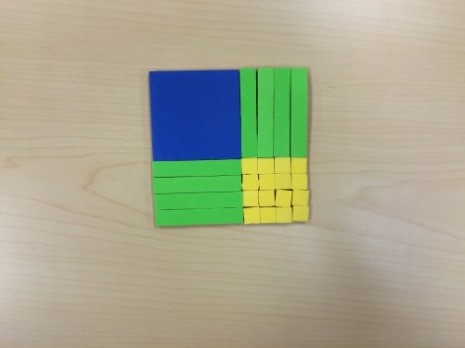
Using Algebra tiles is a great visual way for students to understand completing the square. The students start with the tiles that correspond to the given problem. The unit tiles are then flipped and moved to the other side of the equal sign. The remaining tiles are positioned into a square shape. The corner piece that appears to be missing will be filled unit tiles. What you do to one side, must be done to the other. Therefore the amount of unit tiles added to the square will also be added to the other side of the equation. Find the zero pairs and take them away. Then, find the corresponding tiles that will outline the square, so when multiplied together equals the equation.

Step 1:

square1

Step 2:

square2

Step 3:

square3

Step 4:

square4

Step 5:

square5

Step 6:

square6

Step 7:

square7

Step 8:

square8

green line

D1. What interesting things can you say about the people who contributed to the discovery and/or the development of this topic?

Around 815 – 850 AD, a mathematician Muhammad ibn Musa al-Khwarizmi was hard at work discovering algebra. He was actually the first person to write a text about algebra. His focus for a lot of the text was the dimensions of a square. At the time it was not called completing the square, but Muhammad was the one who came up with it because it is exactly what he did in order to solve the different equations he had at the time. Very similar to the process described using algebra tiles, Muhammad also saw the equations in terms of actual shapes. One of the original problems he tried to solve was x2+10x=39. He looked at x2 as a square with length x and width x. He then created a rectangle with length 10 and width x. The area would equal 10x. To make his theory work he broke up the 10x rectangle into two squares with length x and width 5. Muhammad combined the x2 square and the two 5x pieces into an L shape. This partial square must equal some square with the value of 39. So he came to the conclusion that he had to fill in what was left of the L shape to make it a square. But in order to do that he had to add that same value to the other side. In this case he added 25 (which is 5×5). Muhammad’s final answer was (x+5)2=64, x=3. This was his method but at the time he couldn’t prove that it always worked. So if and when students participate in the algebra tiles activity, they are partaking in a small piece of history.


green line

E1. How can technology be used to effectively engage students with this topic?

This video from Khan Academy is a great tool for completing the square. This video explains why we have to take half of the b value and square it (when looking at ax2+bx+c) to obtain the c value. When the students understand why we do something in math, they are more likely to be interested in the topic. The different colors that are used to write out the process allows the students to organize and understand completing the squares better. This particular video is also just long enough to capture the attention of the students but not so long as to lose it. Also, after hearing the same person explain math all the time, students may not understand it as well as they possibly could. So what is said in this video can easily be explained by the teacher but students sometimes need to hear a different voice explain a concept so they can gain a new perspective on the topic.

https://www.khanacademy.org/math/algebra/quadratics/completing_the_square/v/ex1-completing-the-square


Resources


Engaging students: Square roots

In my capstone class for future secondary math teachers, I ask my students to come up with ideas for engaging their students with different topics in the secondary mathematics curriculum. In other words, the point of the assignment was not to devise a full-blown lesson plan on this topic. Instead, I asked my students to think about three different ways of getting their students interested in the topic in the first place.

I plan to share some of the best of these ideas on this blog (after asking my students’ permission, of course).

This student submission again comes from my former student Tiffany Jones. Her topic, from Algebra: square roots.

green line

B.1 How can this topic be used in your students’ future courses in mathematics or science?


One area of mathematics I wish I had more practice with in grade school is numerical reasoning. I feel that, as a student, I was allowed to use my calculator too much and am struggling to remove my calculator crutch. I hope to encourage my students to sharpen their numerical reasoning skills and to not rely on their calculator. Does this number make sense? Is it too high, too low? Is a negative result valid given the scenario of the problem? The following video introduces a method to estimate the square root of non-perfect squares to the nearest tenth by hand:

“Estimating Square Roots To the Nearest Tenth by Hand” by Fort Bend Tutoring

It gives the students another tool for their toolbox of numerical reasoning, practice using formulas, reviews long division by hand, and strongly encourages students to remember the perfect squares.

I think that introducing this idea as an engage could intrigue student to wonder why the formula works and to wonder what else they are able to do quickly by hand.

Fort Bend Tutoring’s YouTube channel offers videos on a wide verity of high school mathematics topics and courses. The videos cover several examples. They are engaging, not dry and there is also a “theme song” to the videos. I feel that these videos can sever as a great addition to lessons as extra help to the students.

green line

D.1 What interesting things can you say about the people who contributed to the discovery and/or the development of this topic?


The following story was first told to me in a calculus one course. While the telling of the story was to serve as amusement and did not directly relate to the topic of the day, it stuck with me. It comes to mind frequently when working with the Pythagorean theorem and with irrational squares. And when given this assignment, I saw square roots as an option, this story again came to mind. I think having an interesting story cross my mind makes a problem overall more fun. I would want to give that to my students. The article “The Dangerous Ratio” by Brain Clegg does a wonderful job of telling the story, its implications, and gives a mock dialogue so reads can work through the logic. At the end of the article, there is a link to an activity about the proof that the square root of 2 is irrational.


green line

E.1

How can technology be used to effectively engage students with this topic?


I really like the idea of a flipped classroom and hope to be able to practice it in my classroom. While a completely flipped classroom will take some time to implement, videos such as Math Antics’ “Exponents & Square Roots” will be a great place to start.

This particular video address a previously learned topic, namely exponents and relates it to the new topic. It provides definitions and visuals to remember how the terms relate to each other and how to read the symbols. It goes through several examples of varying level and shows the viewer how to use technology such as calculators to solve hard problems. In addition, the video addresses some common misconceptions such as mistaking the root sign and the division sign. Moreover, it ties everything together with a quick review at the end.

One of my favorite aspects so of flipped classrooms, is that the student can review the video over and over. Math Antics does an excellent job of talking the math out to the viewer. The animations are amusing yet helpful. While a lot of information is covered, the video is not dry.


Resources:

“Estimating Square Roots To the Nearest Tenth by Hand” by Fort Bend Tutoring – https://www.youtube.com/watch?v=bUh7Hj-3dkw

“The Dangerous Ratio” by Brian Clegg – http://nrich.maths.org/2671

“Exponents & Square Roots” by Math Antics –https://www.youtube.com/watch?v=C_iKTTI1E34


Engaging students: Fractions and decimals

In my capstone class for future secondary math teachers, I ask my students to come up with ideas for engaging their students with different topics in the secondary mathematics curriculum. In other words, the point of the assignment was not to devise a full-blown lesson plan on this topic. Instead, I asked my students to think about three different ways of getting their students interested in the topic in the first place.

I plan to share some of the best of these ideas on this blog (after asking my students’ permission, of course).

This student submission again comes from my former student Samantha Offutt. Her topic, from Algebra: fractions and decimals.

green line

How can this topic be used in your students’ future courses in mathematics or science?

Students will use/convert fractions and decimals in a number of ways in future courses in mathematics and science. The best example is percentages. In a probability/statistics class, percentages are a major component for answering many types of problems. For example, in the college course Math 3680, percentages are used frequently. So in a large set of data, one is asked to record the frequency of a certain number, take the frequency and divide it by the total number of entries, and one is almost always ask for them to be written as decimals to the 4th number. After determining the relative frequency, you can tell what proportions of the data are between certain stipulations. For example, if there were 50 numbers that are between 1 and 20, one can be asked, “What proportion of the numbers are between 7 and 13.” So even to this day in college, students still use this pre-algebra topic.


green line

How could you as a teacher create an activity or project that involves your topic?

I found this awesome project on a teachers blog: http://teachinginroom6.blogspot.com/2012/02/math-social-studies-awesomeness.html, This certain teacher did a social studies spin on colonial era quilts. I think it was awesome. “I then had the students create a 20 cm x 20 cm square (we have cm graph paper available at school).  Choosing either 2, 4, or 5 colors, the students created a square that had at least one triangle, quadrilateral, was bright, and symmetrical (Stephanie).” Then the students created fractions by counting how many squares, of the 400 squares, took up each color. Later found the decimal of those fractions, and finally determined the percentage each color owned on their square. The teacher took each square and made a quilt. I’m in love with this project and I think it’d look fantastic in the classroom. Students get to practice multiple skills and are given the opportunity to have their work displayed in the classroom.

green line

How can technology (YouTube, Khan Academy [khanacademy.org], Vi Hart, Geometers Sketchpad, graphing calculators, etc.) be used to effectively engage students with this topic?

Technology is a very useful tool for students. Instead of a teacher lecturing, they can find videos of all sorts on the Internet. If a teacher simply wanted to let Khan Academy engage students and do examples for the kids in a short 8 minutes, then they could use this very helpful video (that the students can reference later at home if they have any questions):

Students get to dive right into the topic and see how it is done, but later when they are at home and have forgotten some things, they have access to the exact video. Technology is very useful both in the classroom and at home. Also this video shows more than just one, simple example. I think it’s great the video shows problems of different levels of difficulty.

References

Khan Academy. “Converting Fractions to Decimals | Decimals | Pre-Algebra | Khan Academy.” YouTube. YouTube, 8 Apr. 2007. Web. 04 Sept. 2015.

Stephanie. “Teaching in Room 6: Math + Social Studies = Awesomeness.”Teaching in Room 6: Math + Social Studies = Awesomeness. 3AM Teacher, 5 Feb. 2012. Web. 05 Sept. 2015.


Engaging students: Fractions, decimals, and percents

In my capstone class for future secondary math teachers, I ask my students to come up with ideas for engaging their students with different topics in the secondary mathematics curriculum. In other words, the point of the assignment was not to devise a full-blown lesson plan on this topic. Instead, I asked my students to think about three different ways of getting their students interested in the topic in the first place.

I plan to share some of the best of these ideas on this blog (after asking my students’ permission, of course).

This student submission again comes from my former student Perla Perez. Her topic, from Algebra: fractions, decimals, and percents.

green line

A2. How could you as a teacher create an activity or project that involves your topic?

This past summer when I worked as a program assistant for TexPrep, we had the opportunity to have a pizza party. How fun! Well it took longer than we thought to pick out a place and figure out how much we all had to pay. I got to thinking about how this could be a great engaging activity for students to get excited about decimals, fractions, and percents.

The activity will go as follows:

Students are split up into groups of four with each group given a pizza place. Every person has one of the following roles: the researcher, the recorder, the calculator, and the presenter (to compare with other groups). Their goal is to find the pizza place that is the cheapest, gives the most pizza, and figure out how much each individual would have to pay. By comparing each other’s work during presentations, students get to compare, contrast, and see the different methods used to solve the problems. This also gives the teacher an opportunity to understand their comprehension level of the subject and see if converting a percentage is difficult for them or not. When all the groups are finished gathering their information they will present. Afterwards (if allowed), we will reward ourselves with eating pizza! Through this activity students will have to come up their own way to solve these problems. It leads them to work with: Decimals, since they must include every penny (including tax); Fractions, when it comes to figuring out how much each individual owes; and Precents, when asked to compare prices between pizza places.

green line

C3. How has this topic appeared in the news?

Decimals, fractions, and percent are used in media to represent a variety of concepts from the percent of the candidate poll elections to percent chance of rain. Now some of these topics might not sound interesting to most students, but current events such as the movement to raise minimum wage to $15.00 can grab their attention. Students can then be given questions such as: How does that affect the regular worker financially? Are employees working the same hours? Do employees get fewer hours and more pay, or do they keep their regular hours? In the Time article “Here’s Every City in America Getting a $15 Minimum Wage”, it mentions how some restaurants are increasing their prices from 4% to 21% which begs to question, is everything in the market going to increase as well? All the answers to these questions can be found in the news and prompt their interest in actually doing the math to find out the answers. The news also gives them the real world application student’s consistently are trying to find. Engaging students about the news and simply prompting them before the lesson allows students to continue thinking about it as they go forth in the lesson.

Helpful links:

green line

E1. How can technology (YouTube, Khan Academy [khanacademy.org], Vi Hart, Geometers Sketchpad, graphing calculators, etc.) be used to effectively engage students with this topic?

As we continue to advance in technology, we begin to see how there are many ways a student can learn. The internet is full of different educational games, activities, calculators, and above all videos that are useful to educators. There are videos basically for everything. So what better way to engage students than with a video that knows exactly how they feel like in this one: https://www.youtube.com/watch?v=cGqQOQavbls. The video is a great representation of how a unique activity such as magic can be used to stimulate students in understanding the idea of how fractions, decimals, and percentages relate to one another. Aside from funny videos students also like to interact in games like: http://www.math-play.com/Fractions-Decimals-Percents-Jeopardy/fractions-decimals-percents-jeopardy.html and http://www.topmarks.co.uk/maths-games/7-11-years/fractions-and-decimals. The first game allows students to practice converting fractions, decimals, and fractions from one to another and shows them how they are related. The last website gives teachers a variety of tools to choose from, all of which can help a lot in the classroom.

References: