Engaging students: Introducing proportions

In my capstone class for future secondary math teachers, I ask my students to come up with ideas for engaging their students with different topics in the secondary mathematics curriculum. In other words, the point of the assignment was not to devise a full-blown lesson plan on this topic. Instead, I asked my students to think about three different ways of getting their students interested in the topic in the first place.

I plan to share some of the best of these ideas on this blog (after asking my students’ permission, of course).

This student submission again comes from my former student Deborah Duddy. Her topic, from Pre-Algebra: introducing proportions.

green line

How can this topic be used in your students’ future courses in mathematics or science?


Proportions, in the form a/b = c/d, is a middle school math topic. The introduction of proportions builds upon the students’ understanding of fractions and ability to solve simple equations. This topic is used in the students’ future Geometry and Statistics courses. The use of proportions is used in Geometry to identify similar polygons which are defined as having congruent corresponding angles and proportional corresponding sides. The use of similar triangles and proportions are used to perform indirect measurements. In Statistics, proportions are used throughout measures of central tendency. Additionally, statistics uses sampling proportions including the proportion of successes.


The ability to use proportions for indirect measurements is also included in the study of Physics, Chemistry and Biology.  Chemistry uses proportions to determine based upon the chemical structure of a compound, the number of atoms pertaining to each element of the compound.  The study of Anatomy also uses many proportions including leg length/stature or the sitting height ratio (sitting heigh/stature x 100).


green line

How has this topic appeared in high culture (art, classical music, theatre, etc.)?


In art, proportions are expressed in terms of scale and proportion.  Scale is the proportion of 2 different size objects and proportion is the relative size of parts within the whole.  An example of proportion is Michelangelo’s David.  The proportions within the body are based on an ancient Greek mathematical system which is meant to define perfection in the human body.  Da Vinci’s  Vitruvian Man is also an example of art based upon proportions or constant rates of fractal expansion.  The music of Debussy has been studied to show that several piano pieces are built precisely and intricately around proportions and the two ratios of Golden Section and bisection so that the music is organized in various geometrical patterns which contribute substantially to its expansive and dramatic impact.

The use of proportions is also a constant within Greek and Roman classical architecture.  Many classical architecture buildings such as the Parthenon illustrate the use of proportions through the building.  Additionally, classical architecture uses specific proportions to determine roof height and length plus the placement of columns.


green line

How has this topic appeared in the news?

Proportions are constantly in the news even though they may not be presented in a/b=c/d format.  However, the concept of proportion is used throughout news reporting and even advertising.  The current news topic is the upcoming Presidential election.  Daily, we are provided with new and different poll results.  These results are derived via a proportion.  For example, 100 people are polled, these results are then derived via proportional concepts to provide a percentage voting for each candidate.  Percentage is a specific type of the  a/b = c/d proportion.  Daily news uses proportions when reporting growth trends for national debt, crime and even new housing starts in DFW.   Today, proportions were used when discussing the new Samsung Note7 and its ability to explode.  During the winter, proportions are used to tell us how many inches of rain would result from 2 inches of snow. Sports broadcasters also use proportions when discussing the potential of athletes.  If the athlete can hit 10 homeruns in 20 games, then he will potentially hit 50 homeruns in 100 games.  Proportions even appear in advertising for new medicines detailing the data associated with the medicine trial.


References:

Debussy in Proportion: A Musical Analysis, Dr Roy Howat


Michelangelo’s David


Click to access MOEFranklin.pdf


http://www.brightstorm.com


Engaging students: Solving one-step algebra problems

In my capstone class for future secondary math teachers, I ask my students to come up with ideas for engaging their students with different topics in the secondary mathematics curriculum. In other words, the point of the assignment was not to devise a full-blown lesson plan on this topic. Instead, I asked my students to think about three different ways of getting their students interested in the topic in the first place.

I plan to share some of the best of these ideas on this blog (after asking my students’ permission, of course).

This student submission again comes from my former student Anna Park. Her topic, from Algebra: solving one-step algebra problems.

green line

How could you as a teacher create an activity or project that involves your topic?

Bingo game:

The teacher will create a bingo sheet with a free space in the middle, and integers in the other spaces. These integers represent the answers to the word problems that the teacher will be putting on the board or projector screen. Each word problem will either be a one-step equation or a two-step equation. A one step equation involves only one step to solve for the variable, this means only one operation will be done on the equation. The goal is to have the variable by itself on the left side of the equal sign and the numbers on the right side of the equal sign. A two-step equation is similar to a one step equation. A two-step equation is where it takes only two steps to solve for the variable in the equation that has more than one operation. The goal is the same as a one-step equation.
green line

How can this topic be used in your students’ future courses in mathematics or science?

  1. In future courses students will need to know how to isolate a variable in an equation to receive its value. They will need to know how to graph equations and inequalities in future mathematics courses. From Algebra and on students will need to know how to solve for the value of a variable.
  2. Students will also need to know how to create an equation given to them in word problems. Some of the classes that this will be needed for is Physics, geometry, algebra II, Pre-Calculus, Calculus, college courses..etc. Algebra is a tool for problem solving, and critical thinking. Word problems give real life examples of algebra and students will be able to apply this knowledge to real life situations and understand the problems given to them in future classes.


green line

How can technology (YouTube, Khan Academy [khanacademy.org], Vi Hart, Geometers Sketchpad, graphing calculators, etc.) be used to effectively engage students with this topic?

  1. Kolumath is a great youtube math channel that explains how to do certain math operations with great visual examples and clear explanations. The speaker talks clearly and is easy to understand, and the examples he uses ties in information the students have learned in previous courses. His visual examples allow students who struggle with picturing math functions to connect to the lesson.
  2. This channel also gives definitions over the topic and any definition relatable to the operations done in the video.
  3. Listed below are examples he uses on how to solve one-step and two-step equations. (References)

Solving one step equations:  https://www.youtube.com/watch?v=Ot-KSERw8Gc

Solving two step equations: https://www.youtube.com/watch?v=m7acIUcQ-7E


Engaging students: Venn diagrams

In my capstone class for future secondary math teachers, I ask my students to come up with ideas for engaging their students with different topics in the secondary mathematics curriculum. In other words, the point of the assignment was not to devise a full-blown lesson plan on this topic. Instead, I asked my students to think about three different ways of getting their students interested in the topic in the first place.

I plan to share some of the best of these ideas on this blog (after asking my students’ permission, of course).

This student submission comes from my former student Amber Northcott. Her topic, from Probability: Venn diagrams.

green line

How could you as a teacher create an activity or project that involves your topic?

There are a few activities you can do with Venn diagrams. One idea is for the first day of class you can put up a big poster with a Venn diagram on it or you can draw one on the board. One circle can be ‘loves math’, while the other is ‘do not like math’. Then of course the center where the two circles intertwine will be the students who love math, but yet don’t like it. When your students come into the room you can have them put their name where it seems fit. This way you can get to better know your students on the topic of math. Another idea is that when you get to a topic, for instance arithmetic and geometric sequences, you can create a giant poster Venn diagram or draw it on the board. Then you can have your students write one thing that either arithmetic has or geometric has or both of them have. Once each student has put up just one thing on the Venn diagram, you can start a class discussion on the Venn diagram. While the discussion goes on you may fix a couple things here and there or even add to it. At the end each student will have their own Venn diagram to fil out, so they can have it in their notes.


green line

How can this topic be used in your students’ future courses in mathematics or science?


Venn diagrams are an easier way to compare and contrast two topics. It can help differentiate between the two topics. For example, how are geometric and arithmetic sequences different? Do they have anything in common? What do they have in common? This helps students identify the topics more thoroughly and helps them get a better understanding about each topic.


green line

How has this topic appeared in the news.


Not too long ago Hillary Clinton posted a Venn diagram about gun control on twitter. In response she was getting mocked and criticized. A short article on thehill.com goes into the mockery by showing pictures of people’s tweets to Hillary Clinton. Some had two circles separate from each other with one stating people who know how to make Venn diagrams and the other one stating Hillary’s graphic design staff. The other article from the Washington Post actually goes through her Venn diagram and fixes errors. These errors include the data in the Venn diagram.

Letting students see this, would definitely cause a discussion. I think we can turn the discussion into whether or not we think the Venn diagram was wrong. By having this discussion, we can learn more about what the students know about Venn diagrams and shed more light on how we can use the Venn diagrams in many different ways for many different topics.


References

https://www.washingtonpost.com/news/the-fix/wp/2016/05/20/we-fixed-hillary-clintons-terrible-venn-diagram-on-gun-control/

http://thehill.com/blogs/ballot-box/presidential-races/280706-clinton-mocked-for-misuse-of-venn-diagram


Exponents and the decathlon

During the Olympics, I stumbled across an application of exponents that I had not known before: scoring points in the decathlon or the heptathlon. From FiveThirtyEight.com:

Decathlon, which at the Olympics is a men’s event, is composed of 10 events: the 100 meters, long jump, shot put, high jump, 400 meters, 110-meter hurdles, discus throw, pole vault, javelin throw and 1,500 meters. Heptathlon, a women’s event at the Olympics, has seven events: the 100-meter hurdles, high jump, shot put, 200 meters, long jump, javelin throw and 800 meters…

As it stands, each event’s equation has three unique constants — $latex A$, $latex B$ and $latex C$— to go along with individual performance, $latex P$. For running events, in which competitors are aiming for lower times, this equation is: $latex A(BP)^C$, where $latex P$ is measured in seconds…

B is effectively a baseline threshold at which an athlete begins scoring positive points. For performances worse than that threshold, an athlete receives zero points.

Specifically from the official rules and regulations (see pages 24 and 25), for the decathlon (where P is measured in seconds):

  • 100-meter run: 25.4347(18-P)^{1.81}.
  • 400-meter run: 1.53775(82-P)^{1.81}.
  • 1,500-meter run: 0.03768(480-P)^{1.85}.
  • 110-meter hurdles: 5.74352(28.5-P)^{1.92}.

For the heptathlon:


  • 200-meter run: 4.99087(42.5-P)^{1.81}.
  • 400-meter run: 1.53775(82-P)^{1.88}.
  • 1,500-meter run: 0.03768(480-P)^{1.835}.

Continuing from FiveThirtyEight:


For field events, in which competitors are aiming for greater distances or heights, the formula is flipped in the middle: $latex A(PB)^C$, where $latex P$ is measured in meters for throwing events and centimeters for jumping and pole vault.

Specifically, for the decathlon jumping events (P is measured in centimeters):

  • High jump: 0.8465(P-75)^{1.42}
  • Pole vault: 0.2797(P-100)^{1.35}
  • Long jump: 0.14354(P-220)^{1.4}

For the decathlon throwing events (P is measured in meters):

  • Shot put: 51.39(P-1.5)^{1.05}.
  • Discus: 12.91(P-4)^{1.1}.
  • Javelin: 10.14(P-7)^{1.08}.

Specifically, for the heptathlon jumping events (P is measured in centimeters):

  • High jump: 1.84523(P-75)^{1.348}
  • Long jump: 0.188807(P-210)^{1.41}

For the heptathlon throwing events (P is measured in meters):

  • Shot put: 56.0211(P-1.5)^{1.05}.
  • Javelin: 15.9803(P-3.8)^{1.04}.

I’m sure there are good historical reasons for why these particular constants were chosen, but suffice it to say that there’s nothing “magical” about any of these numbers except for human convention. From FiveThirtyEight:

The [decathlon/heptathlon] tables [devised in 1984] used the principle that the world record performances of each event at the time should have roughly equal scores but haven’t been updated since. Because world records for different events progress at different rates, today these targets for WR performances significantly differ between events. For example, Jürgen Schult’s 1986 discus throw of 74.08 meters would today score the most decathlon points, at 1,384, while Usain Bolt’s 100-meter world record of 9.58 seconds would notch “just” 1,203 points. For women, Natalya Lisovskaya’s 22.63 shot put world record in 1987 would tally the most heptathlon points, at 1,379, while Jarmila Kratochvílová’s 1983 WR in the 800 meters still anchors the lowest WR points, at 1,224.

FiveThirtyEight concludes that, since the exponents in the running events are higher than those for the throwing/jumping events, it behooves the elite decathlete/heptathlete to focus more on the running events because the rewards for exceeding the baseline are greater in these events.

Finally, since all of the exponents are not integers, a negative base (when the athlete’s performance wasn’t very good) would actually yield a complex-valued number with a nontrivial imaginary component. Sadly, the rules of track and field don’t permit an athlete’s score to be a non-real number. However, if they did, scores might look something like this…


What I Learned from Reading “Gamma: Exploring Euler’s Constant” by Julian Havil: Part 17

Let \pi(n) denote the number of positive prime numbers that are less than or equal to n. The prime number theorem, one of the most celebrated results in analytic number theory, states that

\pi(x) \approx \displaystyle \frac{x}{\ln x}.

This is a very difficult result to prove. However, Gamma (page 172) provides a heuristic argument that suggests that this answer might be halfway reasonable.

Consider all of the integers between 1 and x.

  • About half of these numbers won’t be divisible by 2.
  • Of those that aren’t divisible by 2, about two-thirds won’t be divisible by 3. (This isn’t exactly correct, but it’s good enough for heuristics.)
  • Of those that aren’t divisible by 2 and 3, about four-fifths won’t be divisible by 5.
  • And so on.

If we repeat for all primes less than or equal to \sqrt{x}, we can conclude that the number of prime numbers less than or equal to x is approximately

\pi(x) \approx \displaystyle x \prod_{p \le \sqrt{x}} \left(1 - \frac{1}{p} \right).

From this point, we can use Mertens product formula

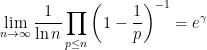
\displaystyle \lim_{n \to \infty} \frac{1}{\ln n} \prod_{p \le n} \left(1 - \frac{1}{p} \right)^{-1} = e^\gamma

to conclude that

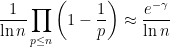
\displaystyle \frac{1}{\ln n} \prod_{p \le n} \left(1 - \frac{1}{p} \right) \approx \displaystyle \frac{e^{-\gamma}}{\ln n}

if n is large. Therefore,

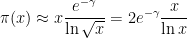
\pi(x) \approx x \displaystyle \frac{e^{-\gamma}}{\ln \sqrt{x}} = 2 e^{-\gamma} \displaystyle \frac{x}{\ln x}.

Though not a formal proof, it’s a fast way to convince students that the unusual fraction \displaystyle \frac{x}{\ln x} ought to appear someplace in the prime number theorem.

green line

When I researching for my series of posts on conditional convergence, especially examples related to the constant \gamma, the reference Gamma: Exploring Euler’s Constant by Julian Havil kept popping up. Finally, I decided to splurge for the book, expecting a decent popular account of this number. After all, I’m a professional mathematician, and I took a graduate level class in analytic number theory. In short, I don’t expect to learn a whole lot when reading a popular science book other than perhaps some new pedagogical insights.

Boy, was I wrong. As I turned every page, it seemed I hit a new factoid that I had not known before.

In this series, I’d like to compile some of my favorites — while giving the book a very high recommendation.

What I Learned from Reading “Gamma: Exploring Euler’s Constant” by Julian Havil: Part 16

Let \pi(n) denote the number of positive prime numbers that are less than or equal to n. The prime number theorem, one of the most celebrated results in analytic number theory, states that

\pi(x) \approx \displaystyle \frac{x}{\ln x}.

This is a very difficult result to prove. However, Gamma (page 172) provides a heuristic argument that suggests that this answer might be halfway reasonable.

Consider all of the integers between 1 and x.

  • About half of these numbers won’t be divisible by 2.
  • Of those that aren’t divisible by 2, about two-thirds won’t be divisible by 3. (This isn’t exactly correct, but it’s good enough for heuristics.)
  • Of those that aren’t divisible by 2 and 3, about four-fifths won’t be divisible by 5.
  • And so on.

If we repeat for all primes less than or equal to \sqrt{x}, we can conclude that the number of prime numbers less than or equal to x is approximately

\pi(x) \approx \displaystyle x \prod_{p \le \sqrt{x}} \left(1 - \frac{1}{p} \right).

From this point, we can use Mertens product formula

\displaystyle \lim_{n \to \infty} \frac{1}{\ln n} \prod_{p \le n} \left(1 - \frac{1}{p} \right)^{-1} = e^\gamma

to conclude that

\displaystyle \frac{1}{\ln n} \prod_{p \le n} \left(1 - \frac{1}{p} \right) \approx \displaystyle \frac{e^{-\gamma}}{\ln n}

if n is large. Therefore,

\pi(x) \approx x \displaystyle \frac{e^{-\gamma}}{\ln \sqrt{x}} = 2 e^{-\gamma} \displaystyle \frac{x}{\ln x}.

Though not a formal proof, it’s a fast way to convince students that the unusual fraction \displaystyle \frac{x}{\ln x} ought to appear someplace in the prime number theorem.

green line

When I researching for my series of posts on conditional convergence, especially examples related to the constant \gamma, the reference Gamma: Exploring Euler’s Constant by Julian Havil kept popping up. Finally, I decided to splurge for the book, expecting a decent popular account of this number. After all, I’m a professional mathematician, and I took a graduate level class in analytic number theory. In short, I don’t expect to learn a whole lot when reading a popular science book other than perhaps some new pedagogical insights.

Boy, was I wrong. As I turned every page, it seemed I hit a new factoid that I had not known before.

In this series, I’d like to compile some of my favorites — while giving the book a very high recommendation.

What I Learned from Reading “Gamma: Exploring Euler’s Constant” by Julian Havil: Part 15

I did not know — until I read Gamma (page 168) — that there actually is a formula for generating nth prime number by directly plugging in n. The catch is that it’s a mess:

p_n = 1 + \displaystyle \sum_{m=1}^{2^n} \left[ n^{1/n} \left( \sum_{i=1}^m \cos^2 \left( \pi \frac{(i-1)!+1}{i} \right) \right)^{-1/n} \right],

where the outer brackets [~ ] represent the floor function.

This mathematical curiosity has no practical value, as determining the 10th prime number would require computing 1 + 2 + 3 + \dots + 2^{10} = 524,800 different terms!

green line

When I researching for my series of posts on conditional convergence, especially examples related to the constant \gamma, the reference Gamma: Exploring Euler’s Constant by Julian Havil kept popping up. Finally, I decided to splurge for the book, expecting a decent popular account of this number. After all, I’m a professional mathematician, and I took a graduate level class in analytic number theory. In short, I don’t expect to learn a whole lot when reading a popular science book other than perhaps some new pedagogical insights.

Boy, was I wrong. As I turned every page, it seemed I hit a new factoid that I had not known before.

In this series, I’d like to compile some of my favorites — while giving the book a very high recommendation.

Another Poorly Written Word Problem: Index

I’m doing something that I should have done a long time ago: collecting a series of posts into one single post. The following links comprised my series poorly written word problem, taken directly from textbooks and other materials from textbook publishers.

Part 1: Addition and estimation.

Part 2: Estimation and rounding.

Part 3: Probability.

Part 4: Subtraction and estimation.

Part 5: Algebra and inequality.

Part 6: Domain and range of a function.

Part 7: Algebra and inequality.

Part 8: Algebra and inequality.

Part 9: Geometric series.


Engaging students: Introducing the number e

In my capstone class for future secondary math teachers, I ask my students to come up with ideas for engaging their students with different topics in the secondary mathematics curriculum. In other words, the point of the assignment was not to devise a full-blown lesson plan on this topic. Instead, I asked my students to think about three different ways of getting their students interested in the topic in the first place.

I plan to share some of the best of these ideas on this blog (after asking my students’ permission, of course).

This student submission comes from my former student Loc Nguyen. His topic, from Precalculus: introducing the number e.

green line

How could you as a teacher create an activity or project that involves your topic?

To be able to understand where the number e is produced in the first place, students need to understand how compound interest is calculated.  Before introducing the number e, I will definitely create an activity for the students to work on so that they can eventually find the formula for compounding interest based on the patterns they produce throughout the process.  The compound interest formula is F=P(1+r/n)nt.  From this formula, I will again provide students a worksheet to work on.  In this worksheet, I will let P=1, r=100%, t=1, then the compound interest formula will be F=(1+1/n)n. Now students will compute the final value from yearly to secondly.

e1

When they do all the computation, they will see all the decimal places of the final value lining up as n gets big.  And finally, they will see that the final value gets to the fixed value as n goes to infinity.  That number is e=2.71828162….,e2


green line

How has this topic appeared in the news?

To help the students realize how important number e is, I would engage them with the real life examples or applications. There were some news that incorporated exponential curves. First, I will show the students the news about how fast deadly disease Ebola will grow through this link http://www.npr.org/sections/goatsandsoda/2014/09/18/349341606/why-the-math-of-the-ebola-epidemic-is-so-scary.  The students will eventually see how exponential curve comes into play. After that I will provide them this link, http://cleantechnica.com/2014/07/22/exponential-growth-global-solar-pv-production-installation/, in this link, the article talked about the global population rate and it provided the scientific evidence that showed the data collected represent the exponential curve.  Up to this point, I will show the students that the population growth model is:

e3

Those examples above was about the growth.  For the next example, I will ask the students that how the scientists figured out the age of the earth.  In this link, http://earthsky.org/earth/how-old-is-the-earth, the students will learn that the scientists used Modern radiometric dating methods to calculate the age of earth.  At this time, I will show them radioactive decay formula and explain to them that this formula is used to determine the lives of the substances such as rocks:e4


green line

How can technology (YouTube, Khan Academy [khanacademy.org], Vi Hart, Geometers Sketchpad, graphing calculators, etc.) be used to effectively engage students with this topic?

To introduce to the students what the number e is, I will engage them with two videos. In the first video, https://www.youtube.com/watch?v=UFgod5tmLYY, the math song “e a magic number” will engage the students why it is a magic number.  While watching this clip, the students will be able to learn the history of e.  Also the students will see many mathematical formulas and expressions that contain e.  This will give them a heads up that they will see these in future when they take higher level math.  It is also pretty humorous of how Dr. Chris Tisdell sang the song.

In the second video, https://www.youtube.com/watch?v=b-MZumdfbt8, it explained why e is everywhere.  The video used probability and exponential function to illustrate the usefulness of e, and showed how e is involving in everything.  It gave many examples of e such as population, finance…  Also the video illustrates the characteristics of the number e and the function that has e in it.  Watching these videos will enhance students’ perception and understanding on the number e, and help them to see how important this number is.

Reference

https://www.youtube.com/watch?v=b-MZumdfbt8

https://www.youtube.com/watch?v=UFgod5tmLYY

http://www.math.unt.edu/~baf0018/courses/handouts/exponentialnotes.pdf

http://cleantechnica.com/2014/07/22/exponential-growth-global-solar-pv-production-installation/

http://www.npr.org/sections/goatsandsoda/2014/09/18/349341606/why-the-math-of-the-ebola-epidemic-is-so-scary

http://earthsky.org/earth/how-old-is-the-earth