Engaging students: Adding, subtracting, multiplying, and dividing complex numbers

In my capstone class for future secondary math teachers, I ask my students to come up with ideas for engaging their students with different topics in the secondary mathematics curriculum. In other words, the point of the assignment was not to devise a full-blown lesson plan on this topic. Instead, I asked my students to think about three different ways of getting their students interested in the topic in the first place.

I plan to share some of the best of these ideas on this blog (after asking my students’ permission, of course).

This student submission again comes from my former student Daniel Adkins. His topic, from Algebra: adding, subtracting, multiplying, and dividing complex numbers.

green line

How has this topic appeared in pop culture?

Robot chicken aired a television episode in which students were being taught about the imaginary number. Upon the instructor’s completion of his definition of the imaginary number, one student, who understands the definition, immediately has his head explode. One student turns to him and says, “I don’t get it. No wait now I-“, and then his head also explodes.

This video can be used as a humorous introduction that only takes a few seconds. It conveys that these concepts can be difficult in a more light-hearted sense. At the same time it satirically exaggerates the difficulty, and therefore might challenge the students. All the while the video provides the definition as well.


green line

How did people’s conception of this topic change over time?

The first point of contact with imaginary numbers is attributed to Heron of Alexandria around the year 50 A.D. He was attempting to solve the section of a pyramid. The equation he eventually deemed impossible was the sqrt(81-114). Attempts to find a solution for a negative square root wouldn’t reignite till the discovery of negative numbers, and even this would lead to the belief that it was impossible. In the early fifteenth century speculations would rise again as higher degree polynomial equations were being worked out, but for the most part negative square roots would just be avoided. In 1545 Girolamo Cardono writes a book titled Ars Magna. He solves an equation with an imaginary number, but he says, “[imaginary numbers] are as subtle as they would be useless.” About them, and most others agreed with him until 1637. Rene Descartes set a standard form for complex numbers, but he still wasn’t too fond of them. He assumed, “that if they were involved, you couldn’t solve the problem.” And individuals like Isaac Newton agreed with him.

Rafael Bombelli strongly supported the concept of complex numbers, but since he wasn’t able to supply them with a purpose, he went mostly unheard. That is until he came up with the concept of using complex numbers to find real solutions. Over the years, individuals eventually began to hear him out.

One of the major ways that helped aid with people eventually come to terms with imaginary numbers was the concept of placing them on a Cartesian graph as the Y-axis. This concept was first introduced in 1685 by John Wallis, but he was largely ignored. A century later, Caspar Wessel published a paper over the concept, but was also ignored. Euler himself labeled the square root of negative 1 as i, which did help in modernizing the concept. Throughout the 19th century, countless mathematicians aided to the growing concept of complex numbers, until Augustin Louis Cauchy and Niels Henrik Able make a general theory of complex numbers.

This is relevant to students because it shows that mathematicians once found these things impossible, then they found them unbelievable, then they found them trivial, until finally, they found a purpose. It encourages students to work hard even if there doesn’t seem to be a reason behind it just yet, and even if it seems like your head is about to blow.


green line

How has this topic appeared in high culture?

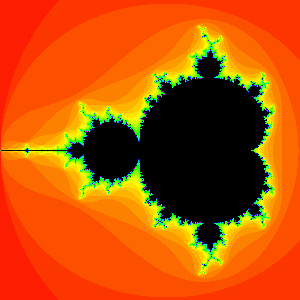
The Mandelbrot set is a beautiful fractal set with highly complex math hidden behind it. However it is extremely complicated, and as Otto von Bismarck put it, “laws are like sausages. Better not to see them being made.”

Like most fractals, the Mandelbrot set begins with a seed to start an iteration. In this case we begin with x2 + c, where c is some real number. This creates an eccentric pattern that grows and grows.

For students, this can show how mathematics can create beautiful patterns that would interest their more artistic senses. Not only would this generate interest in complex numbers, but it might convince students to investigate recurring patterns.
Sources:

https://www.youtube.com/watch?v=oENQ2jlHpfo

History of imaginary numbers:

http://rossroessler.tripod.com/


Mendelbrot sets:

https://plus.maths.org/content/unveiling-mandelbrot-set


Engaging students: Defining a function of one variable

In my capstone class for future secondary math teachers, I ask my students to come up with ideas for engaging their students with different topics in the secondary mathematics curriculum. In other words, the point of the assignment was not to devise a full-blown lesson plan on this topic. Instead, I asked my students to think about three different ways of getting their students interested in the topic in the first place.

I plan to share some of the best of these ideas on this blog (after asking my students’ permission, of course).

This student submission again comes from my former student Matthew Garza. His topic, from Algebra: defining a function of one variable.

green line

How can this topic be used in your students’ future courses in mathematics and science?

Being able to define a function of one variable is necessary for creating a model that describes the most basic phenomenon in math and science. In math, understanding these parent functions is crucial to understanding more complicated functions and, by considering some variables as temporarily fixed, multivariable equations and systems of equations can be easier to understand. In science, we often observe functions of a single variable.  In fact, even if there are multiple variables coming into play, a good lab will likely control all but one variable, so that we can understand the relationship with respect to that single variable – a function.

Consider in science, for example, the ideal gas law: PV = nRT, where P is pressure, V is volume, n is the quantity in moles of a gas, R is the gas constant, and T is temperature.  This law, taught in high school chemistry, is not taught from scratch.  The proportional, single-variable functions that make up the equation are observed individually before the ideal gas law is introduced. Students will probably be taught Boyle’s, Charles’, Gay-Lussac’s, and Avogadro’s laws first. Boyle’s law states pressure and volume are inversely proportional (for a fixed temperature and quantity of gas).  This law can be demonstrated in one lab by clamping a pipette with some water and air inside, thus fixing all but two variables.  Pressure is applied to the pipette and the volume of air is measured using the length of the air column in the pipette.  Students must then evaluate volume V as a function of the single variable pressure P.  It should be noted that the length of the air column is measured, while the diameter of the pipette is fixed, thus volume must be calculated as a function of the single variable length.  Understanding the single variable, proportional and inversely proportional relationships is crucial to understanding the ideal gas law itself.


green line

How can technology (YouTube, Khan Academy [khanacademy.org], Vi Hart, Geometers Sketchpad, graphing calculators, etc.) be used to effectively engage students with this topic? Note: It’s not enough to say “such-and-such is a great website”; you need to explain in some detail why it’s a great website.

Generally speaking, Khan Academy has great videos to help understand math concepts.  Although it’s a little dry, this “Introduction to Functions” video is clear, concise, and touches on several ideas that I was having trouble tying in to every example.  This introductory video begins with the basic concept of a function as a mapping from one value to another single value.  The first examples it uses are a piece-wise function and a less computational function that returns the next highest number beginning with the same letter.  At first I didn’t like that these functions were discontinuous, but this actually gives something else to discuss.  The video links back prior knowledge, explaining that the dependent variable y that students are familiar with is actually a function of x, and represents the two in a table.  The last couple minutes of the video address the fundamental property that a function must produce unique outputs for each x, or it is a relationship.

Source:  https://www.khanacademy.org/math/algebra/algebra-functions/intro-to-functions/v/what-is-a-function

green line

How could you as a teacher create an activity or project that involves your topic?

One idea might be to examine any function in which time is the independent variable.  Basic concepts of motion in physics can supplement an activity – Have groups evaluate position and speed with respect to time of, say, a marble or hot wheels car rolling down a ramp.  Using a stop watch and marking distance on an inclined plane, students could time how long it took to reach certain points and create a graph over time of displacement.  This method might result in some students graphing time as a function of displacement, which could lead to an interesting discussion on independence and dependence, and why it might be useful to view change as a function of time.

Technology could supplement such a lesson as to avoid confusion over whether distance is a function of time or vice versa.  Using motion sensor devices to collect data, such as the CBR2, students can use less time collecting and plotting data and more time examining it.  Different trials resulting in different graphs can lead to discussion on how to model such motion as a function of time – letting an object sit still would result in a constant graph, something rolling down an incline will give a parabolic graph (until the object gets too close to a terminal velocity).

To add variety, students can examine what a graph looks like if they move toward and away from the CBR2 or try to reproduce given position graphs.  This may result in the same position at different times, but since an object can be in only one position at a given time, the utility of using position as a function of time can be represented. Sporadic motion, including changes in speed and direction (like moving back and forth and standing still) also allow discussion of piecewise functions, and that functions don’t necessarily have to have a “rule” as long as only one output is assigned per value in the domain.


Engaging students: Graphs of linear equations

In my capstone class for future secondary math teachers, I ask my students to come up with ideas for engaging their students with different topics in the secondary mathematics curriculum. In other words, the point of the assignment was not to devise a full-blown lesson plan on this topic. Instead, I asked my students to think about three different ways of getting their students interested in the topic in the first place.

I plan to share some of the best of these ideas on this blog (after asking my students’ permission, of course).

This student submission again comes from my former student Anna Park. Her topic, from Algebra: graphs of linear equations.

green line

How could you as a teacher create an activity or project that involves your topic?

  • Have the students enter the room with all of the desks and chairs to the wall, to create a clear floor. On the floor, put 2 long pieces of duct tape that represent the x and y-axis. Have the students get into groups of 3 or 4 and on the board put up a linear equation. One of the students will stand on the Y-axis and will represent the point of the Y-Intercept. The rest of the students have to represent the slope of the line. The students will be able to see if they are graphing the equation right based on how they form the line. This way the students will be able to participate with each other and get immediate feedback. Have the remaining groups of students, those not participating in the current equation, graph the line on a piece of paper that the other group is representing for them. By the end of the engage, students will have a full paper of linear equation examples. The teacher can make it harder by telling the students to make adjustments like changing the y intercept but keeping the slope the same. Or have two groups race at once to see who can physically graph the equation the fastest. Because there is only one “graph” on the floor, have each group go separately and time each group.
  • Have the students put their desks into rows of even numbers. Each group should have between 4 and 5 students. On the wall or white board the teacher has an empty, laminated graph. The teacher will have one group go at a time. The teacher will give the group a linear equation and the student’s have to finish graphing the equation as fast as possible. Each group is given one marker, once the equation is given the first student runs up to the graph and will graph ONLY ONE point. The first student runs back to the second student and hands the marker off to them. That student runs up to the board and marks another point for that graph. The graph is completed once all points are on the graph, the x and y intercepts being the most important. If there are two laminated graphs on the board two groups can go at one time to compete against the other. Similar to the first engage, students will have multiple empty graphs on a sheet of paper that they need to fill out during the whole engage. This activity also gives the students immediate feedback.

green line

What interesting things can you say about the people who contributed to the discovery and/or the development of this topic?

Sir William Rowan Hamilton was an Irish mathematician who lived to be 60 years old. Hamilton invented linear equations in 1843. At age 13 he could already speak 13 languages and at the age of 22 he was a professor at the University of Dublin. He also invented quaternions, which are equations that help extend complex numbers. A complex number of the form w + xi + yj + zk, where wxyz are real numbers and ijk are imaginary units that satisfy certain conditions. Hamilton was an Irish physicist, mathematician and astronomer. Hamilton has a paper written over fluctuating functions and solving equations of the 5th degree. He is celebrated in Ireland for being their leading scientist, and through the years he has been celebrated even more because of Ireland’s appreciation of their scientific heritage.


green line

Culture: How has this topic appeared in pop culture?


An online video game called “Rescue the Zogs” is a fun game for anyone to play. In order for the player to rescue the zogs, they have to identify the linear equation that the zogs are on. This video game is found on mathplayground.com.


References

https://www.teachingchannel.org/videos/graphing-linear-equations-lesson


https://www.reference.com/math/invented-linear-equations-ad360b1f0e2b43b8#


https://en.wikipedia.org/wiki/William_Rowan_Hamilton


http://www.mathplayground.com/SaveTheZogs/SaveTheZogs.html


Engaging students: Equations of two variables

In my capstone class for future secondary math teachers, I ask my students to come up with ideas for engaging their students with different topics in the secondary mathematics curriculum. In other words, the point of the assignment was not to devise a full-blown lesson plan on this topic. Instead, I asked my students to think about three different ways of getting their students interested in the topic in the first place.

I plan to share some of the best of these ideas on this blog (after asking my students’ permission, of course).

This student submission again comes from my former student Madison duPont. Her topic, from Algebra: equations of two variables.

green line

What interesting (i.e., uncontrived) word problems using this topic can your students do now?

Problem: It’s tax free weekend (clothes are tax free) and you want to spend exactly $15 (so you can get $5 back from a $20 bill) on only shirts and shorts. Shirts are on sale for $4 and shorts are on sale for $3.

  1. Write an equation to model this situation.
  2. Determine how many shorts and shirts you should buy to spend exactly $15.

This problem does a good job of introducing a relatable and realistic situation that can be written as an equation with 2 unknowns. The mathematical portion of solving this is also approachable using conceptual strategies such as drawings, counting in groups, or more calculative tactics like trial and error with multiplication and addition, or even more advanced concepts like knowledge of division algorithm. The use of traditional variables is not even necessary to write an equation as the students can use pictures or words next to the coefficients to represent the unknowns. Because there are multiple levels of approaching the problem both in creating an equation and in finding the unknowns, this is a good exercise to have them explore the topic and gain conceptual understanding.


green line

How could you as a teacher create an activity or project that involves your topic?

Activity: Have students sit in groups (2-4). Have 10 di-cut images of apples and 10 di-cut images of bananas (or oranges, etc.) in the center of the group to serve as manipulatives. On each of the apple di-cuts write $.10 in the center and on each of the banana (or other fruit) write $.20. Tell the students they need to find a way to spend exactly $1.00 (using at least one of each fruit).

This activity allows students to explore the concept of considering two unknowns in the same situation in a tactile and conceptual way before encountering the mysterious algebraic equation. Students sharing answers can demonstrate that there are different possibilities and therefore the number of fruits is truly variable and can be written as an equation.


green line

How can this topic be used in your students’ future courses in mathematics or science?

An equation of two variables will be the stepping stone to linear equations and functions. When the equation is solved for “y” in terms of “x” you will get a linear function. Having a decent conceptual understanding of two-variable equations and being familiar with manipulating the equations will help students begin to understand notions of inputs and outputs and to see that having one variable will allow you to find the other. All of those topics will lead to the graphing of functions and taking algebraic work to a visual type of mathematics. Equations of three variables will also be a future topic related to this one as well as solving systems of equations for both two variable and three variable equations. Knowing how much will be built off of this topic makes equations of two variables much more appealing for teachers to teach the topic well and for students to learn conceptual and mathematical components of this topic well.


Engaging students: Multiplying binomials

In my capstone class for future secondary math teachers, I ask my students to come up with ideas for engaging their students with different topics in the secondary mathematics curriculum. In other words, the point of the assignment was not to devise a full-blown lesson plan on this topic. Instead, I asked my students to think about three different ways of getting their students interested in the topic in the first place.

I plan to share some of the best of these ideas on this blog (after asking my students’ permission, of course).

This student submission comes from my former student Lucy Grimmett. Her topic, from Algebra I: multiplying binomials like (a+b)(c+d).

green line

How could you as a teacher create an activity of project that involves your topic?

There are tons of activities that could be created with this topic. The first thing that came to mind was giving each student a notecard when they walked in the room. Each notecard would have a binomial on it. Students would be asked to find a partner in the classroom and multiply their binomials together. They would be able to assist one another, discuss possible misconceptions, and ask questions that they might not want to ask in front of an entire class. This could be a quick 5-minute warm up at the beginning of class, or could turn into a longer activity depending on how many partners you want each student to have. This wouldn’t involve much work on the teacher’s part; all you would have to do is create 30 differing binomials. If you feel the need to create a cheat sheet with answers to every possible pair you can, but that would involve more work then necessary.

green line

How does this topic extend from what your students should already have learned in previous courses?

In previous courses and chapters in algebra, students are set up with knowledge of combining like terms. The most common idea of combining like terms is adding or subtracting, for example 2-1=1 or 2+1=3. Students don’t realize that in the elementary school they are combining like terms. This is a key tool used when multiplying binomials. As future math teachers, we know that when we see 2x + 3x we can quickly combine these numbers to get 5x. This simplifies an equation. Students will struggle with this at first because they will not be used to having a variable, such as x, mixed into the equation, literally. This will be a similar issue when discussing multiplying binomials. Students will have to get used to seeing  (4x+1)(3x-8) and turning it into the longer version 12x^2+3x-32x-8 and then finding the like terms to simplify again, creating the shorter version 12x^2-29x-8. This is an extension of like-terms.

green line

How can technology be used to effectively engage students with this topic?

Algebra tiles are a great tool for students and teachers to use. Even better is an online algebra tile map. This allows a teacher to show students how to use algebra times from a main point, such as a projector, rather then walking around the room and individually showing them. Teachers can have students work individually with their iPad’s (if they have them) or use actual algebra tiles. This would be a great engagement piece for a day when students are recapping distributing or “FOIL” as many teachers like to call it. This can also be a great discovery lesson when students are learning how to multiply binomials. This all depends on if students have used algebra tiles before, and how comfortable the teacher is with implementing a lesson like this in the classroom. Another idea is pairing students and giving them binomials to multiply, which they will present to the class in a short presentation using their online algebra tile tool.

Here’s the link for the online algebra tiles:

http://technology.cpm.org/general/tiles/


Engaging students: Parabolas

In my capstone class for future secondary math teachers, I ask my students to come up with ideas for engaging their students with different topics in the secondary mathematics curriculum. In other words, the point of the assignment was not to devise a full-blown lesson plan on this topic. Instead, I asked my students to think about three different ways of getting their students interested in the topic in the first place.

I plan to share some of the best of these ideas on this blog (after asking my students’ permission, of course).

This student submission comes from my former student Lisa Sun. Her topic, from Algebra II: parabolas.

green line

How has this topic appeared in high culture?

Parabola is a special curve, shaped like an arch. Any point on a parabola is at an equal distance from a fixed point (the focus) and a fixed straight line (the directrix). Today, I will be presenting the parabolas’ unique shape to the class. Parabolas are everywhere in our society today. Students just don’t know it yet because no one has informed them. Parabolic structures can be seen in buildings, mosaic art, bridges, and many more. One that I’m going to share with the class is going to be roller coasters. Similar to this image below:

rollercoaster

This specific roller coaster is The Behemoth. It is a steel coaster located in Canada’s Wonderland in Vaughan, Ontario, Canada. I will first present this photo to the class and ask the following:

  • What do you notice that’s repeating in this roller coaster?
  • Do you think you’ve seen this similar structure anywhere else? Where?

–Present definition of Parabola–

  • Does this roller coaster have any parabolic structure? Where?

With these guiding questions, I want the students to be familiar with how a parabola looks like and that we can see them in our real world other than school.

green line

How has this topic appeared in the news?

https://www.sciencedaily.com/releases/2016/07/160713143146.htm

This link above is a recent article from Science News on how an engineer from the University of Warwick discovered how to build bridges and buildings to enhance the safety and long durability without the need for repair or restructuring by the use of inverted parabolas. Using inverted parabolas and a design process called “form finding”, engineers will be able to take away the main points of weakness in structures. I believe this is a remarkable discovery that must be shared with students. Math is truly used in our everyday life and can definitely benefit the society today by how fast our technology is advancing.

green line

How can technology be used to effectively engage students with this topic?

Prezi favors visual learning and works similar to a graphic organizer or a mind map. It helps students to explore a canvas of small ideas then turning it into a bigger picture or vice versa. Prezi is a great tool to maintain an interactive classroom and creates stunning visual impact on students keeping them engaged in the lecture.

http://www.bbcactive.com/BBCActiveIdeasandResources/UsingPreziInEducation.aspx

Above is a link of a Prezi presentation of parabolas in roller coasters. This is a great example as to what I would create for my students to provide them the information of a parabola.


http://www.rollercoasterking.com/article/behemoth/

https://www.mathsisfun.com/definitions/parabola.html

https://www.sciencedaily.com/releases/2016/07/160713143146.htm

https://prezi.com/pwkzfddbu4bu/parabolas-in-roller-coasters/

http://www.bbcactive.com/BBCActiveIdeasandResources/UsingPreziInEducation.aspx


Engaging students: Word problems involving inequalities

In my capstone class for future secondary math teachers, I ask my students to come up with ideas for engaging their students with different topics in the secondary mathematics curriculum. In other words, the point of the assignment was not to devise a full-blown lesson plan on this topic. Instead, I asked my students to think about three different ways of getting their students interested in the topic in the first place.

I plan to share some of the best of these ideas on this blog (after asking my students’ permission, of course).

This student submission again comes from my former student Jillian Greene. Her topic, from Algebra: word problems involving inequalities.

green line

How could you as a teacher create an activity or project that involves your topic?

The students, in pairs, are stranded on a deserted island. There’s another island nearby that has various items that they need to survive, but that island is overrun by snakes and is virtually uninhabitable. The have one canoe to get to the island and back, but it was damaged and will only last for two roundtrip voyages to the other island. Luckily, the students possess a certain clairvoyance that tells them the weight that the canoe can hold, as well as the weight of each supply. The numbers will vary for each group, but the canoe will hold something like up to 37 lbs (after the weight of the person on the canoe) for the first trip, and 25 lbs for the second trip. There will be weight for individual fire-building supplies, food, water, an old radio, weapons, etc. and will then be left to the students to find the different combinations they can transfer. They then have to choose which items, how many of each item, and what combination they think would benefit them the most. To add a fun element, the teacher might even have a correct answer as to which materials will save them. This activity would be a fun way for student to take numbers given to them and organize them in a way that they’re excited about.


green line

How can this topic be used in your students’ future courses in mathematics or science?

If this is an algebra 1 class, this concept will be new to them. If this is algebra 2, then they should have seen this in geometry already. However, this is a fun way to look at how inequalities help us with very base level geometry. Assuming this is algebra 1, the students will discover the triangle inequality theorem and then be informed that is a big concept that they will discuss next year in geometry. They can do the activity where they’re given uncooked spaghetti noodles and break a piece into three pieces and see if it makes a triangle. They can measure the pieces and see when a triangle does work and when it doesn’t, describe their findings using words, and try to formulate the necessary inequality from that (the third side must be less than or equal to the sum of the other two sides.) If the students are learning this in Algebra II, then they can see how the description connects to the equation, and it will be interesting for them to build off of prior knowledge.

green line

How has this topic appeared in pop culture (movies, TV, current music, video games, etc.)?

This activity is not as much deciphering the inequality from a word problem as it is understanding what inequalities mean in a graphical sense. However, it is indeed a situation involving inequalities, and a TV clip. I do not have the clip available to me right now (legally) but it’s in an episode of Numb3rs called “Blackout” where an attacker is causing blackouts throughout the city and then committing the crimes during the blackouts. The investigators found a code for where the attacks take place and they’re given two inequalities that they need to graph to find region in which it might take place.

https://mathstrategies.wordpress.com/numb3rs-activities/

This will not only allow for a solid practice on how inequalities look on a graph, but for the (kind of) practical application of using things like this. The teacher can ask a few fun questions, like “why do you think the attacker is choosing this region?” or “how would it affect the graph if all of the area between Ramirez St and Gateway Plz was closed due to construction?” This will make the “less than” and “greater than” signs actually hold some amount of meaning.


Engaging students: Polynomials and non-linear functions

In my capstone class for future secondary math teachers, I ask my students to come up with ideas for engaging their students with different topics in the secondary mathematics curriculum. In other words, the point of the assignment was not to devise a full-blown lesson plan on this topic. Instead, I asked my students to think about three different ways of getting their students interested in the topic in the first place.

I plan to share some of the best of these ideas on this blog (after asking my students’ permission, of course).

This student submission comes from my former student Jessica Martinez. Her topic, from Algebra II: polynomials and non-linear functions.

green line

How can technology (YouTube, Khan Academy [khanacademy.org], Vi Hart, Geometers Sketchpad, graphing calculators, etc.) be used to effectively engage students with this topic?

There is a Ted Talk video showing the math behind professional basketball player Michael Jordan’s hang time. The video connects a popular sport and player with mathematics by using quadratic equations to explain how MJ stays in the air as long as he does. You can see that the video is aimed at a younger audience since it’s done with cartoon animation, and it’s fairly easy to follow along as it explains the math. The video explains how they derived the formula for MJ’s jump shot by using his initial velocity and the force of gravity along with the variable of time. It also provides a great visual representation of how jumping into the air resembles a parabola of a quadratic function when they place MJ jumping against a graph. The video shows how applicable quadratics are by explaining that the roots of the parabola of MJ’s jump shot are the spots where he jumps and where he lands again. We could also calculate the maximum height of MJ’s jump by finding the vertex of the parabola and I could modify the equation as a problem for my students to solve. For example, we could look up the world record for highest jump and I could ask my students to calculate what the initial velocity would be for that person to get the highest jump using MJ’s hang time.

green line

How could you as a teacher create an activity or project that involves your topic?

As a student, the first couple of times I looked at the graphs of polynomials I always thought, “Huh, those kind of look like rollercoasters”. I did some researching and I found a project where students are asked to use polynomials to analyze and design rollercoasters. As a teacher, I could introduce this project with a short video or advertisement of a popular theme park (like Six Flags) to get their interest and show some of the cool rollercoasters in action. Then I would have the students answer word problems about rollercoasters and their polynomial functions to find the local max/min of the coasters, where the function is increasing/decreasing (riding down or up on the rollercoaster), and what type of function best models certain parts of the coaster (quadratic, cubic or quartic). After my students have worked some polynomial function problems, I would have them pair up or work in groups to design their own rollercoaster using polynomials. I would also like to collaborate with a physics teacher as well; by using physics, my students could test the equations of their coasters with velocity, force and acceleration and see if they are realistic or not (and they could also see how this topic extends to other courses).

green line

What interesting (i.e., uncontrived) word problems using this topic can your students do now?

Whenever a new infectious disease begins to spread rapidly (like Ebola or the Zika virus), there is coverage of the spread all over the news, making this topic highly relevant for my students. The spread of infectious disease can be modeled through non-linear functions such as exponential functions. I could create multiple word problems about the Ebola outbreak in Africa; for example, I could have my students pretend that scientists have developed a vaccine for the Ebola virus but now the problem is distributing the vaccine to all of the infected people. I would have my students pretend they were a disease control team trying to race against the spread of this disease in order to vaccinate the people before it was too late. By using actual date on reported cases in a specific country in Africa (like Liberia or Sierra Leone), my students could find the exponential function that best represents their data. They could then use that function to estimate the time it would take for all of the population in their country to be infected and compare that to the rate and time it would take to distribute all of the vaccines to the people (making estimates based on research of the country and how it has handled disease spread in the past). Since actual data won’t always match precisely with a mathematical function, I would have my students discuss what other variables and factors could affect their calculations as well.


References

Dawdy, T. (n.d.). Roller Coaster Polynomials. Retrieved September 23, 2016, from http://betterlesson.com/lesson/435674/roller-coaster-polynomials

Honner, P. (2014, November 05). Exponential Outbreaks: The Mathematics of Epidemics. Retrieved September 23, 2016, from http://learning.blogs.nytimes.com/2014/11/05/exponential-outbreaks-the-mathematics-of-epidemics/?_r=0

TEDEd. (2015, June 04). The math behind Michael Jordan’s legendary hang time – Andy Peterson and Zack Patterson. Retrieved September 23, 2016, from https://www.youtube.com/watch?v=sDbmcPnzwy4