Confirming Einstein’s Theory of General Relativity With Calculus, Part 7d: Predicting Precession IV

In this series, I’m discussing how ideas from calculus and precalculus (with a touch of differential equations) can predict the precession in Mercury’s orbit and thus confirm Einstein’s theory of general relativity. The origins of this series came from a class project that I assigned to my Differential Equations students maybe 20 years ago.

We have shown that the motion of a planet around the Sun, expressed in polar coordinates (r,theta) with the Sun at the origin, under general relativity is

u(\theta) \approx  \displaystyle \frac{1}{\alpha} \left[ 1 + \epsilon \cos \left( \theta - \frac{\delta \theta}{\alpha} \right) \right],

where u = \displaystyle \frac{1}{r}, \alpha = a(1-\epsilon^2), a is the semi-major axis of the planet’s orbit, \epsilon is the orbit’s eccentricity, \delta = \displaystyle \frac{3GM}{c^2}, G is the gravitational constant of the universe, m is the mass of the planet, M is the mass of the Sun, P is the planet’s perihelion, \ell is the constant angular momentum of the planet, and c is the speed of light.

The above function u(\theta) is maximized (i.e., the distance from the Sun r(\theta) is minimized) when \displaystyle \cos \left( \theta - \frac{\delta \theta}{\alpha} \right) is as large as possible. This occurs when \theta - \displaystyle \frac{\delta \theta}{\alpha} is a multiple of 2\pi.

Said another way, the planet is at its closest point to the Sun when \theta = 0. One orbit later, the planet returns to its closest point to the Sun when

\theta - \displaystyle \frac{\delta \theta}{\alpha} = 2\pi

\theta \displaystyle\left(1 - \frac{\delta}{\alpha} \right) = 2\pi

\theta = 2\pi \displaystyle\frac{1}{1 - (\delta/\alpha)}

We now use the approximation

\displaystyle \frac{1}{1-x} \approx 1 + x \qquad \hbox{if} \qquad x \approx 0;

this can be demonstrated by linearization, Taylor series, or using the first two terms of the geometric series 1 + x + x^2 + x^3 + \dots. With this approximation, the closest approach to the Sun in the next orbit occurs when

\theta = 2\pi \displaystyle\left(1 + \frac{\delta}{\alpha} \right) = 2\pi + \frac{2\pi \delta}{\alpha},

which is coterminal with the angle

\phi = \displaystyle \frac{2\pi \delta}{\alpha}.

Substituting \alpha = a(1-\epsilon^2) and \delta = \displaystyle \frac{3GM}{c^2}, we see that the amount of precession per orbit is

\phi = \displaystyle 2 \pi \frac{3GM}{c^2} \frac{1}{a(1-\epsilon^2)} = \frac{6\pi G M}{ac^2(1-\epsilon^2)}.

The units of \phi are radians per orbit. In the next post, we will use Mercury’s data to find \phi in seconds of arc per century.

Confirming Einstein’s Theory of General Relativity With Calculus, Part 7c: Predicting Precession III

In this series, I’m discussing how ideas from calculus and precalculus (with a touch of differential equations) can predict the precession in Mercury’s orbit and thus confirm Einstein’s theory of general relativity. The origins of this series came from a class project that I assigned to my Differential Equations students maybe 20 years ago.

We have shown that the motion of a planet around the Sun, expressed in polar coordinates (r,theta) with the Sun at the origin, under general relativity is

u(\theta) \approx  \displaystyle \frac{1}{\alpha} \left[ 1 + \epsilon \cos \left( \theta - \frac{\delta \theta}{\alpha} \right) \right],

where u = \displaystyle \frac{1}{r}, \displaystyle \frac{1}{\alpha} = \frac{GMm^2}{\ell^2}, \epsilon = \displaystyle \frac{\alpha - P}{P}, \delta = \displaystyle \frac{3GM}{c^2}, G is the gravitational constant of the universe, m is the mass of the planet, M is the mass of the Sun, P is the planet’s perihelion, \ell is the constant angular momentum of the planet, and c is the speed of light.

We notice that the orbit of a planet under general relativity looks very, very similar to the orbit under Newtonian physics:

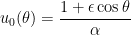
u(\theta) \approx  \displaystyle \frac{1}{\alpha} \left[ 1 + \epsilon \cos \theta \right],

so that

r(\theta) = \displaystyle \frac{\alpha}{1 + \epsilon \cos \theta}.

As we’ve seen, this describes an elliptical orbit, normally expressed in rectangular coordinates as

\displaystyle \frac{(x-h)^2}{a^2} + \frac{y^2}{b^2} = 1,

with semimajor axis along the x-axis. In particular, for an elliptical orbit, the planet’s closest approach to the Sun occurs at \theta = 0:

r(0) = \displaystyle \frac{\alpha}{1 + \epsilon \cos 0} = \frac{\alpha}{1 + \epsilon},

and the planet’s further distance from the Sun occurs at \theta = \pi:

r(\pi) = \displaystyle \frac{\alpha}{1 + \epsilon \cos \pi} = \frac{\alpha}{1 - \epsilon}.

Therefore, the length 2a of the major axis of the ellipse is the sum of these two distances:

2a =  \displaystyle \frac{\alpha}{1 + \epsilon} +  \frac{\alpha}{1 - \epsilon}

2a = \displaystyle \frac{\alpha(1-\epsilon) + \alpha(1+\epsilon)}{(1 + \epsilon)(1 - \epsilon)}

2a= \displaystyle \frac{2\alpha}{1  - \epsilon^2}

a =  \displaystyle \frac{\alpha}{1  - \epsilon^2}.

Said another way, \alpha = a(1-\epsilon^2). This is a far more convenient formula for computing \alpha than \alpha = \displaystyle \frac{\ell^2}{GMm^2}, as the values of a (the semi-major axis) and \epsilon (the eccentricity of the orbit) are more accessible than the angular momentum \ell of the planet’s orbit.

In the next post, we finally compute the precession of the orbit.

Confirming Einstein’s Theory of General Relativity With Calculus, Part 7b: Predicting Precession II

In this series, I’m discussing how ideas from calculus and precalculus (with a touch of differential equations) can predict the precession in Mercury’s orbit and thus confirm Einstein’s theory of general relativity. The origins of this series came from a class project that I assigned to my Differential Equations students maybe 20 years ago.

We have shown that the motion of a planet around the Sun, expressed in polar coordinates (r,\theta) with the Sun at the origin, under general relativity is

u(\theta) \approx  \displaystyle \frac{1 + \epsilon \cos \theta}{\alpha} + \frac{ \delta\epsilon}{\alpha^2} \theta \sin \theta,

where u = \displaystyle \frac{1}{r}, \displaystyle \frac{1}{\alpha} = \frac{GMm^2}{\ell^2}, \delta = \displaystyle \frac{3GM}{c^2}, G is the gravitational constant of the universe, m is the mass of the planet, M is the mass of the Sun, \ell is the constant angular momentum of the planet, and c is the speed of light.

We will now simplify this expression, using the facts that \delta is very small and \alpha is quite large, so that \delta/\alpha is very small indeed. We will use the two approximations

\cos x \approx 1 \qquad \hbox{and} \qquad \sin x \approx x \qquad \hbox{if} \qquad x \approx 0;

these approximations can be obtained by linearization or else using the first term of the Taylor series expansions of \cos x and \sin x about x = 0.

We will also need the trig identity

\cos(\theta_1 - \theta_2) = \cos \theta_1 \cos \theta_2 + \sin \theta_1 \sin \theta_2.

With these tools, we can now simplify u(\theta):

u(\theta) \approx  \displaystyle \frac{1 + \epsilon \cos \theta}{\alpha} + \frac{ \delta\epsilon}{\alpha^2} \theta \sin \theta

=  \displaystyle \frac{1}{\alpha} \left[1 + \epsilon \cos \theta + \frac{ \delta\epsilon}{\alpha} \theta \sin \theta \right]

=  \displaystyle \frac{1}{\alpha} \left[1 + \epsilon \left(\cos \theta + \frac{ \delta}{\alpha} \theta \sin \theta \right) \right]

=  \displaystyle \frac{1}{\alpha} \left[1 + \epsilon \left(\cos \theta \cdot 1 + \sin \theta \cdot \frac{ \delta \theta}{\alpha}  \right) \right]

\approx  \displaystyle \frac{1}{\alpha} \left[1 + \epsilon \left(\cos \theta \cdot \cos \frac{\delta \theta}{\alpha} + \sin \theta \cdot \sin \frac{ \delta \theta}{\alpha}  \right) \right]

\approx  \displaystyle \frac{1}{\alpha} \left[1 + \epsilon \cos \left( \theta - \frac{\delta \theta}{\alpha}  \right) \right].

Confirming Einstein’s Theory of General Relativity With Calculus, Part 7a: Predicting Precession I

In this series, I’m discussing how ideas from calculus and precalculus (with a touch of differential equations) can predict the precession in Mercury’s orbit and thus confirm Einstein’s theory of general relativity. The origins of this series came from a class project that I assigned to my Differential Equations students maybe 20 years ago.

We have shown that the motion of a planet around the Sun, expressed in polar coordinates (r,\theta) with the Sun at the origin, under general relativity is

u(\theta) =  \displaystyle \frac{1 + \epsilon \cos \theta}{\alpha} + \frac{\delta}{\alpha^2} + \frac{\delta \epsilon^2}{2\alpha^2} + \frac{ \delta\epsilon}{\alpha^2} \theta \sin \theta - \frac{ \delta \epsilon^2}{6\alpha^2} \cos 2\theta - \frac{\delta(3+\epsilon^2)}{3\alpha^2} \cos \theta,

where u = \displaystyle \frac{1}{r}, \displaystyle \frac{1}{\alpha} = \frac{GMm^2}{\ell^2}, \delta = \displaystyle \frac{3GM}{c^2}, G is the gravitational constant of the universe, m is the mass of the planet, M is the mass of the Sun, \ell is the constant angular momentum of the planet, and c is the speed of light.

We notice that the first term of the above solution,

\displaystyle \frac{1 + \epsilon \cos \theta}{\alpha} ,

is the same as the solution found earlier under Newtonian physics, without general relativity. Therefore, the remaining terms describe the perturbation due to general relativity. All of these terms contain the small factor \delta, and so these can be expected to be small adjustments to an elliptical orbit.

Of these terms, the terms

\displaystyle \frac{\delta}{\alpha^2} + \frac{\delta \epsilon^2}{2\alpha^2}

are constants, while the terms

- \displaystyle \frac{ \delta \epsilon^2}{6\alpha^2} \cos 2\theta -  \frac{\delta(3+\epsilon^2)}{3\alpha^2} \cos \theta

is bounded since -1 \le \cos \theta \le 1 and -1 \le \cos 2\theta \le 1. By contrast, the term

\displaystyle \frac{ \delta\epsilon}{\alpha^2} \theta \sin \theta

grows without bound. Therefore, for large values of \theta, the planet’s orbit may be accurately described by only including this last perturbation:

u(\theta) =  \displaystyle \frac{1 + \epsilon \cos \theta}{\alpha} + \frac{ \delta\epsilon}{\alpha^2} \theta \sin \theta.

In the next post, we simplify this even further.

Confirming Einstein’s Theory of General Relativity With Calculus, Part 6k: Solving New Differential Equation with Method of Undetermined Coefficients

In this series, I’m discussing how ideas from calculus and precalculus (with a touch of differential equations) can predict the precession in Mercury’s orbit and thus confirm Einstein’s theory of general relativity. The origins of this series came from a class project that I assigned to my Differential Equations students maybe 20 years ago.

We have shown that the motion of a planet around the Sun, expressed in polar coordinates (r,\theta) with the Sun at the origin, under general relativity follows the initial-value problem

u''(\theta) + u(\theta) = \displaystyle \frac{1}{\alpha} + \frac{\delta}{\alpha^2} + \frac{\delta \epsilon^2}{2\alpha^2} + \frac{2\delta \epsilon \cos \theta}{\alpha^2} + \frac{\delta \epsilon^2 \cos 2\theta}{2\alpha^2},

u(0) = \displaystyle \frac{1}{P},

u'(0) = 0,

where u = \displaystyle \frac{1}{r}, \displaystyle \frac{1}{\alpha} = \frac{GMm^2}{\ell^2}, \delta = \displaystyle \frac{3GM}{c^2}, G is the gravitational constant of the universe, m is the mass of the planet, M is the mass of the Sun, \ell is the constant angular momentum of the planet, c is the speed of light, and P is the smallest distance of the planet from the Sun during its orbit (i.e., at perihelion).

In recent posts, we used the method of undetermined coefficients to show that the general solution of the differential equation is

u(\theta) = c_1 \cos \theta + c_2 \sin \theta + \displaystyle \frac{1}{\alpha} + \frac{\delta}{\alpha^2} + \frac{\delta \epsilon^2}{2\alpha^2} +\frac{\delta \epsilon}{\alpha^2} \theta \sin \theta- \frac{\delta \epsilon^2}{6\alpha^2} \cos 2\theta.

We now use the initial conditions to find the constants c_1 and c_2. (We did this earlier when we solved the differential equation via variation of parameters, but we repeat the argument here for completeness.) From the initial condition u(0) = \displaystyle \frac{1}{P} = \frac{1+\epsilon}{\alpha}, we obtain

u(0) = \displaystyle c_1 \cos 0 + c_2 \sin 0 + \displaystyle \frac{1}{\alpha} +  \frac{\delta}{\alpha^2} + \frac{\delta \epsilon^2}{2\alpha^2} + \frac{\delta \epsilon \cdot 0 \cdot \sin 0}{\alpha^2} -\frac{\delta \epsilon^2 \cos 0}{6\alpha^2}

\displaystyle \frac{1+\epsilon}{\alpha} = c_1 + \displaystyle \frac{1}{\alpha} +  \frac{\delta}{\alpha^2} + \frac{\delta \epsilon^2}{2\alpha^2}  -\frac{\delta \epsilon^2}{6\alpha^2}

\displaystyle \frac{\epsilon}{\alpha} = c_1 + \displaystyle \frac{3\delta +\delta \epsilon^2}{3\alpha^2},

so that

c_1 = \displaystyle \frac{\epsilon}{\alpha} - \frac{\delta(3 + \epsilon^2)}{3\alpha^2}.

Next, we compute u'(\theta) and use the initial condition u'(0) = 0:

u'(\theta) = \displaystyle -c_1 \sin \theta + c_2 \cos \theta + \frac{\delta \epsilon}{\alpha^2} (\sin \theta + \theta \cos \theta) + \frac{\delta \epsilon^2 \sin 2\theta}{3\alpha^2}

u'(0) = \displaystyle -c_1 \sin 0 + c_2 \cos 0 + \frac{\delta \epsilon}{\alpha^2} (\sin 0 + 0  \cos 0) + \frac{\delta \epsilon^2 \sin 0}{3\alpha^2}

0 = c_2.

Substituting these values for c_1 and c_2, we finally arrive at the solution

u(\theta) = \displaystyle \left(\frac{\epsilon}{\alpha} - \frac{\delta(3 + \epsilon^2)}{3\alpha^2} \right) \cos \theta + \displaystyle \frac{1}{\alpha} +  \frac{\delta}{\alpha^2} + \frac{\delta \epsilon^2}{2\alpha^2} + \frac{\delta \epsilon \theta \sin \theta}{\alpha^2} -\frac{\delta \epsilon^2 \cos 2\theta}{6\alpha^2}

= \displaystyle \frac{1 + \epsilon \cos \theta}{\alpha} + \frac{\delta}{\alpha^2} + \frac{\delta \epsilon^2}{2\alpha^2} + \frac{ \delta\epsilon}{\alpha^2} \theta \sin \theta - \frac{ \delta \epsilon^2}{6\alpha^2} \cos 2\theta - \frac{\delta(3+\epsilon^2)}{3\alpha^2} \cos \theta.

Confirming Einstein’s Theory of General Relativity With Calculus, Part 6j: Rationale for Method of Undetermined Coefficients VII

In this series, I’m discussing how ideas from calculus and precalculus (with a touch of differential equations) can predict the precession in Mercury’s orbit and thus confirm Einstein’s theory of general relativity. The origins of this series came from a class project that I assigned to my Differential Equations students maybe 20 years ago.

We have shown that the motion of a planet around the Sun, expressed in polar coordinates (r,\theta) with the Sun at the origin, under general relativity follows the initial-value problem

u''(\theta) + u(\theta) = \displaystyle \frac{1}{\alpha} + \frac{\delta}{\alpha^2} + \frac{\delta \epsilon^2}{2\alpha^2} + \frac{2\delta \epsilon \cos \theta}{\alpha^2} + \frac{\delta \epsilon^2 \cos 2\theta}{2\alpha^2},

u(0) = \displaystyle \frac{1}{P},

u'(0) = 0,

where u = \displaystyle \frac{1}{r}, \displaystyle \frac{1}{\alpha} = \frac{GMm^2}{\ell^2}, \delta = \displaystyle \frac{3GM}{c^2}, G is the gravitational constant of the universe, m is the mass of the planet, M is the mass of the Sun, \ell is the constant angular momentum of the planet, c is the speed of light, and P is the smallest distance of the planet from the Sun during its orbit (i.e., at perihelion).

Let me summarize the partial results that we’ve found in the past few posts.

1. The general solution of the associated homogeneous differential equation

u''(\theta) + u(\theta) = 0

is

u_0(\theta) = c_1 \cos \theta + c_2 \sin \theta.

2. One particular solution of the nonhomogeneous differentiatial equation

u''(\theta) + u(\theta) = \displaystyle \frac{1}{\alpha} + \frac{\delta}{\alpha^2} + \frac{\delta \epsilon^2}{2\alpha^2}

is

u_1(\theta) = \displaystyle \frac{1}{\alpha} + \frac{\delta}{\alpha^2} + \frac{\delta \epsilon^2}{2\alpha^2}.

3. One particular solution of the nonhomogeneous differential equation

u''(\theta) + u(\theta) = \displaystyle \frac{2\delta \epsilon \cos \theta}{\alpha^2}

is

u_2(\theta) = \displaystyle \frac{\delta \epsilon}{\alpha^2} \theta \sin \theta.

4. One particular solution of the nonhomogeneous differential equatio

u''(\theta) + u(\theta) = \displaystyle  \frac{\delta \epsilon^2 \cos 2\theta}{2\alpha^2}

is

u_3(\theta) = \displaystyle -\frac{\delta \epsilon^2}{6\alpha^2} \cos 2\theta.

To solve the original differential equation, we will simply add these four solutions together:

u(\theta) = u_0(\theta) + u_1(\theta) + u_2(\theta) + u_3(\theta)

= c_1 \cos \theta + c_2 \sin \theta + \displaystyle \frac{1}{\alpha} + \frac{\delta}{\alpha^2} + \frac{\delta \epsilon^2}{2\alpha^2} +\frac{\delta \epsilon}{\alpha^2} \theta \sin \theta- \frac{\delta \epsilon^2}{6\alpha^2} \cos 2\theta.

It’s a straightforward exercise to show that this new function satisfies the original differential equation:

u''(\theta) + u(\theta) = u_0''(\theta) + u_1''(\theta) + u_2''(\theta) + u_3''(\theta) + u_0(\theta) + u_1(\theta) + u_2(\theta) + u_3(\theta)

=   [u_0''(\theta) +u_0(\theta)]+ [u_1''(\theta)   + u_1(\theta)]+[u_2''(\theta) + u_2(\theta)] + [u_3''(\theta) + u_3(\theta)]

= 0 + \displaystyle \left( \frac{1}{\alpha} + \frac{\delta}{\alpha^2} + \frac{\delta \epsilon^2}{2\alpha^2} \right) + \frac{2\delta \epsilon \cos \theta}{\alpha^2} + \frac{\delta \epsilon^2 \cos 2\theta}{2\alpha^2}

= \displaystyle \frac{1}{\alpha} + \frac{\delta}{\alpha^2} + \frac{\delta \epsilon^2}{2\alpha^2} + \frac{2\delta \epsilon \cos \theta}{\alpha^2} + \frac{\delta \epsilon^2 \cos 2\theta}{2\alpha^2},

as required.

Confirming Einstein’s Theory of General Relativity With Calculus, Part 6i: Rationale for Method of Undetermined Coefficients VI

In this series, I’m discussing how ideas from calculus and precalculus (with a touch of differential equations) can predict the precession in Mercury’s orbit and thus confirm Einstein’s theory of general relativity. The origins of this series came from a class project that I assigned to my Differential Equations students maybe 20 years ago.

In the last few posts, I’ve used a standard technique from differential equations: to solve the nth order homogeneous differential equation with constant coefficients

a_n y^{(n)} + \dots + a_3 y''' + a_2 y'' + a_1 y' + a_0 y = 0,

we first solve the characteristic equation

a_n r^n + \dots + a_3 r^3 + a_2 r^2 + a_1 r + a_0 = 0

using techniques from Precalculus. The form of the roots r determines the solutions of the differential equation.

While this is a standard technique from differential equations, the perspective I’m taking in this series is scaffolding the techniques used to predict the precession in a planet’s orbit using only techniques from Calculus and Precalculus. So let me discuss why the above technique works, assuming that the characteristic equation does not have repeated roots. (The repeated roots case is a little more complicated but is not needed for the present series of posts.)

We begin by guessing that the above differential equation has a solution of the form y = e^{rt}. Differentiating, we find y' = re^{rt}, y'' = r^2 e^{rt}, etc. Therefore, the differential equation becomes

a_n r^n e^{rt} + \dots + a_3 r^3 e^{rt} + a_2 r^2 e^{rt} + a_1 r e^{rt} + a_0 e^{rt} = 0

e^{rt} \left(a_n r^n  + \dots + a_3 r^3 + a_2 r^2 + a_1 r  + a_0 \right) = 0

a_n r^n  + \dots + a_3 r^3 + a_2 r^2 + a_1 r  + a_0 = 0

The last step does not “lose” any possible solutions for r since e^{rt} can never be equal to 0. Therefore, solving the differential equation reduces to finding the roots of this polynomial, which can be done using standard techniques from Precalculus.

For example, one of the differential equations that we’ve encountered is y''+y=0. The characteristic equation is r^2+1=0, which has roots r=\pm i. Therefore, two solutions to the differential equation are e^{it} and e^{-it}, so that the general solution is

y = c_1 e^{it} + c_2 e^{-it}.

To write this in a more conventional way, we use Euler’s formula e^{ix} = \cos x + i \sin x, so that

y = c_1 (\cos t + i \sin t) + c_2 (\cos (-t) + i \sin (-t))

= c_1 \cos t + i c_1 \sin t + c_2 \cos t - i c_2 \sin t

= (c_1 + c_2) \cos t + (ic_1 - ic_2) \sin t

= C_1 \cos t + C_2 \sin t.

Likewise, in the previous post, we encountered the fourth-order differential equation y^{(4)}+5y''+4y = 0. To find the roots of the characteristic equation, we factor:

r^4 + 5r^2 + 4r = 0

(r^2+1)(r^2+4) = 0

r^2 +1 = 0 \qquad \hbox{or} \qquad \hbox{or} r^2 + 4 = 0

r = \pm i \qquad \hbox{or} \qquad r = \pm 2i.

Therefore, four solutions of this differential equation are e^{it}, e^{-it}, e^{2it}, and e^{-2it}, so that the general solution is

y = c_1 e^{it} + c_2 e^{-it} + c_3 e^{2it} + c_4 e{-2it}.

Using Euler’s formula as before, this can be rewritten as

y = C_1 \cos t + C_2 \sin t + C_3 \cos 2t + C_4 \sin 2t.

Confirming Einstein’s Theory of General Relativity With Calculus, Part 6h: Rationale for Method of Undetermined Coefficients V

In this series, I’m discussing how ideas from calculus and precalculus (with a touch of differential equations) can predict the precession in Mercury’s orbit and thus confirm Einstein’s theory of general relativity. The origins of this series came from a class project that I assigned to my Differential Equations students maybe 20 years ago.

We have shown that the motion of a planet around the Sun, expressed in polar coordinates (r,\theta) with the Sun at the origin, under general relativity follows the initial-value problem

u''(\theta) + u(\theta) = \displaystyle \frac{1}{\alpha} + \frac{\delta}{\alpha^2} + \frac{\delta \epsilon^2}{2\alpha^2} + \frac{2\delta \epsilon \cos \theta}{\alpha^2} + \frac{\delta \epsilon^2 \cos 2\theta}{2\alpha^2},

u(0) = \displaystyle \frac{1}{P},

u'(0) = 0,

where u = \displaystyle \frac{1}{r}, \displaystyle \frac{1}{\alpha} = \frac{GMm^2}{\ell^2}, \delta = \displaystyle \frac{3GM}{c^2}, G is the gravitational constant of the universe, m is the mass of the planet, M is the mass of the Sun, \ell is the constant angular momentum of the planet, c is the speed of light, and P is the smallest distance of the planet from the Sun during its orbit (i.e., at perihelion).

In the two previous posts, we derived the method of undetermined coefficients for the simplified differential equations

u''(\theta) + u(\theta) = \displaystyle \frac{1}{\alpha} + \frac{\delta}{\alpha^2} + \frac{\delta \epsilon^2}{2\alpha^2}.

and

u''(\theta) + u(\theta) = \displaystyle \frac{2\delta \epsilon \cos \theta}{\alpha^2}.

In this post, we consider the simplified differential equation if the right-hand side has only the fifth term,

u''(\theta) + u(\theta) =  \displaystyle \frac{\delta \epsilon^2 \cos 2\theta}{2\alpha^2}.

Let v(\theta) = \displaystyle \frac{\delta \epsilon^2 }{2\alpha^2} \cos 2\theta. Then v satisfies the new differential equation v'' + 4v = 0. Also, v = u'' + u. Substituting, we find

(u''+u)'' + 4(u''+u) = 0

u^{(4)} + u'' + 4u'' + 4u = 0

u^{(4)} + 5u'' + 4u = 0

The characteristic equation of this new differential equation is

r^4 + 5r^2 + 4 = 0

(r^2 + 1)(r^2 + 4) = 0

r^2 + 1 = 0 \qquad \hbox{or} \qquad r^2 + 4 = 0

r = \pm i \qquad \hbox{or} \qquad r = \pm 2i

Therefore, the general solution of the new differential equation is

u(\theta) = c_1 \cos \theta + c_2 \sin \theta + c_3 \cos 2\theta + c_4 \sin 2\theta.

The constants c_3 and c_4 can be found by substituting back into the original differential equation:

u''(\theta) + u(\theta) =  \displaystyle \frac{\delta \epsilon^2 \cos 2\theta}{2\alpha^2}

-c_1 \cos \theta - c_2 \sin \theta - 4c_3 \cos 2\theta - 4c_4 \sin 2\theta + c_1 \cos \theta + c_2 \sin \theta + c_3 \cos 2\theta + c_4 \sin 2\theta = \displaystyle \frac{\delta \epsilon^2 \cos 2\theta}{2\alpha^2}

- 3c_3 \cos 2\theta - 3c_4 \sin 2\theta  = \displaystyle \frac{\delta \epsilon^2 \cos 2\theta}{2\alpha^2}

Matching coefficients, we see that c_3 = \displaystyle -\frac{\delta \epsilon^2}{6\alpha^2} and c_4 = 0. Therefore, the solution of the simplified differential equation is

u(\theta) = c_1 \theta + c_2 \theta \displaystyle -\frac{\delta \epsilon^2}{6\alpha^2} \cos 2\theta.

In particular, setting c_1 = 0 and c_2 = 0, we see that

u(\theta) =  \displaystyle -\frac{\delta \epsilon^2}{6\alpha^2} \cos 2\theta

is a particular solution to the simplified differential equation.

In the next post, we put together the solutions of these three simplified differential equations to solve the original differential equation,

u''(\theta) + u(\theta) = \displaystyle \frac{1}{\alpha} + \frac{\delta}{\alpha^2} + \frac{\delta \epsilon^2}{2\alpha^2} + \frac{2\delta \epsilon \cos \theta}{\alpha^2} + \frac{\delta \epsilon^2 \cos 2\theta}{2\alpha^2}.

Confirming Einstein’s Theory of General Relativity With Calculus, Part 6g: Rationale for Method of Undetermined Coefficients IV

In this series, I’m discussing how ideas from calculus and precalculus (with a touch of differential equations) can predict the precession in Mercury’s orbit and thus confirm Einstein’s theory of general relativity. The origins of this series came from a class project that I assigned to my Differential Equations students maybe 20 years ago.

We have shown that the motion of a planet around the Sun, expressed in polar coordinates (r,\theta) with the Sun at the origin, under general relativity follows the initial-value problem

u''(\theta) + u(\theta) = \displaystyle \frac{1}{\alpha} + \frac{\delta}{\alpha^2} + \frac{\delta \epsilon^2}{2\alpha^2} + \frac{2\delta \epsilon \cos \theta}{\alpha^2} + \frac{\delta \epsilon^2 \cos 2\theta}{2\alpha^2},

u(0) = \displaystyle \frac{1}{P},

u'(0) = 0,

where u = \displaystyle \frac{1}{r}, \displaystyle \frac{1}{\alpha} = \frac{GMm^2}{\ell^2}, \delta = \displaystyle \frac{3GM}{c^2}, G is the gravitational constant of the universe, m is the mass of the planet, M is the mass of the Sun, \ell is the constant angular momentum of the planet, c is the speed of light, and P is the smallest distance of the planet from the Sun during its orbit (i.e., at perihelion).

In this post, we will use the guesses

u(\theta) = f(\theta) \cos \theta \qquad \hbox{or} u(\theta) = f(\theta) \sin \theta

that arose from the technique/trick of reduction of order, where f(\theta) is some unknown function, to find the general solution of the differential equation

u^{(4)} + 2u'' + u = 0.

To do this, we will need to use the Product Rule for higher-order derivatives that was derived in the previous post:

(fg)'' = f'' g + 2 f' g' + f g''

and

(fg)^{(4)} = f^{(4)} g + 4 f''' g' + 6 f'' g'' + 4f' g''' + f g^{(4)}.

In these formulas, Pascal’s triangle makes a somewhat surprising appearance; indeed, this pattern can be proven with mathematical induction.

We begin with u(\theta) = f(\theta) \cos \theta. If g(\theta) = \cos \theta, then

g'(\theta) = - \sin \theta,

g''(\theta) = -\cos \theta,

g'''(\theta) = \sin \theta,

g^{(4)}(\theta) = \cos \theta.

Substituting into the fourth-order differential equation, we find the differential equation becomes

(f \cos \theta)^{(4)} + 2 (f \cos \theta)'' + f \cos \theta = 0

f^{(4)} \cos \theta - 4 f''' \sin \theta - 6 f'' \cos \theta + 4 f' \sin \theta + f \cos \theta + 2 f'' \cos \theta - 4 f' \sin \theta - 2 f \cos \theta + f \cos \theta = 0

f^{(4)} \cos \theta - 4 f''' \sin \theta - 6 f'' \cos \theta  + 2 f'' \cos \theta  = 0

f^{(4)} \cos \theta - 4 f''' \sin \theta - 4 f'' \cos \theta = 0

The important observation is that the terms containing f and f' cancelled each other. This new differential equation doesn’t look like much of an improvement over the original fourth-order differential equation, but we can make a key observation: if f'' = 0, then differentiating twice more trivially yields f''' = 0 and f^{(4)} = 0. Said another way: if f'' = 0, then u(\theta) = f(\theta) \cos \theta will be a solution of the original differential equation.

Integrating twice, we can find f:

f''(\theta) = 0

f'(\theta) = c_1

f(\theta) = c_1 \theta + c_2.

Therefore, a solution of the original differential equation will be

u(\theta) = c_1 \theta \cos \theta + c_2 \cos \theta.

We now repeat the logic for u(\theta) = f(\theta) \sin \theta:

(f \sin \theta)^{(4)} + 2 (f \sin \theta)'' + f \sin \theta = 0

f^{(4)} \sin \theta + 4 f''' \cos \theta - 6 f'' \sin \theta - 4 f' \cos\theta + f \sin \theta + 2 f'' \sin \theta + 4 f' \cos \theta - 2 f \sin \theta + f \sin \theta = 0

f^{(4)} \sin\theta + 4 f''' \cos \theta - 6 f'' \sin \theta + 2 f'' \sin \theta = 0

f^{(4)} \sin\theta - 4 f''' \cos\theta - 4 f'' \sin\theta = 0.

Once again, a solution of this new differential equation will be f(\theta) = c_3 \theta + c_4, so that f'' = f''' = f^{(4)} = 0. Therefore, another solution of the original differential equation will be

u(\theta) = c_3 \theta \sin \theta + c_4 \sin \theta.

Adding these provides the general solution of the differential equation:

u(\theta) = c_1 \theta \cos \theta + c_2 \cos \theta + c_3 \theta \sin \theta + c_4 \sin \theta.

Except for the order of the constants, this matches the solution that was presented earlier by using techniques taught in a proper course in differential equations.