
I really enjoyed this simulation of touring the Solar System at the speed of light:
If you don’t want to wait 43 minutes to reach Jupiter, here’s the video sped up by a factor of 15:
I really enjoyed this simulation of touring the Solar System at the speed of light:
If you don’t want to wait 43 minutes to reach Jupiter, here’s the video sped up by a factor of 15:
From Quartz magazine: Netflix was born out of this grad-school math problem
While studying computer science at Stanford University in the 1980s, Hastings said there was an exercise by computer scientist Andrew Tanenbaum in which he had to work out the bandwidth of a station wagon carrying tapes across the US. “It turns out that’s a very high-speed network,” Hastings said, speaking at a Mobile World Congress session in Barcelona. “From that original exercise, it made me think we can build Netflix first on DVD and then eventually the internet would catch up with the postal system and pass it.”
This is how Tanenbaum and co-writer David Wetherall described the problem in their book Computer Networks (fifth edition, pdf):
One of the most common ways to transport data from one computer to another is to write them onto magnetic tape or removable media (e.g., recordable DVDs), physically transport the tape or disks to the destination machine, and read them back in again. Although this method is not as sophisticated as using a geosynchronous communication satellite, it is often more cost effective, especially for applications in which high bandwidth or cost per bit transported is the key factor.
A simple calculation will make this point clear. An industry-standard Ultrium tape can hold 800 gigabytes. A box 60 × 60 × 60 cm can hold about 1000 of these tapes, for a total capacity of 800 terabytes, or 6400 terabits (6.4 petabits). A box of tapes can be delivered anywhere in the United States in 24 hours by Federal Express and other companies. The effective bandwidth of this transmission is 6400 terabits/86,400 sec, or a bit over 70 Gbps. If the destination is only an hour away by road, the bandwidth is increased to over 1700 Gbps. No computer network can even approach this. Of course, networks are getting faster, but tape densities are increasing, too.
If we now look at cost, we get a similar picture. The cost of an Ultrium tape is around $40 when bought in bulk. A tape can be reused at least 10 times, so the tape cost is maybe $4000 per box per usage. Add to this another $1000 for shipping (probably much less), and we have a cost of roughly $5000 to ship 800 TB. This amounts to shipping a gigabyte for a little over half a cent. No network can beat that. The moral of the story is:
Never underestimate the bandwidth of a station wagon full of tapes hurtling down the highway.
From the Chronicle of Higher Education: Meet the Math Professor Who’s Fighting Gerrymandering With Geometry, an interview with Dr. Moon Duchin, an associate professor of math and director of the Science, Technology and Society program at Tufts.
Q. What is the Metric Geometry and Gerrymandering Group’s aim?
A. In redistricting, one of the principles that’s taken seriously by courts is that districts should be compact. The U.S. Constitution does not say that, but many state constitutions do, and it’s taken as a kind of general principle of how districts ought to look.
But nobody knows exactly what compactness means. People just have the idea that it means the shape shouldn’t be too weird, shouldn’t be too eccentric; it should be a kind of reasonable shape. Lots of people have taken a swing at that over the years. Which definition you choose actually has stakes. It changes what maps are acceptable and what maps aren’t. If you look at the Supreme Court history, what you’ll see is that a lot of times, especially in the ’90s, the court would say, Look, some shapes are obviously too bizarre but we don’t know how to describe the cutoff. How bizarre is too bizarre? We don’t know; that sounds hard.
Q. It’s like how they define obscenity.
A. Exactly. When I started thinking about this, I was surprised to see that even though there were different mathematical attempts at a definition, you don’t ever see mathematicians testifying in court about it. So our first aim was to think like mathematicians about compactness and look at all the definitions that already exist, and compare them and try to prove theorems about the relationships between the definitions.
What courts have been looking for is one definition of compactness that they can understand, that we can compute, and that they can use as a kind of go-to standard. I don’t have any illusions that we’re going to settle that debate forever, but I think we can make a contribution to the debate.
See also her lecture for the Mathematical Association of America’s Distinguished Lecture Series:
In my capstone class for future secondary math teachers, I ask my students to come up with ideas for engaging their students with different topics in the secondary mathematics curriculum. In other words, the point of the assignment was not to devise a full-blown lesson plan on this topic. Instead, I asked my students to think about three different ways of getting their students interested in the topic in the first place.
I plan to share some of the best of these ideas on this blog (after asking my students’ permission, of course).
This student submission comes from my former student Zachery Hasegawa. His topic, from Precalculus: geometric sequences.

How has this topic appeared in pop culture? (movies, TV, current music, video games, etc.)
Geometric sequences appear frequently in pop culture. One example that immediately comes to mind is the movie The Happening starring Mark Wahlberg and Zoe Deschanel. In the movie, there is a scene where a gentleman is trying to distract another woman from the chaos happening outside the jeep they’re traveling in. He says to her “If I start out with a penny on the first day of a 31 day month and kept doubling it each day, so I’d have .01 on day 1, .02 on day 2, etc. How much money will I have at the end of the month?” The woman franticly spouts out a wrong answer and the gentleman responds “You’d have over ten million dollars by the end of the month”. The car goes on to crash just after that scene but as a matter of fact, you’d have exactly $10,737,418.20 at the end of the 31-day month. This is an example of a geometric sequence because you start out with 0.01 and to get to the next term (day), you would multiply by a common ratio of 2.
What interesting things can you say about the people who contributed to the discovery and/or the development of this topic?
Geometric sequences are popularly found in Book IX of Elements by Euclid, dating back to 300 B.C. Euclid of Alexandria, a famous Greek mathematician also considered the “Father of Geometry” was the main contributor of this theory. Geometric sequences and series are one of the easiest examples of infinite series with finite sums. Geometric sequences and series have played an important role in the early development of calculus, and have continued to be a main case of study in the convergence of series. Geometric sequences and series are used a lot in mathematics, and they are very important in physics, engineering, biology, economics, computer science, queuing theory, and even finance.
How can technology (specifically Khan Academy/YouTube) be used to effectively engage students with this topic:
I really like the video that Khan Academy does on YouTube about Geometric Sequences. This particular video is a very good introduction to Geometric Sequences because he explains the difference between Geometric Sequences and Series, which I thought to be helpful because I always got the two confused with each other. Mr. Khan starts out by explaining what exactly a Geometric Sequence is. He describes a Geometric sequence as “A progression of numbers where each successive number is a fixed multiple of the one before it.” He goes on to give numerical examples to specifically show you what he means. He explains that a1 is typically our first term; a2 is the second term, etc. He then explains that to get from a1 to a2, you will multiply a1 by the “common ratio” usually represented by “r. For example, “3, 12, 48, 192” is a finite geometric sequence where the common ratio, r, is 4 because to go from 3 to 12 or from 12 to 48, you multiply by 4. He goes on to explain that a Geometric Sequence is a list (sequence) of numbers (terms) that are being multiplied by a common ratio and that a Geometric Series is the sum of the terms (numbers) in the Geometric Sequence. Using the same numbers as from the Geometric Sequence above, the geometric series is “3+12+48+192”.
References:
In my capstone class for future secondary math teachers, I ask my students to come up with ideas for engaging their students with different topics in the secondary mathematics curriculum. In other words, the point of the assignment was not to devise a full-blown lesson plan on this topic. Instead, I asked my students to think about three different ways of getting their students interested in the topic in the first place.
I plan to share some of the best of these ideas on this blog (after asking my students’ permission, of course).
This student submission comes from my former student Perla Perez. Her topic, from Precalculus: graphing parametric equations.
How can technology (YouTube, Khan Academy [khanacademy.org], Vi Hart, Geometers Sketchpad, graphing calculators, etc.) be used to effectively engage students with this topic? Note: It’s not enough to say “such-and-such is a great website”; you need to explain in some detail why it’s a great website.
Graphing calculators and online sketch pads can allow students to be able to visually see how parametric equations look like. Let’s say the teachers is just introducing parametric equations for the first time to his/her students. Since technology is advancing at a fast rate using an online sketchpad such as, http://www.sineofthetimes.org/the-art-of-parametric-equations-2/, allows student/anyone to explore without much thought. Using the sketch pad above, have students create different figures by moving the blue, green, and red slides. The figures represent can range from:
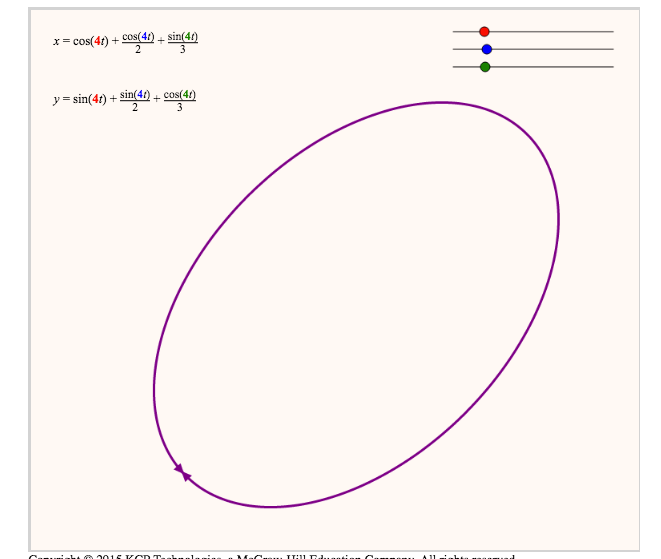
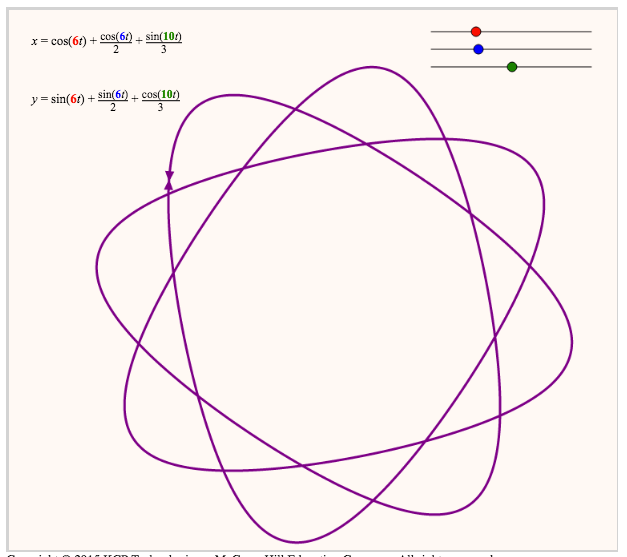

Have a couple student present a figure they like to the class and begin asking simple question like: Why did you chose this picture? Which slides did you use to get here? What did you observe of this sketch? What happens to the equations when you move one of the slides? After the last students shows their figure, bring the class together. Explain that the goal for the next few classes is to be able to graph similar graphs. Although the parametric equations on this sketchpad may be advanced for a high school pre-calculus class, this allows students to get a broader sense of where their high school education can grow.
Resources:
http://www.sineofthetimes.org/the-art-of-parametric-equations-2/
What interesting things can you say about the people who contributed to the discovery and/or the development of this topic? (You might want to consult Math Through The Ages.)
Jules Lissajous (1822–1880) was a professor of mathematics in Lycée Saint-Louis from 1847 till 1874. During this time, though, he mainly focused on the study of vibrations and sound. It is because of him (mainly) that we can visually see sound. The way this was done was by parametric equations specially x=asin(w1t+z2), y=bsin(w2+z2), where a, b are amplitudes w1, w2 angular frequencies, z1, z2 phases, and t is time. Using this he was able to create, “patterns formed when two vibrations along perpendicular lines are superimposed”. To a high school student essentially resembles a coordinate plane. Even though he won the Lacaze Prize in 1867 for what many call, “beautiful experiments”, a man named Nathaniel Bowditch produced them using a compound pendulum in 1815. Even though the work isn’t new, Lissajous did his work independently. Jules has helped advanced our studies of not only math but in physics.
Resources:
http://www.hit.bme.hu/~papay/edu/Lab/Lissajous.pdf
http://www-groups.dcs.st-and.ac.uk/history/Biographies/Lissajous.html
http://www.s9.com/Biography/lissajous-jules-antoine/
What interesting (i.e., uncontrived) word problems using this topic can your students do now? (You may find resources such as http://www.spacemath.nasa.gov to be very helpful in this regard; feel free to suggest others.)
Students in algebra learn how to graph a function in a coordinate plane as well as be able to solve for an equation from a graph. Before, students begin to graph parametric equations for the most have some understanding of what a parametric equation is, at least in most situations. To take the students to the next level and build on their understanding, interesting world problems such as the one below can help the process go more smoothly. This worksheet begins with something students should be able to complete and expand to what graphs of a parametric equations look like.
This word problem is:
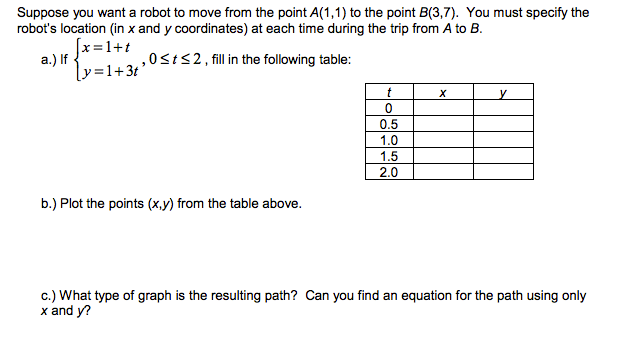
Begin by having students fill the table out. Take a moment to check student’s results. Next, challenge the students to attempt to plot and describe the graph as asked in part b and c. From there on, the instructor can go over what these parts mean. This is a great way to start having student connect their knowledge of equations to a graph to even more topics in-depth.
Resources:
http://www.austincc.edu/lochbaum/11-3%20Parametric%20Equations.pdf
In my capstone class for future secondary math teachers, I ask my students to come up with ideas for engaging their students with different topics in the secondary mathematics curriculum. In other words, the point of the assignment was not to devise a full-blown lesson plan on this topic. Instead, I asked my students to think about three different ways of getting their students interested in the topic in the first place.
I plan to share some of the best of these ideas on this blog (after asking my students’ permission, of course).
This student submission comes from my former student Sarah Asmar. Her topic, from Precalculus: computing trigonometric functions using a unit circle.
How could you as a teacher create an activity or project that involves your topic?
Learning the unit circle can be very challenging for many students. One must know all the elements of the circle and need to know how to apply it. Therefore, I have come up with a few activities to make learning the unit circle more fun and engaging. One activity that would be great when teaching students how to memorize the unit circle and all the elements of it is the game of “I Have Who Has.” I would create a stack of note cards that would have one element of the unit circle on it. For example, one card will have 90° while another will have π. I will do that for all the elements on the unit circle. Then, I would pass out one note card to each student. One student will begin by saying “I have 2π, who has 0° or 360°?” Then, the student that has the card with those two elements on it will say what they have and ask who has the next element. This will go on until all of the elements have been said and it returns to the student that started the game. Another activity I found that would help students see the unit circle in a more colorful way is if they created it on a paper plate using colored yarn or colored markers. The x and y axis would be in one color and the rest would be in different colors. They would label each line/angle with the correct degree and radian, and the correct (x, y). Here is the link to a picture of what I would want the students to do: https://s-media-cache-ak0.pinimg.com/736x/74/e9/23/74e9232e7389804ce4df2ea6890e0ff9.jpg
How does this topic extend what your students should have learned in previous courses?
Students first see trigonometry in Geometry class as sophomores in high school, but they typically go into more depth during pre-calculus. One way to compute trigonometric functions using the unit circle is by using right triangles. You can find the angle measurement by drawing a right triangle on the unit circle and connect two points. The two special right triangles (30-60-90 and 45-45-90) can be used to form the unit circle. Students would need to recall the rules from geometry to figure out the side lengths of the triangles. With this, students are forced to remember what they were taught in geometry class in order to compute trigonometric functions. If students can see how using the two special triangles creates the unit circle, then it might make more sense to them as where all the measurements/elements came from.
How can technology be used to effectively engage students with this topic?
Technology plays a big role in education these days. Students and teachers are encouraged to use technology in the classroom. Khan Academy is one of my favorite websites. He creates very detailed videos about every mathematical topic. I found a few videos on his website to show my students that would help them understand how to use sine, cosine, and tangent with the unit circle. He even has a video that shows a way to remember the unit circle. Another way to implement technology use with tis topic would be with the graphing calculator. Students tend to believe the calculator more than their own teacher. If they saw that the calculator gave them the same exact values as the found using the unit circle, I think they would be amazed and understand how the calculator finds them as well. They might see themselves as smart as the calculator if they can figure out the values by hand and then using the calculator to check their work. I also, might try to find a funny YouTube video that would help the students remember the parts of the unit circle. Once they have the unit circle memorized, it is much easier using it to compute trigonometric functions. Students tend to be more engaged and willing to do something when technology is involved.
References:
In my capstone class for future secondary math teachers, I ask my students to come up with ideas for engaging their students with different topics in the secondary mathematics curriculum. In other words, the point of the assignment was not to devise a full-blown lesson plan on this topic. Instead, I asked my students to think about three different ways of getting their students interested in the topic in the first place.
I plan to share some of the best of these ideas on this blog (after asking my students’ permission, of course).
This student submission comes from my former student Marissa Arevalo. Her topic, from Precalculus: graphing an ellipse.
How have different cultures throughout time used this topic in their society?
In a philosophy paper, I wrote a about the usage of ellipses that applied not only to the field of mathematics but theology and science (more specifically astronomy), and the implications it had throughout time. Throughout centuries, mankind has argued over the ways of the universe and whether or not we are the center of that universe or if something else is. From the times of Ancient Greece, Aristotle believed that the center of our universe revolved around a form of unchanging matter that did not obey the laws of the planet earth. Ptolemy rejected this idea and created a model of a universe centered around Earth itself where the other planets revolved around us, but he could not answer as to why the planetary orbits did not follow a circular path. Later on in the 14th and 15th centuries Copernicus and Galileo respectively argued for a system that orbited the sun rather than the Earth. This idea went against the beliefs of the church and their research caused Galileo to be held into persecution for his radical ideas (Copernicus died before any due harm came to him). It was not until Johannes Kepler, under the tutelage of his teacher Tycho Brahe, observed the motion of the planet Mars and noted that the path did not actually follow a circular path but an elliptical one. His findings disproved his teacher, who was a firm advocate of the church and believed in a geocentric model, showing that the planets were centered around the sun. Sir Isaac Newton’s Laws of Gravity later proved Kepler’s theories, and to this day are known as Kepler’s Laws of Planetary Motion.
We utilize these laws and other properties in order to define what it means to be a planet, therefore a planet:
These properties defined all of our planets, except Pluto, who it was discovered to be smaller than other things that existed in its orbit in the Kuiper Belt and therefore cannot have the third property. While the orbital pattern of Pluto followed the guidelines of the other planets (though with a greater eccentricity), Pluto was too small, therefore removing it off the list of planets in the solar system in 2006 and was defined as a “dwarf planet”. While the students of this time may not relate to the surprise of the reclassification of Pluto in our solar system, it is still relatable to today’s society as this long debate of the way planets move and how our universe was created greatly impacts science even today as we make new discoveries over other celestial bodies in our universe.
How can technology (YouTube, Khan Academy [khanacademy.org]. Vi Hart, Geometers, graphing calculators, etc.) be used to effectively engage students with this topic?
A website that can be utilized for students to get more involved in their own learning would be Gizmos where the students can be given a small exploration sheet in which they can compare the graph of ellipse to its equation and what exactly affects the shape of the ellipse as different aspects are altered. The students can also manipulate the graph and watch the standard form of the equation change over time. The site allows the student to also see the pythagorean and geometric relationships and definitions of an ellipse as the equation is altered. One very important key feature on the exploration of the geometric definition is that the student is able to plot the purple point that moves along the edge of the figure in different locations to show the relationship between the lengths of foci from the edge. The only downside may be that while the teacher can use the site for a short free trial, they may have to make payments in order to continue using it. Desmos is another website that can graph ellipse equations, but it does not provide the ability to see the geometric definition applied to the graph of the function.


How could you as a teacher create an activity or project that involves your topic?
Another idea that would have the students thinking about the geometric concepts surrounding the properties of an ellipse would be for the teacher to have worksheets in which the students would show the representation of where an ellipse could be formed in the cutting of double-napped cone with a plane. The students could lead discussions in their own ideas and how an ellipse, hyperbola, parabola, and circle are created if you literally sliced the cones into pieces. The teacher could have either a physical model of the cones or have the students create the physical model of the cones with play-doh and cut the cones with cardboard/plastic-wear/dental floss (preferred) and describe the shape that was created in by the cuts made. (Another idea is to make the cones with Rice Krispies or scones and jam/chocolate) The good thing about this play-doh is approximately 50 cents at Wal-Mart and provide a nice way for students to make mistakes and restart without having to clean that big of a mess up. The students will be more involved in the material if they are able to create physical models and form their own ideas on things that many teachers do not address in their lessons. This is coming from personal experience of not knowing certain geometric properties of conic sections until taking college courses.

References:
https://www.desmos.com/calculator
https://illuminations.nctm.org/uploadedFiles/Content/Lessons/Resources/9-12/CuttingConics-AS.pdf
https://www.pinterest.com/pin/480759328950528032/
https://www.pinterest.com/pin/343540277799331864/
https://www.explorelearning.com/index.cfm?method=cResource.dspView&ResourceID=132
Cain, F. (2012). Why Pluto is No Longer a Planet – Universe Today. Retrieved March 22, 2016, from http://www.universetoday.com/13573/why-pluto-is-no-longer-a-planet/
Helden, A. V. (2016, February 17). Galileo. Retrieved March 22, 2016, from http://
http://www.britannica.com/biography/Galileo-Galilei
Jones, A. R. (n.d.). Ptolemaic system. Retrieved March 22, 2016, from http://
http://www.britannica.com/topic/Ptolemaic-system
Leveillee, N. P. (2011). Copernicus, Galileo, and the Church: Science in a Religious World.
Student Pulse, 3(5), 1-2. Retrieved March 15, 2016, from http://www.studentpulse.com/
articles/533/copernicus-galileo-and-the-church-science-in-a-religious-world
Rosenburg, M. (2015, April 22). Scientiflix. Retrieved March 22, 2016, from http://
scientiflix.com/post/117082918519/keplers-first-law-of-motion-elliptical-orbits
Simmons, B. (2016, February 21). Mathwords: Foci of an Ellipse. Retrieved March 22, 2016,
from http://www.mathwords.com/f/foci_ellipse.htm
The Universe of Aristotle and Ptolemy. (n.d.). Retrieved March 22, 2016, from http://
csep10.phys.utk.edu/astr161/lect/retrograde/aristotle.html
Westman, R. S. (2016, February 21). Johannes Kepler. Retrieved March 22, 2016, from http://


 Mean Green Math
