Predicate Logic and Popular Culture (Part 180): Queen

Let p be the proposition “I’m just a poor boy,” let P be the set of all people, and let L(x) be the proposition “x loves me.” Translate the logical statement

p \land \forall x \in P( \lnot L(x) ).

This matches a line from “Bohemian Rhapsody.”

Context: Part of the discrete mathematics course includes an introduction to predicate and propositional logic for our math majors. As you can probably guess from their names, students tend to think these concepts are dry and uninteresting even though they’re very important for their development as math majors.

In an effort to making these topics more appealing, I spent a few days mining the depths of popular culture in a (likely futile) attempt to make these ideas more interesting to my students. In this series, I’d like to share what I found. Naturally, the sources that I found have varying levels of complexity, which is appropriate for students who are first learning prepositional and predicate logic.

When I actually presented these in class, I either presented the logical statement and had my class guess the statement in actual English, or I gave my students the famous quote and them translate it into predicate logic. However, for the purposes of this series, I’ll just present the statement in predicate logic first.

Predicate Logic and Popular Culture (Part 179): Harry Potter

Let P be the set of all people, let W(x) be the proposition “x is a witch,” let Z(x) be the proposition “x is a wizard,” let B(x) be the proposition “x went bad,” and let S(x) be the proposition “x was in Slytherin.” Translate the logical statement

\lnot \exists x \in P( (W(x) \lor Z(x)) \land B(x) \land ~S(x)).

This matches matches a line from “Harry Potter and the Sorcerer’s Stone.”

Context: Part of the discrete mathematics course includes an introduction to predicate and propositional logic for our math majors. As you can probably guess from their names, students tend to think these concepts are dry and uninteresting even though they’re very important for their development as math majors.

In an effort to making these topics more appealing, I spent a few days mining the depths of popular culture in a (likely futile) attempt to make these ideas more interesting to my students. In this series, I’d like to share what I found. Naturally, the sources that I found have varying levels of complexity, which is appropriate for students who are first learning prepositional and predicate logic.

When I actually presented these in class, I either presented the logical statement and had my class guess the statement in actual English, or I gave my students the famous quote and them translate it into predicate logic. However, for the purposes of this series, I’ll just present the statement in predicate logic first.

Predicate Logic and Popular Culture (Part 178): Lauryn Hill

Let P be the set of all people, and let f(x) measure how much x loves you.

\lnot \exists x \in P(f(x) > f(I)).

This matches matches a line from “Ex Factor.” This is also a nice exercise in predicate logic, as the statement is also logically equivalent to

\forall x \in P(f(x) \le f(I)).

Context: Part of the discrete mathematics course includes an introduction to predicate and propositional logic for our math majors. As you can probably guess from their names, students tend to think these concepts are dry and uninteresting even though they’re very important for their development as math majors.

In an effort to making these topics more appealing, I spent a few days mining the depths of popular culture in a (likely futile) attempt to make these ideas more interesting to my students. In this series, I’d like to share what I found. Naturally, the sources that I found have varying levels of complexity, which is appropriate for students who are first learning prepositional and predicate logic.

When I actually presented these in class, I either presented the logical statement and had my class guess the statement in actual English, or I gave my students the famous quote and them translate it into predicate logic. However, for the purposes of this series, I’ll just present the statement in predicate logic first.

Predicate Logic and Popular Culture (Part 177): Shakira

Let P be the set of all people, let L(x) be the proposition “x learns,” and let W(x) be the proposition “x gets it wrong.” Translate the logical statement

\lnot \exists x \in P(L(x) \land \lnot W(x)).

This matches this quote from “Try Everything” from “Zootopia.” This is also a nice exercise in predicate logic, as the statement is also logically equivalent to

\forall x \in P(\lnot L(x) \lor W(x))

or

\forall x \in P(L(x) \Rightarrow W(x)).

green line

Context: Part of the discrete mathematics course includes an introduction to predicate and propositional logic for our math majors. As you can probably guess from their names, students tend to think these concepts are dry and uninteresting even though they’re very important for their development as math majors.

In an effort to making these topics more appealing, I spent a few days mining the depths of popular culture in a (likely futile) attempt to make these ideas more interesting to my students. In this series, I’d like to share what I found. Naturally, the sources that I found have varying levels of complexity, which is appropriate for students who are first learning prepositional and predicate logic.

When I actually presented these in class, I either presented the logical statement and had my class guess the statement in actual English, or I gave my students the famous quote and them translate it into predicate logic. However, for the purposes of this series, I’ll just present the statement in predicate logic first.

Predicate Logic and Popular Culture (Part 176): Game of Thrones

Let p be the proposition “You play the game of thrones,” let q be the proposition “You win,” and let r be the proposition “You die.” Translate the logical statement

p \Rightarrow (q \lor r).

This matches this quote from “Game of Thrones.”

green line

Context: Part of the discrete mathematics course includes an introduction to predicate and propositional logic for our math majors. As you can probably guess from their names, students tend to think these concepts are dry and uninteresting even though they’re very important for their development as math majors.

In an effort to making these topics more appealing, I spent a few days mining the depths of popular culture in a (likely futile) attempt to make these ideas more interesting to my students. In this series, I’d like to share what I found. Naturally, the sources that I found have varying levels of complexity, which is appropriate for students who are first learning prepositional and predicate logic.

When I actually presented these in class, I either presented the logical statement and had my class guess the statement in actual English, or I gave my students the famous quote and them translate it into predicate logic. However, for the purposes of this series, I’ll just present the statement in predicate logic first.

Predicate Logic and Popular Culture (Part 175): Diana Ross and the Supremes

Let T(t) be the proposition “We are together at time t.” Translate the logical statement

\exists t > 0 (T(t)).

This matches this classic by Diana Ross and the Supremes.

green line

Context: Part of the discrete mathematics course includes an introduction to predicate and propositional logic for our math majors. As you can probably guess from their names, students tend to think these concepts are dry and uninteresting even though they’re very important for their development as math majors.

In an effort to making these topics more appealing, I spent a few days mining the depths of popular culture in a (likely futile) attempt to make these ideas more interesting to my students. In this series, I’d like to share what I found. Naturally, the sources that I found have varying levels of complexity, which is appropriate for students who are first learning prepositional and predicate logic.

When I actually presented these in class, I either presented the logical statement and had my class guess the statement in actual English, or I gave my students the famous quote and them translate it into predicate logic. However, for the purposes of this series, I’ll just present the statement in predicate logic first.

Predicate Logic and Popular Culture (Part 174): Rocky IV

Let p be the proposition “He dies.” Translate the logical statement

p \Rightarrow p.

This famous tautology was uttered by Ivan Drago in Rocky IV.

green line

Context: Part of the discrete mathematics course includes an introduction to predicate and propositional logic for our math majors. As you can probably guess from their names, students tend to think these concepts are dry and uninteresting even though they’re very important for their development as math majors.

In an effort to making these topics more appealing, I spent a few days mining the depths of popular culture in a (likely futile) attempt to make these ideas more interesting to my students. In this series, I’d like to share what I found. Naturally, the sources that I found have varying levels of complexity, which is appropriate for students who are first learning prepositional and predicate logic.

When I actually presented these in class, I either presented the logical statement and had my class guess the statement in actual English, or I gave my students the famous quote and them translate it into predicate logic. However, for the purposes of this series, I’ll just present the statement in predicate logic first.

Predicate Logic and Popular Culture (Part 173): Alicia Keys

Let P be the set of all people, let $T$ be the set of all things, and let W(x,y) be the proposition “x wants y.” Translate the logical statement

\exists x \in P \forall y \in T (W(x,y)).

Of course, this matches the first line in the chorus of this popular Alicia Keys song.

green line

Context: Part of the discrete mathematics course includes an introduction to predicate and propositional logic for our math majors. As you can probably guess from their names, students tend to think these concepts are dry and uninteresting even though they’re very important for their development as math majors.

In an effort to making these topics more appealing, I spent a few days mining the depths of popular culture in a (likely futile) attempt to make these ideas more interesting to my students. In this series, I’d like to share what I found. Naturally, the sources that I found have varying levels of complexity, which is appropriate for students who are first learning prepositional and predicate logic.

When I actually presented these in class, I either presented the logical statement and had my class guess the statement in actual English, or I gave my students the famous quote and them translate it into predicate logic. However, for the purposes of this series, I’ll just present the statement in predicate logic first.

Engaging students: Geometric sequences

In my capstone class for future secondary math teachers, I ask my students to come up with ideas for engaging their students with different topics in the secondary mathematics curriculum. In other words, the point of the assignment was not to devise a full-blown lesson plan on this topic. Instead, I asked my students to think about three different ways of getting their students interested in the topic in the first place.

I plan to share some of the best of these ideas on this blog (after asking my students’ permission, of course).

This student submission comes from my former student Victor Acevedo. His topic, from Precalculus: geometric sequences.

green line

How has this topic appeared in pop culture (movies, TV, current music, video games, etc.)?

2048 is a fun game on mobile phones and online that can help introduce the concept of geometric sequences to students. The game is based on the powers of 2 and trying to reach 2^11 (or 2048). Each time two matching tiles are combined it creates the next power of 2. At first glance, it may seem that you are just adding the two tiles, so it doesn’t look like a geometric sequence. The geometric sequence shows up when you look at the terms in the sequence being each new tile that is introduced. For example, the 8 tile comes from two 4 tiles, and each 4 tile comes from two 2 tiles, but the 8 tile is still the third new tile making it the third term in the sequence. There can be a discussion about how many tiles are needed to create the first several terms in the sequence up until 2048.

https://play2048.co/

green line

What interesting (i.e., uncontrived) word problems using this topic can your students do now?

A fun problem that involves geometric sequences is the doubling penny problem. You are asked to decide whether you would rather have lump sum of $1,000,000 given to you upfront or take an offer that involves doubling pennies for the next 30 days. The second offer would involve you taking a single penny on the first day, then doubling that amount each day until the 30th day. At first it seems like a reasonable choice to take the lump sum of $1,000,000, but you have to remember that we are dealing with and exponential or geometric growth in the second offer. On the 30th day you would receive 2^30 pennies which would be $107,374,182.40. That number doesn’t even include the sum of all the other days you were receiving pennies. This would be a great way to explore that difference between linear (or arithmetic) and exponential (or geometric) growth.

green line

How have different cultures throughout time used this topic in their society?

The paradox of Achilles and the tortoise is an example where geometric sequences are applied with philosophical thought. Achilles is racing a tortoise.  Achilles gives the tortoise a lead because he believes that he is much faster than the tortoise. The paradox arises from the fact that Achilles will have to try and close the gap between him and tortoise while the tortoise keeps moving forward. By having to always get to where the tortoise has been, Achilles can’t catch up. A simplified way of seeing this is by imagining the tortoise already being at the finish line and Achilles just having to close the gap in between him and the tortoise. He does so in a way that cuts the distance between him and the tortoise in half every minute. By doing so, Achilles will never actually catch up since there is always more distance to travel. In this case the common ratio for the geometric sequence would ½ and the end goal would be 0 but it could never be attained.

Engaging students: Introducing the number e

In my capstone class for future secondary math teachers, I ask my students to come up with ideas for engaging their students with different topics in the secondary mathematics curriculum. In other words, the point of the assignment was not to devise a full-blown lesson plan on this topic. Instead, I asked my students to think about three different ways of getting their students interested in the topic in the first place.

I plan to share some of the best of these ideas on this blog (after asking my students’ permission, of course).

This student submission comes from my former student Julie Thompson. Her topic, from Precalculus: introducing the number e.

green line

What interesting word problems using this topic can your students do now?


I found a very interesting word problem involving the number e and derangements. A derangement is a permutation of a set in which no element is in its original place. The word problem I found is as follows:

“At the bohemian jazz parties frequented by aficionados of the number e, the espresso flows freely, and at the end of the evening, party-goers are just as likely to go home in someone else’s overcoat as they are in their own. After such a party, what are the chances that at least one person goes home wearing the right coat?”

To start off, we need to find out how many permutations, or how many combinations of ways the coats can be put on at random when guests leave the party. The problem asks us to identify the chance that at least one person IS wearing the right coat. In other words, we need to delete all the combinations in which nobody grabbed the correct coat. These are the derangements. Interestingly, when you divide the number of permutations by the number of derangements, you get a number extremely close to the value of e. And the ratio is always so.

Looking at a numerical example with 10 guests, the number of ways 10 people can pick up 10 coats (permutations) is 3628800, and the number of ways nobody would pick up the right coat is 1334961. Dividing, 3628800/1334961= 2.71828, which is extremely close to e. Therefore, the chance of nobody getting the right coat is about 1 in e. How interesting. I feel like this word problem would really interest students!


green line

How was this topic adopted by the mathematical community?

The number e was not discovered as ‘naturally’ as you may think. Mathematicians came close to discovering e in their calculations many times in the 17th century but thought it was just a random number without any real significance. The first person to calculate e is not documented, but historians believe it to not even be a mathematician, but a banker or trader. Why is this?

The number e is very fundamental to a financial process that took off in the 17th century. “The number e lies at the foundations of one of the most fundamental processes of finance: compound interest.” Mathematicians, including Jacob Bernoulli, would later go on to define:

            . e = \displaystyle \lim_{x \to \infty} \left(1 + \frac{1}{x} \right)^x
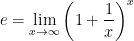
            “This is why the number e appears so often in modeling the exponential growth or decay of everything from bacteria to radioactivity.” This fact was adopted by the mathematical community and many mathematicians started collaborating and making many more discoveries on the number e, such as Euler, who estimated e correctly to 18 decimal places, gave the continued fraction expansion of e, and made a connection between e and the sine and cosine functions. The number e is one of the most beautiful and powerful number in all of mathematics and the use of it was adopted into mathematics most likely by a banker…how interesting.


green line

How can technology be used to effectively engage students with this topic?


Any graphing technology, such as a TI calculator, Mathematica, MatLab, Desmos, etc., are great tools to use in order to engage students when discovering the number e. For instance, to convince students that the above limit is true,

e = \displaystyle \lim_{x \to \infty} \left(1 + \frac{1}{x} \right)^x,

 I can have them graph the function for themselves and actually see that the function approaches the number e as x gets very large. Similarly, I can simulate numbers of e on a computer program with the expansion  1 + 1/1! + 1/2! + 1/3! + … to show the sum getting closer and closer to the value of e the more terms I add. I believe this will be really engaging because the expansion for the number e and the limit for e look like they have nothing to do with e at first glance. To make the connection between them graphically would be somewhat magical to students and hopefully make them curious for more.


References:

http://wmueller.com/precalculus/e/e6.html (this is word problem from A1)

https://brilliant.org/wiki/the-discovery-of-the-number-e/

http://mathworld.wolfram.com/e.html

http://www-history.mcs.st-and.ac.uk/HistTopics/e.html


