
I had forgotten the precise assumptions on uniform convergence that guarantees that an infinite series can be differentiated term by term, so that one can safely conclude

This was part of my studies in real analysis as a student, so I remembered there was a theorem but I had forgotten the details.
So, like just about everyone else on the planet, I went to Google to refresh my memory even though I knew that searching for mathematical results on Google can be iffy at best.
And I was not disappointed. Behold this laughably horrible false analogy (and even worse graphic) that I found on chegg.com:
Suppose Arti has to plan a birthday party and has lots of work to do like arranging stuff for decorations, planning venue for the party, arranging catering for the party, etc. All these tasks can not be done in one go and so need to be planned. Once the order of the tasks is decided, they are executed step by step so that all the arrangements are made in time and the party is a success.
Similarly, in Mathematics when a long expression needs to be differentiated or integrated, the calculation becomes cumbersome if the expression is considered as a whole but if it is broken down into small expressions, both differentiation and the integration become easy.

Pedagogically, I’m all for using whatever technique an instructor might deem necessary to to “sell” abstract mathematical concepts to students. Nevertheless, I’m pretty sure that this particular party-planning analogy has no potency for students who have progressed far enough to rigorously study infinite series.
 be the set of all times, and let
  measure how good day
  is. Translate the logical statement
 is today.


 and
and  be independent normally distributed random variables, each with its own mean and variance. Show that the variance of
  is smaller than the variance of
  , then
  is always positive, where
 must be positive: show that
  . If I could prove both of these claims, then that would prove that
  ,
,  .
. , it’s even easier. If
  is non-negative, then
 .
. , so that
  , thus concluding the solution.
 , then
  is always positive, where
 must be greater than
  .
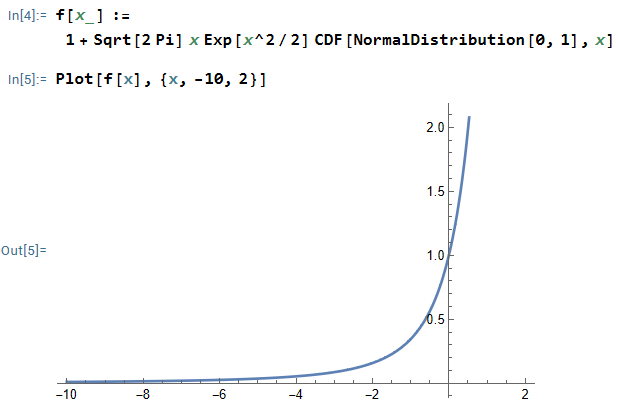
.
 . If I could prove both of these claims, then that would prove that
  .
. , we integrate by parts. (This is permissible: the integrands below are well-behaved if

![= \displaystyle x e^{x^2/2} \left[ -\frac{1}{t} e^{-t^2/2} \right]_{-\infty}^x - x e^{x^2/2} \int_{-\infty}^x \frac{d}{dt} \left(\frac{1}{t} \right) \left( -e^{-t^2/2} \right) \, dt](https://s0.wp.com/latex.php?latex=%3D+%5Cdisplaystyle++x+e%5E%7Bx%5E2%2F2%7D+%5Cleft%5B+-%5Cfrac%7B1%7D%7Bt%7D+e%5E%7B-t%5E2%2F2%7D+%5Cright%5D_%7B-%5Cinfty%7D%5Ex+-+x+e%5E%7Bx%5E2%2F2%7D+%5Cint_%7B-%5Cinfty%7D%5Ex+%5Cfrac%7Bd%7D%7Bdt%7D+%5Cleft%28%5Cfrac%7B1%7D%7Bt%7D+%5Cright%29+%5Cleft%28+-e%5E%7B-t%5E2%2F2%7D+%5Cright%29+%5C%2C+dt&bg=ffffff&fg=000000&s=0&c=20201002)
![= \displaystyle x e^{x^2/2} \left[ -\frac{1}{x} e^{-x^2/2} - 0 \right] + |x| e^{x^2/2} \int_{-\infty}^x \frac{1}{t^2} e^{-t^2/2} \, dt](https://s0.wp.com/latex.php?latex=%3D+%5Cdisplaystyle++x+e%5E%7Bx%5E2%2F2%7D+%5Cleft%5B+-%5Cfrac%7B1%7D%7Bx%7D+e%5E%7B-x%5E2%2F2%7D+-+0+%5Cright%5D+%2B+%7Cx%7C+e%5E%7Bx%5E2%2F2%7D+%5Cint_%7B-%5Cinfty%7D%5Ex+%5Cfrac%7B1%7D%7Bt%5E2%7D+e%5E%7B-t%5E2%2F2%7D+%5C%2C+dt&bg=ffffff&fg=000000&s=0&c=20201002)

 .
. .
. ,
, .
. ,
, ,
,  ,
,  , and
, and  . With these definitions, we may write
  and
and  , where
  and
and  are independent standard normal random variables.
 . In previous posts, we showed that it will be sufficient to show that
  , where
  and
and  . We also showed that
  , where
  and
and
![\hbox{Var}(Z_1 \mid Z_1 > a + bZ_2) = E(Z_1^2 \mid Z_1 + a bZ_2) - [E(Z_1 \mid Z_1 > a + bZ_2)]^2](https://s0.wp.com/latex.php?latex=%5Chbox%7BVar%7D%28Z_1+%5Cmid+Z_1+%3E+a+%2B+bZ_2%29+%3D+E%28Z_1%5E2+%5Cmid+Z_1+%2B+a+bZ_2%29+-+%5BE%28Z_1+%5Cmid+Z_1+%3E+a+%2B+bZ_2%29%5D%5E2&bg=ffffff&fg=000000&s=0&c=20201002) ,
,
 .
.
![= 1 - \displaystyle\frac{c e^{-c^2/2}}{ \sqrt{2\pi} (b^2+1) \Phi(c)} - \frac{e^{-c^2}}{2\pi (b^2+1) [\Phi(c)]^2}](https://s0.wp.com/latex.php?latex=%3D+1+-++%5Cdisplaystyle%5Cfrac%7Bc+e%5E%7B-c%5E2%2F2%7D%7D%7B+%5Csqrt%7B2%5Cpi%7D+%28b%5E2%2B1%29+%5CPhi%28c%29%7D+-+%5Cfrac%7Be%5E%7B-c%5E2%7D%7D%7B2%5Cpi+%28b%5E2%2B1%29+%5B%5CPhi%28c%29%5D%5E2%7D&bg=ffffff&fg=000000&s=0&c=20201002)
![= 1 - \displaystyle\frac{c}{ \sqrt{2\pi} (b^2+1) \Phi(c) e^{c^2/2}} - \frac{1}{2\pi (b^2+1) [\Phi(c)]^2e^{c^2}}](https://s0.wp.com/latex.php?latex=%3D+1+-++%5Cdisplaystyle%5Cfrac%7Bc%7D%7B+%5Csqrt%7B2%5Cpi%7D+%28b%5E2%2B1%29+%5CPhi%28c%29+e%5E%7Bc%5E2%2F2%7D%7D+-+%5Cfrac%7B1%7D%7B2%5Cpi+%28b%5E2%2B1%29+%5B%5CPhi%28c%29%5D%5E2e%5E%7Bc%5E2%7D%7D&bg=ffffff&fg=000000&s=0&c=20201002)
![= 1 - \displaystyle\frac{\sqrt{2\pi} c e^{c^2/2} \Phi(c) + 1}{2\pi (b^2+1) [\Phi(c)]^2 e^{c^2}}](https://s0.wp.com/latex.php?latex=%3D+1+-++%5Cdisplaystyle%5Cfrac%7B%5Csqrt%7B2%5Cpi%7D+c+e%5E%7Bc%5E2%2F2%7D+%5CPhi%28c%29+%2B+1%7D%7B2%5Cpi+%28b%5E2%2B1%29+%5B%5CPhi%28c%29%5D%5E2+e%5E%7Bc%5E2%7D%7D&bg=ffffff&fg=000000&s=0&c=20201002) .
. , it suffices to show that the second term must be positive. Furthermore, since the denominator of the second term is positive, it suffices to show that
  must also be positive.
 .
. ,
, is the joint probability density function of
  .
. ,
, for the event
  .
. 
![=\displaystyle \left[ -z_1 e^{-z_1^2/2} \right]_{a+bz_2}^\infty + \int_{a+bz_2}^\infty e^{-z_1^2/2} \, dz_1](https://s0.wp.com/latex.php?latex=%3D%5Cdisplaystyle+%5Cleft%5B+-z_1+e%5E%7B-z_1%5E2%2F2%7D+%5Cright%5D_%7Ba%2Bbz_2%7D%5E%5Cinfty+%2B+%5Cint_%7Ba%2Bbz_2%7D%5E%5Cinfty+e%5E%7B-z_1%5E2%2F2%7D+%5C%2C+dz_1&bg=ffffff&fg=000000&s=0&c=20201002)
![= (a+bz_2) \displaystyle \exp \left[-\frac{(a+bz_2)^2}{2} \right] + \int_{a+bz_2}^\infty e^{-z_1^2/2} \, dz_1](https://s0.wp.com/latex.php?latex=%3D+%28a%2Bbz_2%29+%5Cdisplaystyle+%5Cexp+%5Cleft%5B-%5Cfrac%7B%28a%2Bbz_2%29%5E2%7D%7B2%7D+%5Cright%5D+%2B+%5Cint_%7Ba%2Bbz_2%7D%5E%5Cinfty+e%5E%7B-z_1%5E2%2F2%7D+%5C%2C+dz_1&bg=ffffff&fg=000000&s=0&c=20201002)
![E(Z_1^2 I_A) = \displaystyle \frac{1}{2\pi} \int_{-\infty}^\infty (a+bz_2) \exp \left[-\frac{(a+bz_2)^2}{2} \right] \exp \left[ -\frac{z_2^2}{2} \right] \, dz_2 + \int_{-\infty}^\infty \int_{a+bz_2}^\infty \frac{1}{2\pi} e^{-z_1^2/2} e^{-z_2^2/2} \, dz_1 dz_2](https://s0.wp.com/latex.php?latex=E%28Z_1%5E2+I_A%29+%3D+%5Cdisplaystyle+%5Cfrac%7B1%7D%7B2%5Cpi%7D+%5Cint_%7B-%5Cinfty%7D%5E%5Cinfty+%28a%2Bbz_2%29+%5Cexp+%5Cleft%5B-%5Cfrac%7B%28a%2Bbz_2%29%5E2%7D%7B2%7D+%5Cright%5D+%5Cexp+%5Cleft%5B+-%5Cfrac%7Bz_2%5E2%7D%7B2%7D+%5Cright%5D+%5C%2C+dz_2+%2B+%5Cint_%7B-%5Cinfty%7D%5E%5Cinfty+%5Cint_%7Ba%2Bbz_2%7D%5E%5Cinfty+%5Cfrac%7B1%7D%7B2%5Cpi%7D+e%5E%7B-z_1%5E2%2F2%7D+e%5E%7B-z_2%5E2%2F2%7D+%5C%2C+dz_1+dz_2&bg=ffffff&fg=000000&s=0&c=20201002) .
. since the double integral is
  . For the first integral, we complete the square as before:
![E(Z_1^2 I_A) = \Phi(c) + \displaystyle \frac{1}{2\pi} \int_{-\infty}^\infty (a+bz_2) \exp \left[-\frac{(b^2+1)z_2^2 + 2abz_2 + a^2}{2} \right] \, dz_2](https://s0.wp.com/latex.php?latex=E%28Z_1%5E2+I_A%29+%3D+%5CPhi%28c%29+%2B+%5Cdisplaystyle+%5Cfrac%7B1%7D%7B2%5Cpi%7D+%5Cint_%7B-%5Cinfty%7D%5E%5Cinfty+%28a%2Bbz_2%29+%5Cexp+%5Cleft%5B-%5Cfrac%7B%28b%5E2%2B1%29z_2%5E2+%2B+2abz_2+%2B+a%5E2%7D%7B2%7D+%5Cright%5D+%5C%2C+dz_2&bg=ffffff&fg=000000&s=0&c=20201002)
![= \Phi(c) + \displaystyle \frac{1}{2\pi} \int_{-\infty}^\infty (a + bz_2) \exp \left[ -\frac{b^2+1}{2} \left( z_2^2 + \frac{2abz_2}{b^2+1} \,\,\,\,\,\,\,\,\,\,\,\,\,\,\,\, \right) \right] \exp \left[ -\frac{1}{2} \left(a^2 \,\,\,\,\,\,\,\,\,\,\,\,\,\,\,\, \right) \right] dz_2](https://s0.wp.com/latex.php?latex=%3D+%5CPhi%28c%29+%2B+%5Cdisplaystyle+%5Cfrac%7B1%7D%7B2%5Cpi%7D+%5Cint_%7B-%5Cinfty%7D%5E%5Cinfty+%28a+%2B+bz_2%29+%5Cexp+%5Cleft%5B+-%5Cfrac%7Bb%5E2%2B1%7D%7B2%7D+%5Cleft%28+z_2%5E2+%2B+%5Cfrac%7B2abz_2%7D%7Bb%5E2%2B1%7D+%5C%2C%5C%2C%5C%2C%5C%2C%5C%2C%5C%2C%5C%2C%5C%2C%5C%2C%5C%2C%5C%2C%5C%2C%5C%2C%5C%2C%5C%2C%5C%2C+%5Cright%29+%5Cright%5D+%5Cexp+%5Cleft%5B+-%5Cfrac%7B1%7D%7B2%7D+%5Cleft%28a%5E2+%5C%2C%5C%2C%5C%2C%5C%2C%5C%2C%5C%2C%5C%2C%5C%2C%5C%2C%5C%2C%5C%2C%5C%2C%5C%2C%5C%2C%5C%2C%5C%2C+%5Cright%29+%5Cright%5D+dz_2&bg=ffffff&fg=000000&s=0&c=20201002)
![= \Phi(c) +\displaystyle \frac{1}{2\pi} \int_{-\infty}^\infty (a + bz_2)\exp \left[ -\frac{b^2+1}{2} \left( z_2^2 + \frac{2abz_2}{b^2+1} + \frac{a^2b^2}{(b^2+1)^2} \right) \right] \exp \left[ -\frac{1}{2} \left(a^2 - \frac{a^2b^2}{b^2+1} \right) \right] dz_2](https://s0.wp.com/latex.php?latex=%3D+%5CPhi%28c%29+%2B%5Cdisplaystyle+%5Cfrac%7B1%7D%7B2%5Cpi%7D+%5Cint_%7B-%5Cinfty%7D%5E%5Cinfty+%28a+%2B+bz_2%29%5Cexp+%5Cleft%5B+-%5Cfrac%7Bb%5E2%2B1%7D%7B2%7D+%5Cleft%28+z_2%5E2+%2B+%5Cfrac%7B2abz_2%7D%7Bb%5E2%2B1%7D+%2B+%5Cfrac%7Ba%5E2b%5E2%7D%7B%28b%5E2%2B1%29%5E2%7D+%5Cright%29+%5Cright%5D+%5Cexp+%5Cleft%5B+-%5Cfrac%7B1%7D%7B2%7D+%5Cleft%28a%5E2+-+%5Cfrac%7Ba%5E2b%5E2%7D%7Bb%5E2%2B1%7D+%5Cright%29+%5Cright%5D+dz_2&bg=ffffff&fg=000000&s=0&c=20201002)
![= \Phi(c) +\displaystyle \frac{1}{2\pi} \int_{-\infty}^\infty (a + bz_2)\exp \left[ -\frac{b^2+1}{2} \left( z_2 + \frac{ab}{b^2+1} \right)^2 \right] \exp \left[ -\frac{1}{2} \left( \frac{a^2}{b^2+1} \right) \right] dz_2](https://s0.wp.com/latex.php?latex=%3D+%5CPhi%28c%29+%2B%5Cdisplaystyle+%5Cfrac%7B1%7D%7B2%5Cpi%7D+%5Cint_%7B-%5Cinfty%7D%5E%5Cinfty+%28a+%2B+bz_2%29%5Cexp+%5Cleft%5B+-%5Cfrac%7Bb%5E2%2B1%7D%7B2%7D+%5Cleft%28+z_2+%2B+%5Cfrac%7Bab%7D%7Bb%5E2%2B1%7D+%5Cright%29%5E2+%5Cright%5D+%5Cexp+%5Cleft%5B+-%5Cfrac%7B1%7D%7B2%7D+%5Cleft%28+%5Cfrac%7Ba%5E2%7D%7Bb%5E2%2B1%7D+%5Cright%29+%5Cright%5D+dz_2&bg=ffffff&fg=000000&s=0&c=20201002)
![= \Phi(c) +\displaystyle \frac{e^{-c^2/2}}{2\pi} \int_{-\infty}^\infty (a + bz_2)\exp \left[ -\frac{b^2+1}{2} \left( z_2 + \frac{ab}{b^2+1} \right)^2 \right] dz_2](https://s0.wp.com/latex.php?latex=%3D+%5CPhi%28c%29+%2B%5Cdisplaystyle+%5Cfrac%7Be%5E%7B-c%5E2%2F2%7D%7D%7B2%5Cpi%7D+%5Cint_%7B-%5Cinfty%7D%5E%5Cinfty+%28a+%2B+bz_2%29%5Cexp+%5Cleft%5B+-%5Cfrac%7Bb%5E2%2B1%7D%7B2%7D+%5Cleft%28+z_2+%2B+%5Cfrac%7Bab%7D%7Bb%5E2%2B1%7D+%5Cright%29%5E2+%5Cright%5D+dz_2&bg=ffffff&fg=000000&s=0&c=20201002) .
. and multiplying and dividing by
  in the denominator:
![E(Z_1^2 I_A) = \Phi(c) + \displaystyle \frac{e^{-c^2/2}}{\sqrt{2\pi}\sqrt{b^2+1}} \int_{-\infty}^\infty (a+bz_2) \frac{1}{\sqrt{2\pi} \sqrt{ \displaystyle \frac{1}{b^2+1}}} \exp \left[ - \frac{\left(z_2 + \displaystyle \frac{ab}{b^2+1} \right)^2}{2 \cdot \displaystyle \frac{1}{b^2+1}} \right] dz_2](https://s0.wp.com/latex.php?latex=E%28Z_1%5E2+I_A%29+%3D+%5CPhi%28c%29+%2B+%5Cdisplaystyle+%5Cfrac%7Be%5E%7B-c%5E2%2F2%7D%7D%7B%5Csqrt%7B2%5Cpi%7D%5Csqrt%7Bb%5E2%2B1%7D%7D+%5Cint_%7B-%5Cinfty%7D%5E%5Cinfty+%28a%2Bbz_2%29+%5Cfrac%7B1%7D%7B%5Csqrt%7B2%5Cpi%7D+%5Csqrt%7B+%5Cdisplaystyle+%5Cfrac%7B1%7D%7Bb%5E2%2B1%7D%7D%7D+%5Cexp+%5Cleft%5B+-+%5Cfrac%7B%5Cleft%28z_2+%2B+%5Cdisplaystyle+%5Cfrac%7Bab%7D%7Bb%5E2%2B1%7D+%5Cright%29%5E2%7D%7B2+%5Ccdot+%5Cdisplaystyle+%5Cfrac%7B1%7D%7Bb%5E2%2B1%7D%7D+%5Cright%5D+dz_2&bg=ffffff&fg=000000&s=0&c=20201002) .
. with
with  and
and  . Therefore, the integral is equal to
  , so that
 ,
,


 .
. .
. , then
  and
and  , so that
  , matching what we found earlier.
 .
. .
. ,
, .
. ,
,![E(Z_1 I_A) = \displaystyle \frac{1}{2\pi} \int_{-\infty}^\infty \left[ - e^{-z_1^2/2} \right]_{a+bz_2}^\infty e^{-z_2^2/2} \, dz_2](https://s0.wp.com/latex.php?latex=E%28Z_1+I_A%29+%3D+%5Cdisplaystyle+%5Cfrac%7B1%7D%7B2%5Cpi%7D+%5Cint_%7B-%5Cinfty%7D%5E%5Cinfty+%5Cleft%5B+-+e%5E%7B-z_1%5E2%2F2%7D+%5Cright%5D_%7Ba%2Bbz_2%7D%5E%5Cinfty+e%5E%7B-z_2%5E2%2F2%7D+%5C%2C+dz_2+&bg=ffffff&fg=000000&s=0&c=20201002)
![= \displaystyle \frac{1}{2\pi} \int_{-\infty}^\infty \exp \left[ -\frac{(a+bz_2)^2}{2} \right] \exp\left[-\frac{z_2^2}{2} \right] dz_2](https://s0.wp.com/latex.php?latex=%3D+%5Cdisplaystyle+%5Cfrac%7B1%7D%7B2%5Cpi%7D+%5Cint_%7B-%5Cinfty%7D%5E%5Cinfty+%5Cexp+%5Cleft%5B+-%5Cfrac%7B%28a%2Bbz_2%29%5E2%7D%7B2%7D+%5Cright%5D+%5Cexp%5Cleft%5B-%5Cfrac%7Bz_2%5E2%7D%7B2%7D+%5Cright%5D+dz_2&bg=ffffff&fg=000000&s=0&c=20201002)
![= \displaystyle \frac{1}{2\pi} \int_{-\infty}^\infty \exp \left[ -\frac{(b^2+1)z_2^2+2abz_2+a^2}{2} \right]](https://s0.wp.com/latex.php?latex=%3D+%5Cdisplaystyle+%5Cfrac%7B1%7D%7B2%5Cpi%7D+%5Cint_%7B-%5Cinfty%7D%5E%5Cinfty+%5Cexp+%5Cleft%5B+-%5Cfrac%7B%28b%5E2%2B1%29z_2%5E2%2B2abz_2%2Ba%5E2%7D%7B2%7D+%5Cright%5D&bg=ffffff&fg=000000&s=0&c=20201002) .
.![E(Z_1 I_A) = \displaystyle \frac{1}{2\pi} \int_{-\infty}^\infty \exp \left[ -\frac{b^2+1}{2} \left( z_2^2 + \frac{2abz_2}{b^2+1} \,\,\,\,\,\,\,\,\,\,\,\,\,\,\,\, \right) \right] \exp \left[ -\frac{1}{2} \left(a^2 \,\,\,\,\,\,\,\,\,\,\,\,\,\,\,\, \right) \right] dz_2](https://s0.wp.com/latex.php?latex=E%28Z_1+I_A%29+%3D+%5Cdisplaystyle+%5Cfrac%7B1%7D%7B2%5Cpi%7D+%5Cint_%7B-%5Cinfty%7D%5E%5Cinfty+%5Cexp+%5Cleft%5B+-%5Cfrac%7Bb%5E2%2B1%7D%7B2%7D+%5Cleft%28+z_2%5E2+%2B+%5Cfrac%7B2abz_2%7D%7Bb%5E2%2B1%7D+%5C%2C%5C%2C%5C%2C%5C%2C%5C%2C%5C%2C%5C%2C%5C%2C%5C%2C%5C%2C%5C%2C%5C%2C%5C%2C%5C%2C%5C%2C%5C%2C+%5Cright%29+%5Cright%5D+%5Cexp+%5Cleft%5B+-%5Cfrac%7B1%7D%7B2%7D+%5Cleft%28a%5E2+%5C%2C%5C%2C%5C%2C%5C%2C%5C%2C%5C%2C%5C%2C%5C%2C%5C%2C%5C%2C%5C%2C%5C%2C%5C%2C%5C%2C%5C%2C%5C%2C+%5Cright%29+%5Cright%5D+dz_2&bg=ffffff&fg=000000&s=0&c=20201002)
![= \displaystyle \frac{1}{2\pi} \int_{-\infty}^\infty \exp \left[ -\frac{b^2+1}{2} \left( z_2^2 + \frac{2abz_2}{b^2+1} + \frac{a^2b^2}{(b^2+1)^2} \right) \right] \exp \left[ -\frac{1}{2} \left(a^2 - \frac{a^2b^2}{b^2+1} \right) \right] dz_2](https://s0.wp.com/latex.php?latex=%3D+%5Cdisplaystyle+%5Cfrac%7B1%7D%7B2%5Cpi%7D+%5Cint_%7B-%5Cinfty%7D%5E%5Cinfty+%5Cexp+%5Cleft%5B+-%5Cfrac%7Bb%5E2%2B1%7D%7B2%7D+%5Cleft%28+z_2%5E2+%2B+%5Cfrac%7B2abz_2%7D%7Bb%5E2%2B1%7D+%2B+%5Cfrac%7Ba%5E2b%5E2%7D%7B%28b%5E2%2B1%29%5E2%7D+%5Cright%29+%5Cright%5D+%5Cexp+%5Cleft%5B+-%5Cfrac%7B1%7D%7B2%7D+%5Cleft%28a%5E2+-+%5Cfrac%7Ba%5E2b%5E2%7D%7Bb%5E2%2B1%7D+%5Cright%29+%5Cright%5D+dz_2&bg=ffffff&fg=000000&s=0&c=20201002)
![= \displaystyle \frac{1}{2\pi} \int_{-\infty}^\infty \exp \left[ -\frac{b^2+1}{2} \left( z_2 + \frac{ab}{b^2+1} \right)^2 \right] \exp \left[ -\frac{1}{2} \left( \frac{a^2}{b^2+1} \right) \right] dz_2](https://s0.wp.com/latex.php?latex=%3D+%5Cdisplaystyle+%5Cfrac%7B1%7D%7B2%5Cpi%7D+%5Cint_%7B-%5Cinfty%7D%5E%5Cinfty+%5Cexp+%5Cleft%5B+-%5Cfrac%7Bb%5E2%2B1%7D%7B2%7D+%5Cleft%28+z_2+%2B+%5Cfrac%7Bab%7D%7Bb%5E2%2B1%7D+%5Cright%29%5E2+%5Cright%5D+%5Cexp+%5Cleft%5B+-%5Cfrac%7B1%7D%7B2%7D+%5Cleft%28+%5Cfrac%7Ba%5E2%7D%7Bb%5E2%2B1%7D+%5Cright%29+%5Cright%5D+dz_2&bg=ffffff&fg=000000&s=0&c=20201002)
![= \displaystyle \frac{e^{-c^2/2}}{2\pi} \int_{-\infty}^\infty \exp \left[ -\frac{b^2+1}{2} \left( z_2 + \frac{ab}{b^2+1} \right)^2 \right] dz_2](https://s0.wp.com/latex.php?latex=%3D+%5Cdisplaystyle+%5Cfrac%7Be%5E%7B-c%5E2%2F2%7D%7D%7B2%5Cpi%7D+%5Cint_%7B-%5Cinfty%7D%5E%5Cinfty+%5Cexp+%5Cleft%5B+-%5Cfrac%7Bb%5E2%2B1%7D%7B2%7D+%5Cleft%28+z_2+%2B+%5Cfrac%7Bab%7D%7Bb%5E2%2B1%7D+%5Cright%29%5E2+%5Cright%5D++dz_2&bg=ffffff&fg=000000&s=0&c=20201002) .
.![E(Z_1 I_A) = \displaystyle \frac{e^{-c^2/2}}{\sqrt{2\pi}\sqrt{b^2+1}} \int_{-\infty}^\infty \frac{1}{\sqrt{2\pi} \sqrt{ \displaystyle \frac{1}{b^2+1}}} \exp \left[ - \frac{\left(z_2 + \displaystyle \frac{ab}{b^2+1} \right)^2}{2 \cdot \displaystyle \frac{1}{b^2+1}} \right] dz_2](https://s0.wp.com/latex.php?latex=E%28Z_1+I_A%29+%3D+%5Cdisplaystyle+%5Cfrac%7Be%5E%7B-c%5E2%2F2%7D%7D%7B%5Csqrt%7B2%5Cpi%7D%5Csqrt%7Bb%5E2%2B1%7D%7D+%5Cint_%7B-%5Cinfty%7D%5E%5Cinfty++%5Cfrac%7B1%7D%7B%5Csqrt%7B2%5Cpi%7D+%5Csqrt%7B+%5Cdisplaystyle+%5Cfrac%7B1%7D%7Bb%5E2%2B1%7D%7D%7D+%5Cexp+%5Cleft%5B+-+%5Cfrac%7B%5Cleft%28z_2+%2B+%5Cdisplaystyle+%5Cfrac%7Bab%7D%7Bb%5E2%2B1%7D+%5Cright%29%5E2%7D%7B2+%5Ccdot+%5Cdisplaystyle+%5Cfrac%7B1%7D%7Bb%5E2%2B1%7D%7D+%5Cright%5D+dz_2&bg=ffffff&fg=000000&s=0&c=20201002) .
. , where
  , we have
 ,
, .
. , and
, and  , then
  , and
, and  , we have
 ,
, .
. . As discussed in the previous post, this can be rewritten as
  , where
  . We begin by using the definition
![\hbox{Var}(X \mid A) = E(X^2 \mid A) - [E(X \mid A)]^2 = \displaystyle \frac{E(X^2 I_A)}{P(A)} - \left[ \frac{E(XI_A)}{P(A)} \right]^2](https://s0.wp.com/latex.php?latex=%5Chbox%7BVar%7D%28X+%5Cmid+A%29+%3D+E%28X%5E2+%5Cmid+A%29+-+%5BE%28X+%5Cmid+A%29%5D%5E2+%3D+%5Cdisplaystyle+%5Cfrac%7BE%28X%5E2+I_A%29%7D%7BP%28A%29%7D+-+%5Cleft%5B+%5Cfrac%7BE%28XI_A%29%7D%7BP%28A%29%7D+%5Cright%5D%5E2&bg=ffffff&fg=000000&s=0&c=20201002) .
. and
and  . First,
![E(XI_A) = E([\mu_1 + \sigma_1 Z_1] I_A) = \mu E(I_A) + E(\sigma_1 Z_1 I_A) = \mu_1 P(A) + \sigma_1 E(Z_1 I_A)](https://s0.wp.com/latex.php?latex=E%28XI_A%29+%3D+E%28%5B%5Cmu_1+%2B+%5Csigma_1+Z_1%5D+I_A%29+%3D+%5Cmu+E%28I_A%29+%2B+E%28%5Csigma_1+Z_1+I_A%29+%3D+%5Cmu_1+P%28A%29+%2B+%5Csigma_1+E%28Z_1+I_A%29&bg=ffffff&fg=000000&s=0&c=20201002) ,
, .
.![E(X^2 I_A) = E([\mu_1 + \sigma_1 Z_1]^2 I_A)](https://s0.wp.com/latex.php?latex=E%28X%5E2+I_A%29+%3D+E%28%5B%5Cmu_1+%2B+%5Csigma_1+Z_1%5D%5E2+I_A%29&bg=ffffff&fg=000000&s=0&c=20201002)
![= E([\mu_1^2 + 2\mu_1 \sigma_1 Z_1+ \sigma_1^2 Z_1^2] I_A)](https://s0.wp.com/latex.php?latex=%3D+E%28%5B%5Cmu_1%5E2+%2B+2%5Cmu_1+%5Csigma_1+Z_1%2B+%5Csigma_1%5E2+Z_1%5E2%5D+I_A%29&bg=ffffff&fg=000000&s=0&c=20201002)
 ,
, .
.![\hbox{Var}(A) = E(X^2 \mid A) - [ E(X \mid A) ]^2](https://s0.wp.com/latex.php?latex=%5Chbox%7BVar%7D%28A%29+%3D++E%28X%5E2+%5Cmid+A%29+-+%5B+E%28X+%5Cmid+A%29+%5D%5E2&bg=ffffff&fg=000000&s=0&c=20201002)
![= \mu_1^2 + 2 \mu_1 \sigma_1 E(Z_1 \mid A) + \sigma_1^2 E(Z_1^2 \mid A) - [\mu_1 + \sigma_1 E(Z_1 \mid A)]^2](https://s0.wp.com/latex.php?latex=%3D+%5Cmu_1%5E2+%2B+2+%5Cmu_1+%5Csigma_1+E%28Z_1+%5Cmid+A%29++%2B+%5Csigma_1%5E2+E%28Z_1%5E2+%5Cmid+A%29+-+%5B%5Cmu_1+%2B+%5Csigma_1+E%28Z_1+%5Cmid+A%29%5D%5E2&bg=ffffff&fg=000000&s=0&c=20201002)
![=\mu_1^2 + 2 \mu_1 \sigma_1 E(Z_1 \mid A) + \sigma_1^2 E(Z_1^2 \mid A) - \mu_1^2 - 2\mu_1 \sigma_1 E(Z_1 \mid A) - \sigma_1^2 [E(Z_1 \mid A)]^2](https://s0.wp.com/latex.php?latex=%3D%5Cmu_1%5E2+%2B+2+%5Cmu_1+%5Csigma_1+E%28Z_1+%5Cmid+A%29++%2B+%5Csigma_1%5E2+E%28Z_1%5E2+%5Cmid+A%29++-+%5Cmu_1%5E2+-+2%5Cmu_1+%5Csigma_1+E%28Z_1+%5Cmid+A%29+-+%5Csigma_1%5E2+%5BE%28Z_1+%5Cmid+A%29%5D%5E2&bg=ffffff&fg=000000&s=0&c=20201002)
![= \sigma_1^2 E(Z_1^2 \mid A) - [E(Z_1 \mid A)]^2](https://s0.wp.com/latex.php?latex=%3D+%5Csigma_1%5E2+E%28Z_1%5E2+%5Cmid+A%29+-+%5BE%28Z_1+%5Cmid+A%29%5D%5E2&bg=ffffff&fg=000000&s=0&c=20201002)
 .
. .
.  , where
  .
. Mean Green Math