Engaging students: Half-life

In my capstone class for future secondary math teachers, I ask my students to come up with ideas for engaging their students with different topics in the secondary mathematics curriculum. In other words, the point of the assignment was not to devise a full-blown lesson plan on this topic. Instead, I asked my students to think about three different ways of getting their students interested in the topic in the first place.

I plan to share some of the best of these ideas on this blog (after asking my students’ permission, of course).

This student submission comes from my former student Trenton Hicks. His topic: working with the half-life of a radioactive element.

green line

How can this topic be used in you students’ future courses in mathematics or science?

The topic of half life is a direct intersection of math and chemistry. In addition to being a common precalculus problem, we see half life come up in radioactive decay in chemistry. Half life is a concept that extends all the way into upper college chemistry, physics, and even archaeology when it comes to carbon dating. If students use carbon dating to any extent, they can use half life to determine the age of organic material since carbon 14 is radioactive (Wood). Since half life has to due with nuclear chemistry, this can also tie into nuclear power, since half life is crucial in computations related to efficiency and nuclear engineering. Half life is a form of exponential decay. If students have a thorough understanding of half life, they can better understand other natural phenomena that exhibit properties that are consistent with exponential decay. These phenomena include RC circuits, atmospheric pressure, and toxicity.

green line

In Chernobyl Ukraine, 1986, there was a disaster at a nuclear power plant that has had lasting effects on the environment, people, and culture. The initial explosion was harmful enough, as 2 people lost their lives. Furthermore, radiation leaked into the atmosphere, and it’s speculated that many individuals are suffering the health consequences. When this story first broke, it shook everyone, and scared people away from nuclear power. Lately, there was another documentary that came to light about the incident from HBO. Many people don’t know that the former power plant is still very dangerous to this day. Why? Because the highly radioactive byproducts of the meltdown have half lives that makes them stick around for quite a while. One particularly dangerous isotope, caesium 137, has a half life of about 30 years. This means that in 2016, about half of the caesium decayed. Half of the sheer amount of caesium that was leaked due to the meltdown is still an enormously dangerous amount. News and documentaries report that there’s still a massive constructive effort to contain the radiation. Showing these news stories to students will convey the importance of half life and give them a little bit of insight into how much care should be given to nuclear power.

green line

Half life began as a model proposed by Rutherford in the late 1800’s and very early 1900’s. Rutherford discovered that radioactive decay would turn one element into another. This change happens at a rate that we recognize as exponential decay, hence the model we use is consistent with that idea. Rutherford’s work would soon earn him a Nobel Prize. Other disciplines have taken the idea of “half life,” and have created convincing arguments for how the universe behaves. For instance, toxicology uses half life to convey how potent a dose of toxin is versus long it takes for the body to metabolize the toxin. Another notable development is the blog post on the fs website (linked below) that discusses half lives in terms of how our brains retain information, as well as the information itself. Relaying that half life isn’t just a chemistry or math topic to students, and providing them with this history might just increase the half life on their retaining of the concept.

References:

Fs blog:

Half Life: The Decay of Knowledge and What to Do About It

Sources:
Author: Rachael Wood
https://theconversation.com/explainer-what-is-radiocarbon-dating-and-how-does-it-work-9690#:
~:text=Radiocarbon%20dating%20works%20by%20comparing,but%20different%20numbers%2
0of%20neutrons.&text=While%20the%20lighter%20isotopes%2012,C%20(radiocarbon)%20is
%20radioactive

Click to access ExponentialDecay.pdf

https://www.greenfacts.org/en/chernobyl/toolboxes/half-life-radioisotopes.htm

Click to access Section_4.5.pdf

Thoughts on Numerical Integration (Part 2): The bell curve

Numerical integration is a standard topic in first-semester calculus. From time to time, I have received questions from students on various aspects of this topic, including:

  • Why is numerical integration necessary in the first place?
  • Where do these formulas come from (especially Simpson’s Rule)?
  • How can I do all of these formulas quickly?
  • Is there a reason why the Midpoint Rule is better than the Trapezoid Rule?
  • Is there a reason why both the Midpoint Rule and the Trapezoid Rule converge quadratically?
  • Is there a reason why Simpson’s Rule converges like the fourth power of the number of subintervals?

In this series, I hope to answer these questions. While these are standard questions in a introductory college course in numerical analysis, and full and rigorous proofs can be found on Wikipedia and Mathworld, I will approach these questions from the point of view of a bright student who is currently enrolled in calculus and hasn’t yet taken real analysis or numerical analysis.

In this post, I’d like to take a closer look at the indefinite integral \displaystyle \int e^{-x^2} dx, which is closely related to the area under the bell curve \displaystyle \frac{1}{\sqrt{2\pi}} e^{-x^2/2} dx. This integral cannot be computed using elementary functions. However, using integration by parts, there are some related integrals that can be computed:

\displaystyle \int x e^{-x^2} dx = -\displaystyle \frac{1}{2} e^{-x^2}

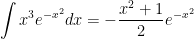
\displaystyle \int x^3 e^{-x^2} dx = -\displaystyle \frac{x^2+1}{2} e^{-x^2}

\displaystyle \int x^5 e^{-x^2} dx = -\displaystyle \frac{x^4+2x^2+2}{2} e^{-x^2}

\displaystyle \int x^7 e^{-x^2} dx = -\displaystyle \frac{x^6+3x^4+6x^2+6}{2} e^{-x^2}

Based on these examples, it stands to reason that, if \displaystyle \int e^{-x^2} dx can be written in terms of elementary functions, it should have the form

\displaystyle \int e^{-x^2} dx = f(x) e^{-x^2},

where f(x) is some polynomial to be determined. We will now show that this is impossible.

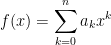
Suppose f(x) = \displaystyle \sum_{k=0}^n a_k x^k, a polynomial of degree n to be determined. Then we have

\displaystyle \frac{d}{dx} \left[ f(x) e^{-x^2} \right] = e^{-x^2}

or

f'(x) e^{-x^2} - 2 x f(x) e^{-x^2} =e^{-x^2}

or

f'(x) - 2x f(x) = 1.

In other words, all terms on the left-hand side except the constant term must cancel. However, this is impossible: 2x f(x) is a polynomial of degree n+1 while f'(x) is a polynomial of degree n-1. Therefore, the left hand side must have degree n+1 and therefore cannot be a constant.

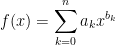
A similar argument shows that f(x) cannot have the form f(x) = \displaystyle \sum_{k=0}^n a_k x^{b_k}, where the exponents b_k may or may not be integers.

This may be enough to convince a calculus student that there is no elementary antiderivative of \displaystyle e^{-x^2} dx. Indeed, although the proof goes well beyond first-year calculus, there is a theorem that says that if \displaystyle \int x^a e^{bx^2} can be expressed in terms of elementary functions, then the antiderivative must have the form f(x) e^{b x^2}. So the guess above actually can be rigorously justified. References:

  • Elena Anne Marchisotto and Gholam-Ali Zakeri, “An Invitation to Integration in Finite Terms,” The College Mathematics Journal , Sep., 1994, Vol. 25, No. 4 (Sep., 1994), pp. 295-308
  • J. F. Ritt, Integration in Finite Terms: Liouville’s Theory of Elementary Methods, Columbia University Press, New York, 1948

Engaging students: Using sequences

In my capstone class for future secondary math teachers, I ask my students to come up with ideas for engaging their students with different topics in the secondary mathematics curriculum. In other words, the point of the assignment was not to devise a full-blown lesson plan on this topic. Instead, I asked my students to think about three different ways of getting their students interested in the topic in the first place.

I plan to share some of the best of these ideas on this blog (after asking my students’ permission, of course).

This student submission comes from my former student Gary Sin. His topic, from Precalculus: using sequences.

green line

How has this topic appeared in pop culture?

Probably the most used sequence in pop culture or art is the Fibonacci sequence. I learned about the Fibonacci sequence myself from “The Da Vinci Code” by Dan Brown. The Fibonacci sequence has been explored by many mathematicians over the years and if we divided 2 successive numbers (larger divided by the smaller), the limit of the ratio is the golden ratio.

The golden ratio was heavily believed to be seen in nature itself. Naturally people were fascinated that such a number could be seen everywhere in nature. Many artists based their art on the golden ratio, believing that the ratio is aesthetically pleasing. A great example is the polyhedral seen in “’The Sacrament of the  Last Supper” by  Salvador Dali. Modern architects also utilize the golden ratio in their builds. It was also believed that the proportions of the different parts of the limbs of humans are in the golden ratio.

The Fibonacci Sequence is fascinating and is a great way to demonstrate to students the beauty in math and how even artists are influenced by it and is a beautiful link to how mathematics can also be seen in nature.

green line

How could you as a teacher create an activity or project that involves your topic?

Sequences are fun to play around with as some sequences are infinite or finite and the series they form could converge to a number. Students could be given a starting sequence and are asked to find the nth term of a sequence. I could also point out how sequences can be seen in something as simple as the list of natural numbers, multiples of positive integers.

Students could also be given both arithmetic and geometric sequences and plot them on a graph accordingly to see if the sequence progresses linearly or exponentially. I could also introduce sequences that are neither and that are divergent.

One of the important usefulness of sequences is how it relates to limits of a sequence. I could provide a fun riddle for students to figure out the limit of a sequence using word problems like Zeno’s Paradox. Students can figure out the rule of a sequence and plot it on the graph to see how it converges toward a number.

green line

How does this topic extend what your students’ should have learned in previous courses?

The most amazing thing about sequences is that students use them from the moment they learn how to count as kids. Natural numbers are sequences that are obtained by adding 1 to the previous term. Naturally, the multiples of positive integers are also sequences. Students will also realize that the powers of a base are geometric sequences. When learning about plotting functions, linear, quadratic or cubic; the students are basically using sequences and basic pattern recognition to create tables of values and observing the rate of change.

Sequences are especially important in bridging a simple concept like a sequence to limits of functions, limits of infinity are an important abstract idea that provokes the students to think more about how a function would act if it  kept going forever.

When determining a recursive of exclusive formula for sequences, students will also have to apply basic algebra, order of operations, arithmetic, exponents in order to create or prove that a formula works for a sequence.

Thoughts on Numerical Integration (Part 1): Why numerical integration?

Numerical integration is a standard topic in first-semester calculus. From time to time, I have received questions from students on various aspects of this topic, including:

  • Why is numerical integration necessary in the first place?
  • Where do these formulas come from (especially Simpson’s Rule)?
  • How can I do all of these formulas quickly?
  • Is there a reason why the Midpoint Rule is better than the Trapezoid Rule?
  • Is there a reason why both the Midpoint Rule and the Trapezoid Rule converge quadratically?
  • Is there a reason why Simpson’s Rule converges like the fourth power of the number of subintervals?

In this series, I hope to answer these questions. While these are standard questions in a introductory college course in numerical analysis, and full and rigorous proofs can be found on Wikipedia and Mathworld, I will approach these questions from the point of view of a bright student who is currently enrolled in calculus and hasn’t yet taken real analysis or numerical analysis.

First, let’s talk about why numerical integration is necessary in the first place. Indeed, I can still remember a high school calculus teacher asking me this question nearly 20 years ago, and this question really got me thinking about what we’re collectively teaching in the secondary curriculum. Indeed, in a Calculus I course, it seems like every integral can be computed if only the proper trick is used. We teach students to search for these different tricks:

  • Let u = x^2+5 to find \displaystyle \int \frac{6x \, dx}{\sqrt{x^2+9}}.
  • Let x = 3\tan \theta to find \displaystyle \int \frac{6 \, dx}{\sqrt{x^2+9}}
  • Use integration by parts to find \displaystyle \int x^3 e^x \, dx

In fact, we teach so many tricks that we may give the impression that every integral can be computed if only the proper trick is employed. Indeed, my university hosts an annual “Integration Bee” that challenges students to find the right technique(s) to evaluate some pretty tough integrals.

Unfortunately, not every integral can be solved in terms of a finite number of elementary functions (polynomials, rational functions, exponential functions, logarithms, trigonometric and inverse trigonometric functions). One function that is commonly known to many students which does not have an elementary antiderivative is \displaystyle \frac{1}{\sqrt{2\pi}} e^{-x^2/2}, otherwise known as the bell curve. For most numbers a and b, the area

\displaystyle \int_a^b \frac{1}{\sqrt{2\pi}} e^{-x^2/2}

cannot be found exactly, and so we ask students to either use a table in the back of the textbook or else use a function on their scientific calculators to find the answer.

Just for the fun of it, I went through my Ph.D. thesis and wrote down some of the integrals that I had to integrate numerically while in school. As an applied mathematician, I was initially stunned by the teacher’s innocent question because so much of my work would be utterly impossible if it wasn’t for numerical integration. Here are some of the easier ones:

  • \displaystyle \int_0^t \frac{1-e^{-x}}{x} dx
  • \displaystyle \int_{2R}^\infty t^2 g(t) \left( \frac{a_1 t^4 + a_2 t^2 + a_3}{(t^2-R^2)^7} +\frac{b_1 t^2 + b_2}{(t^2-R^2)^5} + \frac{c}{(t^2-R^2)^3} \right) dt
  • \displaystyle \int_{d_2}^\infty \int_0^{d_1} \frac{y^2-x^2}{(x^2+y^2)^2} \left(e^{-a(x+d_1)-b d_2} - c\right) dx \, dy
  • \displaystyle \int_{x/2}^\infty \sqrt{r^2 - k^2/4} \phi(r) \, dr
  • \displaystyle \int_{x/2}^\infty \left( \frac{z \sqrt{4r^2-z^2}}{4} + r^2 \arcsin \left( \frac{z}{2r} \right) \right) \phi(r) \, dr
  • \displaystyle \int_0^{2R} e^{-sz} \exp \left[ -c \left( z \sqrt{4R^2-z^2}  + 4R^2 \arcsin \frac{z}{2R} \right) \right] dz
  • \displaystyle \int_0^d \exp \left[ -sz - \lambda \left(z - \frac{z^2}{4d} \right) \right] dz
  • \displaystyle \int_d^{d \sqrt{2}} \exp \left[ -sz - \lambda \left( \frac{d (\pi+1)}{2} - d \arcsin \frac{d}{z} + \frac{z^2}{4d} - \sqrt{z^2-d^2} \right) \right] dz
  • \displaystyle \int_0^\infty \exp \left[-sz - \eta \left(1 - e^{-cz/2} - \frac{cz}{4} e^{-cz/2} \right) \right] dz
  • \displaystyle \int_{-\infty}^x \frac{e^t}{t} dt

All this to say, there are plenty of integrals that arise from a real-world context that have a numerical answer but cannot be computed using the techniques commonly taught in the first-year calculus sequence.


Engaging students: Computing logarithms with base 10

In my capstone class for future secondary math teachers, I ask my students to come up with ideas for engaging their students with different topics in the secondary mathematics curriculum. In other words, the point of the assignment was not to devise a full-blown lesson plan on this topic. Instead, I asked my students to think about three different ways of getting their students interested in the topic in the first place.

I plan to share some of the best of these ideas on this blog (after asking my students’ permission, of course).

This student submission comes from my former student Jonathan Chen. His topic, from Precalculus: computing logarithms with base 10.

green line

What interesting (i.e., uncontrived) word problems using this topic can your students do now?

Computing logarithms with base 10 can appear in many scientific applications for word problems. To define the acidity or alkalinity of a substance, Chemists use the formula pH = \log [H^+]. “[H+] is the hydrogen ion concentration that is measured in moles per liter” (Stapel, n.d.). We know lemon juice is acidic because the pH value is less than 7. We know bleach is basic because the pH value is greater than 7. When a pH value is equal to 7, the solution is neutral. An example of something neutral would be pure water. Teacher can create word problems based on the information given about a liquid solution. Noise can be measured in decibels. The formula used to measure the strength of a sound is dB = 10 \log(I \div I_0). “I0 is the intensity of ‘threshold sound,’ or sound that can be barely be perceived” (Stapel, n.d.). Teachers can create word problems based on the defined terms of how many times more intense a sound is than the threshold sound. Similar problems with the topic of computing logarithms can be made involving earthquake intensity.

green line

How can this topic be used in your students’ future courses in mathematics or science?

As shown in the above answer, this topic can reappear in student’s future science course in the topic of pH levels, earthquake intensity, or “loudness” measured in decibels. In order to find the pH levels, [H+] concentration, or the [OH] concentration you may need to know how to calculate logarithms with base 10 when dealing with the equation pH = \log [H^+]. Similar things can be said about measuring “loudness” and earthquake intensity. Their formulas involve calculating logarithms with base 10. Other future topics students may encounter in mathematics are logarithmic functions, Euler’s number, natural log, and logarithm rules. While not all of these future topics are strongly related to the topic of calculating logarithms with base 10, they can be loosely connected to where the practice of calculating logarithms with base 10 makes it easier to understand and do things related to the future topics. With the topic of logarithmic rules, it can help better simply and calculate with logarithms with base 10.

green line

How was this topic adopted by the mathematical community?

Calculating logarithms with base 10 has been around since 1614. John Napier invented logarithms and ever since then small additions have been made. Additions such as a logarithmic table made it easier to solve logarithmic problems. The logarithmic tables are similar to the multiplication tables elementary schoolers memorize to calculate simple multiplication faster for their future problems. Many mathematicians made their contributions to add more to the logarithmic table to the point where the calculations reached up to 200,000. Aside from the logarithmic tables, there were other methods to calculate logarithms with base 10 such as the slide rule. It was also possible to memorize the values of the logs with base 10 of 1 through 10 and use the logarithmic rules to calculate bigger values. Because

\log 400 = \log(100 \times 4) = \log 4 + \log 100

by expansion and logarithmic rules, people can solve this problem my memorizing that \log 4 = 0.602 and knowing that \log 100 = \log 10^2 = 2. Knowing this makes the equation more clear to recognize and easier to solve by hand. Calculating logarithms with base 10 were used extensively until the creation of the calculator made it easier to calculate anything, including logarithms.

References

“The Log Log Duplex Trig” “Slide Rule”. (n.d.). Retrieved from Web Archive: https://web.archive.org/web/20090214020502/http://www.mccoys-kecatalogs.com/K%26EManuals/4081-3_1943/4081-3_1943.htm

Bourne, M. (n.d.). 4. Logarithms to Base 10. Retrieved from Interactive Mathematics: https://www.intmath.com/exponential-logarithmic-functions/4-logs-base-10.php

Calculating Base 10 Logarithms in your Head. (n.d.). Retrieved from Nerd Paradise: https://nerdparadise.com/math/base10logs

John Napier and the invention of logarithms, 1614; a lecture. (n.d.). Retrieved from Archive.org: https://archive.org/details/johnnapierinvent00hobsiala/page/18/mode/2up

Stapel, E. (n.d.). Logarithmic Word Problems. Retrieved from Purple Math: https://www.purplemath.com/modules/expoprob.htm

Terrific video on Taylor series

Some time ago, I posted a series on the lecture that I’ll give to student to remind them about Taylor series. I won’t repost the whole thing here, but the basic ideas are inductively motivating the concept by starting with a polynomial and then reinforcing the concept with both numerical calculation and comparison of graphs.

After giving this lecture recently, one of my students told me about this terrific video on Taylor series that does much of the same things, with the added bonus of engaging animations. I recommend this highly.

Engaging students: Exponential Growth and Decay

In my capstone class for future secondary math teachers, I ask my students to come up with ideas for engaging their students with different topics in the secondary mathematics curriculum. In other words, the point of the assignment was not to devise a full-blown lesson plan on this topic. Instead, I asked my students to think about three different ways of getting their students interested in the topic in the first place.

I plan to share some of the best of these ideas on this blog (after asking my students’ permission, of course).

This student submission comes from my former student Angelica Albarracin. Her topic, from Precalculus: exponential growth and decay.

green line

How could you as a teacher create an activity or project that involves your topic?

During my freshman year of high school, my school offered AP Human Geography. One of the most important figures you learn about in this class is Thomas Malthus, who was an English economist and demographer during the late 1700s and early 1800s. Malthus was most known for his theory that population growth would outpace the world’s food supply. His argument was that since population grows at an exponential rate, and food supply at the time was increasing at a linear rate, then the world would run out of food in a short amount of time. Of course, today we know that Malthus’s theory was incorrect because it did not account for the profound effect that the industrial revolution would have on agriculture. However, if this theory were to be explained to a group of people who may not know what the difference between a linear and exponential function is, the usage of a graph as a visual aid would be extremely helpful.

Given this premise, students may be asked to create a graph with given coordinates to compare the difference between a linear and exponential graph, allowing students to see for themselves why this theory may have been extremely alarming to people during this time. After this, the students may be presented with several different scenarios such as “Graph a constant population of 1 billion vs. a rapidly declining food supply due to locust swarms” or “Graph a sudden population boom 5 years prior to a boom in food supply that increases at twice the rate of the population”. Students could be asked questions such as “Will the population have enough food to survive?” or “How many years will it take for there to be enough food to feed the entire population?”. I think this would be an extremely engaging activity for students as the premise behind it is an interesting piece of mathematical history and students’ imaginations can be engaged during the different scenarios.

green line

How can this this topic be used in your students’ future courses in mathematics or science?

Exponential growth functions are commonly used to model the population growth of a species in Environmental Science. An important concept in Environmental Science is carrying capacity, which is the largest population a habit can support without degradation. Due to the carrying capacity, we typically see S-curves in the population models in Environmental Science as opposed to the normal J-curves. When students are familiar with the rapid rate in which exponential functions can grow, it provides intuitive reasoning for why carrying capacity exists in nature as habits very clearly have a finite amount of resources that cannot possibly support an infinitely growing population.

The concept of radioactive decay and half-lives is also very important in Chemistry. A half-life is a measure of the amount of time it takes for half of a radioactive isotope to decay.  While not all isotopes are radioactive, the ones that are decay at an exponential rate. Having knowledge of an isotopes half-life enables scientists to handle such material safely. Typically, scientists wait to handle such radioactive material until it has decayed below detection limits, which occurs around 10 half-lives. Beyond this, doctors must also use their knowledge of half-lives when using radioactive isotopes to help treat patients. For a radioactive isotope to be useful in this manner, its radioactivity must be active enough to treat the condition, but not too long as to harm healthy cells.

green line

How has this topic appeared in the news?

Historically, exponential growth and decay graphs have been used to model the spread of epidemics/pandemics. Recently, with the advent of the Covid-19 epidemic, we are constantly seeing such graphs all over the news and agency websites such as the CDC. In the graph depicted below, we can see exponential growth in the number of cases around March, a small decline, and then another bout of exponential growth around June. Of course, in the real world, very few data follow an exact mathematical form so using the phrase “exponential growth” is an approximation. However, this exponential trend demonstrates just how contagious this virus is as we can see how thousands of people can be affected in a short amount of time.

This image has an empty alt attribute; its file name is covid.png

During the Australian bushfires that occurred during January 2020, many articles began to attribute this disaster with climate change due to human activity. Though the causes of wildfires are highly variable and difficult to track, many scientists felt that Australia’s record warmth and dryness during the previous year, at the very least, allowed the fires to spread much quicker.    In the graph below, we can see a slight trend between the climate change seen in Australia (as recorded by the Australian Bureau of Meteorology (BOM)) versus the average climate change seen around the world by 41 models. A line of best fit has been drawn through the graph of 41 climate models, though hard to see, allows us to see more clearly that this data set increases at an exponential rate. While it is still difficult to determine whether this climate change can be directly attributed to the wildfires, we can still see our risk for such disasters increase as time goes on.

This image has an empty alt attribute; its file name is wildfire.png

References:

https://www.britannica.com/biography/Thomas-Malthus

https://opentextbc.ca/introductorychemistry/chapter/half-life-2/#:~:text=An%20interesting%20and%20useful%20aspect,initial%20amount%20of%20that%20isotope.

https://www.dummies.com/education/science/chemistry/nuclear-chemistry-half-lives-and-radioactive-dating/

https://covid.cdc.gov/covid-data-tracker/#trends_dailytrendscases

http://www.bom.gov.au/climate/change/index.shtml#tabs=Tracker&tracker=timeseries&tQ=graph%3Dtmax%26area%3Daus%26season%3D0112%26ave_yr%3D0

https://www.nytimes.com/2020/03/04/climate/australia-wildfires-climate-change.html

Predicate Logic and Popular Culture (Part 234): Linkin Park

Let p be the statement “They turn down the lights,” and let q be the statement “I hear my battle symphony.” Translate the logical statement

p \Rightarrow q.

This matches part of the chorus of “Battle Symphony” by Linkin Park.

Context: Part of the discrete mathematics course includes an introduction to predicate and propositional logic for our math majors. As you can probably guess from their names, students tend to think these concepts are dry and uninteresting even though they’re very important for their development as math majors.

In an effort to making these topics more appealing, I spent a few days mining the depths of popular culture in a (likely futile) attempt to make these ideas more interesting to my students. In this series, I’d like to share what I found. Naturally, the sources that I found have varying levels of complexity, which is appropriate for students who are first learning prepositional and predicate logic.

When I actually presented these in class, I either presented the logical statement and had my class guess the statement in actual English, or I gave my students the famous quote and them translate it into predicate logic. However, for the purposes of this series, I’ll just present the statement in predicate logic first.

Engaging students: Solving exponential equations

In my capstone class for future secondary math teachers, I ask my students to come up with ideas for engaging their students with different topics in the secondary mathematics curriculum. In other words, the point of the assignment was not to devise a full-blown lesson plan on this topic. Instead, I asked my students to think about three different ways of getting their students interested in the topic in the first place.

I plan to share some of the best of these ideas on this blog (after asking my students’ permission, of course).

This student submission comes from my former student Jesus Alanis. His topic, from Precalculus: solving exponential equations.

green line

How could you as a teacher create an activity or project that involves your topic?

An activity for solving exponential equations is Bingo. If you know how to play Bingo, you know that there are many ways to win. You could either have five in a row, blackout, in an X and 4 corners.  In the regular Bingo game, you have a free space, but it is up to you if you want to have a free space or add an extra problem on there. The way I would do the bingo cards is use all the spaces so that means I must create 25 equations with graphs. I am using this website as a reference to get some ideas on how to setup and may even borrow some graphs and equations. The way I would set it up is on the bingo card to have a mix of both equations and graphs. I would also create like a class set and place them in sheet protectors so the students can use expo markers. Since students cannot write on the bingo card, give the students scratch paper so that the students are able to work it out. Once students have solved their Bingo cards, we would start the game, and this would make students not have to worry about a time limit. Students could just play and check their work as well since the students will have the same graphs and equations. During the game, you as the teacher could go over the question and this would be a good time to teach students or show students how the problem will be solved and the answer. This will also give students the how and why the answer is the answer.

green line

How has this topic appeared in the news?

The way exponential equations have appeared in the news is in our current times we are in a pandemic. The coronavirus pandemic to be specific. When the pandemic first started and quarantine had been placed, the news was talking about the number of cases that were being reported. The news had displayed a graph of the number of cases that had happen in a few days. Now the graph has changed to months and the graph is an example of an exponential function. The coronavirus has been a very contagious disease that has taken deaths and sadly there is a graph for this to and it is exponential. The graphs that are being displayed are of exponential function and sadly they are exponential growth functions. This is also a real-world connection of exponential equations and why they are used.

green line

How can technology be used to effectively engage students with this topic?

The way technology can be used to effectively engage students to exponential equations is to show or make students hear the song Billionaire with Bruno Mars. Using the song will make students wake up and be ready for class. It is up to you how long you want to play the song, or you could have it as background music while having these questions posted either on your whiteboard or projector. The question is “Would you rather be given million dollars right now or be given one penny today and each day be given double what you were given the day before for thirty days?”. This question will make students think and start to do math. The question talks about the penny and double each previous day’s amount. The value earned is exponential growing. This could also introduce the lesson and reference it to businesses and how they work. This could also be a life lesson about being patient and how things take time to become successful.

Reference

Predicate Logic and Popular Culture (Part 233): Panic! At The Disco

Let F(x) be the statement “x feels good,” let H(x) be the statement “x tastes good,” let M(x) be the statement “x is mine,” and let H be the set of all things. Translate the logical statement

\forall x \in H( (F(x) \land H(x)) \Rightarrow M(x)).

This matches a line from “Emperor’s New Clothes” by Panic! At The Disco.

Context: Part of the discrete mathematics course includes an introduction to predicate and propositional logic for our math majors. As you can probably guess from their names, students tend to think these concepts are dry and uninteresting even though they’re very important for their development as math majors.

In an effort to making these topics more appealing, I spent a few days mining the depths of popular culture in a (likely futile) attempt to make these ideas more interesting to my students. In this series, I’d like to share what I found. Naturally, the sources that I found have varying levels of complexity, which is appropriate for students who are first learning prepositional and predicate logic.

When I actually presented these in class, I either presented the logical statement and had my class guess the statement in actual English, or I gave my students the famous quote and them translate it into predicate logic. However, for the purposes of this series, I’ll just present the statement in predicate logic first.