
I wish I had the talent to do something like this.
Author: John Quintanilla
I'm a Professor of Mathematics and a University Distinguished Teaching Professor at the University of North Texas. For eight years, I was co-director of Teach North Texas, UNT's program for preparing secondary teachers of mathematics and science.
Day One of my Calculus I class: Part 6
In this series of posts, I’d like to describe what I tell my students on the very first day of Calculus I. On this first day, I try to set the table for the topics that will be discussed throughout the semester. I should emphasize that I don’t hold students immediately responsible for the content of this lecture. Instead, this introduction, which usually takes 30-45 minutes, depending on the questions I get, is meant to help my students see the forest for all of the trees. For example, when we start discussing somewhat dry topics like the definition of a continuous function and the Mean Value Theorem, I can always refer back to this initial lecture for why these concepts are ultimately important.
I’ve told students that the topics in Calculus I build upon each other (unlike the topics of Precalculus), but that there are going to be two themes that run throughout the course:
- Approximating curved things by straight things, and
- Passing to limits
I’ve then quickly used these themes to solve two completely different problems: (1) finding the speed of a falling object at impact and (2) finding the area under a parabola. I can usually cover these topics in less than 50 minutes, sometimes in 35 minutes. Again, because I’m not immediately holding my students responsible for the contents of this introduction, I feel freer to move a little quicker than I would otherwise in the hopes of showing the forest for all of the trees.
I then ask the obvious question: what do these two questions have to do with each other. One involves the distance-rate-time formula. The other involves the areas of rectangles. At first blush, these two questions seem completely unrelated. And at second blush. And at third blush.
I tell my class that these two apparently unrelated questions are indeed related by something called the Fundamental Theorem of Calculus. Somehow, the process of finding the area under a curve is intimately related to finding an instantaneous rate of change. I then make a bold, eye-catching statement: The Fundamental Theorem of Calculus is one of the greatest discoveries in the history of mankind, period. And, at the ripe old age of 17, 18, or 19 years old, my students are now privileged to understand this great accomplishment.
This ends my introduction to Calculus I. I’ll then begin the more mundane development of limits on the way to formally defining a derivative.
Day One of my Calculus I class: Part 5
In this series of posts, I’d like to describe what I tell my students on the very first day of Calculus I. On this first day, I try to set the table for the topics that will be discussed throughout the semester. I should emphasize that I don’t hold students immediately responsible for the content of this lecture. Instead, this introduction, which usually takes 30-45 minutes, depending on the questions I get, is meant to help my students see the forest for all of the trees. For example, when we start discussing somewhat dry topics like the definition of a continuous function and the Mean Value Theorem, I can always refer back to this initial lecture for why these concepts are ultimately important.
I’ve told students that the topics in Calculus I build upon each other (unlike the topics of Precalculus), but that there are going to be two themes that run throughout the course:
- Approximating curved things by straight things, and
- Passing to limits
We are now trying to answer the following problem.
Problem #2. Find the area under the parabola
between
and
.
Using five rectangles with right endpoints, we find the approximate answer of 


![0.01[ (0.01)^2 + (0.02)^2 + \dots + (0.99)^2 + 1^2]](https://s0.wp.com/latex.php?latex=0.01%5B+%280.01%29%5E2+%2B+%280.02%29%5E2+%2B+%5Cdots+%2B+%280.99%29%5E2+%2B+1%5E2%5D&bg=ffffff&fg=000000&s=0&c=20201002)
At this juncture, what I’ll do depends on my students’ background. For many years, I had the same group of students for both Precalculus and Calculus I, and so I knew full well that they had seen the formula for 
Assuming students have the necessary prerequisite knowledge, I’ll ask, “What happens if we have 


![\displaystyle \frac{1}{n} \left[ \frac{1^2}{n^2} + \frac{2^2}{n^2} + \dots + \frac{n^2}{n^2} \right]](https://s0.wp.com/latex.php?latex=%5Cdisplaystyle+%5Cfrac%7B1%7D%7Bn%7D+%5Cleft%5B+%5Cfrac%7B1%5E2%7D%7Bn%5E2%7D+%2B+%5Cfrac%7B2%5E2%7D%7Bn%5E2%7D+%2B+%5Cdots+%2B+%5Cfrac%7Bn%5E2%7D%7Bn%5E2%7D+%5Cright%5D&bg=ffffff&fg=000000&s=0&c=20201002)
![\displaystyle \frac{1}{n^3} \left[ 1^2 + 2^2 + \dots + n^2 \right]](https://s0.wp.com/latex.php?latex=%5Cdisplaystyle+%5Cfrac%7B1%7D%7Bn%5E3%7D+%5Cleft%5B+1%5E2+%2B+2%5E2+%2B+%5Cdots+%2B+n%5E2+%5Cright%5D&bg=ffffff&fg=000000&s=0&c=20201002)
I then ask my class, what’s the formula for this sum? Invariably, they’ve forgotten the formula in the five or six weeks between the end of Precalculus and the start of Calculus I, and I’ll tease them about this a bit. Eventually, I’ll give them the answer (or someone volunteers an answer that’s either correct or partially correct):


I’ll then directly verify that our previous numerical work matches this expression by plugging in 


I then ask, “What limit do we need to take this time?” Occasionally, I’ll get the incorrect answer of sending 

Day One of my Calculus I class: Part 4
In this series of posts, I’d like to describe what I tell my students on the very first day of Calculus I. On this first day, I try to set the table for the topics that will be discussed throughout the semester. I should emphasize that I don’t hold students immediately responsible for the content of this lecture. Instead, this introduction, which usually takes 30-45 minutes, depending on the questions I get, is meant to help my students see the forest for all of the trees. For example, when we start discussing somewhat dry topics like the definition of a continuous function and the Mean Value Theorem, I can always refer back to this initial lecture for why these concepts are ultimately important.
I’ve told students that the topics in Calculus I build upon each other (unlike the topics of Precalculus), but that there are going to be two themes that run throughout the course:
- Approximating curved things by straight things, and
- Passing to limits
I then applied these two themes to find the speed of a falling object at impact.
I now switch to a second, completely unrelated (or at least it seems completely unrelated) problem.
Problem #2. Find the area under the parabola
I draw the picture and ask, “OK, what formula from geometry can we use for this one?” Stunned silence.
I say, “Of course you can’t do this yet. This is a curved thing. Back in high school geometry, you learned (with one exception) the areas of straight things. What straight things had area formulas in high school geometry?” I’ll always get rectangles and triangles as responses. Occasionally, someone will volunteer parallelogram or rhombus or kite.
So I ask the leading question, which of these shapes is easiest? Students always answer, “Rectangles.” Which then leads me to the next question: How can we approximate the area under a parabola with a bunch of rectangles?
Again, stunned silence. I let my students think about it for at least a minute, sometimes two minutes. Hopefully, one student will volunteer the answer that I want, though occasionally I’ll have to coax it out of them.
Eventually either a student volunteers (or else I tell the class) that we ought to use a bunch of thin rectangles. For starters, I’ll use five rectangles and a very rough sketch on the board.
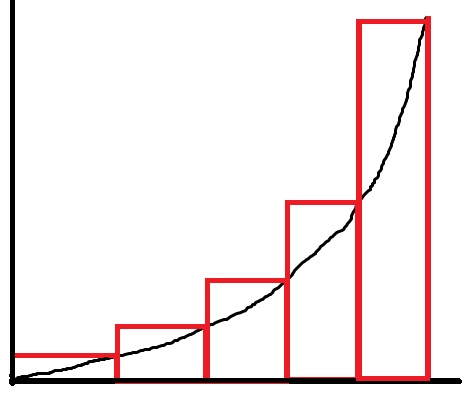
I’ll start with the right-most rectangle… what is its area? Students immediately see that the width is 


I then move to the rectangle that’s second to the right. This also has a width of 

Eventually, we get that the sum of the areas is 
I then ask the same question that I had before: how can we get a better approximation? Students will usually volunteer either “More rectangles” or “Thinner rectangles,” which of course are logically equivalent. I then proceed with 10 equal-width rectangles. Occasionally, a student volunteers that perhaps we should use thinner rectangles only on the right side of the figure, which of course is a very astute observation. However, I tell my class that, for the sake of simplicity, we’ll stick with rectangles of equal width.
With ten rectangles (and I redraw the picture with ten thin rectangles), the approximation is quickly found to be
![0.1 [ (0.1)^2 + (0.2)^2 + \dots + (0.9)^2 + 1^2] = 0.385](https://s0.wp.com/latex.php?latex=0.1+%5B+%280.1%29%5E2+%2B+%280.2%29%5E2+%2B+%5Cdots+%2B+%280.9%29%5E2+%2B+1%5E2%5D+%3D+0.385&bg=ffffff&fg=000000&s=0&c=20201002)
I like using ten rectangles, as that’s probably the largest number that can be handled in class without a calculator (until the very last step of adding up the areas).
By now, the class sees what the next steps are: take more and more rectangles. At this point, I’ll resort to classroom technology to make the process a little quicker. I personally prefer Microsoft Excel, though other software packages can be used for this purpose. For 
![0.01 [ (0.01)^2 + (0.02)^2 + \dots + (0.99)^2 +( 1.00)^2] = 0.33835](https://s0.wp.com/latex.php?latex=0.01+%5B+%280.01%29%5E2+%2B+%280.02%29%5E2+%2B+%5Cdots+%2B+%280.99%29%5E2+%2B%28+1.00%29%5E2%5D+%3D+0.33835&bg=ffffff&fg=000000&s=0&c=20201002)
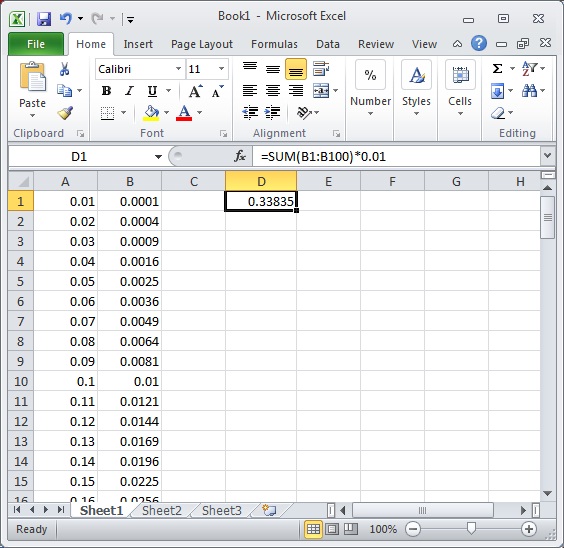
My class can see that the answer is still too large, but it’s certainly closer to the correct answer.
I’ll then tell the class that this is another example of passing to limits, the second theme of calculus. I’ll describe this more fully in the next post.
Day One of my Calculus I class: Part 3
In this series of posts, I’d like to describe what I tell my students on the very first day of Calculus I. On this first day, I try to set the table for the topics that will be discussed throughout the semester. I should emphasize that I don’t hold students immediately responsible for the content of this lecture. Instead, this introduction, which usually takes 30-45 minutes, depending on the questions I get, is meant to help my students see the forest for all of the trees. For example, when we start discussing somewhat dry topics like the definition of a continuous function and the Mean Value Theorem, I can always refer back to this initial lecture for why these concepts are ultimately important.
I’ve just told students that the topics in Calculus I build upon each other (unlike the topics of Precalculus), but that there are going to be two themes that run throughout the course:
- Approximating curved things by straight things, and
- Passing to limits
We are now studying the following problem.
Problem #1. A building on campus is 144 feet tall. A professor takes a particularly annoying student to the top of the building, and throws him (or her) off to his (or her) certain demise. (Usually I pick a student that I know and like as the one to throw off the building. This became a badge of honor over the years.) The distance that the student travels (in feet) after
seconds is
. How fast is the student going when he (or she) hits the concrete sidewalk?
At this point in the lecture, we have done some experimental numerical work with successfully smaller time intervals to find better and better approximations to the speed at impact.
- With a time interval of length
seconds, the approximation is
ft/s.
- With a time interval of length
seconds, the approximation is
ft/s.
- With a time interval of length
seconds, the approximation is
ft/s.
- With a time interval of length
seconds, the approximation is
ft/s.
- With a time interval of length
seconds, the approximation is
ft/s.
I’ll then tell the class that this is an example of passing to limits, the second theme of calculus. By making the time intervals smaller and smaller, we get better and better approximations to the true speed at impact.
By this point, students realize that we’re getting better and better approximations… however, we’re probably not going to get the correct answer by just plugging in numbers. And we certainly can’t just take a time interval of 
Depending on my read of the class — on whether or not they’re ready for a little more abstraction — I’ll then ask the class, “How can we make these fractions without plugging in all of these numbers?” Usually students are at a loss at first. Perhaps someone will volunteer that we ought to introduce a variable… but, in my experience, even bright students at the start of calculus do not have this step of abstraction at the tips of their fingers. So I’ll lay out the fractions that we’ve studied so far, like


and ask, “How could we do this more systematically? Does anyone see a pattern in these fractions?” Hopefully someone will notice that the input of the second function call is 3 minus the denominator; if not, I’ll volunteer this observation to the class. So both of these fractions can be written as

where 


The last step is permitted because
- If
, then
, matching the previous answer.
- If
, then
, matching the previous answer.
I then ask the class, what’s the ultimate goal with 
Reviewing, the curved thing was the changing speed of the falling object, which was approximated by the straight thing, the ordinary distance-rate-time formula. Finally, we passed to limits to find the real velocity at impact.
All of the above is eventually done more systematically later in the semester after the properties of derivatives have been more fully developed. However, I think that doing this calculation on the very first day of class gives my students a taste of what’s going to be happening in the days and weeks to come. Again, I emphasize that I probably cover this material in maybe 15-20 minutes, and that I don’t hold students immediately responsible for repeating such a calculation on their own. (I do hold them responsible for this, of course, after they know how to differentiate 
Day One of my Calculus I class: Part 2
In this series of posts, I’d like to describe what I tell my students on the very first day of Calculus I. On this first day, I try to set the table for the topics that will be discussed throughout the semester. I should emphasize that I don’t hold students immediately responsible for the content of this lecture. Instead, this introduction, which usually takes 30-45 minutes, depending on the questions I get, is meant to help my students see the forest for all of the trees. For example, when we start discussing somewhat dry topics like the definition of a continuous function and the Mean Value Theorem, I can always refer back to this initial lecture for why these concepts are ultimately important.
I’ve just told students that the topics in Calculus I build upon each other (unlike the topics of Precalculus), but that there are going to be two themes that run throughout the course:
- Approximating curved things by straight things, and
- Passing to limits
I then transition to applying these two themes to two different problems. Here’s the first.
Problem #1. A building on campus is 144 feet tall. A professor takes a particularly annoying student to the top of the building, and throws him (or her) off to his (or her) certain demise. (Usually I pick a student that I know and like as the one to throw off the building. This became a badge of honor over the years.) The distance that the student travels (in feet) after
And then I ask my students how to solve this. Usually, they can come up with the first few ideas.
1. When the student hits the sidewalk and meet his/her demise? So we must solve 


2. How fast is the student going after
At this point, I’ll volunteer that the changing speed is a curved thing. Back in pre-algebra, students were taught

under the assumption that the rate was constant. However, if the rate is changing, all bets are off.
Still, the question remains: how fast is the student moving after 3 seconds? How should we measure this? Usually, someone will suggest that we just divide 
This leads to the next question: is this estimate too high or too low? Unequivocally, students answer “too low” since the student travels the slowest at the start of the fall and the fastest at the end of the fall. So since this interval of 3 seconds includes the slower speeds at the start of the fall, the answer of
Which then leads to the next obvious question: How can we get a better approximation? I leave the question open-ended like this and take suggestions from the class. This often takes a while, and I’ll get a lot of creative (but bad) ideas. And that’s OK… the next step is hardly the most intuitive thing that immediately jumps to mind. I think that the process of keeping the answer unknown until someone volunteers the correct next step is worth it.
Eventually (though it might take a couple of minutes), somebody will suggest using a shorter time interval, like the distance traveled between 


I then note that the previous approximation was 
Then I ask the obvious next question, “How do we find a better approximation?” The class typically responds something to the effect of, “Take a smaller interval.” I ask for a suggestion, and I’ll usually get something like 


Then I do it again: “How do we find a better approximation?” The class typically respond, “Take an even smaller interval.” I suggest 


I turn to the class and ask, “Have we found the right answer yet?” They’ll answer “No” in unison, but they’ll note that the approximations are probably pretty good right now. Astute students will notice that the approximations appear to be “leveling off” to some final value.
I’ll then tell the class that this is an example of passing to limits, the second theme of calculus. By making the time intervals smaller and smaller, we get better and better approximations to the true speed at impact. In the next post, I’ll describe how I informally introduce the concept of a limit with this example.
Day One of my Calculus I class: Part 1
In this series of posts, I’d like to describe what I tell my students on the very first day of Calculus I. On this first day, I try to set the table for the topics that will be discussed throughout the semester. I should emphasize that I don’t hold students immediately responsible for the content of this lecture. Instead, this introduction, which usually takes 30-45 minutes, depending on the questions I get, is meant to help my students see the forest for all of the trees. For example, when we start discussing somewhat dry topics like the definition of a continuous function and the Mean Value Theorem, I can always refer back to this initial lecture for why these concepts are ultimately important.
I begin by noting the different topics that appear in Precalculus, which they should have taken in the recent past:
- The definition of a function and an inverse function
- Graphing polynomials and rational functions
- Properties and applications of exponential and logarithmic functions
- Trigonometry
- Sequences and series
These different topics, when taught in Precalculus, really don’t talk to one another. With a couple of exceptions, it feels like five different units being squeezed into the same course. I’ll present a visual image of laying down an imaginary brick on the floor, and then laying down a second brick next to the first one, and so on. The above topics (with a couple of exceptions) really don’t build upon each other; they’re lateral to one another. In other words, these topics made the foundation necessary for the study of calculus. After all, the class was called Pre-Calculus.
Now that we’re in calculus, I tell my students, we’re going to have topics that build on this foundation, and the topics will build on each other. Continuing the building image, I’ll start laying imaginary bricks on the initial foundation, building vertically higher and higher, noting that the topics that we’ll see in Weeks 13 and 14 will ultimately be built upon the topics that we’ll talk about in Weeks 1 and 2. Unlike Precalculus, the topics in Calculus are explicitly interconnected, building up a body of thought from the foundation of Precalculus.
So the good news is that, unlike Precalculus, Calculus I will be an incrementally developed course from start to finish. The bad news, of course, is that Calculus I will be an incrementally developed course from start to finish. In Precalculus, if you didn’t particularly like one topic (say, logarithms), that really would not affect your success later on with a future topic (say, trigonometry). However, in Calculus, the whole course is put together from start to finish.
The good news is that while there are many interconnected topics in calculus, there are going to be two themes that run throughout the course:
- Approximating curved things by straight things, and
- Passing to limits
And we’re going to be applying these two themes again and again throughout the semester. (I wish I could take credit for synthesizing the topics of calculus into these two themes, but I learned this idea from my own calculus professor back in the mid-1980s.)
For the remainder of this first lecture, I show how these two themes apply to two completely different problems:
- Finding the speed of a falling object when it hits the ground.
- Finding the area under the curve
between
and
.
I’ll describe how I present these to new calculus students in the coming posts.
Engaging students: Central and inscribed angles
In my capstone class for future secondary math teachers, I ask my students to come up with ideas for engaging their students with different topics in the secondary mathematics curriculum. In other words, the point of the assignment was not to devise a full-blown lesson plan on this topic. Instead, I asked my students to think about three different ways of getting their students interested in the topic in the first place.
I plan to share some of the best of these ideas on this blog (after asking my students’ permission, of course).
This student submission comes from my former student Theresa (Tress) Kringen. Her topic, from Geometry: central and inscribed angles.

What interesting word problems using this topic can students do now?
After defining the terms central angle and inscribed angle, students can use a central angles to draw a pie graph or pie chart. They can depict the data using a visual. Based in the percentage of any part of a whole, they will crate a fraction of the whole circle by dividing 360 degrees by that percentage to give the piece of the pie in which they needed to find.
Say a student is given the data below and asked to graph the data into a pie chart:
Students’ favorite colors:
Blue 10
Yellow 3
Red 7
Orange 3
Green 10
Purple 6
Pink 9
Other 2
Students would be required to give percentages based on the 50 students with the percentages listed as: Blue 20%, Yellow 6%, Red 14%, Orange 6%, Green 20%, Purple 12%, Pink 18%, other 4%. This would correspond to the percentage of the 360 degree central angle.
To tie in inscribe angles, I would have to students explain why a pie chart would not work with inscribed angles.
How does this topic appear in high culture?
In order to engage students I could help them understand inscribed angles by relating it to the camera angle in their video games. Describing an inscribed angle as a camera angle on their video game would help them understand it better. As they move throughout the game, their camera angle changes. Based on the camera’s location, you are able to see a certain portion of the screen. If there isn’t much of an angle, the range of view is small or zoomed in. This could be explained as the radius of the circle. The smaller the radius, the less view there is. Thus, the opposite is true. If the radius is large, the camera has a larger view of the object. If the camera has a larger angle of view, more is visible in the camera. I would then relate this to the arc length that the angle creates. I would explain that if the angle of the camera is small, the area of the arc length, or view of the camera would also be small. If the angle of the camera is larger, the arc length or view of the camera is much larger.
How can technology be used to effectively engage students with this topic?
Once students are given the application problem listed above, I could then engage them further by asking them to use word or excel to graph the information given into a document. They would be required to make a chart of the data with the listed percentages of each parameter along with the degree of the angle that the parameter requires to make the pie graph. I would require this since the technology would calculate this on its own without the student having to put in the effort. To make it fun, I would give the students a few extra minutes to make their pie graph their own by customizing it to reflect their personality and style.
To further engage them, I could also ask that each student create a questionnaire that asked each student what their favorite choice of any given set of choices were. They would be required to have at least 7 responses as to make a 7 piece pie chart, but they would be able to choose the topic, and find the information for their parameters on their own. Once they did this, they would be required to make an additional pie chart with their results to present to the class.
Engaging students: Finding least common multiples
In my capstone class for future secondary math teachers, I ask my students to come up with ideas for engaging their students with different topics in the secondary mathematics curriculum. In other words, the point of the assignment was not to devise a full-blown lesson plan on this topic. Instead, I asked my students to think about three different ways of getting their students interested in the topic in the first place.
I plan to share some of the best of these ideas on this blog (after asking my students’ permission, of course).
This student submission comes from my former student Theresa (Tress) Kringen. Her topic, from Pre-Algebra: finding least common multiples.
What interesting word problems using this topic can your students do now?
While having students working on finding the least common multiples I could engage them by having them solve some word problems that would bring up real world problems in a way that they can relate what they learned to problems that deal more than with just numbers. One problem that could be presented ot the students is the following:
If you’re given packages of notebooks that contain 6 each and you are required to repackage them to send them to a school in need in groups of 22, what it the least amount of groups and original packages of notebooks that you can get without any notebooks left over?
In this problem, the students would be required to find the least common multiple of both 6 and 21. Since six doesn’t not go into 22 without a remainder, they would have to find lcm(6,22). Since the least common multiple of both 6 and 22 is 66, the students would have to apply what they know about least common multiples of numbers to figure out the word problem.
To continue with this, the students could then be asked to do the same thing for three numbers.
How does this topic extend what your students should have learned in previous courses?
Students should have covered factors and multiples of numbers around fifth grade. Therefore finding the least common multiple of a number extends the topic from these previous topics. Since students can figure out the factors of a number, they should also know if one number is a factor of the second. If it is, then they will know that the second number is the least common multiple of the two given numbers. Say the students are given 3 and 9. The students should be able to tell right away that 3 goes into 9. Since 3×3=9 and 9×1=9 and since no number smaller than 9 can also be a multiple of nine, the least common multiple of 3 and 9 is 9.
When also looking at the least common multiples of a number, students know what multiples of a number are from previous courses. They will know that 18 is a multiple of nine as well as 27, 36, and 45. Students know that 3 times 9 is 27, but they will also know that since the multiples of 3 are 3, 6, 9, 12, 15, 18, 21, 24, 27, and 30, etc. they will also know that even though 3 times 9 is 27, that there is a number smaller than 27 that is also a common multiple of 3 and 9.
How can technology be used to effectively engage students with this topic?
Students like games and it’s even better for the teacher if they are able to play while they learn or practice a given subject that they have learned. In order to engage each student, there a number of online games students can play to help them practice finding the least common multiples of given numbers. I have found a number of online games that students could go to for an activity. It pushes them, allows the students to go at their own pace, and allows students to be less worried about how fast or slow they are compared to other students.
One game is a timed game that gives the students two numbers to find the least common multiple of. They are given two minutes to see how many they can compute in that amount of time. They are still permitted to go at their own pace, but they are also pushing themselves to do better than the time before.
http://www.basic-mathematics.com/least-common-multiple-game.html
A second game give the students two numbers and asks for the least common multiple. It is basically multiple choice since they are to select a number our of five or six different numbers. If they select the correct answer, they are permitted to “throw a snowball.” Each correct response helps them win the snowball fight.
http://www.fun4thebrain.com/beyondfacts/lcmsnowball.html
Engaging students: Slope-intercept form of a line
In my capstone class for future secondary math teachers, I ask my students to come up with ideas for engaging their students with different topics in the secondary mathematics curriculum. In other words, the point of the assignment was not to devise a full-blown lesson plan on this topic. Instead, I asked my students to think about three different ways of getting their students interested in the topic in the first place.
I plan to share some of the best of these ideas on this blog (after asking my students’ permission, of course).
This student submission comes from my former student Theresa (Tress) Kringen. Her topic, from Algebra I: the point-slope intercept form of a line.
What interesting word problem using this topic can your students do now?
When learning about slope-intercept from of a line, word problems would help my students engage and help process the information in a real world situation. I would present an equation for the speed of a ball that is thrown in a straight line up into the air. The equation given: 

1. What is the slope of the given equation? Since the equation is given in slope intercept form, the students should be able to give the answer quickly if they understood the lesson. The answer is 
2. Without graphing the equation, which way would the line be headed, up and to the right or down and to the right? Because the students know that the slope is negative and given that they understood the lesson, they should be able to answer that the line is decreasing and is headed down and to the right.
http://www.purplemath.com/modules/slopyint.htm
How can this topic be used in your students’ future courses in mathematics or science?
Students can use this topic for many math or science courses. When dealing with a linear equation, slope-intercept form of a line can help the student understand what the graph looks like without actually graphing it. This is useful when needing to find the 


How can technology be used to effectively engage students with this topic?
When working with slope-intercept form, a student can actively be engaged through technology by attempting to make connections of how a graph looks on the graphing calculator and what the equation looks like in slope-intercept form. When allowing the students to make connections between them in small groups, they will have discovered the information form themselves. This will allow the students to more effectively program the information into their memories. To set this up, I would give each group a graphing calculator and a list of equations in slope-intercept form. On the paper with the list, I would have the students fill out information pertaining to the graph that they see. This information would include the slope and the y-intercept. I would split up the students into their cooperative learning groups two and ask them to draw a conclusion between where the line ends up compared to what the equation looks like. Once the students have typed their equation into the graphing calculator the students should fill out the paper provided. Once they have finished, I would ask them to see if they see any patterns between the equations and their answers.

