Which is worth more: a pound of dimes, a pound of quarters, or a pound of dollars?
Rather than spoiling the fun for my readers, I’ll just leave this one unanswered and let you think about it. Feel free to Google for help.

Which is worth more: a pound of dimes, a pound of quarters, or a pound of dollars?
Rather than spoiling the fun for my readers, I’ll just leave this one unanswered and let you think about it. Feel free to Google for help.
Today I happily link to this wonderful article about how elementary school students “should” subtract two numbers, as it challenges the commonly held notion that there is only one way that subtraction should be implemented.
The common algorithm taught in schools today is the Decomposition Algorithm.
http://www.youtube.com/watch?v=3itmfsP6HoM
But there’s also the Equal Additions Algorithm.
http://www.youtube.com/watch?v=AN8XN_MSucI
And the Complement Algorithm.
http://www.youtube.com/watch?v=krNVuaIwi-o
And the Austrian Algorithm.
The author concludes:
The teaching and learning of subtraction is just as important today as it was in the past. Innovations in technology and mathematics curriculum have certainly occurred since the 1700s and 1800s, but the need for the teaching and learning of subtraction has not changed. Today, in many classrooms, subtraction is often taught through student-invented algorithms. Looking to the past may give teachers insight into invented algorithms or other algorithms students may use. Additionally, many teachers who do not encourage students to invent strategies teach only the “standard subtraction algorithm” presented in nearly every textbook across the United States, the decomposition algorithm. This research and analysis provides the modern teacher with an opportunity to reflect on the algorithms being taught in his or her classroom and allows the teacher to begin to think about why decomposition became the dominant algorithm in the United States. Teachers can ask their students to reflect on whether they agree with this historical turn of events. Incorporating the history of subtraction algorithms into modern elementary school mathematics invites robust mathematical discussion of subtraction and also of how, for many mathematical operations, there isn’t just one algorithm, but rather many algorithms from which to choose.
Exploring the history of subtraction in past school mathematics may provide us with insight into students’ mathematical struggles as they attempt to conceptualize not only subtraction, but also negative numbers and other notoriously challenging mathematical concepts. As educators and researchers, we need to devote more attention to issues in mathematics education such as the development of specific algorithms in elementary mathematics.
In my capstone class for future secondary math teachers, I ask my students to come up with ideas for engaging their students with different topics in the secondary mathematics curriculum. In other words, the point of the assignment was not to devise a full-blown lesson plan on this topic. Instead, I asked my students to think about three different ways of getting their students interested in the topic in the first place.
I plan to share some of the best of these ideas on this blog (after asking my students’ permission, of course).
This student submission comes from my former student Roderick Motes. His topic, from Precalculus: Pascal’s triangle.

History – What are the contributions of various cultures to this topic?
Through doing this project I learned that the history of Pascal’s triangle is actually pretty fascinating, and could be an excellent talking point for students.
Pascal’s Triangle was named after Blaise Pascal, who published the right angled version of the triangle, the binomial theorem, and the proof that n choose k corresponds to the kth element of the nth row of the triangle. But this wasn’t the first time interesting results about the triangle had been published, not even in the west.
The triangle was actually independently developed and worked on as early as the 11’th century in both China and modern day Iran. In China two mathematicians, Chia Hsien and Yang Hui, worked on the triangle and it’s applications to solving polynomials. Hsien used the triangle to aid in solving for cubic roots. Hui built upon the work of Hsien and actually gave us the first visual model of the triangle and used the triangle to aid in solving higher degree roots.

Independently Omar Khayyam in Persia (modern Iran) used the triangle and binomial theorem (which was known to Arabic mathematicians at the time) to solve nth roots of polynomials.
In addition the triangle was used before Pascal to solve cubic equations, and in Europe in particular we get to the old controversy of Cardano and Del Ferro of ‘who found the general formula for cubic roots’ because another Italian man by the name of Niccolo Tartaglia claimed to have used the triangle to solve cubics and dervice the formula before Cardano published his formula.
So there were a variety of cultures who all independently recognized the significance of the triangle and used it well before Pascal. Consequently the triangle is called many things in many cultures. In China it is referred to as Yang Hui’s triangle, in Iran it is still called the Khayyam-Pascal triangle. All this goes to show that the history we think we know of mathematics may not be quite so true, and that mathematical understanding is the product of many cultures over many years.
Technology- How can you effectively use technology to engage students on this subject?
There are a variety of technological resources you could use to craft a lesson. In particular I’m fond of the Texas Instruments exploration lessons. The lessons are available for free at education.ti.com and come with a slew of materials and handouts prepared for you. I’ve used the TI Nspire to teach the Law of Sines and the activity went tremendously well.
For Pascal’s Triangle and Binomial Theorem there are equivalent lessons with the TI Nspire and TI 84. The links are included at the end of this. The lessons allow the students to see Pascal’s triangle side by side with the triangle of coefficients which they are generating on the calculator. This could be backed up with having the students physically create the triangles on paper and see that they match up. The lesson then has the students conjecture what they believe the binomial theorem is.
This could be a powerful lesson for engaging learners of various strengths. Kinetic learners will love the physical action of the calculator, visual learners will love seeing the triangles update in real time.
Curriculum- How can this topic be extended to your students future math courses?
Pascal’s triangle has a large relationship to probability and statistics. There are a variety of ways you can tie statistics lessons back to Pascal’s triangle and the binomial theorem. In particular we can examine how we might game a Pachinko machine in order to maximize our winnings.
Pachinko (or Plinko or a variety of other things depending on where you are) is fairly simple in idea.
You have a rectangular grid of pegs in which each row is slightly offset from the row above it. You drop a disc or puck of some kind down and attempt to get it into one of the small bins at the bottom. Sometimes prizes will be attached to certain bins (this is a popular carnival game) and sometimes money will (this is also a popular gambling game.)
The bin in which the puck will land follows a normal distribution based on the starting position. This is unsurprising and can be introduced very easily in a Statistics class when you’re teaching about probability distributions and normal distributions. What is more interesting is that this is very deeply related to Pascal’s Triangle.
Overlaying the triangle on top of the machine yields a triangle which shows the number of possible paths to get to each point. You can use this to make a statistical analysis and actually assign values to the probability of landing in a given spot. Using this knowledge you can game the machine and maximize your odds of getting the giant teddy bear or the fat stack of cash.
This application of Pascal’s triangle and its relationship to elementary combinatorics (which should hearken back to Middle School mathematics in addition to being extendable into Statistics,) is looked at in depth in a paper by Katie Asplund of Iowa State University. I have included this paper below. In addition to this suggestions she also relates a specific activity useful in the exploration where the students look at the various options of n choose k and relate the possibilities back to Pascal’s Triangle. I could not get the link for that specific activity as it requires access to Mathematics Teacher which I was unable to find using the UNT Library Resources.

References and Other Such Things
http://www.math.iastate.edu/thesisarchive/MSM/AsplundCCSS09.pdf
– This paper is written by Katie Asplund. In it she explores a variety of patterns and connections between Pascal’s Triangle and various parts of the high school math curriculum. In particular she is interested in seeing how she can relate the patterns to her own high school pre calculus class. I recommend reading this entirely because it is simply illuminating and has quite a few suggestions you could implement.
http://pages.csam.montclair.edu/~kazimir/history.html
– This website has a quick history of Pascal’s triangle as well as several applications. Using this and Wikipedia I was able to learn about the histories and cultures which led to our modern understanding of the triangle. In particular Omar Khayyam is a very interesting person to talk about if you feel like injecting some history of the Islamic Golden Age and the history of Mathematics after the fall of Rome. Khayyam was a Poet as well as a mathematician, and was one of the first to openly question Euclid’s use of the Parallel Postulate.
– This is the TI Nspire activity on the Binomial Theorem and Pascal’s Triangle. It’s fairly straightforward but, like many of the TI Activities, it has some nice tricks that it uses the calculator to accomplish.
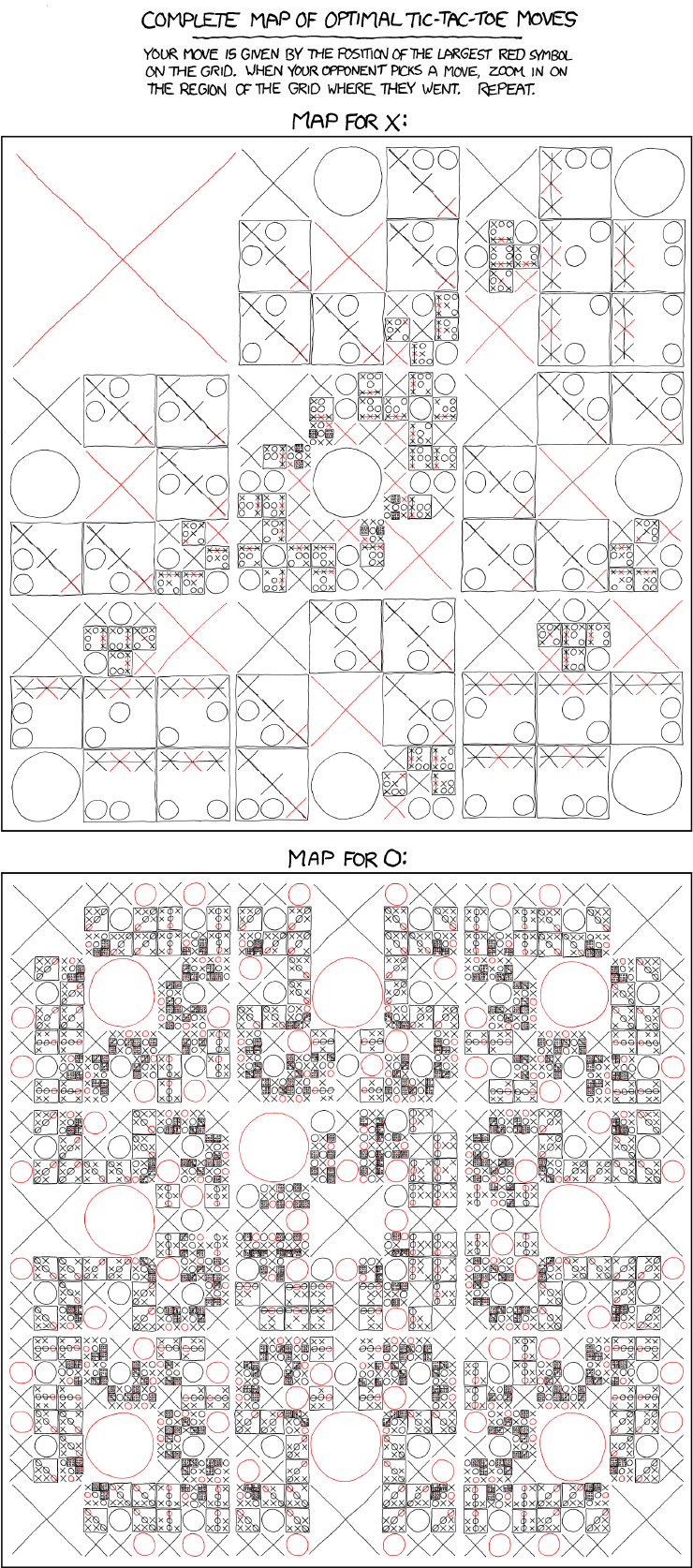
Source: http://www.xkcd.com/832_large/
From Math with Bad Drawings:
Last week, 6,000 mathematicians met in Baltimore. They crowded in conference rooms, swapped gossip over beers, and wherever free food appeared, they lined up like ants.
On a table in the hallway of the convention center, I stationed paper, markers, and the following invitation:
I got 39 replies, 39 tributes to math’s power—in short, 39 ways to love mathematics.
See the results here: http://mathwithbaddrawings.com/2014/01/22/39-ways-to-love-math/
One of the formulas typically taught in mathematics is
In ordinary English, the probability that either event 

For example, when rolling two fair six-sided dice, the probability that at least one three appears is

It’s necessary to subtract something off at the end because it’s possible for the first die to be a four and simultaneously the second die to be a four.
This can be a conceptual barrier for students if it’s not directly addressed. In mathematics, the word “or” means “one or the other… or maybe both.” In the previous example, event
Of course, this is different than the way we typically use “or” is spoken English. For example, in the final episode of each season of “The Bachelor,” the guy has to choose one woman or the other… and there’s no possibility of him choosing both! When a student says, “Next semester, my morning class will be history or physics,” we don’t think that there’s a possibility that the student will choose both classes… the student will choose one or the other, but not both.
In terms of mathematical logic, the word “or” in ordinary speech really is an “exclusive or.”
As I said, this isn’t a big deal for students to see, but in my opinion it’s best to directly address this subtlety rather than have students confused about which meaning of the word “or” they should be using when doing their homework.
P.S. The good news is that the word “and” means the same thing in the language of probability/logic as its meaning in ordinary speech.
When I teach Algebra II or Precalculus (or train my future high school teachers to teach these subjects), we eventually land on the Rational Root Test and Descartes’ Rule of Signs as an aid for finding the roots of cubic equations or higher. Before I get too deep into this subject, however, I like to give a 10-15 minute pseudohistory about the discovery of how polynomial equations can be solved. Historians of mathematics will certain take issue with some of this “history.” However, the main purpose of the story is not complete accuracy but engaging students with the history of mathematics. I think the story I tell engages students while remaining reasonably accurate… and I always refer students to various resources if they want to get the real history.
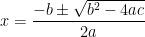
To begin, I write down the easiest two equations to solve (in all cases, 

These are pretty easy to solve, with solutions well known to students:

In other words, there are formulas that you can just stick in the coefficients and get the answer out without thinking too hard. Sure, there are alternate ways of solving for 
These formulas were known to Babylonian mathematicians around 2000 B.C. (When I teach this in class, I write the date, and all other dates and discoverers, next to the equations for dramatic pedagogical effect.) Though not written in these modern terms, basically every ancient culture on the globe that did mathematics had some version of these formulas: for example, the ancient Egyptians, Greeks, Chinese, and Mayans.
Naturally, this leads to a simple question: is there a formula for the cubic:
Is there some formula that we can just plug 


Tartaglia’s discovery was arguably the first triumph of the European Renaissance. The solution of the cubic was perhaps the first thing known to European mathematicians in the Middle Ages that was unknown to the ancient Greeks.
In 1535, Tartaglia was a relatively unknown mathematician, and so he told a more famous mathematician, Cardano, about his formula. Cardano told Tartaglia, why yes, that is very interesting, and then published the formula under his own name, taking credit without mention of Tartaglia. To this day, the formula is called Cardano’s formula.
So there is a formula. But it would take an entire chalkboard to write down the formula. That’s why we typically don’t make students learn this formula in high school; it’s out there, but it’s simply too complicated to expect students to memorize and use.
This leads to the next natural question: what about quartic equations?
The solution of the quartic was discovered less than five years later by an Italian mathematician named Ferrari. Ferrari found out that there is a formula that you can just plug in 
Of course, Ferrari had some famous descendants in the automotive industry.
So now we move onto my favorite equation, the quintic. (If you don’t understand why it’s my favorite, think about my last name.)
After solving the cubic and quartic in rapid succession, surely there should also be a formula for the quintic. So they tried, and they tried, and they tried, and they got nowhere fast. Finally, the problem was solved nearly 300 years later, in 1832 (for the sake telling a good story, I don’t mention Abel) by a French kid named Evariste Galois. Galois showed that there is no formula. That takes some real moxie. There is no formula. No matter how hard you try, you will not find a formula that can work for every quintic. Sure, there are some quintics that can be solved, like 
Galois made this discovery when he was 19 years old… in other words, approximately the same age as my students. In fact, we know when wrote down his discovery, because it happened the night before he died. You see, he was living in France in 1832. What was going on in France in 1832? I ask my class, have they seen Les Miserables?
France was torn upside-down in 1832 in the aftermath of the French Revolution, and young Galois got into a heated argument with someone over politics; Galois was a republican, while the other guy was a royalist. More importantly, both men were competing for the hand of the same young woman. So they decided to settle their differences like honorable Frenchmen, with a duel. So Galois wrote up his mathematical notes one night, and the next day, he fought the duel, he lost the duel, and he died.
Thus giving complete and total proof that tremendous mathematical genius does not prevent somebody from being a complete idiot.
For the present, there are formulas for cubic and quartic equations, but they’re long and impractical. And for quintic equations and higher, there is no formula. So that’s why we teach these indirect methods like the Rational Root Test and Descartes’ Rule of Signs, as they give tools to use to guess at the roots of higher-order polynomials without using something like the quadratic formula.
Real references:
http://mathworld.wolfram.com/QuadraticEquation.html
http://mathworld.wolfram.com/CubicFormula.html
http://mathworld.wolfram.com/QuarticEquation.html
http://mathworld.wolfram.com/AbelsImpossibilityTheorem.html
http://mathworld.wolfram.com/QuinticEquation.html
I just read a recent post by David Bressoud, former president of the Mathematical Association of America, concerning the percentage of college students in Calculus I who ultimately enroll in Calculus II. Some interesting quotes:
[J]ust because a student needs further mathematics for the intended career and has done well in the last mathematics course is no guarantee that he or she will decide to continue the study of mathematics. This loss between courses is a significant contributor to the disappearance from STEM fields of at least half of the students who enter college with the intention of pursuing a degree in science, technology, engineering, or mathematics.
And:
Our study offered students who had chosen to switch out a variety of reasons from which they could select any with which they agreed. Just over half reported that they had changed their major to a field that did not require Calculus II. A third of these students, as well as a third of all switchers, identified their experience in Calculus I as responsible for their decision. It also was a third of all switchers who reported that the reason for switching was that they found calculus to require too much time and effort.This observation was supported by other data from our study that showed that switchers visit their instructors and tutors more often than persisters and spend more time studying calculus. As stated before, these are students who are doing well, but have decided that continuing would require more effort than they can afford.
And:
[W]e do need to find ways of mitigating the shock that hits so many students when they transition from high school to college. We need to do a better job of preparing students for the demands of college, working on both sides of the transition to equip them with the skills they need to make effective use of their time and effort.Twenty years ago, I surveyed Calculus I students at Penn State and learned that most had no idea what it means to study mathematics. Their efforts seldom extended beyond trying to match the problems at the back of the section to the templates in the book or the examples that had been explained that day. The result was that studying mathematics had been reduced to the memorization of a large body of specific and seemingly unrelated techniques for solving a vast assortment of problems. No wonder students found it so difficult. I fear that this has not changed.
The full post can be found at http://launchings.blogspot.com/2013/12/maa-calculus-study-persistence-through.html.
Here’s a problem that a friend posed to me a while ago. Apparently this is called the Coin Problem, but I’d never heard of it before.
McNuggets used to come in boxes of 6, 9, or 20. Given that scheme, what is the largest number of nuggets that cannot be ordered exactly?
Here’s a similar problem:
In American football, teams can score points in increments of 3 (field goal) and 7 (touchdown plus extra point). What is the largest number that can’t be a valid football score? (I’ve ignored other possible ways of scoring — 2-point safeties, 6-point touchdowns without the extra point, 8-point touchdowns with a two-point conversion — because the problem is utterly trivial with these extra options.)
I’m not going to give the answers (if you want to cheat, see the above link), but I suggest questions like these as a way of engaging elementary-school students (who have mastered addition and multiplication) with a non-traditional math question.
This note appeared in the October 2012 issue of the American Mathematical Monthly.