In my capstone class for future secondary math teachers, I ask my students to come up with ideas for engaging their students with different topics in the secondary mathematics curriculum. In other words, the point of the assignment was not to devise a full-blown lesson plan on this topic. Instead, I asked my students to think about three different ways of getting their students interested in the topic in the first place.
I plan to share some of the best of these ideas on this blog (after asking my students’ permission, of course).
This student submission again comes from my former student Daniel Littleton. His topic, from Algebra II: the quadratic formula.

A1: What interesting word problems using this topic can your students do now?
The quadratic equation is a formula used to find the solutions of second order polynomials. Meaning, that if f(x) is a polynomial with the highest power of x being two the quadratic equation may be used to find the solution set of the function. This solution set describes the values at which the function crosses the x-axis, resulting in a solution set of (x_1, 0), (x_2, 0). These points on the graph of the function are often referred to as the zeroes of the function.
With this knowledge regarding the information that is derived from the quadratic equation, a student could be asked the following word problem.
“Congratulations, your motorcycle stunt career is really taking off. Now it is time for you to get ready for your next jump off of a ramp. Your team has determined that in the arena you will be performing in it will be safe for your jump to follow the path of the following function, f(x) = -10/87x^2 + 11/29x + 5, where x is measured in meters. They determined this from setting the middle of the arena to the origin of the graph, (0, 0); and from the knowledge that the total length of the arena is 24 meters. In order to ensure your safety, you need to inspect the set-up of the stunt and ensure everything was done correctly. At what points on the graph will you take off into your jump, and land from your jump? Also, how many meters of open arena will you have behind you at the beginning of your jump and in front of you after your landing?”
The solution set of this equation are the points at which the motorcycle rider would leave the ground for the jump, and fall back to the ground for the landing. It can be easily determined that factoring this quadratic equation is not a feasible option to find the solution set. Therefore, the student would use the quadratic formula with a=(-10/87), b=(11/29) and c=5. After using the quadratic formula the student will arrive at the solution set of (-5.15, 0) and (8.45, 0). The student would interpret this data to mean that the jump begins 5.15 meters back from the center of the arena and ends 8.45 meters ahead of the center of the arena. The rider would also have 6.85 meters of clearance behind him at the start of the jump, and 3.55 meters of clearance in front of him at the end of the jump. These solutions are determined from the knowledge that the total length of the arena is 24 meters and the center of the arena is the origin of the graph.
This is one stimulating example of a word problem that a student could complete in order to engage their interest in the quadratic formula. Word problems following this could vary in complexity and application.
B1: How can this topic be used in your students’ future courses in mathematics or science?
The quadratic equation has multiple applications in solving polynomial equations of the second degree. In future mathematics courses, most likely at the Pre-Calculus level, students will be asked to solve for variables within trigonometric equations. These equations can also be solved using the quadratic equation when the options of using linear interpretations, factoring, or trigonometric identities is not feasible.
For example, a student could be asked to find all solutions of the formula cot x(cot x + 3) = 1. After factoring the equation and setting the answer equal to zero we derive a standard quadratic form of the equation, cot ^2 x + 3 cot x – 1 = 0. The quadratic equation can be utilized in this situation by setting a=1, b=3, c= (-1) and cot x as the variable. After using the quadratic formula we determine the solutions of cot x = (-3.302775638) or (.3027756377). As a calculator cannot be used to find the inverse of cotangent, we use the fact that cot x = 1/tan x and take the reciprocals of the solutions to find that tan x= (-.3027756377) or (3.302775638). By finding the inverse tangent of these values we conclude that x = (-.2940013018) or (1.276795025).
I would like to take this opportunity to note that this is only one set of the solutions to the value of x. In order to express all solutions we need to add integer multiples of the period of the tangent, π, to each of the expressed solutions. Resulting in the final solutions of
x = (-.2940013018) + nπ or (1.276795025) + nπ where n ϵ integers.
This is one example of an occasion when a student would need to apply the quadratic equation in order to derive a solution to an advanced trigonometric formula.
D1: What interesting things can you say about the people who contributed to the discovery and/or development of this topic?
The first efforts to discover a general formula to solve quadratic equations can be traced back to the efforts of Pythagoras and Euclid. Pythagoras and his followers are the ones responsible for the development of the Pythagorean Theorem. Euclid was the individual responsible for the development of the subject of Geometry as it is still used today. The efforts of these two individuals took a strictly geometric approach to the problem; however Pythagoras first noted that the ratios between the area of a square and the length of the side were not always an integer. Euclid built upon the efforts of Pythagoras by concluding that this proportion might not be rational and irrational numbers exist. The works of Euclid and Pythagoras traveled from ancient Greece to India where Hindu mathematicians were using the decimal system that is still in use today. Around 700 A.D. the general solution for the quadratic equation, using the number system, was developed by the mathematician Brahmagupta. Brahmagupta used irrational numbers in his analysis of the quadratic equation and also recognized the existence of two roots in the solution.
By the year 820 A.D. the advancements made by Brahmagupta had traveled to Persia, where a mathematician by the name of Al-Khwarizmi completed further work on the derivation of the quadratic equation. Al-Khwarizmi is the Islamic mathematician given the greatest amount of credit for the development of Algebra as it is known today. However, Al-Khwarizmi rejected the possibility of negative solution. The works of Al-Khwarizmi were brought to Europe by Jewish mathematician Abraham bar Hiyya. It was in the Renaissance Era of Europe, around 1500 A.D., that the quadratic equation in use today was formulated. By 1545 A.D. Girolamo Cardano, a Renaissance scientist, compiled the works of Al-Khwarizmi and Euclid and completed work upon the quadratic equation allowing for the existence of complex numbers. After the development of a universally accepted system of symbols for mathematicians, this form of the quadratic formula was published and distributed throughout the mathematical and scientific community.
This information was collected from the web page http://www.bbc.co.uk/dna/place-london/plain/A2982567


 if
if ![f(x) = \left[6x^2 + \sin 5x \right]^3](https://s0.wp.com/latex.php?latex=f%28x%29+%3D+%5Cleft%5B6x%5E2+%2B+%5Csin+5x+%5Cright%5D%5E3&bg=ffffff&fg=000000&s=0&c=20201002)
![f'(x) = 3 \left[6x^2 + \sin 5x \right]^2 \left(12x + [\cos 5x] \cdot 5 \right)](https://s0.wp.com/latex.php?latex=f%27%28x%29+%3D+3+%5Cleft%5B6x%5E2+%2B+%5Csin+5x+%5Cright%5D%5E2+%5Cleft%2812x+%2B+%5B%5Ccos+5x%5D+%5Ccdot+5+%5Cright%29&bg=ffffff&fg=000000&s=0&c=20201002)
![f'(x) = 3 \left[6x^2 + \sin 5x \right]^2 \left(12x + \cos 5x \right) \cdot 5](https://s0.wp.com/latex.php?latex=f%27%28x%29+%3D+3+%5Cleft%5B6x%5E2+%2B+%5Csin+5x+%5Cright%5D%5E2+%5Cleft%2812x+%2B+%5Ccos+5x+%5Cright%29+%5Ccdot+5&bg=ffffff&fg=000000&s=0&c=20201002)
 at the end of the derivative. Students can so easily get into the rhythm of just multiplying by the derivative of the inside that they can forget where the derivative of the inside should be placed.
 for positive and negative integers
  , the trigonometric function, and
  . They also know the Product and Quotient Rules.
 . Then

 .
. . Then


 . Then

 . Then





 in the first example as $\latex 3 \times 2$.
 and
and  . In other words, there’s a significant front-end investment of time as students discover the Chain Rule, but applying the Chain Rule generally moves along quite quickly once it’s been discovered.

 and
and  . Then
 .
. is clearly equal to
  .
. , so that
 .
. :
:
 . Using the above identity again, we find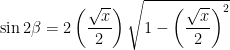





 for some integer
  and
and  , we see that
  . (From its definition, $\beta$ is the arcsine of a positive number and therefore must be nonnegative.) Therefore,
  .
.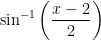 and
and 


 , so that
  and
and  :
:


