Langley’s Adventitious Angles (Part 2)

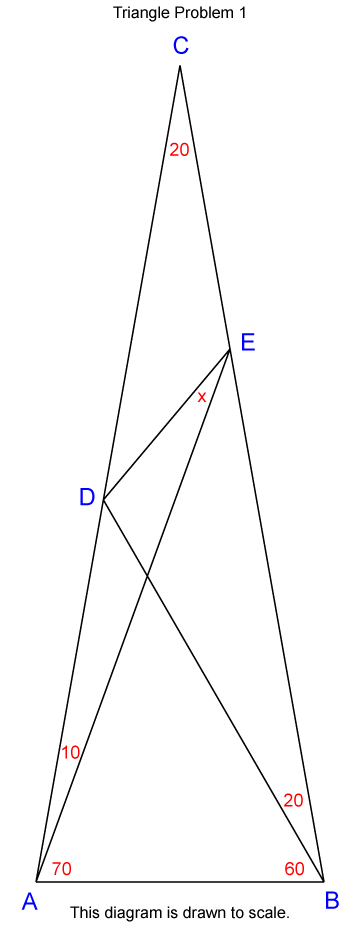
As a follow-up to yesterday’s triangle problem, here’s another one in the same equivalence class that I found at http://thinkzone.wlonk.com/MathFun/Triangle.htm (via the comments at Math With Bad Drawings). The author of this webpage tantalizingly calls this the World’s Hardest Easy Geometry Problem: solve for x in the figure below.


This figure is similar to the figure in yesterday’s post, except the values of m\angle BAE and m\angle DAE have changed.

So as to not ruin the fun, I won’t give the answer here. Instead, I’ll leave a thought bubble so you can think about the answer. In case you’re wondering: yes, I did figure this out for myself without using the Laws of Sines and Cosines. But I needed over an hour to solve this problem , and that’s after I had time to read and reflect upon the solution to the problem I posed in yesterday’s post.

green_speech_bubble

Langley’s Adventitious Angles (Part 1)

Math With Bad Drawings had an interesting post about solving for x in the following picture (this picture is taken from http://thinkzone.wlonk.com/MathFun/Triangle.htm):

I had never heard of this problem before, but it’s apparently well known and is called Langley’s Adventitious Angles. See Math With Bad Drawings, Wikipedia, and Math Pages for more information about the solution of this problem. Math Pages has a nice discussion about mathematical aspects of this problem, including connections to the Laws of Sines and Cosines and to various trig identities.

I’d encourage you to try to solve for x without clicking on any of these links… a certain trick out of the patented Bag of Tricks is required to solve this problem using only geometry (as opposed to the Law of Cosines and the Law of Sines). I have a story that I tell my students about the patented Bag of Tricks: Socrates gave the Bag of Tricks to Plato, Plato gave it to Aristotle, it passed down the generations, my teacher taught the Bag of Tricks to me, and I teach it to my students. In the same post, Math With Bad Drawings has a nice discussion about pedagogical aspects of this problem concerning when a “trick” becomes a “technique”.

I recommend this problem for advanced geometry students who need to be challenged; even bright students will be stumped concerning coming up with the requisite trick on their own. Indeed, the problem still remains quite challenging even after the trick is shown.

The antiderivative of 1/(x^4+1): Part 10

This antiderivative has arguable the highest ratio of “really hard to compute” to “really easy to write”:

\displaystyle \int \frac{1}{x^4 + 1} dx

As we’ve seen in this series, the answer is

\displaystyle \frac{\sqrt{2}}{8} \ln \left(\frac{x^2 + x\sqrt{2} + 1}{x^2 - x\sqrt{2} + 1} \right) + \frac{\sqrt{2}}{4} \tan^{-1} ( x\sqrt{2} - 1 ) + \frac{\sqrt{2}}{4} \tan^{-1}( x \sqrt{2} + 1) + C

Also, as long as x \ne 1 and x \ne -1, there is an alternative answer:

\displaystyle \int \frac{1}{x^4 + 1} dx = \displaystyle \frac{\sqrt{2}}{8} \ln \left(\frac{x^2 + x\sqrt{2} + 1}{x^2 - x\sqrt{2} + 1} \right) + \frac{\sqrt{2}}{4} \tan^{-1} \left( \displaystyle \frac{x \sqrt{2}}{1 - x^2} \right) + C.

In this concluding post of this series, I’d like to talk about the practical implications of the assumptions that x \ne 1 and x \ne -1.

For the sake of simplicity for the rest of this post, let

F(x) = \displaystyle \frac{\sqrt{2}}{8} \ln \left(\frac{x^2 + x\sqrt{2} + 1}{x^2 - x\sqrt{2} + 1} \right) + \frac{\sqrt{2}}{4} \tan^{-1} ( x\sqrt{2} - 1 ) + \frac{\sqrt{2}}{4} \tan^{-1}( x \sqrt{2} + 1)

and

G(x) = \displaystyle \int \frac{1}{x^4 + 1} dx = \displaystyle \frac{\sqrt{2}}{8} \ln \left(\frac{x^2 + x\sqrt{2} + 1}{x^2 - x\sqrt{2} + 1} \right) + \frac{\sqrt{2}}{4} \tan^{-1} \left( \displaystyle \frac{x \sqrt{2}}{1 - x^2} \right).

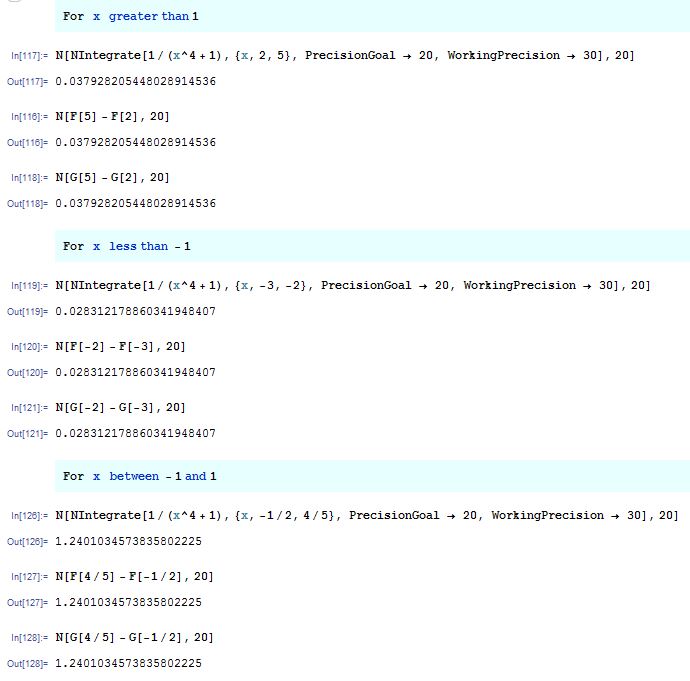
If I evaluate a definite integral of \displaystyle \frac{1}{x^4+1} over an interval that contains neither x = 1 or x = -1, then either F or G can be used. Courtesy of Mathematica:

integral1

green line

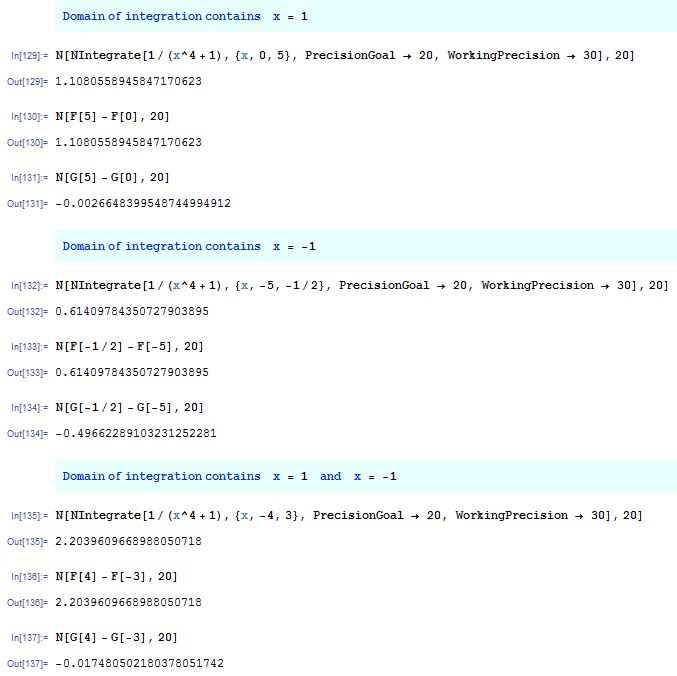
However, if the region of integration contains either x = -1 or x =1 (or both), then only using F returns the correct answer.

integral2So this should be a cautionary tale about solving for angles, as the innocent-looking +n\pi that appeared several posts ago ultimately makes a big difference in the final answers that are obtained.

The antiderivative of 1/(x^4+1): Part 9

In the course of evaluating the antiderivative

\displaystyle \int \frac{1}{x^4 + 1} dx,

I have stumbled across a very curious trigonometric identity:

\tan^{-1} ( x\sqrt{2} - 1 ) + \tan^{-1}( x \sqrt{2} + 1) = \tan^{-1} \left( \displaystyle \frac{x \sqrt{2}}{1 - x^2} \right) -\pi if x < x_2,

\tan^{-1} ( x\sqrt{2} - 1 ) + \tan^{-1}( x \sqrt{2} + 1) = \tan^{-1} \left( \displaystyle \frac{x \sqrt{2}}{1 - x^2} \right) if x_2 < x < x_1,

\tan^{-1} ( x\sqrt{2} - 1 ) + \tan^{-1}( x \sqrt{2} + 1) = \tan^{-1} \left( \displaystyle \frac{x \sqrt{2}}{1 - x^2} \right) + \pi if x> x_1,

where x_1 and x_2 are the unique values so that

\tan^{-1} ( x_1\sqrt{2} - 1 ) + \tan^{-1}( x_1 \sqrt{2} + 1) = \displaystyle \frac{\pi}{2},

\tan^{-1} ( x_2\sqrt{2} - 1 ) + \tan^{-1}( x_2 \sqrt{2} + 1) = -\displaystyle \frac{\pi}{2}.

I will now show that x_1 = 1 and x_2 = -1. Indeed, it’s apparent that these have to be the two transition points because these are the points where \displaystyle \frac{x \sqrt{2}}{1 - x^2} is undefined. However, it would be more convincing to show this directly.

To show that x_1 = 1, I need to show that

\tan^{-1} (\sqrt{2} - 1 ) + \tan^{-1}( \sqrt{2} + 1) = \displaystyle \frac{\pi}{2}.

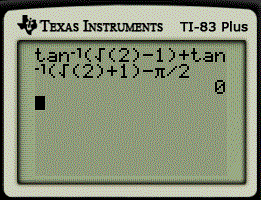
I could do this with a calculator…

arctangent…but that would be cheating.

Instead, let \alpha = \tan^{-1} (\sqrt{2} - 1 ) and \beta = \tan^{-1} (\sqrt{2} + 1 ), so that

\tan \alpha = \sqrt{2} - 1,

\tan \beta = \sqrt{2} + 1.

Indeed, by SOHCAHTOA, the angles \alpha and \beta can be represented in the figure below:
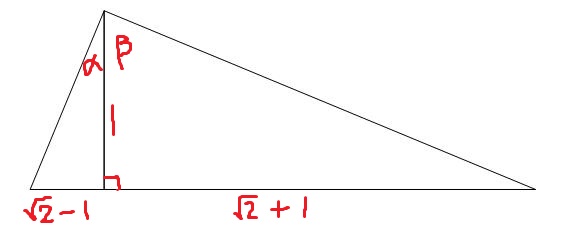
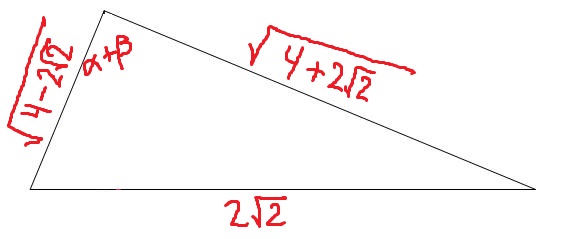
arctangenttriangle2The two small right triangles make one large triangle, and I will show that the large triangle is also a right triangle. To do this, let’s find the lengths of the three sides of the large triangle. The length of the longest side is clearly \sqrt{2} - 1 + \sqrt{2} + 1 = 2\sqrt{2}. I will use the Pythagorean theorem to find the lengths of the other two sides. For the small right triangle containing \alpha, the missing side is

\sqrt{ \left(\sqrt{2} - 1 \right)^2 + 1^2} = \sqrt{2 - 2\sqrt{2} + 1 + 1} = \sqrt{4-2\sqrt{2}}

Next, for the small right triangle containing \beta, the missing side is

\sqrt{ \left(\sqrt{2} + 1 \right)^2 + 1^2} = \sqrt{2 + 2\sqrt{2} + 1 + 1} = \sqrt{4+2\sqrt{2}}

So let me redraw the figure, eliminating the altitude from the previous figure:
arctangenttriangle3

Notice that the condition of the Pythagorean theorem is satisfied, since

\left( \sqrt{4-2\sqrt{2}} \right)^2 + \left( \sqrt{4+2\sqrt{2}} \right)^2 = 4 - 2\sqrt{2} + 4 + 2 \sqrt{2} = 8,

or

\left( \sqrt{4-2\sqrt{2}} \right)^2 + \left( \sqrt{4+2\sqrt{2}} \right)^2 = \left( 2\sqrt{2} \right)^2.

Therefore, by the converse of the Pythagorean theorem, the above figure must be a right triangle (albeit a right triangle with sides of unusual length), and so \alpha + \beta = \pi/2. In other words, x_1 = 1, as required.

To show that x_2 = -1, I will show that the function f(x) = \tan^{-1} ( x\sqrt{2} - 1 ) + \tan^{-1}( x \sqrt{2} + 1) is an odd function using the fact that \tan^{-1} x is also an odd function:

f(-x) = \tan^{-1} ( -x\sqrt{2} - 1 ) + \tan^{-1}( -x \sqrt{2} + 1)

= \tan^{-1} ( -[x\sqrt{2} + 1] ) + \tan^{-1}( -[x \sqrt{2} - 1])

= -\tan^{-1} ( x\sqrt{2} + 1 ) - \tan^{-1}( x \sqrt{2} - 1)

= - \left[ \tan^{-1} ( x\sqrt{2} + 1 ) + \tan^{-1}( x \sqrt{2} - 1) \right]

= -f(x).

Therefore, f(-1) = -f(1) = -\displaystyle \frac{\pi}{2}, and so x_2 = -1.

The antiderivative of 1/(x^4+1): Part 8

In the course of evaluating the antiderivative

\displaystyle \int \frac{1}{x^4 + 1} dx,

I’ve accidentally stumbled on a very curious looking trigonometric identity:

\tan^{-1} ( x\sqrt{2} - 1 ) + \tan^{-1}( x \sqrt{2} + 1) = \tan^{-1} \left( \displaystyle \frac{x \sqrt{2}}{1 - x^2} \right) -\pi if x < -1,

\tan^{-1} ( x\sqrt{2} - 1 ) + \tan^{-1}( x \sqrt{2} + 1) = \tan^{-1} \left( \displaystyle \frac{x \sqrt{2}}{1 - x^2} \right) if -1 < x < 1,

\tan^{-1} ( x\sqrt{2} - 1 ) + \tan^{-1}( x \sqrt{2} + 1) = \tan^{-1} \left( \displaystyle \frac{x \sqrt{2}}{1 - x^2} \right) + \pi if x> 1.

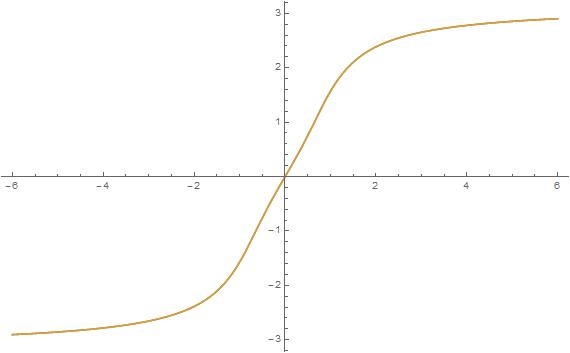
The extra -\pi and \pi are important. Without them, the graphs of the left-hand side and right-hand sides are clearly different if x < -1 or x > 1:

TwoArctangents1

However, they match when those constants are included:
TwoArctangents2

Let’s see if I can explain why this trigonometric identity occurs without resorting to the graphs.

Since \tan^{-1} x assumes values between -\pi/2 and \pi/2, I know that

-\displaystyle \frac{\pi}{2} < \tan^{-1} ( x\sqrt{2} - 1 ) < \frac{\pi}{2},

-\displaystyle \frac{\pi}{2} < \tan^{-1} ( x\sqrt{2} + 1 ) < \frac{\pi}{2},

and so

-\pi< \tan^{-1} ( x\sqrt{2} - 1 ) + \tan^{-1} ( x\sqrt{2} + 1 ) < \pi.

However,

-\displaystyle \frac{\pi}{2} < \tan^{-1} \left( \displaystyle \frac{x \sqrt{2}}{1 - x^2} \right) < \frac{\pi}{2},

and so \tan^{-1} ( x\sqrt{2} - 1 ) + \tan^{-1} ( x\sqrt{2} + 1 ) and \tan^{-1} \left( \displaystyle \frac{x \sqrt{2}}{1 - x^2} \right) must differ if \tan^{-1} ( x\sqrt{2} - 1 ) + \tan^{-1} ( x\sqrt{2} + 1) is in the interval [-\pi,-\pi/2] or in the interval [\pi/2,\pi].

I also notice that

-\pi< \tan^{-1} ( x\sqrt{2} - 1 ) + \tan^{-1} ( x\sqrt{2} + 1 ) < \pi,

-\displaystyle \frac{\pi}{2} < -\tan^{-1} \left( \displaystyle \frac{x \sqrt{2}}{1 - x^2} \right) < \frac{\pi}{2},

and so

-\displaystyle \frac{3\pi}{2} < \tan^{-1} ( x\sqrt{2} - 1 ) + \tan^{-1} ( x\sqrt{2} + 1 )-\tan^{-1} \left( \displaystyle \frac{x \sqrt{2}}{1 - x^2} \right) < \frac{3\pi}{2}.

However, this difference can only be equal to a multiple of \pi, and there are only three multiples of \pi in the interval \displaystyle \left( -\frac{3\pi}{2}, \frac{3\pi}{2} \right), namely -\pi, 0, and \pi.

To determine the values of x where this happens, I also note that f_1(x) = x \sqrt{2} - 1, f_2(x) = x \sqrt{2} + 1, and f_3(x) = \tan^{-1} x are increasing functions, and so f(x) = \tan^{-1} ( x\sqrt{2} - 1 ) + \tan^{-1}( x \sqrt{2} + 1) must also be an increasing function. Therefore, to determine where f(x) lies in the interval [\pi/2,\pi],it suffices to determine the unique value x_1 so that f(x_1) = \pi/2. Likewise, to determine where f(x) lies in the interval [-\pi,-\pi/2],it suffices to determine the unique value x_2 so that f(x_2) = -\pi/2.

In summary, I have shown so far that

\tan^{-1} ( x\sqrt{2} - 1 ) + \tan^{-1}( x \sqrt{2} + 1) = \tan^{-1} \left( \displaystyle \frac{x \sqrt{2}}{1 - x^2} \right) -\pi if x < x_2,

\tan^{-1} ( x\sqrt{2} - 1 ) + \tan^{-1}( x \sqrt{2} + 1) = \tan^{-1} \left( \displaystyle \frac{x \sqrt{2}}{1 - x^2} \right) if x_2 < x < x_1,

\tan^{-1} ( x\sqrt{2} - 1 ) + \tan^{-1}( x \sqrt{2} + 1) = \tan^{-1} \left( \displaystyle \frac{x \sqrt{2}}{1 - x^2} \right) + \pi if x> x_1,

where x_1 and x_2 are the unique values so that

\tan^{-1} ( x_1\sqrt{2} - 1 ) + \tan^{-1}( x_1 \sqrt{2} + 1) = \displaystyle \frac{\pi}{2},

\tan^{-1} ( x_2\sqrt{2} - 1 ) + \tan^{-1}( x_2 \sqrt{2} + 1) = -\displaystyle \frac{\pi}{2}.

So, to complete the proof of the trigonometric identity, I need to show that x_1 = 1 and x_2 = -1. I will do this in tomorrow’s post.

The antiderivative of 1/(x^4+1): Part 7

This antiderivative has arguable the highest ratio of “really hard to compute” to “really easy to write”:

\displaystyle \int \frac{1}{x^4 + 1} dx

As we’ve seen in this series, the answer is

\displaystyle \frac{\sqrt{2}}{8} \ln \left(\frac{x^2 + x\sqrt{2} + 1}{x^2 - x\sqrt{2} + 1} \right) + \frac{\sqrt{2}}{4} \tan^{-1} ( x\sqrt{2} - 1 ) + \frac{\sqrt{2}}{4} \tan^{-1}( x \sqrt{2} + 1) + C

It turns out that this can be simplified somewhat as long as x \ne 1 and x \ne -1. I’ll use the trig identity

\tan(\alpha + \beta) = \displaystyle \frac{\tan \alpha + \tan \beta}{1 - \tan \alpha \tan \beta}

When I apply this trig identity for \alpha = \tan^{-1} ( x\sqrt{2} - 1 ) and \beta = \tan^{-1} ( x\sqrt{2} + 1 ) , I obtain

\tan \left[ \tan^{-1} ( x\sqrt{2} - 1 ) + \tan^{-1}( x \sqrt{2} + 1) \right] = \displaystyle \frac{x \sqrt{2} - 1 + x \sqrt{2} + 1}{1 - (x\sqrt{2} - 1)(x\sqrt{2} + 1)}

= \displaystyle \frac{2x \sqrt{2}}{1 - (2x^2 - 1)}

= \displaystyle \frac{2x \sqrt{2}}{2 - 2x^2}

= \displaystyle \frac{x \sqrt{2}}{1 - x^2}.

So we can conclude that

\tan^{-1} ( x\sqrt{2} - 1 ) + \tan^{-1}( x \sqrt{2} + 1) = \tan^{-1} \left( \displaystyle \frac{x \sqrt{2}}{1 - x^2} \right) + n\pi

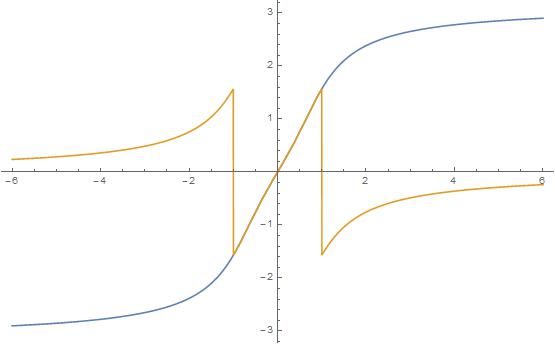
for some integer n that depends on x. The +n\pi is important, as a cursory look reveals that y = \tan^{-1} ( x\sqrt{2} - 1 ) + \tan^{-1}( x \sqrt{2} + 1) and y = \tan^{-1} \left( \displaystyle \frac{x \sqrt{2}}{1 - x^2} \right) have different graphs. (The vertical lines in the orange graph indicate where the right-hand side is undefined when x = 1 or x = -1.

TwoArctangents1

The two graphs coincide when -1 < x < 1 but differ otherwise. However, it appears that the two graphs differ by a constant. Indeed, if I subtract \pi from the orange graph if x < -1 and add \pi to the orange graph if x > 1, then they match:

TwoArctangents2

So, evidently

\tan^{-1} ( x\sqrt{2} - 1 ) + \tan^{-1}( x \sqrt{2} + 1) = \tan^{-1} \left( \displaystyle \frac{x \sqrt{2}}{1 - x^2} \right) -\pi if x < -1,

\tan^{-1} ( x\sqrt{2} - 1 ) + \tan^{-1}( x \sqrt{2} + 1) = \tan^{-1} \left( \displaystyle \frac{x \sqrt{2}}{1 - x^2} \right) if -1 < x < 1,

\tan^{-1} ( x\sqrt{2} - 1 ) + \tan^{-1}( x \sqrt{2} + 1) = \tan^{-1} \left( \displaystyle \frac{x \sqrt{2}}{1 - x^2} \right) + \pi if x> 1.

So as long as x \ne 1 and x \ne -1, this constant -\pi, 0, or \pi can be absorbed into the constant C:

\displaystyle \int \frac{1}{x^4 + 1} dx = \displaystyle \frac{\sqrt{2}}{8} \ln \left(\frac{x^2 + x\sqrt{2} + 1}{x^2 - x\sqrt{2} + 1} \right) + \frac{\sqrt{2}}{4} \tan^{-1} \left( \displaystyle \frac{x \sqrt{2}}{1 - x^2} \right) + C.

However, a picture may be persuasive but is not a proof, and there are some subtle issues with this simplification. I’ll discuss these further details in tomorrow’s post.

The antiderivative of 1/(x^4+1): Part 6

This antiderivative has arguable the highest ratio of “really hard to compute” to “really easy to write”:

\displaystyle \int \frac{1}{x^4 + 1} dx

So far, I’ve shown that the denominator can be factored over the real numbers:

\displaystyle \int \frac{dx}{x^4 + 1} = \displaystyle \int \frac{dx}{\left(x^2 - x \sqrt{2} + 1 \right) \left(x^2 + x \sqrt{2} + 1\right)}

= \displaystyle \int \frac{ -\displaystyle \frac{\sqrt{2}}{4} x + \frac{1}{2}}{ x^2 - x \sqrt{2} + 1 } dx + \int \frac{ \displaystyle \frac{\sqrt{2}}{4} x + \frac{1}{2}}{ x^2 - x \sqrt{2} + 1 } dx

= \displaystyle \frac{\sqrt{2}}{8} \ln \left( \frac{x^2 + x\sqrt{2} + 1}{x^2 - x\sqrt{2} + 1} \right) + \frac{1}{4} \int \frac{ dx }{ x^2 - x \sqrt{2} + 1 } + \frac{1}{4} \int \frac{ dx }{ x^2 + x \sqrt{2} + 1 } dx

To evaluate the remaining two integrals, I’ll use the antiderivative
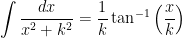
\displaystyle \int \frac{dx}{x^2 + k^2} = \displaystyle \frac{1}{k} \tan^{-1} \left( \frac{x}{k} \right).

To begin, I’ll complete the squares:

\displaystyle \frac{1}{4} \int \frac{ dx }{ x^2 - x \sqrt{2} + 1 } + \frac{1}{4} \int \frac{ dx }{ x^2 + x \sqrt{2} + 1 } dx = \displaystyle \frac{1}{4} \int \frac{ dx }{ x^2 - x \sqrt{2} + \displaystyle \frac{1}{2} + \displaystyle \frac{1}{2} } + \frac{1}{4} \int \frac{ dx }{ x^2 + x \sqrt{2} + \displaystyle \frac{1}{2} + \displaystyle \frac{1}{2} }

= \displaystyle \frac{1}{4} \int \frac{ dx }{ \left(x - \displaystyle \frac{ \sqrt{2}}{2} \right)^2 + \left(\displaystyle \frac{\sqrt{2}}{2} \right)^2 } + \frac{1}{4} \int \frac{ dx }{\left(x + \displaystyle \frac{ \sqrt{2}}{2} \right)^2 + \left(\displaystyle \frac{\sqrt{2}}{2} \right)^2 }

Applying the substitutions u = x - \displaystyle \frac{ \sqrt{2}}{2} and v = x + \displaystyle \frac{ \sqrt{2}}{2}, I can continue:

= \displaystyle \frac{1}{4} \int \frac{ du }{ u^2 + \left(\displaystyle \frac{\sqrt{2}}{2} \right)^2 } + \frac{1}{4} \int \frac{ dv }{v^2 + \left(\displaystyle \frac{\sqrt{2}}{2} \right)^2 }

= \displaystyle \frac{\sqrt{2}}{4} \tan^{-1} \left( \frac{u}{\sqrt{2}/2} \right) + \frac{\sqrt{2}}{4} \tan^{-1} \left( \frac{v }{\sqrt{2}/2} \right) + C

= \displaystyle \frac{\sqrt{2}}{4} \tan^{-1} \left( \frac{x - \displaystyle \frac{ \sqrt{2}}{2}}{\sqrt{2}/2} \right) + \frac{\sqrt{2}}{4} \tan^{-1} \left( \frac{x + \displaystyle \frac{ \sqrt{2}}{2} }{\sqrt{2}/2} \right) + C

= \displaystyle \frac{\sqrt{2}}{4} \tan^{-1} \left( x\sqrt{2} - 1 \right) + \frac{\sqrt{2}}{4} \tan^{-1} \left( x \sqrt{2} + 1 \right) + C

Combining, I finally arrive at the answer for \displaystyle \int \frac{dx}{x^4 + 1}:

\displaystyle \frac{\sqrt{2}}{8} \ln \left(\frac{x^2 + x\sqrt{2} + 1}{x^2 - x\sqrt{2} + 1} \right) + \frac{\sqrt{2}}{4} \tan^{-1} ( x\sqrt{2} - 1 ) + \frac{\sqrt{2}}{4} \tan^{-1}( x \sqrt{2} + 1) + C

 Naturally, this can be checked by differentiation, but I’m not going type that out.