What I Learned from Reading “Gamma: Exploring Euler’s Constant” by Julian Havil: Part 9

When teaching students mathematical induction, the following series (well, at least the first two or three) are used as typical examples:

1 + 2 + 3 + \dots + n = \displaystyle \frac{n(n+1)}{2}

1^2 + 2^2 + 3^2 + \dots + n^2 = \displaystyle \frac{n(n+1)(2n+1)}{6}

1^3 + 2^3 + 3^3 + \dots + n^3 = \displaystyle \frac{n^2(n+1)^2}{4}

1^4 + 2^4 + 3^4 + \dots + n^4 = \displaystyle \frac{n(n+1)(2n+1)(3n^2+3n-1)}{30}

What I didn’t know (Gamma, page 81) is that Johann Faulhaber published the following cute result in 1631 (see also Wikipedia): If k is odd, then

1^k + 2^k + 3^k + \dots + n^k = f_k(n(n+1)),

where f_k is a polynomial. For example, to match the above examples, f_1(x) = x/2 and f_3(x) = x^2/4. Furthermore, if k is even, then

1^k + 2^k + 3^k + \dots + n^k = (2n+1) f_k(n(n+1)),

where again f_k is a polynomial. For example, to match the above examples, f_2(x) = x/6 and f_3(x) = x(3x-1)/30.

green line

When I researching for my series of posts on conditional convergence, especially examples related to the constant \gamma, the reference Gamma: Exploring Euler’s Constant by Julian Havil kept popping up. Finally, I decided to splurge for the book, expecting a decent popular account of this number. After all, I’m a professional mathematician, and I took a graduate level class in analytic number theory. In short, I don’t expect to learn a whole lot when reading a popular science book other than perhaps some new pedagogical insights.

Boy, was I wrong. As I turned every page, it seemed I hit a new factoid that I had not known before.

In this series, I’d like to compile some of my favorites — while giving the book a very high recommendation.

What I Learned from Reading “Gamma: Exploring Euler’s Constant” by Julian Havil: Part 8

I had always wondered how the constant \gamma can be computed to high precision. I probably should have known this already, but here’s one way that it can be computed (Gamma, page 89):

\gamma = \displaystyle \sum_{k=1}^n \frac{1}{k} - \ln n - \sum_{k=1}^{\infty} \frac{B_{2k}}{2k \cdot n^{2k}},

where B_{2k} is the 2kth Bernoulli number.


green line

When I researching for my series of posts on conditional convergence, especially examples related to the constant \gamma, the reference Gamma: Exploring Euler’s Constant by Julian Havil kept popping up. Finally, I decided to splurge for the book, expecting a decent popular account of this number. After all, I’m a professional mathematician, and I took a graduate level class in analytic number theory. In short, I don’t expect to learn a whole lot when reading a popular science book other than perhaps some new pedagogical insights.

Boy, was I wrong. As I turned every page, it seemed I hit a new factoid that I had not known before.

In this series, I’d like to compile some of my favorites — while giving the book a very high recommendation.

What I Learned from Reading “Gamma: Exploring Euler’s Constant” by Julian Havil: Part 7

Suppose that two positive integers are chosen at random. What is the probability that they are relatively prime (that is, have no common factors except 1)?

The answer is exactly what you’d expect it be (Gamma, p. 68): 6/\pi^2, or about 60.8%.

Yes, that was a joke.

Indeed, if k positive integers are random, the probability that they are relatively prime is 1/\zeta(k), where Riemann’s zeta function arises once again.

Even more, the probability that k random positive integers lack a nth power common divisor is 1/\zeta(nk).

I’ll refer the interested reader to Gamma and also to Mathworld (and references therein) for more details.


green line

When I researching for my series of posts on conditional convergence, especially examples related to the constant \gamma, the reference Gamma: Exploring Euler’s Constant by Julian Havil kept popping up. Finally, I decided to splurge for the book, expecting a decent popular account of this number. After all, I’m a professional mathematician, and I took a graduate level class in analytic number theory. In short, I don’t expect to learn a whole lot when reading a popular science book other than perhaps some new pedagogical insights.

Boy, was I wrong. As I turned every page, it seemed I hit a new factoid that I had not known before.

In this series, I’d like to compile some of my favorites — while giving the book a very high recommendation.

What I Learned from Reading “Gamma: Exploring Euler’s Constant” by Julian Havil: Part 6

As noted in Gamma (page 65), mathematician meant astrologer in context. Still, what a terrific quote.

green line

When I researching for my series of posts on conditional convergence, especially examples related to the constant \gamma, the reference Gamma: Exploring Euler’s Constant by Julian Havil kept popping up. Finally, I decided to splurge for the book, expecting a decent popular account of this number. After all, I’m a professional mathematician, and I took a graduate level class in analytic number theory. In short, I don’t expect to learn a whole lot when reading a popular science book other than perhaps some new pedagogical insights.

Boy, was I wrong. As I turned every page, it seemed I hit a new factoid that I had not known before.

In this series, I’d like to compile some of my favorites — while giving the book a very high recommendation.

What I Learned from Reading “Gamma: Exploring Euler’s Constant” by Julian Havil: Part 5

Check out this lovely integral, dubbed the Sophomore’s Dream, found by Johann Bernoulli in 1697 (Gamma, page 44):

\displaystyle \int_0^1 \frac{dx}{x^x} = \displaystyle \frac{1}{1^1} + \frac{1}{2^2} + \frac{1}{3^3} + \frac{1}{4^4} + \dots.

I’ll refer to either Wikipedia or Mathworld for the derivation.

green line

When I researching for my series of posts on conditional convergence, especially examples related to the constant \gamma, the reference Gamma: Exploring Euler’s Constant by Julian Havil kept popping up. Finally, I decided to splurge for the book, expecting a decent popular account of this number. After all, I’m a professional mathematician, and I took a graduate level class in analytic number theory. In short, I don’t expect to learn a whole lot when reading a popular science book other than perhaps some new pedagogical insights.

Boy, was I wrong. As I turned every page, it seemed I hit a new factoid that I had not known before.

In this series, I’d like to compile some of my favorites — while giving the book a very high recommendation.

What I Learned from Reading “Gamma: Exploring Euler’s Constant” by Julian Havil: Part 4

For s > 1, Riemann’s famous zeta function is defined by

\zeta(s) = \displaystyle \sum_{n=1}^{\infty} \frac{1}{n^s}.

This is also called a p-series in calculus.

What I didn’t know (Gamma, page 41) is that, in 1748, Leonhard Euler exactly computed this infinite series for s = 26 without a calculator! Here’s the answer:

\displaystyle 1 + \frac{1}{2^{26}} + \frac{1}{3^{26}} + \frac{1}{4^{26}} + \dots = \frac{1,315,862 \pi^{26}}{11,094,481,976,030,578,125}.

I knew that Euler was an amazing human calculator, but I didn’t know he was that amazing.

green line

When I researching for my series of posts on conditional convergence, especially examples related to the constant \gamma, the reference Gamma: Exploring Euler’s Constant by Julian Havil kept popping up. Finally, I decided to splurge for the book, expecting a decent popular account of this number. After all, I’m a professional mathematician, and I took a graduate level class in analytic number theory. In short, I don’t expect to learn a whole lot when reading a popular science book other than perhaps some new pedagogical insights.

Boy, was I wrong. As I turned every page, it seemed I hit a new factoid that I had not known before.

In this series, I’d like to compile some of my favorites — while giving the book a very high recommendation.

What I Learned from Reading “Gamma: Exploring Euler’s Constant” by Julian Havil: Part 3

At the time of this writing, it is unknown if there are infinitely many twin primes, which are prime numbers that differ by 2 (like 3 and 5, 5 and 7, 11 and 13, 17 and 19, etc.) However, significant progress has been made in recent years. However, it is known (Gamma, page 30) the sum of the reciprocals of the twin primes converges:

\displaystyle \left( \frac{1}{3} + \frac{1}{5} \right) + \left( \frac{1}{5} + \frac{1}{7} \right) + \left( \frac{1}{11} + \frac{1}{13} \right) + \left( \frac{1}{17} + \frac{1}{19} \right) = 1.9021605824\dots.

This constant is known as Brun’s constant (see also Mathworld). In the process of computing this number, the infamous 1994 Pentium bug was found.

Although this sum is finite, it’s still unknown if there are infinitely many twin primes since it’s possible for an infinite sum to converge (like a geometric series).

green line

When I researching for my series of posts on conditional convergence, especially examples related to the constant \gamma, the reference Gamma: Exploring Euler’s Constant by Julian Havil kept popping up. Finally, I decided to splurge for the book, expecting a decent popular account of this number. After all, I’m a professional mathematician, and I took a graduate level class in analytic number theory. In short, I don’t expect to learn a whole lot when reading a popular science book other than perhaps some new pedagogical insights.

Boy, was I wrong. As I turned every page, it seemed I hit a new factoid that I had not known before.

In this series, I’d like to compile some of my favorites — while giving the book a very high recommendation.

What I Learned from Reading “Gamma: Exploring Euler’s Constant” by Julian Havil: Part 2

Let’s define partial sums of the harmonic series as follows:

H(m,n) = \displaystyle \frac{1}{m} + \frac{1}{m+1} + \frac{1}{m+2} + \dots + \frac{1}{n-1} + \frac{1}{n},

where m < n are positive integers. Here are a couple of facts that I didn’t know before reading Gamma (pages 24-25):

  • H(m,n) is never equal to an integer.
  • The only values of n for which H(1,n) is an integer are n = 2 and n=6.

green line

When I researching for my series of posts on conditional convergence, especially examples related to the constant \gamma, the reference Gamma: Exploring Euler’s Constant by Julian Havil kept popping up. Finally, I decided to splurge for the book, expecting a decent popular account of this number. After all, I’m a professional mathematician, and I took a graduate level class in analytic number theory. In short, I don’t expect to learn a whole lot when reading a popular science book other than perhaps some new pedagogical insights.

Boy, was I wrong. As I turned every page, it seemed I hit a new factoid that I had not known before.

In this series, I’d like to compile some of my favorites — while giving the book a very high recommendation.

What I Learned from Reading “Gamma: Exploring Euler’s Constant” by Julian Havil: Part 1

When I researching for my series of posts on conditional convergence, especially examples related to the constant \gamma, the reference Gamma: Exploring Euler’s Constant by Julian Havil kept popping up. Finally, I decided to splurge for the book, expecting a decent popular account of this number. After all, I’m a professional mathematician, and I took a graduate level class in analytic number theory. In short, I don’t expect to learn a whole lot when reading a popular science book other than perhaps some new pedagogical insights.

Boy, was I wrong. As I turned every page, it seemed I hit a new factoid that I had not known before.

In this series, I’d like to compile some of my favorites — while giving the book a very high recommendation.

green lineIt is well known the harmonic series diverges:

\displaystyle 1 + \frac{1}{2} + \frac{1}{3} + \frac{1}{4} + \dots = \infty.

This means that, no matter what number N you choose, I can find a number n so that

\displaystyle 1 + \frac{1}{2} + \frac{1}{3} + \frac{1}{4} + \dots + \frac{1}{n} > N.

What I didn’t know (p. 23 of Gamma) is that, in 1968, somebody actually figured out the precise number of terms that are needed for the sum on the left hand side to exceed 100. Here’s the answer:

15,092,688,622,113,788,323,693,563,264,538,101,449,859,497.

With one fewer term, the sum is a little less than 100.

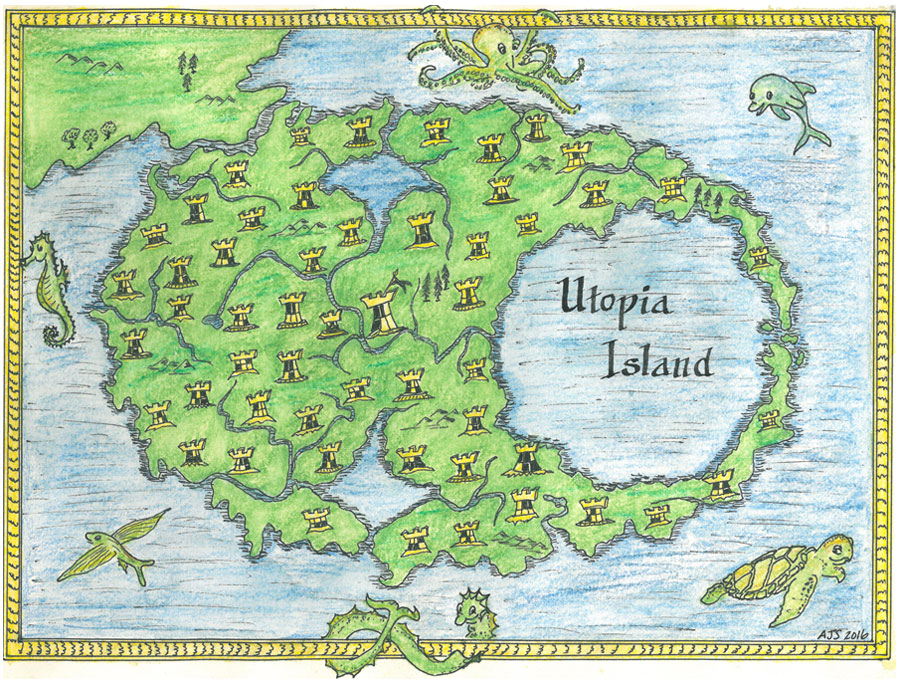
Math Maps The Island of Utopia

Under the category of “Somebody Had To Figure It Out,” Dr. Andrew Simoson of King University (Bristol, Tennessee) used calculus to determine the shape of the island of Utopia in the 500-year-old book by Sir Thomas More based on the description of island given in the book’s introduction.

News article: https://www.insidescience.org/news/math-maps-island-thomas-mores-utopia

Paper by Dr. Simoson: http://archive.bridgesmathart.org/2016/bridges2016-65.html