The following problem appeared in Volume 97, Issue 3 (2024) of Mathematics Magazine.
Two points and are chosen at random (uniformly) from the interior of a unit circle. What is the probability that the circle whose diameter is segment lies entirely in the interior of the unit circle?
As discussed in the previous post, I guessed from simulation that the answer is . Naturally, simulation is not a proof, and so I started thinking about how to prove this.
My first thought was to make the problem simpler by letting only one point be chosen at random instead of two. Suppose that the point is fixed at a distance from the origin. What is the probability that the point , chosen at random, uniformly, from the interior of the unit circle, has the desired property?
My second thought is that, by radial symmetry, I could rotate the figure so that the point is located at . In this way, the probability in question is ultimately going to be a function of .
There is a very nice way to compute such probabilities since is chosen at uniformly from the unit circle. Let be the probability that the point has the desired property. Since the area of the unit circle is , the probability of desired property happening is
.
So, if I could figure out the shape of , I could compute this conditional probability given the location of the point .
But, once again, I initially had no idea of what this shape would look like. So, once again, I turned to simulation with Mathematica.
First, a technical detail that I ignored in the previous post. To generate points at random inside the unit circle, one might think to let and , where the distance from the origin is chosen at random between 0 and 1 and the angle is chosen at random from . Unfortunately, this simple simulation generates too many points that are close to the origin and not enough that are close to the circle:
To see why this happened, let denote the distance of a randomly chosen point from the origin. Then the event is the same as saying that the point lies inside the circle centered at the origin with radius , so that the probability of this event should be
.
However, in the above simulation, was chosen uniformly from , so that . All this to say, the above simulation did not produce points uniformly chosen from the unit circle.
To remedy this, we employ the standard technique of using the inverse of the above function , which is clearly . In other words, we will chose randomly chosen radius to have the form , where is chosen uniformly on . In this way,
,
as required. Making this modification (highlighted in yellow) produces points that are more evenly distributed in the unit circle; any bunching of points or empty spaces are simply due to the luck of the draw.
In the next post, I’ll turn to the simulation of .
The following problem appeared in Volume 97, Issue 3 (2024) of Mathematics Magazine.
Two points and are chosen at random (uniformly) from the interior of a unit circle. What is the probability that the circle whose diameter is segment lies entirely in the interior of the unit circle?
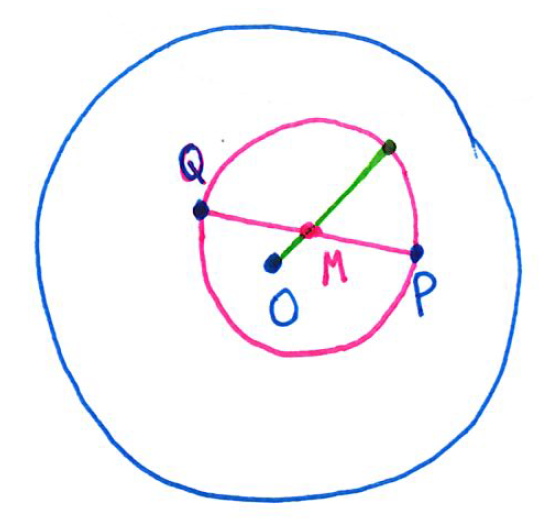
It took me a while to wrap my head around the statement of the problem. In the figure, the points and are chosen from inside the unit circle (blue). Then the circle (pink) with diameter has center , the midpoint of . Also, the radius of the pink circle is .
The pink circle will lie entirely the blue circle exactly when the green line containing the origin , the point , and a radius of the pink circle lies within the blue circle. Said another way, the condition is that the distance plus the radius of the pink circle is less than 1, or
.
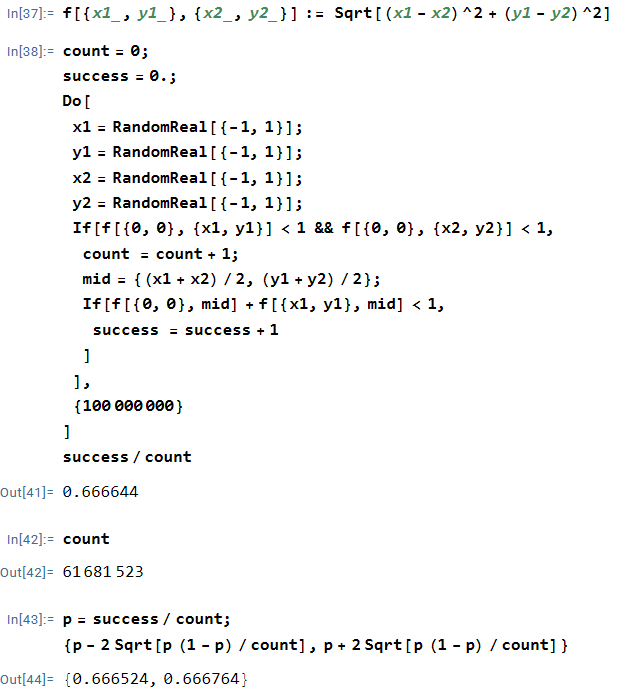
As a first step toward wrapping my head around this problem, I programmed a simple simulation in Mathematica to count the number of times that when points and were chosen at random from the unit circle.
In the above simulation, out of about 61,000,000 attempts, 66.6644% of the attempts were successful. This leads to the natural guess that the true probability is . Indeed, the 95% confidence confidence interval contains , so that the difference of from can be plausibly attributed to chance.
I end with a quick programming note. This certainly isn’t the ideal way to perform the simulation. First, for a fast simulation, I should have programmed in C++ or Python instead of Mathematica. Second, the coordinates of and are chosen from the unit square, so it’s quite possible for or or both to lie outside the unit circle. Indeed, the chance that both and lie in the unit disk in this simulation is , meaning that about of the simulations were simply wasted. So the only sense that this was a quick simulation was that I could type it quickly in Mathematica and then let the computer churn out a result. (I’ll talk about a better way to perform the simulation in the next post.)
The following problem appeared in Volume 96, Issue 3 (2023) of Mathematics Magazine.
Evaluate the following sums in closed form:
and
.
By using the Taylor series expansions of and and flipping the order of a double sum, I was able to show that
.
I immediately got to thinking: there’s nothing particularly special about and for this analysis. Is there a way of generalizing this result to all functions with a Taylor series expansion?
Suppose
,
and let’s use the same technique to evaluate
.
To see why this matches our above results, let’s start with and write out the full Taylor series expansion, including zero coefficients:
,
so that
or
After dropping the zero terms and collecting, we obtain
.
A similar calculation would apply to any even function .
The following problem appeared in Volume 96, Issue 3 (2023) of Mathematics Magazine.
Evaluate the following sums in closed form:
and
.
In the previous two posts, I showed that
;
the technique that I used was using the Taylor series expansions of and to write and as double sums and then interchanging the order of summation.
In the post, I share an alternate way of solving for and . I wish I could take credit for this, but I first learned the idea from my daughter. If we differentiate , we obtain
.
Something similar happens when differentiating the series for ; however, it’s not quite so simple because of the term. I begin by separating the term from the sum, so that a sum from to remains:
.
I then differentiate as before:
.
At this point, we reindex the sum. We make the replacement , so that and varies from to . After the replacement, we then change the dummy index from back to .
With a slight alteration to the term, this sum is exactly the definition of :
.
Summarizing, we have shown that and . Differentiating a second time, we obtain
or
.
This last equation is a second-order nonhomogeneous linear differential equation with constant coefficients. A particular solution, using the method of undetermined coefficients, must have the form . Substituting, we see that
We see that and which then lead to the particular solution
Since and are solutions of the associated homogeneous equation , we conclude that
,
where the values of and depend on the initial conditions on . As it turns out, it is straightforward to compute and , so we will choose for the initial conditions. We observe that and are both clearly equal to 0, so that as well.

and
are chosen at random (uniformly) from the interior of a unit circle. What is the probability that the circle whose diameter is segment
lies entirely in the interior of the unit circle?


![[0,1]](https://s0.wp.com/latex.php?latex=%5B0%2C1%5D&bg=ffffff&fg=000000&s=0&c=20201002)


 , the midpoint of
  .
.  , the point
  plus the radius of the pink circle is less than 1, or
  .
.
 contains
  from
from  , meaning that about
  of the simulations were simply wasted. So the only sense that this was a quick simulation was that I could type it quickly in Mathematica and then let the computer churn out a result. (I’ll talk about a better way to perform the simulation in the next post.)
 .
. and
and  and flipping the order of a double sum, I was able to show that
  .
. ,
,


![= x \displaystyle \left[ (a_0)' + \sum_{k=1}^\infty \left(a_k x^k \right)' \right]](https://s0.wp.com/latex.php?latex=%3D+x+%5Cdisplaystyle+%5Cleft%5B+%28a_0%29%27+%2B++%5Csum_%7Bk%3D1%7D%5E%5Cinfty+%5Cleft%28a_k+x%5Ek+%5Cright%29%27+%5Cright%5D&bg=ffffff&fg=000000&s=0&c=20201002)


 .
.
 and write out the full Taylor series expansion, including zero coefficients:
 ,
,


 .
. .
. ,
,

 ,
,

 .
. ;
; and
and  as double sums and then interchanging the order of summation.
![g'(x) = \displaystyle \sum_{n=0}^\infty \left( [\sin x]' - [x]' + \left[\frac{x^3}{3!}\right]' - \left[\frac{x^5}{5!}\right]' \dots + \left[(-1)^{n-1} \frac{x^{2n+1}}{(2n+1)!}\right]' \right)](https://s0.wp.com/latex.php?latex=g%27%28x%29+%3D+%5Cdisplaystyle+%5Csum_%7Bn%3D0%7D%5E%5Cinfty+%5Cleft%28+%5B%5Csin+x%5D%27+-+%5Bx%5D%27+%2B+%5Cleft%5B%5Cfrac%7Bx%5E3%7D%7B3%21%7D%5Cright%5D%27+-+%5Cleft%5B%5Cfrac%7Bx%5E5%7D%7B5%21%7D%5Cright%5D%27+%5Cdots+%2B+%5Cleft%5B%28-1%29%5E%7Bn-1%7D+%5Cfrac%7Bx%5E%7B2n%2B1%7D%7D%7B%282n%2B1%29%21%7D%5Cright%5D%27+%5Cright%29&bg=ffffff&fg=000000&s=0&c=20201002)


 .
. term. I begin by separating the
  term from the sum, so that a sum from
  to
to  remains:
 .
.![f'(x) = (\cos x - 1)' + \displaystyle \sum_{n=1}^\infty \left( [\cos x - 1]' + \left[ \frac{x^2}{2!} \right]' - \left[ \frac{x^4}{4!} \right]' \dots + \left[ (-1)^{n-1} \frac{x^{2n}}{(2n)!} \right]' \right)](https://s0.wp.com/latex.php?latex=f%27%28x%29+%3D+%28%5Ccos+x+-+1%29%27+%2B+%5Cdisplaystyle+%5Csum_%7Bn%3D1%7D%5E%5Cinfty+%5Cleft%28+%5B%5Ccos+x+-+1%5D%27+%2B+%5Cleft%5B+%5Cfrac%7Bx%5E2%7D%7B2%21%7D+%5Cright%5D%27+-+%5Cleft%5B+%5Cfrac%7Bx%5E4%7D%7B4%21%7D+%5Cright%5D%27+%5Cdots+%2B+%5Cleft%5B+%28-1%29%5E%7Bn-1%7D+%5Cfrac%7Bx%5E%7B2n%7D%7D%7B%282n%29%21%7D+%5Cright%5D%27+%5Cright%29&bg=ffffff&fg=000000&s=0&c=20201002)


 .
. , so that
  and
and  varies from
  to
to  .
.


 term, this sum is exactly the definition of

 .
. and
and  . Differentiating
  a second time, we obtain
 .
. . Substituting, we see that
![[Ax \cos x + B x \sin x]'' + A x \cos x + Bx \sin x = -\cos x](https://s0.wp.com/latex.php?latex=%5BAx+%5Ccos+x+%2B+B+x+%5Csin+x%5D%27%27+%2B+A+x+%5Ccos+x+%2B+Bx+%5Csin+x+%3D+-%5Ccos+x&bg=ffffff&fg=000000&s=0&c=20201002)


 and
and  which then lead to the particular solution
 , we conclude that
 ,
, and
and  depend on the initial conditions on
  . As it turns out, it is straightforward to compute
  and
and  , so we will choose
  for the initial conditions. We observe that
  are both clearly equal to 0, so that
  as well.
  clearly imples that
  :
:


 .
. , we conclude that
  , and so

 .
. Mean Green Math