
In this series, I’m discussing how ideas from calculus and precalculus (with a touch of differential equations) can predict the precession in Mercury’s orbit and thus confirm Einstein’s theory of general relativity. The origins of this series came from a class project that I assigned to my Differential Equations students maybe 20 years ago.
In this series, we found an approximate solution to the governing initial-value problem
![u''(\theta) + u(\theta) = \displaystyle \frac{1}{\alpha} + \delta [u(\theta)]^2](https://s0.wp.com/latex.php?latex=u%27%27%28%5Ctheta%29+%2B+u%28%5Ctheta%29+%3D+%5Cdisplaystyle+%5Cfrac%7B1%7D%7B%5Calpha%7D+%2B+%5Cdelta+%5Bu%28%5Ctheta%29%5D%5E2&bg=ffffff&fg=000000&s=0&c=20201002)


where 


We used the following steps to find an approximate solution.
Step 0. Ignore the general-relativity contribution and solve the simpler initial-value problem


which is a zeroth-order approximation to the real initial-value problem. We found that the solution of this differential equation is
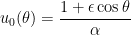
which is the equation of an ellipse in polar coordinates.
Step 1. Solve the initial-value problem
![u_1''(\theta) + u_1(\theta) = \displaystyle \frac{1}{\alpha} + \delta [u_0(\theta)]^2](https://s0.wp.com/latex.php?latex=u_1%27%27%28%5Ctheta%29+%2B+u_1%28%5Ctheta%29+%3D+%5Cdisplaystyle+%5Cfrac%7B1%7D%7B%5Calpha%7D+%2B+%5Cdelta+%5Bu_0%28%5Ctheta%29%5D%5E2&bg=ffffff&fg=000000&s=0&c=20201002)


which partially incorporates the term due to general relativity. This is a first-order approximation to the real differential equation. After much effort, we found that the solution of this initial-value problem is

For large values of 

which can be further approximated as
![u_1(\theta) \approx \displaystyle \frac{1}{\alpha} \left[ 1 + \epsilon \cos \left( \theta - \frac{\delta \theta}{\alpha} \right) \right]](https://s0.wp.com/latex.php?latex=u_1%28%5Ctheta%29+%5Capprox+%5Cdisplaystyle+%5Cfrac%7B1%7D%7B%5Calpha%7D+%5Cleft%5B+1+%2B+%5Cepsilon+%5Ccos+%5Cleft%28+%5Ctheta+-+%5Cfrac%7B%5Cdelta+%5Ctheta%7D%7B%5Calpha%7D+%5Cright%29+%5Cright%5D&bg=ffffff&fg=000000&s=0&c=20201002)
From this expression, the precession in a planet’s orbit due to general relativity can be calculated.

Roughly 20 years ago, I presented this application of differential equations at the annual meeting of the Texas Section of the Mathematical Association of America. After the talk, a member of the audience asked what would happen if we did this procedure yet again to find a second-order approximation. In other words, I was asked to consider…
Step 2. Solve the initial-value problem
![u_2''(\theta) + u_2(\theta) = \displaystyle \frac{1}{\alpha} + \delta [u_1(\theta)]^2](https://s0.wp.com/latex.php?latex=u_2%27%27%28%5Ctheta%29+%2B+u_2%28%5Ctheta%29+%3D+%5Cdisplaystyle+%5Cfrac%7B1%7D%7B%5Calpha%7D+%2B+%5Cdelta+%5Bu_1%28%5Ctheta%29%5D%5E2&bg=ffffff&fg=000000&s=0&c=20201002)


It stands to reason that the answer should be an even more accurate approximation to the true solution 
I didn’t have an immediate answer for this question, but I can answer it now. Letting Mathematica do the work, here’s the answer:

Yes, it’s a mess. The term in red is 


The term in green is the next largest term in 

How does this compare to our previous approximation of
![u(\theta) \approx \displaystyle \frac{1}{\alpha} \left[ 1 + \epsilon \cos \left( \theta - \frac{\delta \theta}{\alpha} \right) \right]](https://s0.wp.com/latex.php?latex=u%28%5Ctheta%29+%5Capprox+%5Cdisplaystyle+%5Cfrac%7B1%7D%7B%5Calpha%7D+%5Cleft%5B+1+%2B+%5Cepsilon+%5Ccos+%5Cleft%28+%5Ctheta+-+%5Cfrac%7B%5Cdelta+%5Ctheta%7D%7B%5Calpha%7D+%5Cright%29+%5Cright%5D&bg=ffffff&fg=000000&s=0&c=20201002)
Well, to a second-order Taylor approximation, it’s the same! Let
![f(x) = \displaystyle \frac{1}{\alpha} \left[ 1 + \epsilon \cos \left( \theta - x \right) \right]](https://s0.wp.com/latex.php?latex=f%28x%29+%3D+%5Cdisplaystyle+%5Cfrac%7B1%7D%7B%5Calpha%7D+%5Cleft%5B+1+%2B+%5Cepsilon+%5Ccos+%5Cleft%28+%5Ctheta+-+x+%5Cright%29+%5Cright%5D&bg=ffffff&fg=000000&s=0&c=20201002)
Expanding about 
![f(x) \approx f(0) + f'(0) x + \displaystyle \frac{f''(0)}{2} x^2 = \displaystyle \frac{1}{\alpha} \left[ 1 + \epsilon \cos \left( \theta\right) \right] + \frac{\epsilon}{\alpha} x \sin \theta - \frac{\epsilon}{2\alpha} x^2 \cos \theta](https://s0.wp.com/latex.php?latex=f%28x%29+%5Capprox+f%280%29+%2B+f%27%280%29+x+%2B+%5Cdisplaystyle+%5Cfrac%7Bf%27%27%280%29%7D%7B2%7D+x%5E2+%3D+%5Cdisplaystyle+%5Cfrac%7B1%7D%7B%5Calpha%7D+%5Cleft%5B+1+%2B+%5Cepsilon+%5Ccos+%5Cleft%28+%5Ctheta%5Cright%29+%5Cright%5D+%2B+%5Cfrac%7B%5Cepsilon%7D%7B%5Calpha%7D+x+%5Csin+%5Ctheta+-+%5Cfrac%7B%5Cepsilon%7D%7B2%5Calpha%7D+x%5E2+%5Ccos+%5Ctheta&bg=ffffff&fg=000000&s=0&c=20201002)
Substituting 
Said another way, proceeding to a second-order approximation merely provides additional confirmation for the precession of a planet’s orbit.
Just for the fun of it, I also used Mathematica to find the solution of Step 3:
Step 2. Solve the initial-value problem
![u_3''(\theta) + u_3(\theta) = \displaystyle \frac{1}{\alpha} + \delta [u_2(\theta)]^2](https://s0.wp.com/latex.php?latex=u_3%27%27%28%5Ctheta%29+%2B+u_3%28%5Ctheta%29+%3D+%5Cdisplaystyle+%5Cfrac%7B1%7D%7B%5Calpha%7D+%2B+%5Cdelta+%5Bu_2%28%5Ctheta%29%5D%5E2&bg=ffffff&fg=000000&s=0&c=20201002)


I won’t copy-and-paste the solution from Mathematica; unsurpisingly, it’s really long. I will say that, unsurprisingly, the leading terms are

I said “unsurprisingly” because this matches the third-order Taylor polynomial of our precession expression. I don’t have time to attempt it, but surely there’s a theorem to be proven here based on this computational evidence.
 Mean Green Math
One thought on “Confirming Einstein’s Theory of General Relativity With Calculus, Part 8: Second- and Third-Order Approximations”