Confirming Einstein’s Theory of General Relativity With Calculus, Part 6e: Rationale for Method of Undetermined Coefficients II

In this series, I’m discussing how ideas from calculus and precalculus (with a touch of differential equations) can predict the precession in Mercury’s orbit and thus confirm Einstein’s theory of general relativity. The origins of this series came from a class project that I assigned to my Differential Equations students maybe 20 years ago.

We have shown that the motion of a planet around the Sun, expressed in polar coordinates (r,\theta) with the Sun at the origin, under general relativity follows the initial-value problem

u''(\theta) + u(\theta) = \displaystyle \frac{1}{\alpha} + \frac{\delta}{\alpha^2} + \frac{\delta \epsilon^2}{2\alpha^2} + \frac{2\delta \epsilon \cos \theta}{\alpha^2} + \frac{\delta \epsilon^2 \cos 2\theta}{2\alpha^2},

u(0) = \displaystyle \frac{1}{P},

u'(0) = 0,

where u = \displaystyle \frac{1}{r}, \displaystyle \frac{1}{\alpha} = \frac{GMm^2}{\ell^2}, \delta = \displaystyle \frac{3GM}{c^2}, G is the gravitational constant of the universe, m is the mass of the planet, M is the mass of the Sun, \ell is the constant angular momentum of the planet, c is the speed of light, and P is the smallest distance of the planet from the Sun during its orbit (i.e., at perihelion).

In the previous post, we derived the method of undetermined coefficients for the simplified differential equation

u''(\theta) + u(\theta) = \displaystyle \frac{1}{\alpha} + \frac{\delta}{\alpha^2} + \frac{\delta \epsilon^2}{2\alpha^2}.

In this post, we consider the simplified differential equation if the right-hand side has only the fourth term,
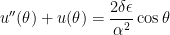
u''(\theta) + u(\theta) =  \displaystyle \frac{2\delta \epsilon }{\alpha^2}\cos \theta.

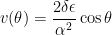
Let v(\theta) =  \displaystyle \frac{2\delta \epsilon }{\alpha^2}\cos \theta. Then v satisfies the new differential equation v'' + v = 0. Since u'' + u = v, we may substitute:

(u''+u)'' + (u'' + u) = 0

u^{(4)} + u'' + u'' + u = 0

u^{(4)} + 2u'' + u = 0.

The characteristic equation of this homogeneous differential equation is r^4 + 2r^2 + 1 = 0, or (r^2+1)^2 = 0. Therefore, r = i and r = -i are both double roots of this quartic equation. Therefore, the general solution for u is

u(\theta) = c_1 \cos \theta + c_2 \sin \theta + c_3 \theta \cos \theta + c_4 \theta \sin \theta.

Substituting into the original differential equation will allow for the computation of c_3 and c_4:

u''(\theta) + u(\theta) = -c_1 \cos \theta - c_2 \sin \theta - 2c_3 \sin \theta - c_3 \theta \cos \theta + 2c_4 \cos \theta - c_4 \theta \sin \theta

+   c_1 \cos \theta + c_2 \sin \theta + c_3 \theta \cos \theta + c_4 \theta \sin \theta

\displaystyle \frac{2\delta \epsilon }{\alpha^2}\cos \theta = - 2c_3 \sin \theta+ 2c_4 \cos \theta

Matching coefficients, we see that c_3 = 0 and c_4 = \displaystyle \frac{\delta \epsilon }{\alpha^2}. Therefore,

u(\theta) = c_1 \cos \theta + c_2 \sin \theta + \displaystyle \frac{\delta \epsilon }{\alpha^2} \theta \sin \theta

is the general solution of the simplified differential equation. Setting c_1 = c_2 = 0, we find that

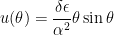
u(\theta) =  \displaystyle \frac{\delta \epsilon }{\alpha^2} \theta \sin \theta

is one particular solution of this simplified differential equation. Not surprisingly, this matches the result is the method of undetermined coefficients had been blindly followed.

As we’ll see in a future post, the presence of this \theta \sin \theta term is what predicts the precession of a planet’s orbit under general relativity.

One thought on “Confirming Einstein’s Theory of General Relativity With Calculus, Part 6e: Rationale for Method of Undetermined Coefficients II

Leave a comment

This site uses Akismet to reduce spam. Learn how your comment data is processed.