
In this series, I’m discussing how ideas from calculus and precalculus (with a touch of differential equations) can predict the precession in Mercury’s orbit and thus confirm Einstein’s theory of general relativity. The origins of this series came from a class project that I assigned to my Differential Equations students maybe 20 years ago.
In a previous post, we showed that the polar equation

is equivalent to the rectangular equation
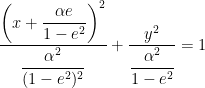
as long as 


While not directly related to our discussion of precession, it turns out that this equation represents a hyperbola if 


This matches the form of a left-right hyperbola
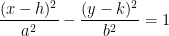
where the center of the hyperbola is located at

Also, for a hyperbola, the distance 

so that
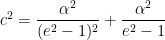
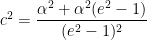


The two foci are located a distance 
Furthermore, the eccentricity 
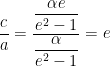
so that, once again, the well-chosen parameter
 Mean Green Math
One thought on “Confirming Einstein’s Theory of General Relativity With Calculus, Part 2d: Hyperbolas and Polar Coordinates”