
I really enjoyed this Prezi timeline showing a 200-year history of mathematics eduction: https://prezi.com/v_buakpkvs5v/history-of-math-education-a-timeline/
H/T: https://nebusresearch.wordpress.com/2015/11/30/a-timeline-of-mathematics-education/
I really enjoyed this Prezi timeline showing a 200-year history of mathematics eduction: https://prezi.com/v_buakpkvs5v/history-of-math-education-a-timeline/
H/T: https://nebusresearch.wordpress.com/2015/11/30/a-timeline-of-mathematics-education/
In my capstone class for future secondary math teachers, I ask my students to come up with ideas for engaging their students with different topics in the secondary mathematics curriculum. In other words, the point of the assignment was not to devise a full-blown lesson plan on this topic. Instead, I asked my students to think about three different ways of getting their students interested in the topic in the first place.
I plan to share some of the best of these ideas on this blog (after asking my students’ permission, of course).
This student submission again comes from my former student Irene Ogeto. Her topic, from Algebra: graphing parabolas.

B2. How does this topic extend what your students should have learned in previous courses?
In previous courses, students should have learned about linear functions of the form y = mx + b. Parabolas are functions of the form y = a(x-h) + k. Graphing parabolas extends their thinking because it allows to students to see the graph of a function that is different from the graph of a line. Students can explore the similarities and differences between linear functions and quadratic functions. Students can apply the same logic they used when graphing linear functions by making a table and use the points to plot the graph. Students can use the graph of parabolas to determine the equation of the quadratic function. Students can apply transformations of graphs such as reflecting, stretching or compressing to parabolic functions as well. Graphing parabolas allows students to explore concepts they previously learned such as parent functions, y-intercepts, x-intercepts, and symmetry.
C2. How has this topic appeared in high culture (art, classical music, theatre, etc.)?
Parabolic curves are all around us in buildings, churches, restaurants, homes, schools and other places. Parabolas are apparent in numerous places in architecture. One example where parabolic curves can be found in architecture is in suspension bridges such as the Brooklyn Bridge in New York, the Golden Gate Bridge in California, or the George Washington Bridge in New Jersey. Suspension bridges are mainly used to carry loads over a long distance and most suspension bridges are lengthy in distance. In suspension bridges, cables, ropes or chains are suspended throughout the road. The cables under tension form the parabolic curve. The towers and hangers are used to support the cables throughout the bridge. Seeing how parabolas appear in high culture will allow students to make a connection between math and the things that may see around them. Hopefully the students can see that math, specifically parabolas in this case are not only found in the classroom.


E1. How can technology (YouTube, Khan Academy [khanacademy.org], VI Hart, Geometers Sketchpad, graphing calculators, etc.) be used to effectively engage students with this topic?
This YouTube video, “Water Slide Stunt,” is a great way to introduce students to graphing parabolas. It allows students to see the curve that parabolic functions make. In addition, it gives students an example of a real-world situation where projectile motion and parabolic functions can be seen. This video can be used at the beginning of a lesson on graphing parabolas. This video is engaging because it gets the students thinking about projectile motion and it shows how math can be related to different things in our society. In addition, students can also look up this video on YouTube on their own time and share with others.
References:
https://www.youtube.com/watch?v=3wAjpMP5eyo
http://science.howstuffworks.com/engineering/civil/bridge6.htm
I really enjoyed reading a recent article on Math With Bad Drawings centered on solving the following problem without a calculator:

I won’t repeat the whole post here, but it’s an excellent exercise in numeracy, or developing intuitive understanding of numbers without necessarily doing a ton of computations. It’s also a fun exercise to see how much we can figure out without resorting to plugging into a calculator. I highly recommend reading it.
When I saw this problem, my first reflex wasn’t the technique used in the post. Instead, I thought to try the logic that follows. I don’t claim that this is a better way of solving the problem than the original solution linked above. But I do think that this alternative solution, in its own way, also encourages numeracy as well as what we can quickly determine without using a calculator.
Let’s get a common denominator for the two fractions:


Since the denominators are the same, there is no need to actually compute 


We can figure out which one is bigger without a calculator — or even directly figuring out each product.
 , so we can ignore this common term in both expressions.
 and
and  are both equal to
  , and so we can ignore the middle two terms of both expressions.
 on the top line and a
  on the bottom line.
Therefore, the first numerator is the larger one, and so 
Once again, I really like the original question as a creative question that initially looks intractable that is nevertheless within the grasp of middle-school students. Also, I reiterate that I don’t claim that the above is a superior method, as I really like the method suggested in the original post. Instead, I humbly offer this alternate solution that encourages the development of numeracy.
In my capstone class for future secondary math teachers, I ask my students to come up with ideas for engaging their students with different topics in the secondary mathematics curriculum. In other words, the point of the assignment was not to devise a full-blown lesson plan on this topic. Instead, I asked my students to think about three different ways of getting their students interested in the topic in the first place.
I plan to share some of the best of these ideas on this blog (after asking my students’ permission, of course).
This student submission again comes from my former student Tiffany Jones. Her topic, from Algebra: using the point-slope equation of a line.
B1. How can this topic be used in your students’ future courses in mathematics or science?
The topic of using the point-slope equation of a line comes up in some of the early topics of Calculus 1 such as, how to find the equation of the tangent line of a curve at a given point. The slope, , of the tangent line of a curve at a given point, , is equal to the instantaneous rate of change or slope of the curve at that given point. The slope is calculated by evaluating the following limit:
If the difference quotient has a limit as h approaches zero, then that limit is called the derivative of the function at . Then, values of and are substituted into the point-slope equation of a line to determine the equation of the tangent line of a curve at a given point.
C1. How has this topic appeared in pop culture?
On December 31st 1965, Chuck Jones’ released an animated short titled “The Dot and The Line: A Romance in Low Mathematics”. This ten minute, Oscar-winning film explores the complex relationship between lines, dots, and disorganization. The Line as desperately in love with the Dot. Yet, the Dot is currently involved with a chaotic Squiggle. The Dot ignores the Line, disregarding him as boring and predictable. He lacks complexity. Through a montage following this rejection, the line teaches himself to create angles, form curves, and produce close-ended shapes as well. With this new confidence, he then reveals his newfound self to the Dot. The Dot sees that there is no method to the Squiggles madness.
While the topic of using the point slope equation of a line is not an explicit topic of the short, I feel that this video as an engage activity can be great conversation starter about the relationship between a point and a line. From there the lesson can go on to talk about the point-slope equation. Furthermore, this video can open discussions about the slope-intercept and the point-point forms of a line.
E1. How can technology be used to effectively engage students with this topic?
Explore Learning offers a Gizmo and worksheet on the point-slope form of a line. The Gizmo is an interactive simulator that allows the student to physically move the point around the Cartesian plane or use the sliders to adjust the point values and the slope value. The Gizmo shows the resulting line. I think that the use of such a tool can reinforce the relationship of a particular slope and a particular point to give an equation of a line.
The Gizmo offers to the slope-intercept form of the equation. So this simulator can also be used for a lesson on the slope-intercept form. Also, the Gizmo can place a right triangle along the line with leg lengths to show how the rise and run values change with the overall slope value.
Additionally, I think that this simulator can be used to allow the students to explore the equation. For instance, the students can see why when the graph is shifted to the left 2 units, the resulting equation has (x+2).
References:
http://www.imdb.com/title/tt0059122/?ref_=ttawd_awd_tt
https://www.youtube.com/watch?v=OmSbdvzbOzY
https://www.explorelearning.com/index.cfm?ResourceID=16*4&method=cResource.dspDetail
https://s3.amazonaws.com/el-gizmos/materials/PointSlopeSE.pdf
In my capstone class for future secondary math teachers, I ask my students to come up with ideas for engaging their students with different topics in the secondary mathematics curriculum. In other words, the point of the assignment was not to devise a full-blown lesson plan on this topic. Instead, I asked my students to think about three different ways of getting their students interested in the topic in the first place.
I plan to share some of the best of these ideas on this blog (after asking my students’ permission, of course).
This student submission again comes from my former student Perla Perez. Her topic, from Algebra: multiplying binomials.
B1. How can this topic be used in your students’ future courses in mathematics or science?
As students progress through different levels of math, they will continue to utilize tools, such as multiplication of binomials. When I give students the solutions to a quadratic function and ask them to find the equation, I expect for them to know how to multiply the binomials. For example: find the quadratic equation with the solution x=-2,2. The students are to set up as: (x+2)(x-2) and go forth. The students can also be given a quadratic equation, x2+6x+8 and are to find the solutions in representation (x+2)(x+4). In order to arrive at the answer, the students will have to factor the original equation. To check their work, they can just multiply the answer that they get. Multiplying the binomials is a more complex form of the distributive property. It’s a building block for more challenging math concepts. Multiplying binomials essentially does the opposite of factorization, which students will learn later on in their algebra class. Binomials are also used in sciences, such as physics, biology, and computer science, so it helps for students to have a strong foundation on this topic.
B2. How does this topic extend what your students should have learned in previous courses?
I’ve seen students panic when a new concept, equation, or definition is introduce. Before they begin thinking again that math is some sort of sorcery, showing them something familiar will help ease the students into a new topic that is an extension of what they previously learned. Students learn about distributive property in their pre-algebra course. In order for students to multiply binomials students need to understand distributive property. Distributive property is a building block that is needed for the multiplication of binomials. It works with singles terms being multiplied, where as binomial multiplication works with two. In a way it is like learning how to add single digits to double digits. In order to teach this, I would first reintroduce 4-5 problems they’ve seen in their previous class using distributive property with single terms such as 4(x+5). Once they begin to recognize and solve the problems, I will begin to introduce two terms rather than just one. When they compare their previous knowledge to this new idea they will see that it is not very different.
A1. What interesting (i.e., uncontrived) word problems using this topic can your students do now? (You may find resources such as http://www.spacemath.nasa.gov to be very helpful in this regard; feel free to suggest others.)
Students often find it difficult to understand why we use certain tools, such as the multiplication of binomials. Word problems are a good solution when introducing a new topic. There are many methods for multiplying binomials, such as the FOIL and the CLAW methods, and it is important that student learn them; however, students who struggle with the topic need new information to be presented in a different way. The website mathisfun.com has a great word problem for multiplying binomials.
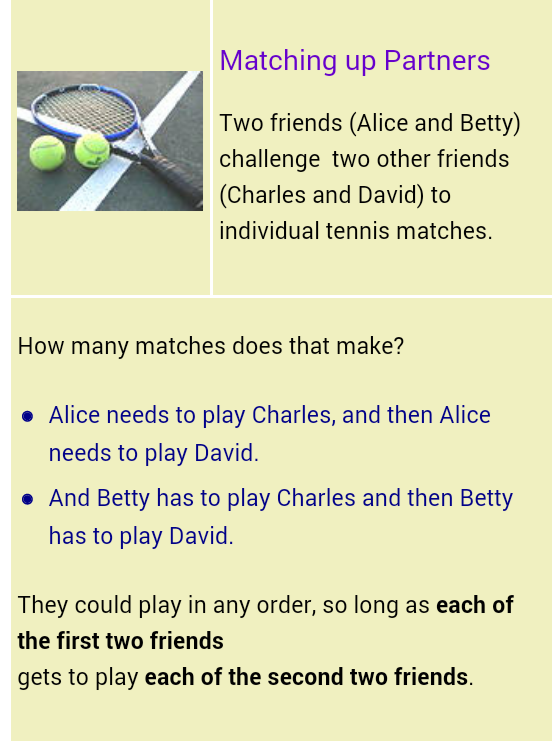
I like this problem because it divides the topic into separate steps, making it easier for the student to understand what to do. With this particular word problem, the teacher can begin to see where the students are having difficulties. This allows the teacher to see what areas need to be revisited, such as order of operations, the multiplication of a negative or positive number etc. Word problems also help teachers evaluate the critical thinking skills of their students.
My References are:
https://www.mathsisfun.com/algebra/polynomials-multiplying.html
http://ritter.tea.state.tx.us/rules/tac/chapter111/ch111c.html
In my capstone class for future secondary math teachers, I ask my students to come up with ideas for engaging their students with different topics in the secondary mathematics curriculum. In other words, the point of the assignment was not to devise a full-blown lesson plan on this topic. Instead, I asked my students to think about three different ways of getting their students interested in the topic in the first place.
I plan to share some of the best of these ideas on this blog (after asking my students’ permission, of course).
This student submission again comes from my former student Loc Nguyen. His topic, from Algebra: fitting data to a quadratic function.
A1. What interesting (i.e., uncontrived) word problems using this topic can your students do now?
To engage students on this topic, I will provide them the word problems in the real life so they can see the usefulness of quadratic regression in predictive purposes. The question to the problem is about the estimated numbers of AIDS cases that can be diagnosed in 2006. The data only show from 1999 to 2003. This will be students’ job to figure out the prediction. I will provide the instructions for this task and I will also walk them through the process of finding the best curve that fit the given data. The best fit to the curve will give us the estimation. Here is how the instruction looks like:

In the end, students will be able to acquire the parabola curve which fit the given data. By letting students work through the real life problems, they will be able to understand why mathematics is important and see how this concept is useful in their lives.
B2. How does this topic extend what your students should have learned in previous courses?
Before getting into this topic, the students should have eventually been familiar with the word “quadratic” such as quadratic function, quadratic equation. Students should have been taught when the curve concaves up or down. In the previous course, students would be given the quadratic functions and they would be asked to find the maxima, minima, or intercepts. Or they would be asked to solve the quadratic equation and find the roots. The universal properties of quadratic function never change. When students encountered the concept of quadratic regression, they would not be so overwhelmed with the topic. There is no new rule or properties. The process is just backward. The Instead of having the given function, in this case, students will have to find the function based on the given data so that the curve would fit the data. Their prior knowledge is really essential for this topic, and this would help them to understand the concept of quadratic regression easier.
C1. How has this topic appeared in pop culture (movies, TV, current music, video games, etc.)?
At the beginning of the class, I would like to show students the short video of football incident.
This incident was really interesting. The Titans punt went so high so that it hit the scoreboard in Cowboys stadium. Surprisingly, this was Cowboy’s new stadium. There were many questions about what was going on when the architecture built this stadium. It was supposed to be great. This incident revealed the errors in predicting the height of the scoreboard. The data they collected in past year may have been incorrect. I want to incorporate this incident into the concept of quadratic regression. I will pose several questions such as:
Was Titan football punter really that powerful? What was really wrong in this situation?
When the architectures built this stadium, did they ever think that the ball would reach the ceiling?
How come did the architectures fail to measure the height of the ceiling? Did they just assume the height of the stadium tall enough?
What was the path of the ball?
Students will eagerly respond to these questions, and I will slowly bring in the important of quadratic regression. I will then explain how quadratic regression helps us to predict the height based on collected data from past years.
References:
https://www.youtube.com/watch?v=V4N3LEi5a1Q
http://www.algebralab.org/Word/Word.aspx?file=Algebra_QuadraticRegression.xml
In my capstone class for future secondary math teachers, I ask my students to come up with ideas for engaging their students with different topics in the secondary mathematics curriculum. In other words, the point of the assignment was not to devise a full-blown lesson plan on this topic. Instead, I asked my students to think about three different ways of getting their students interested in the topic in the first place.
I plan to share some of the best of these ideas on this blog (after asking my students’ permission, of course).
This student submission again comes from my former student Joe Wood. His topic, from Algebra: adding, subtracting, and multiplying matrices.
A1. What interesting (i.e., uncontrived) word problems using this topic can your students do now?
One interesting real world problem for matrix operations can be found in Chapter 4.1.3 at http://spacemath.gsfc.nasa.gov/algebra2.html. The problem deals with astronomical photography. It starts by explaining the process by which NASA gets its images and relates the process of taking the pictures from blurry to clear using matrices. The problem goes as follows:
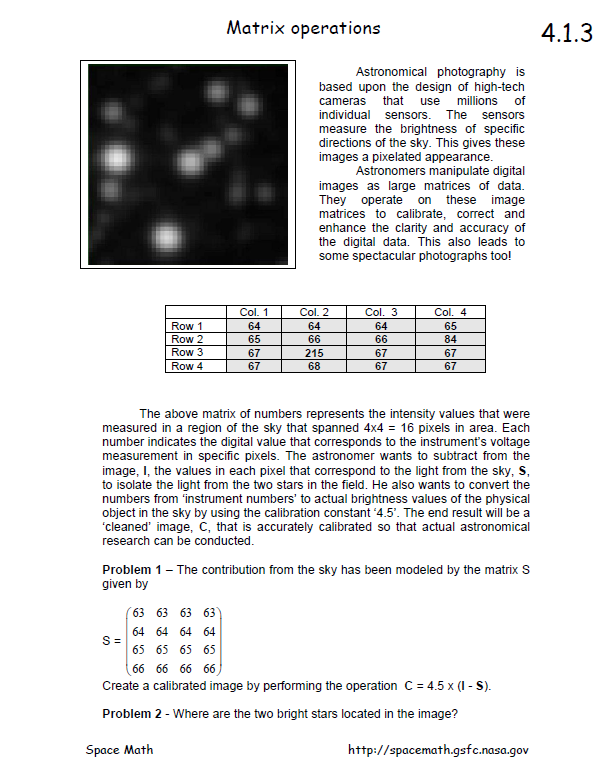
For a way to engage students who are not interested in astronomy, and to allow students to learn more on their own time of the uses, a homework assignment could be for them to find places other than NASA that this process could be used.
D1. What interesting things can you say about the people who contributed to the discovery and/or the development of this topic? (You might want to consult Math Through The Ages.)
“Nine Chapters of the Mathematical Art”, an ancient book that dates between 300 BC and AD 200, gives the first documented use of matrices. Even though matrices were used as early as 300 BC, the term “matrix” was not used until 1850 by James Joseph Sylvester. The term matrix actually comes from a Latin word meaning “womb”.
Below is a list published on the Harvard website of important matrix concepts and the years they were introduced.
| 200 BC: Han dynasty, coefficients are written on a counting board [6] |
| 1545 Cardan: Cramer rule for 2×2 matrices. [6] |
| 1683 Seki and Leibnitz independently first appearance of Determinants [6] |
| 1750 Cramer (1704-1752) rule for solving systems of linear equations using determinants [8] |
| 1764 Bezout rule to determine determinants |
| 1772 Laplace expansion of determinants |
| 1801 Gauss first introduces determinants [6] |
| 1812 Cauchy multiplication formula of determinant. Independent of Binet |
| 1812 Binet (1796-1856) discovered the rule det(AB) = det(A) det(B) [1] |
| 1826 Cauchy Uses term “tableau” for a matrix [6] |
| 1844 Grassman, geometry in n dimensions [14], (50 years ahead of its epoch [14 p. 204-205] |
| 1850 Sylvester first use of term “matrix” (matrice=pregnant animal in old french or matrix=womb in latin as it generates determinants) |
| 1858 Cayley matrix algebra [7] but still in 3 dimensions [14] |
| 1888 Giuseppe Peano (1858-1932) axioms of abstract vector space [12] |
B1. How can this topic be used in your students’ future courses in mathematics or science?
Matrices and matrix operations are used in many math classes from Algebra and Calculus, to Linear Algebra and beyond. So any student interested in studying any discipline of Engineering or mathematics should become very familiar with matrices since they are used in a wide variety of ways (one way is seen above). Matrices are also useful in other courses as well. In Chemistry, matrices can be used for balancing chemical equations. In Physics, matrices can be used to decompose forces. Even in ecology or biology classes, matrices can be crucial. A great example would be studying animal populations under given conditions.
One hope in giving so many brief examples is that a student who cares nothing about the topic of matrices would here about a topic they are interested in (say animals) and that would spark questions into how or why matrices are useful. And of course, when dealing with matrices, addition subtraction, and multiplication of matrices follows closely behind.
References:
“Common Topics Covered in Standard Algebra II Textbooks.” Space Math @ NASA. NASA, n.d. Web. 18 Sept. 2015.
Knill, Oliver. “When Was Matrix Multiplication Invented?” When Was Matrix Multiplication Invented? Harvard, 24 July 2014. Web. 18 Sept. 2015.
Smoller, Laura. “The History of Matrices.” The History of Matrices. University of Arkansas at Little Rock, Apr. 2001. Web. 18 Sept. 2015.
Here in Texas, it’s the start of tornado season as well as the start of high-stakes testing season, so it’s important for teachers to know what to do if the two events should overlap. (Source: http://suzyred.com/takstestprotocol.html)
Sadly, I’m not teaching class today and therefore can’t pull a similar prank on my class. I’ll have to wait for a future year when April 1 falls on a day that I’m teaching.


 Mean Green Math