So far in this series, I have used three different techniques to show that
.
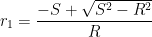
For the third technique, a key step in the calculation was showing that the residue of the function
at the point
was equal to
.
Initially, I did this by explicitly computing the Laurent series expansion about and identifying the coefficient for the term .
In this post and the next post, I’d like to discuss alternate ways that this residue could have been obtained.
Notice that the function has the form , where and are differentiable functions so that and . Therefore, we may rewrite this function using the Taylor series expansion of about :
Therefore, the residue at is equal to , or the constant term in the Taylor expansion of about . Therefore,
For the function at hand and . Therefore, the residue at is equal to , matching the result found earlier.
I'm a Professor of Mathematics and a University Distinguished Teaching Professor at the University of North Texas. For eight years, I was co-director of Teach North Texas, UNT's program for preparing secondary teachers of mathematics and science.
View all posts by John Quintanilla




![f(z) = \displaystyle \frac{1}{z-r} \left[ \frac{g(z)}{h(z)} \right]](https://s0.wp.com/latex.php?latex=f%28z%29+%3D+%5Cdisplaystyle+%5Cfrac%7B1%7D%7Bz-r%7D+%5Cleft%5B+%5Cfrac%7Bg%28z%29%7D%7Bh%28z%29%7D+%5Cright%5D&bg=ffffff&fg=000000&s=0&c=20201002)
![f(z) = \displaystyle \frac{1}{z-r} \left[ a_0 + a_1 (z-r) + a_2 (z-r)^2 + a_3 (z-r)^3 + \dots \right]](https://s0.wp.com/latex.php?latex=f%28z%29+%3D+%5Cdisplaystyle+%5Cfrac%7B1%7D%7Bz-r%7D+%5Cleft%5B+a_0+%2B+a_1+%28z-r%29+%2B+a_2+%28z-r%29%5E2+%2B+a_3+%28z-r%29%5E3+%2B+%5Cdots+%5Cright%5D&bg=ffffff&fg=000000&s=0&c=20201002)


 Mean Green Math
One thought on “How I Impressed My Wife: Part 4g”