Engaging students: Defining the acute, right, and obtuse

In my capstone class for future secondary math teachers, I ask my students to come up with ideas for engaging their students with different topics in the secondary mathematics curriculum. In other words, the point of the assignment was not to devise a full-blown lesson plan on this topic. Instead, I asked my students to think about three different ways of getting their students interested in the topic in the first place.

I plan to share some of the best of these ideas on this blog (after asking my students’ permission, of course).

This student submission again comes from my former student Randall Hall. His topic, from Geometry: defining the terms acute, right, and obtuse.

green line

D4. What are the contributions of various cultures to this topic?

In ancient times, Euclid adopted the idea of a right angle and defined a right angle to be an angle that was to be congruent to it, an acute angle was denoted by less than a right angle and obtuse angle was denoted to be greater than a right angle. Euclid defined it that way because back then Geometry wasn’t associated with numbers; Geometry was associated with circles, lines, line segments and triangles. Many things we know now such as the Pythagorean Theorem can be explained by what we know now to be a right angle.

The Babylonians were one of the first to use degrees in measurements of astronomy between 5000 and 4000 BC. The Babylonians had an interesting number system in that they used a base-60 counting system while today we use a base-10 system. It is because of them that we have a sixty minutes in an hour and 360 degrees in a circle.

Source: http://math.ucsd.edu/~wgarner/math4c/textbook/chapter5/angles_radians.htm


green line

D5. How have different cultures throughout time used this topic in their society?

The history of the mathematical measurement of angles possibly dates back to 1500BC in Egypt, where measurements were taken of the Sun’s shadow against graduations marked on stone tables, examples of which can be seen in the Egyptian Museum in Berlin. The shadow was cast but a vertical rod (Gnomon) along the length of the markings on a stone tablet, enabling time and seasons to be measured with some degree of accuracy.

The first known instrument for measuring angles was possibly the Egyptian Groma, an instrument used in construction massive objects such as the pyramids. The Groma consisted of four stones hanging by cords from sticks set at right angles; measurements were then taken by the visual alignment of two of the suspended cords and the point to be set out. It was limited due to it was only usable on fairly flat terrain and its accuracy limited by distance. The Groma continued to set out right angles for many Roman constructions, including roads, which were straight lines, set by the Groma.

Source: http://www.fig.net/pub/cairo/papers/wshs_01/wshs01_02_wallis.pdf


green line

E1. How can technology (YouTube, Khan Academy [khanacademy.org], Vi Hart, Geometers Sketchpad, graphing calculators, etc.) be used to effectively engage students with this topic?

The link below contains a great JAVA applet that features an angle within the apple that allows the user to designate what the user wants the angle to be. In addition to showing the angle, the applet will recognize that number and then output the appropriate angle type. For example, if the applet recognizes a 90 in the “degree of angle” box and then outputs ‘Right’. In addition to the JAVA application, a description of an angle is given for each type of angle. The classifications of angles are: acute, right, obtuse, straight, reflux, and full rotation. This is excellent for the student because it provides the student a visual of what each type of angles look like. Visuals, such as this, are good for the student because it encompasses all types of learning style. It is also good for ESL learners because it provides them an alternative method for interpreting what is being discussed.

http://www.cut-the-knot.org/Curriculum/Geometry/Angle.shtml

The Best Job of 2014: Mathematician

Sources: http://blogs.wsj.com/atwork/2014/04/15/best-jobs-of-2014-congratulations-mathematicians/ and http://www.careercast.com/jobs-rated/best-jobs-2014

Another day, another reason to get better at math.

It’s no secret that quantitative skills are in high demand on the job market—one analytics recruiter recently told The Journal that workers who can’t crunch numbers may ultimately face a “permanent pink slip.”

Now, a new ranking from the job-search website CareerCast.com names mathematician as the best occupation of 2014. “Math skills unlock a world of career opportunities,” publisher Tony Lee said. (Cue the Square One theme, and tune in Mathnet.)

Data whizzes of all stripes fared well in the annual list: Statisticians (No. 3), actuaries (No. 4) and computer systems analysts (No. 8) all landed near the top.

On a related note, I’m often asked what careers are possible in mathematics. A great resource is provided by the American Mathematical Society at http://www.ams.org/profession/career-info/career-index.

Engaging students: Using a truth table

In my capstone class for future secondary math teachers, I ask my students to come up with ideas for engaging their students with different topics in the secondary mathematics curriculum. In other words, the point of the assignment was not to devise a full-blown lesson plan on this topic. Instead, I asked my students to think about three different ways of getting their students interested in the topic in the first place.

I plan to share some of the best of these ideas on this blog (after asking my students’ permission, of course).

This student submission again comes from my former student Bich Tram Do. Her topic, from Geometry: using a truth table.

green line

Funny video to engage student that a university professor made in class.

Or another clip from the movie “Liar, Liar”

How can you tell if an argument is valid or invalid? In this lesson, we will learn about the truth table and technique to detect the validity of any simple argument.

A2. How could you as a teacher create an activity or project that involves your topic?

I could split students into a group of three students and hand each group 3 bags of different colors cards with printed statements on each one. For example:

Bag 1 has statements such as:

If you are a hound dog, then you howl at the moon.

Bag 2 contains conditions:

You don’t howl at the moon.

Bag 3 has conclusions:

Therefore, you aren’t a hound dog.

In each group, the teacher gives a poster/ construction paper that students must search for the correct responses, match them up, and paste them on the construction paper on the left side. On the right side of the paper, the students are asked to answer the question whether the arguments are valid or not and their reason by making a truth table.

Students will have total of five sets and given about twenty minutes to finish. When the students have all finished, I will ask each group coming up with a new example, state their reasons and present to the class. I might have the students volunteer to be 3 judges and vote for the group with the best example. The activity is fun and helps students to apply what they learned as well as their mastery of the materials.

green line


D1. What interesting things you can say about the people who contributed to the discovery and/or the development of this topic?

According to Shosky (1997), the truth table matrices was claimed to be invented by Bertrand Russell and Ludwig Wittgenstein around 1912. However, there was evidence shown that the logician Charles Peirce (1839-1914) had worked on the truth table logic (1883-84) even before the other two mathematicians worked on the same logic. However, Peirce’s unpublished manuscript did not directly show as a “table”, but the “truth functional analysis”, and was in matrix form. Peirce used abbreviations v (for true) and f (for false) and a special symbol ―< to connect the relationship between statements, say a and b. Later, Russell and Wittgenstein (1912) claimed the first appearance of the truth table device, causing doubts if they worked together or separated and evidences needed to make the claim. In short, the invention of the truth table was credited to Charles Peirce in “The Algebra of Logic” (around 1880) and the “table” form was developed to be clearer and easier for understanding, along with many important contributions of Russell, Wittgenstein based on their knowledge of matrix, number theory, and algebra.


green line

E1. How can technology be used to effectively engage students with this topic?

The truth table topic doesn’t have many engaging activities for students to learn even though it has many applications, especially in digital designing, electrical systems. However, we can include some use of technology so that students who finished group activities early or students who needed more practice can find. This website is an interactive activity for students to do so:

http://webspace.ship.edu/deensley/discretemath/flash/ch1/sec1_3/truthtables/tt_control.html

There are different conditions represented by p, q, and r on the first three columns. The next columns, students are asked to fill out the answer (True or False) to each corresponding condition. When they are done with one column, just click on the statement “I’m done with this column”, and then the students will be directed to another one to try. In addition, they can always click on the pink rectangular box in the bottom to change to a different truth table.

Source:

http://digitalcommons.mcmaster.ca/cgi/viewcontent.cgi?article=1119&context=russelljournal&sei-redir=1#search=%22truth+tables+history%22

http://www.math.fsu.edu/~wooland/argumentor/TruthTablesandArgs.html

http://arxiv.org/ftp/arxiv/papers/1108/1108.2429.pdf

Engaging students: Radius, diameter, and circumference of circles.

In my capstone class for future secondary math teachers, I ask my students to come up with ideas for engaging their students with different topics in the secondary mathematics curriculum. In other words, the point of the assignment was not to devise a full-blown lesson plan on this topic. Instead, I asked my students to think about three different ways of getting their students interested in the topic in the first place.

I plan to share some of the best of these ideas on this blog (after asking my students’ permission, of course).

This student submission again comes from my former student Nataly Arias. Her topic, from Geometry: the radius, diameter, and circumference of circles.

green line

D3. How did people’s conception of this topic change over time?

In order to calculate the circumference of a circle we must multiply the diameter by . The diameter of a circle is the length of the line through the center and touching two points on its edge. In simpler terms the diameter is two times the radius. To get the circumference of a circle we have to work with its radius or diameter and . So the more important question is, what is and how does it relate to circles? Pi or π is a mathematical constant which represents the ratio of any circle’s circumference to its diameter in Euclidean geometry. It is the same as the ratio of a circle’s area to the square of its radius. This can be seen as far back as 250 BCE in the times of Archimedes. Archimedes wrote several mathematical works including the measurement of a circle. Measurement of the circle is a fragment of a longer work in which is shown to lie between the limits of 3 \frac{10}{71} and 3 \frac{1}{7} . His approach to determining consisted on inscribing and circumscribing regular polygons with a large number of sides. His approach was followed by everyone until the development of infinite series expansions in India during the 15th century and the 17th century in Europe. The circumference of circles was found in the works of Archimedes and is now reflected in our math textbooks. This topic has been seen for many centuries and is still seen today. It has become an important part of math and has become an important part of the mathematics curriculum in schools.


green line

E1. How can technology (YouTube, Khan Academy [khanacademy.org], Vi Hart, Geometers, Sketchpad, graphing calculators, etc.) be used to effectively engage students with this topic?

If I was teaching a middle school class on radius, diameter, and circumference of circles I would incorporate technology in my lesson. I have seen firsthand how effective technology can be when teaching your students. I showed the class a video clip during the lesson. As soon as I pulled down the screen projector they sat up, their eyes lit up and they were excited. This is why I have chosen this video clip from YouTube for this particular topic. I think it’s important to change it up and not always stick to a particular teaching style. Some students learn more visually and watching a video instead of listening to a lecture might be more entertaining for students. I know that teachers can’t rely on only technology to teach their students but using things like YouTube can certainly help and be beneficial. I chose this clip because I liked that it used and went over several examples and related circles to things students see every day like a pizza, tire, and table. I also like that it went over definitions in a clear and easy to understand way for students. It explained what a radius and diameter is and how to find it. This helpful video discusses the calculation of the circumference and its area. It also explains the relationship between and the circumference. This 8 minute clip could be used as part of your explain section of your lesson or could even be used to help students review the topic before a test or quiz.


green line

D4. What are the contributions of various cultures to this topic?

When dealing with the radius, diameter, and the circumference of circles there is no escaping pi. Pi represents the ratio of any circle’s circumference to its diameter and is one of the most important mathematical constants. It’s used in many formulas from mathematics, engineering, and science. In math we use to solve for the circumference of a circle with formula C=2\pi r. Sometime in early history someone discovered the relationship between the size of the circumference and the diameter of all circles was a constant ratio. This was seen and presented in the earliest recorded mathematical documents of Babylon and Egypt over 2000 years ago. At this time they did not use the symbol that we use today it wasn’t till much later. They had established that the ratio was equal to \frac{C}{D}, where C is the circumference and D is the diameter of any given circle. At this stage, the Egyptian and Babylonian mathematicians came up with numerical approximations to \frac{C}{D} which is the number we now call pi. Their methods are still unclear and unknown today. In their time period there was no modern number system. They didn’t even have pencil and paper. It has been predicted that they used a rope and sticks to draw circles in the sand and that they also used the rope to measure how many diameters made up a circumference of a circle.
 

References


http://www.britannica.com/EBchecked/topic/458986/pi


http://www.britannica.com/EBchecked/topic/32808/Archimedes


http://www.youtube.com/watch?v=Yb1HYyBfLfc


http://www.ms.uky.edu/~lee/ma502/pi/MA502piproject.html


http://www.ams.org/samplings/feature-column/fc-2012-02


Engaging students: Finding the volume and surface area of pyramids and cones

In my capstone class for future secondary math teachers, I ask my students to come up with ideas for engaging their students with different topics in the secondary mathematics curriculum. In other words, the point of the assignment was not to devise a full-blown lesson plan on this topic. Instead, I asked my students to think about three different ways of getting their students interested in the topic in the first place.

I plan to share some of the best of these ideas on this blog (after asking my students’ permission, of course).

This student submission again comes from my former student Laura Lozano. Her topic, from Geometry: finding the volume and surface area of pyramids and cones.

green line

C1. How has this topic appeared in pop culture (movies, TV, current music, video games, etc.)?

Now days, pyramids have appeared almost all over pop culture because of the illuminati conspiracy. Famous artist like Katy Perry, Kanye West, Jay-Z, Beyoncé, and many others are believed to be part of this group that practices certain things to retain their wealth. Since it’s a conspiracy, it might not be true. Although that’s another topic, they all use an equilateral triangle and pyramids to represent they are part of the illuminati group. They display it in their music videos and while they are performing at a concert or awards show.

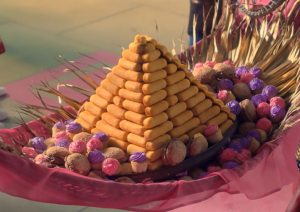
In Katy Perry’s new music video, were she portrays herself as a Egyptian queen, for some weird reason, she has a pyramid made out of what looks like twinkies.

LL1

To make this, the base and height had to be measured to create the surface area of the pyramid.

Also, the picture below is from Kanye West’s concerts. He is at the top of the pyramid.

LL2

To make this, they had to consider the size of the stage to fit the pyramid. So the size of the base depended on the size of the stage.

The most famous cone is the ice cream cone. When most people think of cone they initially think ice cream! Ice cream cones are made using the surface area of a cone and taking into consideration the volume of the cone. The bigger the surface area, the bigger the volume, the more ice cream!

LL3green line

C2. How has this topic appeared in high culture (art, classical music, theatre, etc.)

Some musical instruments have the form of a cone. For example, the tuba, trumpet, and the French horn all have a cone like shape.

LL4


The sound that comes out of the instrument depends on the volume of the cone shaped part as well as the other parts of the instrument. The bigger volume of the cone shaped part is, the deeper the sound, the smaller the volume of the cone shaped part is, the higher pitched it is.

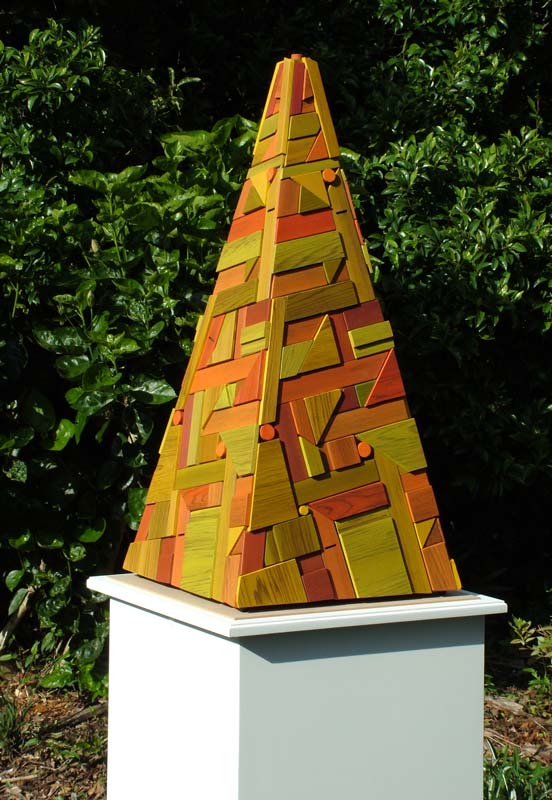
Pyramids can be used in art work. Most of the art work done with pyramids is paintings of the Egyptian Pyramids. But, they can also be used to make sculptures of abstract art. Here is one example of an abstract sculpture made from recycled materials.


LL5


If the sculpture is hallow, then to make it you would only need the surface area. If it’s not, then you would also need to calculate the volume to see how much recycled material was used.

green line

D5. How have different cultures throughout time used this topic in their society?

In ancient history, the Egyptians used to build pyramids to build a tomb for pharaohs and their queens to protect their bodies after their death. The pyramids were built to last forever. No one knows exactly how they built the pyramids but people have had theorys on how they were built.

The most famous pyramids are the Pyramids of Giza. The pyramids are Pyramid Khafre, Pyramid Menkaure, and Pyramid Khufu. It is the biggest and greatest pyramid of Egypt. This pyramid used to measure about 481 feet in height and the base length is about 756 feet long. However, because the pyramid is very very old, erosion causes changes in the measurements of the pyramid. When scientiest and archeologist had to find the differrent measurements they most likely used the formula to find the volume and surface area of the pyramid. However, back then, the formula was probably not discovered yet.


LL6

An example for cones is the conical hat. Used by most the Asian culture, conical hats, also know as rice hats, or farmers hat, were worn by farmers, and they are still somewhat used today. There are many types of conical hats that can be made today. Some are widder than others, and some are taller than others. To make the hats, the maker of the hat has to consider the surface area of the hat to make the hat properly.

LL7.

Resources:

http://www.history.com/topics/ancient-history/the-egyptian-pyramids

http://www.thelineofbestfit.com/news/latest-news/kanye-wests-yeezus-stage-show-includes-mountains-pyramids-and-jesus-impersonator-139788

http://www.youtube.com/watch?v=0KSOMA3QBU0

http://earthmatrix.com/great/pyramid.htm

Engaging students: Finding the volume and surface area of spheres

In my capstone class for future secondary math teachers, I ask my students to come up with ideas for engaging their students with different topics in the secondary mathematics curriculum. In other words, the point of the assignment was not to devise a full-blown lesson plan on this topic. Instead, I asked my students to think about three different ways of getting their students interested in the topic in the first place.

I plan to share some of the best of these ideas on this blog (after asking my students’ permission, of course).

This student submission again comes from my former student Allison Myers. Her topic, from Geometry: finding the volume and surface area of spheres..

green line

How could you as a teacher create an activity or project that involves your topic?

Show students pictures of the Personal Satellite Assistant (PSA). Tell students they are going to investigate how the surface area and volume of a sphere change as its radius changes.

Explain that they will also determine how big the PSA is in real life.

Remind students that NASA engineers have created a 30.5-centimeter

(12-inch) diameter model of the PSA, but they want to shrink it to 20 centimeters (8 inches) in diameter.

Use a 30.5-centimeter (12-inch) diameter globe and let students know the globe is roughly the size of the current PSA model.

Ask students how the PSA might look different if its surface area were reduced by half.

Ask how the function of the PSA might be different if its volume were reduced by half.

Ask students what information they need to calculate its surface area and volume.

If they appear confused, draw three circles of different sizes and ask students how to calculate the area of each of the circles.

The only information they need is the radius of the sphere. Review the properties of a sphere.

Ask students what formulas are necessary to calculate the surface area and volume of the sphere. Write these formulas on the board:

Surface Area = 4 x πx radius x radius

Volume = 4/3 x πx radius x radius x radius

Show students a baseball, softball, volleyball, and basketball. Ask them if they think the surface area and volume of a sphere change at equal rates as the spheres increase from the size of a baseball to the size of a basketball.

Ask students how they will verify their hypotheses.


green line

Curriculum

How can this topic be used in your students’ future courses in mathematics or science?

          In calculus students will learn that you can revolve a curve about the x or y-axis to generate a solid. For example, a semicircle [f(x) = √(r2-x2)] can be revolved about the x-axis to obtain a sphere with radius r. From this, the different formulas for calculating the volume of a sphere can be derived.

In calculus, students will also learn how to find the surface area of a sphere by integrating about either the x or y axis.

Resource: http://www.math.hmc.edu/calculus/tutorials/volume/

At some point, students may also extend their knowledge of spheres into higher dimensions (hyperspheres), where they will learn how volume changes according the dimensions they are working in.

Resource: http://spacemath.gsfc.nasa.gov/weekly/6Page89.pdf


green line

What interesting (i.e., uncontrived) word problems using this topic can your students do now?

For Volume of a Sphere:

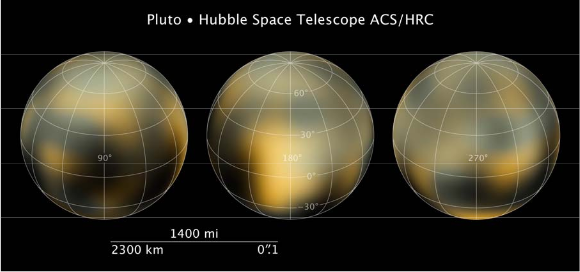
Pluto

Recent Hubble Space Telescope studies of Pluto have confirmed that its atmosphere is undergoing considerable change, despite its frigid temperatures. The images, created at the very limits of Hubble’s resolving power, show enigmatic light and dark regions that are probably organic compounds (dark areas) and methane or water-ice deposits (light areas). Since these photos are all that we are likely to get until NASA’s New Horizons spacecraft arrives in 2015, let’s see what we can learn from the image!

Problem 1

– Using a millimeter ruler, what is the scale of the Hubble image in kilometers/millimeter?
Problem 2

– What is the largest feature you can see on any of the three images, in kilometers, and how large is this compared to a familiar earth feature or landmark such as a state in the United States?
Problem 3

– The satellite of Pluto, called Charon, has been used to determine the total mass of Pluto. The mass determined was about 1.3 x 10²² kilograms. From clues in the image, calculate the volume of Pluto and determine the average density of Pluto. How does it compare to solid-rock (3000 kg/m3), water-ice (917 kg/m3)?
Inquiry:

Can you create a model of Pluto that matches its average density and predicts what percentage of rock and ice may be present?
Resource: http://spacemath.gsfc.nasa.gov/weekly/6Page143.pdf