In the last few posts, we studied the SSA case of solving for a triangle, when two sides and an non-included angle are given. (Some mathematics instructors happily prefer the angle-side-side acronym to bluntly describe the complications that arise from this possibly ambiguous case. I personally prefer not to use this acronym.)
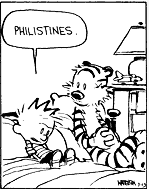
A note on notation: when solving for the parts of , will be the length of the side opposite , will be the length of the side opposite , and will be the length of the side opposite angle . Also will be the measure of , will be measure of , and will be the measure of . Modern textbooks tend not to use , , and for these kinds of problems, for which I have only one response:https://meangreenmath.com/wp-content/uploads/2014/10/philistines.png
Suppose that , , and the nonincluded angle are given, and we are supposed to solve for , , and . As we’ve seen in this series, there are four distinct cases — and handling these cases requires accurately solving equation like on the interval .
Case 1. . In this case, there are no solutions. When the Law of Sines is employed and we reach the step
the is greater than 1, which is impossible.
Case 2. . This rarely arises in practice (except by careful writers of textbooks). In this case, there is exactly one solution. When the Law of Sines is employed, we obtain
We conclude that , so that is a right triangle.
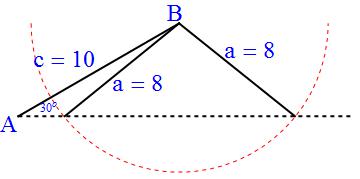
Case 3. . This is the ambiguous case that yields two solutions. The Law of Sines yields
so that there are two possible choices for , and .
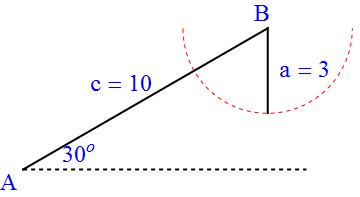
Case 4. . This yields one solution. Similar to Case 3, the Law of Sines yields
so that there are two possible choices for , and . However, when the second larger value of is attempted, we end up with a negative angle for , which is impossible (unlike Case 3).
Many mathematics students prefer to memorize rules like those listed above. However, I try to encourage my students not to blindly use rules when solving the SSA case, as it’s just too easy to make a mistake in identifying the proper case. Instead, I encourage them to use the Law of Sines and to remember that the equation
has two solutions in as long as $0 < t < 1$:
If they can remember this fact, then students can just follow their noses when applying the Law of Sines, identifying impossible and ambiguous cases when the occasions arise.
I'm a Professor of Mathematics and a University Distinguished Teaching Professor at the University of North Texas. For eight years, I was co-director of Teach North Texas, UNT's program for preparing secondary teachers of mathematics and science.
View all posts by John Quintanilla



![[0^\circ, 180^\circ]](https://s0.wp.com/latex.php?latex=%5B0%5E%5Ccirc%2C+180%5E%5Ccirc%5D&bg=ffffff&fg=000000&s=0&c=20201002)






 Many mathematics students prefer to memorize rules like those listed above. However, I try to encourage my students not to blindly use rules when solving the SSA case, as it’s just too easy to make a mistake in identifying the proper case. Instead, I encourage them to use the Law of Sines and to remember that the equation

 Mean Green Math