
We’ve seen in this series that blinding using the arcsine function on a calculator is insufficient for finding all solutions of an equation like 
A note on notation: when solving for the parts of 


Why does an SSA triangle produce an ambiguous case (unlike the SAS, SSS, or ASA cases)? Here’s a possible problem that has exactly one solution:
Solve
,
, and
.
A student new to the Law of Sines might naively start solving the problem by drawing something like this:

Of course, that’s an inaccurate picture that isn’t drawn to scale. A more accurate picture would look like this:

Notice that the red circle intersects the dashed black line at exactly one point. Therefore, we know that there will be exactly one solution for this case. We also note that the circle would have intersected the black dashed line had the dashed line been extended to the left. This will become algebraically clear in the solution below.
Of course, students should not be expected to make a picture this accurately when doing homework. Fortunately, this impossibility naturally falls out of the equation when using the Law of Sines:

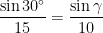


At this point, the natural inclination of a student is to pop out the calculator and find 

This is incorrect logic that, as discussed extensively in yesterday’s post, there are two angles between 


or, in degrees,

So we have two different cases to check.
Case 1: 

Then we can use the Law of Sines (or, in this case, the Pythagorean Theorem), to find 


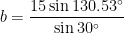
Case 2: 

Oops. That’s clearly impossible. So there is only one possible triangle, and the missing pieces are 

It turns out that Case 2 will always fail in SSA will always fail as long as the side opposite the given angle is longer than the other given side (in this case, 
 Mean Green Math