
In this series of posts, I consider how two different definitions of the number 
- Algebra II/Precalculus: If
dollars are invested at interest rate
for
years with continuous compound interest, then the amount of money after
.
- Calculus: The number
from
to
is equal to
, so that

These two definitions appear to be very, very different. One deals with making money. The other deals with the area under a hyperbola. Amazingly, these two definitions are related to each other. In this series of posts, I’ll discuss the connection between the two.
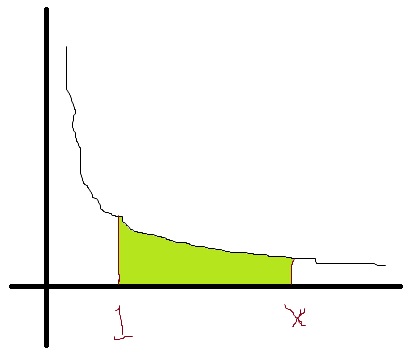

We begin with the second definition, which is usually considered the true definition of


beginning with this definition of the number
Theorem. 
Proof #1.In an earlier post in this series, I showed that

Let’s now replace 


Multiply both sides by


![rt = \displaystyle \lim_{n \to \infty} \ln \left[ \left(1 + \frac{r}{n} \right)^{n} \right]^t](https://s0.wp.com/latex.php?latex=rt+%3D+%5Cdisplaystyle+%5Clim_%7Bn+%5Cto+%5Cinfty%7D+%5Cln+%5Cleft%5B+%5Cleft%281+%2B+%5Cfrac%7Br%7D%7Bn%7D+%5Cright%29%5E%7Bn%7D+%5Cright%5D%5Et&bg=ffffff&fg=000000&s=0&c=20201002)
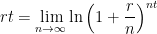
Since 
![rt = \displaystyle \ln \left[ \lim_{n \to \infty} \left(1 + \frac{r}{n} \right)^{nt} \right]](https://s0.wp.com/latex.php?latex=rt+%3D+%5Cdisplaystyle+%5Cln+%5Cleft%5B+%5Clim_%7Bn+%5Cto+%5Cinfty%7D+%5Cleft%281+%2B+%5Cfrac%7Br%7D%7Bn%7D+%5Cright%29%5E%7Bnt%7D+%5Cright%5D&bg=ffffff&fg=000000&s=0&c=20201002)
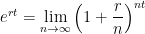
Finally, we multiply both sides by

(A second proof of this theorem, using L’Hopital’s Rule, will be presented in tomorrow’s post.)
This firmly established, at last, the connection between the continuous compound interest formula and the area under the hyperbola. I’ve noted that my students feel a certain sense of accomplishment after reaching this point of the exposition.
 Mean Green Math
One thought on “Different definitions of e (Part 9): Connecting the two definitions”