
In this series of posts, I explore properties of complex numbers that explain some surprising answers to exponential and logarithmic problems using a calculator (see video at the bottom of this post). These posts form the basis for a sequence of lectures given to my future secondary teachers.
Definition. If 

Even though this isn’t the usual way of defining the exponential function for real numbers, the good news is that one Law of Exponents remains true. (At we saw in an earlier post in this series, we can’t always assume that the usual Laws of Exponents will remain true when we permit the use of complex numbers.)
Theorem. If 

I will formally prove this in the next post. Today, I want to talk about the idea behind the proof. Notice that

Let’s multiply this out (ugh!), but we’ll only worry about terms where the sum of the exponents of


Next, we rearrange the terms according to the sum of the exponents. For example, the terms with 


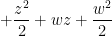


For each line, we obtain a common denominator:
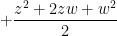
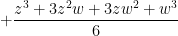

We recognize the familiar entries of Pascal’s triangle in the coefficients of the numerators, and so it appears that

If the pattern on the right-hand side holds up for exponents greater than 4, this proves that
So that’s the idea of the proof. The formal proof will be presented in the next post.

For completeness, here’s the movie that I use to engage my students when I begin this sequence of lectures.
 Mean Green Math
2 thoughts on “Calculators and complex numbers (Part 14)”