
In my capstone class for future secondary math teachers, I ask my students to come up with ideas for engaging their students with different topics in the secondary mathematics curriculum. In other words, the point of the assignment was not to devise a full-blown lesson plan on this topic. Instead, I asked my students to think about three different ways of getting their students interested in the topic in the first place.
I plan to share some of the best of these ideas on this blog (after asking my students’ permission, of course).
This student submission again comes from my former student Isis Flores. Her topic, from Geometry: introducing translation, rotation, and reflection of figures.

B2: How does this topic extend what your students should have learned in previous courses?
In order for students to be able to be successful understanding, performing, and identifying translations, rotations and reflections there are a few things that they must have a grasp on from previous classes. Included in these topics is understanding the Cartesian plane and the different relationships between each quadrant. Knowledge of the plane will be extended when students began to work with different degrees of rotations around the plane. Students should also be able to perform several different tasks on the plane such as, plotting points and lines. Being able to perform such tasks will ease the transition of now working with more complex shapes on the plane. Since the topic deals with transformations of figures students must also have an understanding of the basic geometric figures and their different characteristics and classifications. Having a base knowledge of geometric shapes will aid the students when comparing different types of transformations. In previous courses students should also have acquired knowledge of the basic mathematical operations, (addition, subtraction, multiplication, division), which will enable them to perform specific dictated transformations better. The concept of basic mathematical operations will be extended to students as they explore how these operations may play out on a coordinate plane with geometric figures.
C2. How has this topic appeared in high culture (art, classical music, theatre, etc.)?
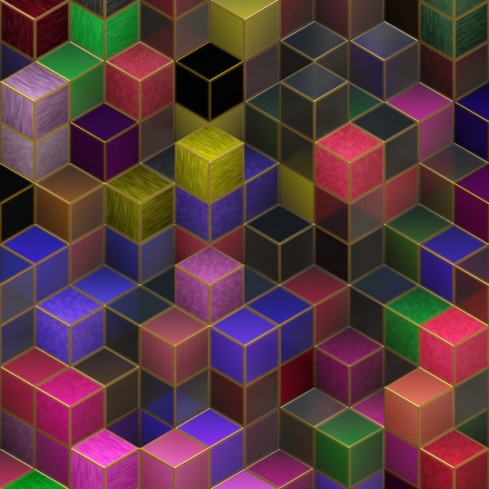
In any classroom there is always a variety of students with a variety of interests. One of these interests may include art, which can lend itself quite easily to the exploration of different transformations. A specific type of art which uses translations, rotations and reflections is called Geometric Abstraction. Geometric Abstraction became widely popular in the early 20th century making it an even closer connection for students. The art form uses different types of geometric shapes to create abstract and quite modern looking pieces of work. The fact that the art form is quite new compared to other forms of art does not prevent pieces from being high end items, and the monetary aspect may be another way to engage students. Showing students different pieces of art which were composed using geometric transformations and also showing how highly priced they are, is a great way to show the relevancy and demand for the topic.


A2. How could you as a teacher create an activity or project that involves your topic?
As a teacher at times it is difficult to get students motivated and excited about a specific topic. A great way to give students motivation towards an activity is to give them a bit of autonomy. For translations, rotations and reflections a project that students may perform may be their own art work which would display their knowledge of the content. To even personalize the project even more students may be ask to include an object which is personal to them, for example if a student play soccer then a soccer ball would be an appropriate object for their art work. Students may be asked to also provide directions on their art work so that a classmate may replicate it. Perhaps to take a step further students may analyze each other’s art pieces and try to figure out what order of transformations created the finished piece. For students who may not feel as artistically inclined, or even as another class project, the option of going and finding a real life depiction of transformations may be offered. Students should provide evidence of their findings with an image. The task can be furthered challenged by asking students to find something in their school which depicts transformations. The first project will require students to show their proficiency in performing the transformation, while the second will call on them to show their understanding of what each transformation looks like.
References:
http://www.artspace.com/assume_vivid_astro_focus/starburst
http://www.artspace.com/magazine/art_101/art_101_geometric_abstraction
 Mean Green Math