
Here’s a standard problem that could be found in any Algebra I textbook.
Find the equation of the line between
and
.
The first step is clear: the slope of the line is

At this point, there are two reasonable approaches for finding the equation of the line.
Method #1. This is the method that was hammered into my head when I took Algebra I. We use the point-slope form of the line:

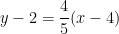
For what it’s worth, the point-slope form of the line relies on the fact that the slope between 


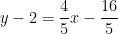
Method #2. I can honestly say that I never saw this second method until I became a college professor and I saw it on my students’ homework. In fact, I was so taken aback that I almost marked the solution incorrect until I took a minute to think through the logic of my students’ solution. Let’s set up the slope-intercept form of a line:

Then we plug in one of the points for 


Therefore, the line is 
 My experience is that most college students prefer Method #2, and I can’t say that I blame them. The slope-intercept form of a line is far easier to use than the point-slope form, and it’s one less formula to memorize.
Still, I’d like to point out that there are instances in courses above Algebra I that the point-slope form is really helpful, and so the point-slope form should continue to be taught in Algebra I so that students are prepared for these applications later in life.
Topic #1. In calculus, if 


This linearization is immediately obtained from the point-slope form of a line. It also can be obtained using Method #2 above, so it takes a little bit of extra work.
This linearization is used to derive Newton’s method for approximating the roots of functions, and it is a precursor to Taylor series.
Topic #2. In statistics, a common topic is finding the least-squares fit to a set of points 
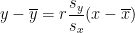
In this equation,
and
are the means of the
and
values, respectively.
and
are the sample standard deviations of the
is the correlation coefficient between the
The formula of the regression line is decidedly easier to write in point-slope form than in slope-intercept form. Also, the point-slope form makes the interpretation of the regression line clear: it must pass through the point of averages 
 Mean Green Math