Dissertations

I first saw this gem in the delightful book Absolute Zero Gravity: Science Quotes, Jokes and Anecdotes.

green line

A little rabbit was sitting in a field, scribbling on a pad of paper, when a fox came along. “What are you doing, little rabbit?”

“I’m working on my dissertation,” said the rabbit.

“Really?” said the fox. “And what is your topic?”

“Oh, the topic doesn’t matter,” said the rabbit.

“No, tell me,” begged the fox.

“If you must know,” said the rabbit, “I’m advancing a theory that rabbits can eat many quite large animals – including, for instance, foxes.”

“Surely you have no experimental evidence for that,” scoffed the fox.

“Yes, I do,” said the rabbit, “and if you’d like to step inside this cave for a moment I’ll be glad to show you.” So the fox followed the rabbit into the cave. About half an hour passed. Then the rabbit came back out, brushing a tuft of fox fur off his chin, and began once more to scribble on his pad of paper.

News spreads quickly in the forest, and it wasn’t long before a curious wolf came along. “I hear you’re writing a thesis, little rabbit,” said the wolf.

“Yes,” said the rabbit, scribbling away.

“And the topic?” asked the wolf.

“Not that it matters, but I’m presenting some evidence that rabbits can eat larger animals – including, for example, wolves.” The wolf howled with laughter. “I see you don’t believe me,” said the rabbit. “Perhaps you would like to step inside this cave and see my experimental apparatus.”

Licking her chops, the wolf followed the rabbit into the cave. About half an hour passed before the rabbit came out of the cave with his pad of paper, munching on what looked like the end of a long gray tail.

Then along came a big brown bear. “What’s this I hear about your thesis topic?” he demanded.

“I can’t imagine why you all keep pestering me about my topic,” said the rabbit irritably. “As if the topic made any difference at all.”

The bear sniggered behind his paw. “Something about rabbits eating bigger animals was what I heard – and apparatus inside the cave.”

“That’s right,” snapped the rabbit, putting down his pencil. “And if you want to see it I’ll gladly show you.” Into the cave they went, and a half hour later the rabbit came out again picking his teeth with a big bear claw.

By now all the animals in the forest were getting nervous about the rabbit’s project, and a little mouse was elected to sneak up and peek into the cave when the rabbit’s back was turned. There she discovered that the mystery of the rabbit’s thesis had not only a solution but also a moral. The mystery’s solution is that the cave contained an enormous lion. And the moral is that your thesis topic really doesn’t matter – as long as you have the right thesis advisor.
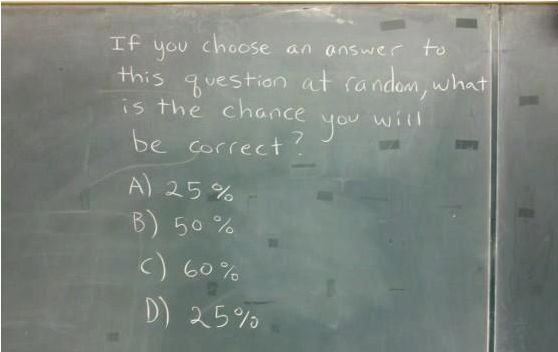

Multiple choice

I had a good chuckle at the following photo.


4132012165940iwsmt

Here’s a thought bubble if you’d like to think about it before I reveal the answer.

green_speech_bubble

You’d think that, since there are four possible answers, that you should answer 25%. However, there are two choices for 25%, so the chance of picking 25% as your answer is 2/4, or 50%. But there’s only one way to answer 50%, so the answer should be 1/4, or 25%. To quote “The King and I,” et cetera, et cetera, et cetera.

The correct answer, of course, is adding a fifth option: E) 20%.

Transition from high school to college

One of my (perhaps unsolvable) professional concerns is the large number of students who ace high school but flounder once hitting the higher academic expectations in college. This particular article was written by a student from Washington, DC, but it really could’ve come from anywhere.

A major contributing cause (though not the only one) is that the high-stakes tests that high school students take at the end of the year does not even come close to measuring college readiness. If I could wave my magic wand, I would assess the effectiveness of high schools not only with high-staking testing but also with graduates’ GPA in core classes during their freshman year of college.

Math emporium

It took some convincing, but I’m now a supporter of this novel way of using technology to teach lower-level mathematics courses at the collegiate level. The results speak for themselves.

http://www.washingtonpost.com/local/education/at-virginia-tech-computers-help-solve-a-math-class-problem/2012/04/22/gIQAmAOmaT_story.html?hpid=z4

http://www.emporium.vt.edu/emporium/home.html

http://www.thencat.org/R2R/AcadPrac/CM/MathEmpFAQ.htm

Something we’ve lost

A quote from George Will, from the extended commentary of Ken Burns’ excellent series on the Civil War.

How the common men and women of [the Civil War era] used the English language at that time is worth pondering. I think the normally literate 19th century American had as his entertainment popular novels: Balzac, Dickens, George Eliot. They didn’t turn on the television; they weren’t in that passive receiving mode. They were in the active mode, which reading is, and popular entertainment then was popular novels. Dickens: not bad. Also, they didn’t pick up the phone when they wanted to communicate. They wrote letters. They had the discipline of expressing themselves in complete sentences and rounded paragraphs. And that’s something we’ve lost.

Infinite number of monkeys

From Wikipedia:

The infinite monkey theorem states that a monkey hitting keys at random on a typewriter keyboard for an infinite amount of time will almost surely type a given text, such as the complete works of William Shakespeare.

This can be formally proven using the second Borel-Cantelli Lemma, a topic which requires measure-theoretic probability. Thus leading me to one of the driest observations that I’ve ever read in a graduate-level textbook, following the proofs of the Borel-Cantelli Lemmas:

The record of a prolonged coin-tossing game is bound to contain every conceivable book in the Morse code [using heads for dot and tails for dash], from Hamlet to eight-place logarithmic tables. It has been suggested that an army of monkeys might be trained to pound typewriters at random in the hope that ultimately great works of literature would be produced. Using a coin for the same purpose may save feeding and training expenses and free the monkeys for other monkey business.

W. Feller, An Introduction to Probability Theory and Its Applications, Volume 1 (Chapter 8.3), page 202.