
A provost complains to the physics faculty about how much money it costs for labs, lasers, technical staff, and other associated costs of doing their work. “Why can’t you be more like the Math Department?” asks the provost. “All they need is money for pencils, paper, and a wastebasket. Or better still, you could be like the Philosophy Department. All they need is money for pencils and paper.”
Year: 2013
The Hitchhiker’s Guide to the Galaxy
In 1979, Douglas Adams envisioned the iPad at a time when the Apple II was the state of the art. From now on, I’ll always think someone’s reading the Hitchhiker’s Guide to the Galaxy when they’re fiddling with their tablet (especially if they also have a towel nearby).
“[Ford Prefect] also had a device that looked rather like a largish electronic calculator. This had about a hundred tiny flat press buttons and a screen about four inches square on which any one of a million pages could be summoned at a moment’s notice. It looked insanely complicated, and this was one of the reasons why the snug plastic cover it fitted into had the words DON’T PANIC printed on it in large friendly letters. The other reason was that this device was in fact that most remarkable of all books ever to come out of the great publishing corporations of Ursa Minor — The Hitchhiker’s Guide to the Galaxy. The reason why it was published in the form of a micro sub meson electronic component is that if it were published in normal book form, an interstellar hitchhiker would require several inconveniently large buildings to carry it around in.”
From Chapter 3 of “The Hitchhiker’s Guide to the Galaxy.”
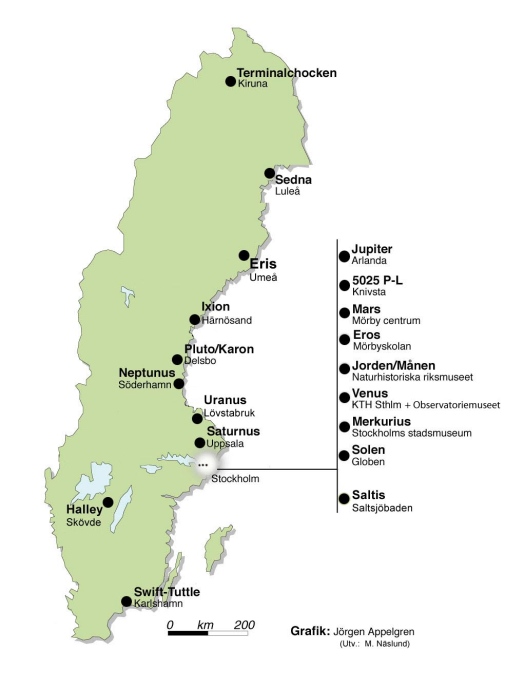
World’s largest model solar system
I think this is really cool: the Department of Astronomy at Stockholm University (Sweden) have devised the world’s largest model solar system, at a scale of 
Triangles of pennies
Useless fact of the day: Make a triangle of arbitrary size with pennies, like in the picture below. What is the least number of pennies that have to be moved to make an upside-down triangle?

Turns out the answer is the number of pennies divided by 3, ignoring the remainder. So for the 10-penny triangle above, the answer is 3 moves (since 
Image credit: http://www.coolmath4kids.com/math_puzzles/p4-pennytriangle.html
Probabilities in Monopoly
Somebody had to figure this out: Probabilities in Monopoly, including long term probabilities for each square, expected income per roll for each square, payback times for purchases, and mortgage payback and loss times.
Bug in TI-83 Plus?
On my TI-83 plus emulator, I input the following in the statistical command 2-SampTInt:
x1 = 51.71
s1 = 0.79
n1 = 10
x2 = 136.14
s2 = 3.59
n2 = 10
C-Level: .95
Pooled: No
The calculator returns 9.896 degrees of freedom; it should be more like 12 degrees of freedom according to Welch’s formula (which is also implemented with T.TEST in Microsoft Excel).
I’m assuming the TI has some non-standard way of computing the number of degrees of freedom, but I haven’t the faintest idea what it could be. What’s odd is that the number of degrees of freedom appears to be computed with Welch’s formula when using the parallel command 2-SampTTest.
Bumper sticker
For what it’s worth, I also have this bumper sticker on my office door.

Medical trials
This is a great and highly readable layman’s article about something that I wish I was more proficient in: the use of statistics to validate (or invalidate) medical trials.
Assessing private schools
Here’s a pet peeve that probably only bothers me: I get disturbed when a private school partially assesses the quality of its academic program by comparing the SAT scores of its graduates to either national or state averages. The children who attend private schools are those who’d be expected to do well on the SAT in the first place: they come from families able to afford a private education, and (sadly) SAT scores are highly correlated with family income. The table below shows the average SAT scores in 2009-10 based on family income and is taken from the above link.
| Family income | Critical Reading | Math | Writing |
|---|---|---|---|
| All students | 501 | 516 | 492 | Less than $20,000 | 437 | 460 | 432 |
| $20,000, but less than $40,000 | 465 | 479 | 455 |
| $40,000, but less than $60,000 | 490 | 500 | 478 |
| $60,000, but less than $80,000 | 504 | 514 | 492 |
| $80,000, but less than $100,000 | 518 | 529 | 505 |
| $100,000, but less than $120,000 | 528 | 541 | 518 |
| $120,000, but less than $140,000 | 533 | 546 | 523 |
| $140,000, but less than $160,000 | 540 | 554 | 531 |
| $160,000, but less than $200,000 | 547 | 561 | 540 |
| More than $200,000 | 568 | 586 | 567 |
Note that students who comes from families earning between $60,000-80,000 are at about the average for the country.
Based on this chart, my personal opinion is that private schools of average academic quality should produce graduates that score, on each of the three sections, about 35 or 40 points higher than the rest of the country. However, for very exclusive and expensive private schools, the difference should be 50 or even 60 points on each section.
NB: These comments are strictly limited to this one assessment of the academic programs of private schools. There are other assessments of academic quality besides the SAT, and there are plenty of nonacademic reasons for parents to choose a private education if they have the means to do so.
How not to give a presentation
I doodled this list during a particularly grueling workshop presentation:
HOW NOT TO CONDUCT A TRAINING WORKSHOP
- Assume your audience consists entirely of peer reviewers judging the suitability of your presentation for publication.
- Make sure that every facet and angle of the theoretical and philosophical underpinnings of your presentation are covered.
- Present a thoroughly detailed and annotated literature review of all prior results.
- Design all PowerPoint slides in 10-point font or less.
- Present all quantitative results in at least two different useless graphical formats, courtesy of the fun charts that Microsoft Excel will let you make.
- Create multiple acronyms and use them aggressively.
- Devote the most amount of time to the most difficult topics and processes that only a select few will be asked to perform.
- Name-drop the top brass.
- Demonstrate complicated software without providing notes for the audience’s future reference.
- Emphasize how much the new process costs, so that everyone fully comprehends how importance it is that the new process doesn’t fail.
 Mean Green Math