
Year: 2013
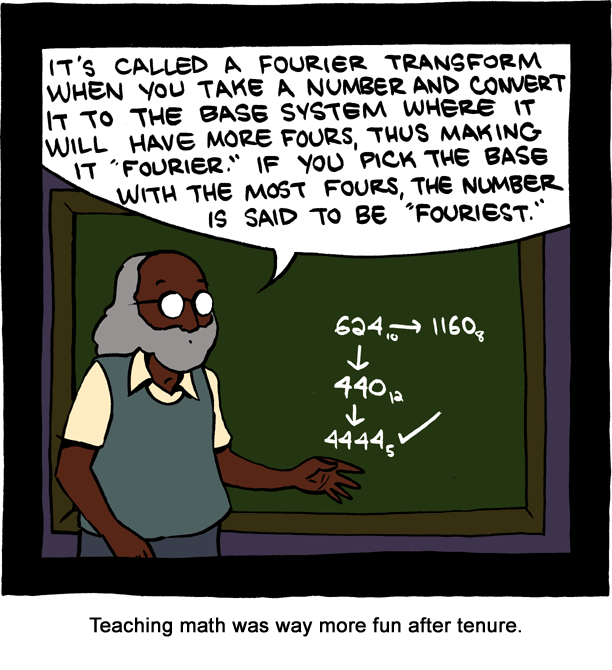
Fourier transform
More on divisibility
Based on my students’ reactions, I gave my best math joke in years as I went over the proofs for checking that an integer was a multiple of 3 or a multiple of 9. I started by proving a lemma that 9 is always a factor of 


Some of my students laughed so hard that they cried.
There are actually at least three ways of proving this lemma. I love lemmas like these, as they offer a way of, in the words of my former professor Arnold Ross, to think deeply about simple things.
(1) By subtracting, 
(2) We can use the rule

The conclusion follows by letting 

From my experience, my senior math majors all learned the rule for factoring the difference of two squares, but very few learned the rule for factoring the difference of two cubes, while almost none of them learned the general factorization rule above. As always, it’s not my students’ fault that they weren’t taught these things when they were younger.
I also supplement this proof with a challenge to connect Proof #2 with Proof #1… why does 
(3) We can use mathematical induction.
If 

We now assume that
To show that 

and both terms on the right-hand side are multiples of 9. (I also challenge my students to connect the right-hand side with the original expression

Divisibility tricks
Based on personal experience, about half of our senior math majors never saw the basic divisibility rules (like adding the digits to check if a number is a multiple of 3 or 9) when they were children. I guess it’s also possible that some of them just forgot the rules, but I find that hard to believe since they’re so simple and math majors are likely to remember these kinds of tricks from grade school. Some of my math majors actually got visibly upset when I taught these rules in my Math 4050 class; they had been part of gifted and talented programs as children and would have really enjoyed learning these tricks when they were younger.
Of course, it’s not my students’ fault that they weren’t taught these tricks, and a major purpose of Math 4050 is addressing deficiencies in my students’ backgrounds so that they will be better prepared to become secondary math teachers in the future.
My guess that the divisibility rules aren’t widely taught any more because of the rise of calculators. When pre-algebra students are taught to factor large integers, it’s no longer necessary for them to pre-check if 3 is a factor to avoid unnecessary long division since the calculator makes it easy to do the division directly. Still, I think that grade-school students are missing out if they never learn these simple mathematical tricks… if for no other reason than to use these tricks to make factoring less dull and more engaging.
A mathematical magic trick
In case anyone’s wondering, here’s a magic trick that I did my class for future secondary math teachers while dressed as Carnac the Magnificent. I asked my students to pull out a piece of paper, a pen or pencil, and (if they wished) a calculator. Here were the instructions I gave them:
- Write down just about any number you want. Just make sure that the same digit repeated (not something like 88,888). You may want to choose something that can be typed into a calculator.
- Scramble the digits of your number, and write down the new number. Just be sure that any repeated digits appear the same number of times. (For example, if your first number was 1,232, your second number could be 2,231 or 1,322.)
- Subtract the smaller of the two numbers from the bigger, and write down the difference. Use a calculator if you wish.
- Pick any nonzero digit in the difference, and scratch it out.
- Add up the remaining digits (that weren’t scratched out).
I asked my students one at a time what they got after Step 5, and I responded, as the magician, with the number that they had scratched out. One student said 34, and I answered 2. Another said 24, and I answered 3. After doing this a couple more times, one student simply stated, “My mind is blown.”
This is actually a simple trick to perform, and the mathematics behind the trick is fairly straightforward to understand. Based on personal experience, this is a great trick to show children as young as 2nd or 3rd grade who have figured out multiple-digit subtraction and single-digit multiplication.
I offer the following thought bubble if you’d like to think about it before looking ahead to find the secret to this magic trick.
 What the magician does: the magician finds the next multiple of 9 greater than the volunteer’s number, and answers with the difference. For example, if the volunteer answers 25, the magician figures out that the next multiple of 9 after 25 is 27. So 27-25 = 2 was the digit that was scratched out.
This trick works because of two important mathematical facts.
(1) The difference 




Each of the numbers in parentheses is a multiple of 9, and so the difference
A more algebraic proof of (1) is set apart in the block quote below; feel free to skip it if the above numerical example is convincing enough.
More formally, suppose that the original number is
in base-10 notation, and suppose the scrambled number is
, where
is a permutation of the numbers
. Without loss of generality, suppose that the original number is larger. Then the difference
The transition from the second to the third line work because the terms of the first sum are merely rearranged by the permutation
To show that
is a multiple of 9.
- If
, then
, and the term in parentheses is guaranteed to be a multiple of 9.
- If
, then
, and the term in parentheses is guaranteed to be a (negative) multiple of 9.
- If
, then
, a multiple of 9.


Because the difference
As I mentioned earlier, I showed this trick (and the proof of why it works) to a class of senior math majors who are about to become secondary math teachers. I think it’s a terrific and engaging way of deepening their content knowledge (in this case, base-10 arithmetic and the rule of checking that a number is a multiple of 9.)
As thanks for reading this far, here’s a photo of me dressed as Carnac as I performed the magic trick. Sadly, most of the senior math majors of 2013 were in diapers when Johnny Carson signed off the Tonight Show in 1992, so they didn’t immediately get the cultural reference.

Bad puns
I thought I saw an eye-doctor on an Alaskan island, but it turned out to be an optical Aleutian.
No matter how much you push the envelope, it’ll still be stationery.
A dog gave birth to puppies near the road and was cited for littering.
A grenade thrown into a kitchen in France would result in Linoleum Blownapart.
Two silk worms had a race. They ended up in a tie.
Time flies like an arrow. Fruit flies like a banana.
Two hats were hanging on a hat rack in the hallway. One hat said to the other: ‘You stay here; I’ll go on a head.’
I wondered why the baseball kept getting bigger. Then it hit me.
A sign on the lawn at a drug rehab center said: ‘Keep off the Grass.’
The midget fortune-teller who escaped from prison was a small medium at large.
The soldier who survived mustard gas and pepper spray is now a seasoned veteran.
A backward poet writes inverse.
In a democracy it’s your vote that counts. In feudalism it’s your count that votes.
If you jumped off the bridge in Paris, you’d be in Seine.
A vulture carrying two dead raccoons boards an airplane. The stewardess looks at him and says, ‘I’m sorry, sir, only one carrion allowed per passenger.’
Two Eskimos sitting in a kayak were chilly, so they lit a fire in the craft. Unsurprisingly it sank, proving once again that you can’t have your kayak and heat it too.
Two hydrogen atoms meet. One says, ‘I’ve lost my electron.’ The other says, ‘Are you sure?’ The first replies, ‘Yes, I’m positive.’
Did you hear about the Buddhist who refused Novocain during a root-canal? His goal: transcend dental medication.
There was the person who sent ten puns to friends, with the hope that at least one of the puns would make them laugh. No pun in ten did.
 And now for some math puns:
What’s purple and commutes? An Abelian grape.
What is lavender and commutes? An Abelian semigrape.
What’s purple, commutes, and is worshipped by a limited number of people? A finitely-venerated Abelian grape.
What do you get when you cross a mountain goat with a mountain climber? You can’t — a mountain climber is a scalar.
How does a linear algebraist get an elephant in a refrigerator? He splits the elephant into components, stuffs the components in the refrigerator, and declares the refrigerator closed under addition.
A Valentine’s Day card
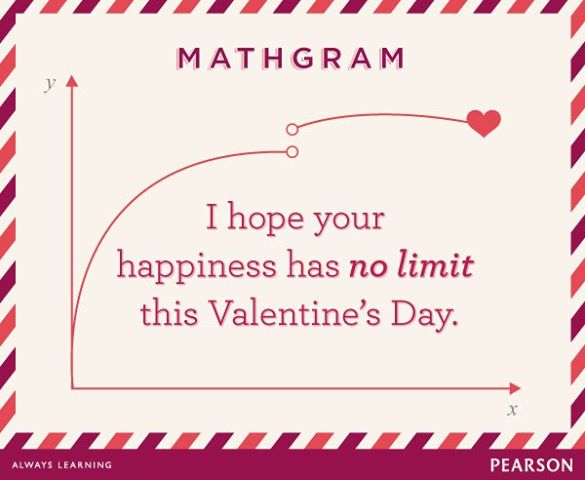
No joke, a textbook publisher sent me this image on Valentine’s Day.
On joking with students
At some point in recent years, my students lost the ability of discerning when I playfully give them a hard time. To pick just one example of many from last semester…
Student: Did you get my homework that was slid under your door last Thursday?
Me: Oh, so *that’s* what I threw in the trash on Friday.
Student: (groans) I told my friend that she should’ve put it in your mailbox. Is there anything I can do to get my homework to you?
Me: Nope. C’est la vie.
I kept this up for about a minute before telling him that I was only kidding and that I had his homework. And this is just one of several anecdotes I could relate.
I conclude that either:
- I’m a world-class comedic straight-man up there with Bud Abbott and “Super” Dave Osborne,
- I’ve now old enough to be around the age of my students’ fathers instead of their older brothers, and so the jokes that worked 10 years ago elicit a different response now, or
- (more likely) Students have been so conditioned by past experiences with inflexible and uncompromising professors that they react submissively when I feign unreasonableness.
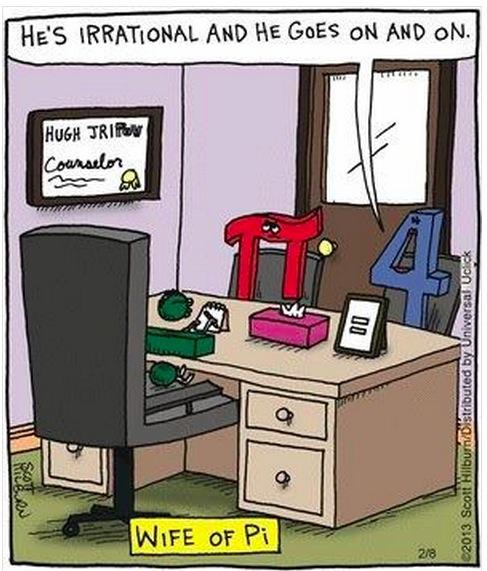
A good clean joke
Measuring terminal velocity
Using a simultaneously falling softball as a stopwatch, the terminal velocity of a whiffle ball can be obtained to surprisingly high accuracy with only common household equipment. In the January 2013 issue of College Mathematics Monthly, we describe an classroom activity that engages students in this apparently daunting task that nevertheless is tractable, using a simple model and mathematical techniques at their disposal.
 Mean Green Math