Square roots and logarithms without a calculator (Part 3)

I’m in the middle of a series of posts concerning the elementary operation of computing a square root. This is such an elementary operation because nearly every calculator has a \sqrt{~~} button, and so students today are accustomed to quickly getting an answer without giving much thought to (1) what the answer means or (2) what magic the calculator uses to find square roots. I like to show my future secondary teachers a brief history on this topic… partially to deepen their knowledge about what they likely think is a simple concept, but also to give them a little appreciation for their elders.

Today’s topic is the use of log tables. I’m guessing that many readers have either forgotten how to use a log table or else were never even taught how to use them. After showing how log tables were used in the past, I’ll conclude with some thoughts about its effectiveness for teaching students logarithms for the first time.

This will be a fairly long post about log tables. In the next post, I’ll discuss how log tables can be used to compute square roots.

To begin, let’s again go back to a time before the advent of pocket calculators… say, 1912.

Before the advent of pocket calculators, most professional scientists and engineers had mathematical tables for keeping the values of logarithms, trigonometric functions, and the like. The following images come from one of my prized possessions: College Mathematics, by Kaj L. Nielsen (Barnes & Noble, New York, 1958). Some saint gave this book to me as a child in the late 1970s; trust me, it was well-worn by the time I actually got to college.

With the advent of cheap pocket calculators, mathematical tables are a relic of the past. The only place that any kind of mathematical table common appears in modern use are in statistics textbooks for providing areas and critical values of the normal distribution, the Student t distribution, and the like.

That said, mathematical tables are not a relic of the remote past. When I was learning logarithms and trigonometric functions at school in the early 1980s — one generation ago — I distinctly remember that my school textbook had these tables in the back of the book.

And it’s my firm opinion that, as an exercise in history, log tables can still be used today to deepen students’ facility with logarithms. In this post and Part 4 of this series, I discuss how the log table can be used to compute logarithms and (using the language of past generations) antilogarithms without a calculator. In Part 5, I’ll discuss my opinions about the pedagogical usefulness of log tables, even if logarithms can be computed more easily nowadays with scientific calculators. In Part 6, I’ll return to square roots — specifically, how log tables can be used to find square roots.

logtables1 logtables2

How to use the table, Part 1. How do you read this table? The left-most column shows the ones digit and the tenths digit, while the top row shows the hundredths digit. So, for example, the bottom row shows ten different base-10 logarithms:

\log_{10} 9.90 \approx 0.9956, \log_{10} 9.91 \approx 0.9961, \log_{10} 9.92 \approx 0.9965,

\log_{10} 9.93 \approx 0.9969, \log_{10} 9.94 \approx 0.9974, \log_{10} 9.95 \approx 0.9978,

\log_{10} 9.96 \approx 0.9983, \log_{10} 9.97 \approx 0.9987, \log_{10} 9.98 \approx 0.9991,

\log_{10} 9.99 \approx 0.9996

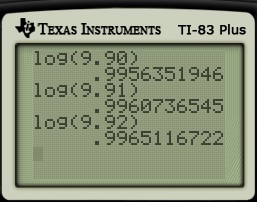
So, rather than punching numbers into a calculator, the table was used to find these logarithms. You’ll notice that these values match, to four decimal places, the values found on a modern calculator.
TIlog

How to use the table, Part 2. What if we’re trying to take the logarithm of a number between 1 and 10 which has more than two digits after the decimal point, like \log_{10} 5.1264? From the table, we know that the value has to lie between

\log_{10} 5.12 \approx 0.7093 and \log_{10} 5.13 \approx 0.7101

So, to estimate \log_{10} 5.1264, we will employ linear interpolation. That’s a fancy way of saying “Find the line connecting (5.12,0.7093) and (5.13,0.7101), and find the point on the line whose x-coordinate is 5.1264. The graph of $y = \log_{10} x$ is not a straight line, of course, but hopefully this linear interpolation will be reasonably close to the correct answer.

Finding this line is a straightforward exercise in the point-slope form of a line:

m = \displaystyle \frac{0.7101-0.7093}{5.13-5.12} = 0.08

y - 0.7093= 0.08 (x - 5.12)

y = 0.7093+ 0.08 (5.1264-5.12)

y = 0.7093+ 0.08(0.0064) = 0.7093 + 0.000512 = 0.709812

Remembering that this log table is only good to four significant digits, we estimate \log_{10} 5.1264 \approx 0.7098.

With a little practice, one can do the above calculations with relative ease. Also, many log tables of the past had a column called “proportional parts” that essentially replaced the step of linear interpolation, thus speeding the use of the table considerably.

Again, this matches the result of a modern calculator to four decimal places:

TIlog3

How to use the table, Part 3. So far, we’ve discussed taking the logarithms of numbers between 1 and 10 and the antilogarithms of numbers between 0 and 1. Let’s now consider what happens if we pick a number outside of these intervals.

To find \log_{10} 12,345, we observe that

\log_{10}12345 = \log_{10} (10,000 \times 1.2345)

\log_{10} 12345 = \log_{10} 10,000 + \log_{10} 1.2345

\log_{10} 12345 = 4 + \log_{10} 1.2345

More intuitively, we know that the answer must lie between \log_{10} 10,000 = 4 and 100,000 = 5, so the answer must be 4.\hbox{something}. The value of \log_{10} 1.2345 is the necessary \hbox{something}.

We then find \log_{10} 1.2345 by linear interpolation. From the table, we see that

\log_{10} 1.23 \approx 0.0899 and \log_{10} 1.24 \approx 0.0934

Employing linear interpolation, we find

m = \displaystyle \frac{0.0934-0.0899}{1.24-1.23} = 0.35

y - 0.0899= 0.35 (x - 1.23)

y = 0.0899+ 0.35 (1.2345-1.23)

y = 0.0899+ 0.35(0.0045) = 0.0899 + 0.001575 = 0.091475

Remembering that this log table is only good to four significant digits, we estimate \log_{10} 1.2345 \approx 0.0915, so that \log_{10} 12,345 \approx 4.0915.

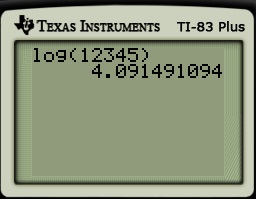
Again, this matches the result of a modern calculator to four decimal places (in this case, five significant digits):
TIlog5

How to use the table, Part 4.  Let’s now consider what happens if we pick a positive number less than 1. To find \log_{10} 0.00012345, we observe that

\log_{10}0.00012345 = \log_{10} \left( 1.2345 \times 10^{-4} \right)

\log_{10}0.00012345 = \log_{10} 1.2345 + \log_{10} 10^{-4}

\log_{10} 0.00012345 = -4 + \log_{10} 1.2345

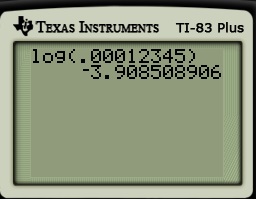
We have already found \log_{10} 1.2345 \approx 0.0915 by linear interpolation. We therefore conclude that \log_{10} 12,345 \approx 0.0915 - 4 = -3.9085. Again, this matches the result of a modern calculator to four decimal places (in this case, five significant digits):

TIlog6

green line

So that’s how to compute logarithms without a calculator: we rely on somebody else’s hard work to compute these logarithms (which were found in the back of every precalculus textbook a generation ago), and we make clever use of the laws of logarithms and linear interpolation.

Log tables are of course subject to roundoff errors. (For that matter, so are pocket calculators, but the roundoff happens so deep in the decimal expansion — the 12th or 13th digit — that students hardly ever notice the roundoff error and thus can develop the unfortunate habit of thinking that the result of a calculator is always exactly correct.)

For a two-page table found in a student’s textbook, the results were typically accurate to four significant digits. Professional engineers and scientists, however, needed more accuracy than that, and so they had entire books of tables. A table showing 5 places of accuracy would require about 20 printed pages, while a table showing 6 places of accuracy requires about 200 printed pages. Indeed, if you go to the old and dusty books of any decent university library, you should be able to find these old books of mathematical tables.

In other words, that’s how the Brooklyn Bridge got built in an era before pocket calculators.

At this point you may be asking, “OK, I don’t need to use a calculator to use a log table. But let’s back up a step. How were the values in the log table computed without a calculator?” That’s a perfectly reasonable question, but this post is getting long enough as it is. Perhaps I’ll address this issue in a future post.

Square roots and logarithms without a calculator (Part 2)

I’m in the middle of a series of posts concerning the elementary operation of computing a square root. This is such an elementary operation because nearly every calculator has a \sqrt{~~} button, and so students today are accustomed to quickly getting an answer without giving much thought to (1) what the answer means or (2) what magic the calculator uses to find square roots.

I like to show my future secondary teachers a brief history on this topic… partially to deepen their knowledge about what they likely think is a simple concept, but also to give them a little appreciation for their elders. Indeed, when I show this method to today’s college students, they are absolutely mystified that a square root can be extracted by hand, without the aid of a calculator.

To begin, let’s again go back to a time before the advent of pocket calculators… say, ancient Rome. (I personally love using Back to the Future for the pedagogical purpose of simulating time travel, but I already used that in the previous post.)

How did previous generations figure out \sqrt{4213} without a calculator? In the previous post, I introduced a trapping method that directly used the definition of \sqrt{~~} for obtaining one digit at a time. Here’s a second trapping method that’s significantly more efficient. As we’ll see, this second method works because of base-10 arithmetic and a very clever use of Algebra I. My understanding is that this procedure was a standard topic in the mathematical training of children as little as 50 years ago.

Personally, I was taught this method when I was maybe 10 or 11 years old by my math teacher; I don’t doubt that she had to learn to extract square roots by hand when she was a student. Of course, this trapping method fell out of pedagogical favor with the advent of cheap pocket calculators.

I’ll illustrate this method again with \sqrt{4213}. After illustrating the method, I’ll discuss how it works using Algebra I.

green line

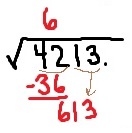
1. To begin, we start from the decimal point and group digits in block of two. (If the number had been 413, then the 4 would have been in a group by itself.) I start with the 42. What perfect square is closest to 42 without going over? Clearly, the answer is 6. So, mimicking the algorithm for long division:

  • We’ll place a 6 over the 42, signifying that the answer is in the 60s.
  • We’ll subtract 36 from 42, for an answer of 6.

sqrt12. On the next step, we’ll do a couple of things that are different from ordinary long division:

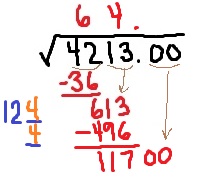
  • We’ll bring down the next two digits. So we’ll work with 613.
  • We’ll double the number currently on top and place the result to the side. In our case $6 \times 2 = 12$.
  • We’ll place a small ___ after the 12 and under the 12.
  • The basic question is: I need 120something times the same something to be as close to 613 as possible without going over. I like calling this The Price Is Right problem, since so many games on that game show involve guessing a price without going over the actual price. For example…

121 \times 1 = 121: too small

122 \times 2 = 244: too small

123 \times 3 = 369: too small

124 \times 4 = 496: too small

125 \times 5 = 625: too big

  • Based on the above work, the next digit is 4. We place the 4 over the next block of digits and subtract 124 \times 4 = 496 from 613. So we will work with 613-496 = 117 on the next step.

sqrt23. On the next step, we’ll do a couple of things that are different from ordinary long division:

  • We’ll bring down the next two digits. On this step, the next two digits are the first two zeroes after the decimal point. So we’ll work with 11,700.
  • We’ll double the number currently on top and place the result to the side. In our case $64 \times 2 = 128$.
  • We’ll place a small ___ after the 128 and under the 128.
  • The basic question is: I need 1280something times the same something to be as close to 11,700 as possible without going over. For example…

1281 \times 1 = 1281: too small

1282 \times 2 = 2564: too small

1283 \times 3 = 3849: too small

1284 \times 4 = 5136: too small

1285 \times 5 = 6425: too small

1286 \times 6 = 7716: too small

1287 \times 7 = 9009: too small

1288 \times 8 = 10,304: too small

1289 \times 9 = 11,601: still too small

  • Based on the above work, the next digit is 9. We place the 9 over the next block of digits and subtract 1289 \times 9 = 11,601 from 11,700. So we will work with 11,700-11,601 = 99 on the next step.

Then, to quote The King and I, et cetera, et cetera, et cetera. Each step extracts an extra digit of the square root. With a little practice, one gets better at guessing the correct value of x.

A personal story: when I was a teenager and too cheap to buy a magazine, I would extract square roots to kill time while waiting in the airport for a flight to start boarding. My parents hated missing flights, so I was always at the gate with plenty of time to spare… and I could extract about 20 digits of \sqrt{2} while waiting for the boarding announcement.

So why does this algorithm work? I offer a thought bubble if you’d like to think about before I give the answer.

P.S. In case anyone complains, the people of ancient Rome could not have performed this algorithm since they used Roman numerals and not a base 10 decimal system.

green_speech_bubble

To see why this works, let’s consider the first two steps of finding \sqrt{4213}. Clearly, the answer lies between 60 and 70 somewhere (that was Step 1). So the basic problem is to solve for x if

(60+x)^2 = 4213,

where x is the excess amount over 60. Squaring, we obtain

3600 + 120x + x^2 = 4213,

or

120x + x^2 = 613,

or

(120+x)x = 613

Notice that the right-hand side is 4213-3600, which was obtained at the start of Step 2. The left-hand side has the form 120something times the same something, which was the key part of completing Step 2. So the value of x that gets (120+x)x as close to 613 as possible (without going over) will be the next digit in the decimal representation of \sqrt{4213}.

The logic for the remaining digits is similar.

green line

I should mention that third roots, fourth roots, etc. can (in principle) be found using algebra to find excess amounts. However, it’s quite a bit more work for these higher roots. For example, to find the cube root of 4213, we immediately see that 10^3 = 1000 < 4213 < 8000 = 20^3, so that the answer lies between 10 and 20. To find the excess amount over 10, we need to solve

(10+x)^3 = 4213,

which reduces to

(300 + 30x + x^2)x = 3213.

So we then try out values of x so that the left-hand side gets as close to 3213 as possible without going over.

In closing, in honor of this method, here’s a great compilation of clips from The Price Is Right when the contestant guessed a price that was quite close to the actual price without going over.

Square roots and logarithms without a calculator (Part 1)

This post begins a series of posts concerning the elementary operation of computing a square root. This is such an elementary operation because nearly every calculator has a \sqrt{~~} button, and so students today are accustomed to quickly getting an answer without giving much thought to (1) what the answer means or (2) what magic the calculator uses to find square roots.

I like to show my future secondary teachers a brief history on this topic… partially to deepen their knowledge about what they likely think is a simple concept, but also to give them a little appreciation for their elders.

To begin, let’s go back to a time before the advent of pocket calculators… say, 1955. (When actually teaching this in class, I find the movie clip to be a great and brief way to get students into the mindset of going back in time.)

How did people in 1955 figure out \sqrt{4213}? After all, plenty of marvelous feats of engineering were made before the advent of calculators. So was this computed back then?

green lineOne rudimentary method is simply by trapping the solution. In other words, let’s try guessing the answer to x^2 = 4213 and see if we get it right.

1. First, the tens digit.

  • 60^2 = 3600. Too small.
  • 70^2 = 4900. Too big.
  • Since 3600 < 4213 < 4900, the answer has to be somewhere between 60 and 70.

2. Next, the ones digit. Since 4213 is about halfway between 3600 and 4900, let’s start by guessing 65.

  • 65^2 = 4225. Too big, but not much too big. So let’s try 64 next, as opposed to 62 or 63.
  • 64^2 = 4096. Too small.
  • So the answer has to be somewhere between 64 and 65.

3. Next, the tenth digit. Since 4213 is so close to 4225, let’s start closer to 65 than to 64.

  • 64.8^2 = 4199.04
  • 64.9^2 = 4212.01
  • We already know that 65.0^2 = 4225
  • So the answer has to be somewhere between 64.9 and 65.

And we keep repeating this procedure, obtaining one digit at a time. (My next guess, for the hundredths digit, would be 64.91 or 64.92.) Back in 1955, all of the above squaring was done by hand, without a calculator. With enough patience, \sqrt{4213} can be obtained to as many digits as required.

I distinctly remember using this procedure, just for the fun of it, when I was 7 or 8 years old (with the help of calculator, however). This exercise was far more cumbersome that simply hitting the \sqrt{~~} button, but it really developed my number sense as a young child, not to mention internalizing the true meaning of what a square root actually was. Little insights like “let’s start closer to 65 than to 64 just don’t come naturally without this kind of trial-and-error practice.

For what it’s worth, the above procedure is the essence of the binary search algorithm (from computer science) or the method of successive bisections (from numerical analysis), with a little human intuition thrown in for good measure.

Advertising for slide rules, from 1940

I’m about to begin a series of posts concerning how previous generations did complex mathematical calculations without the aid of scientific calculators.

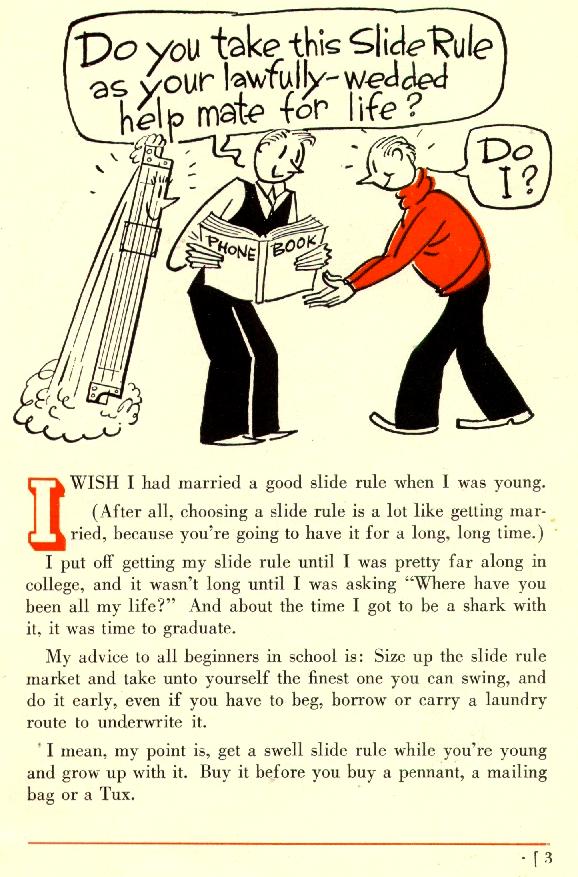
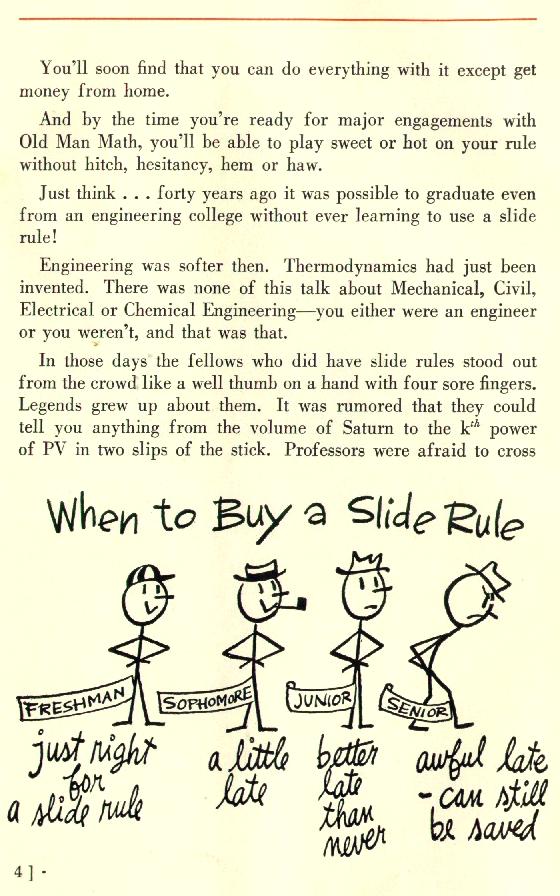
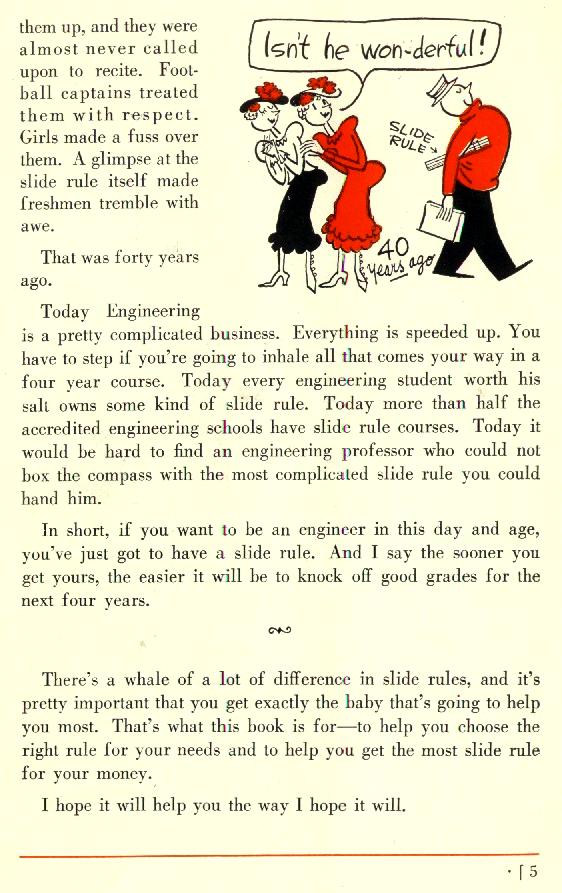
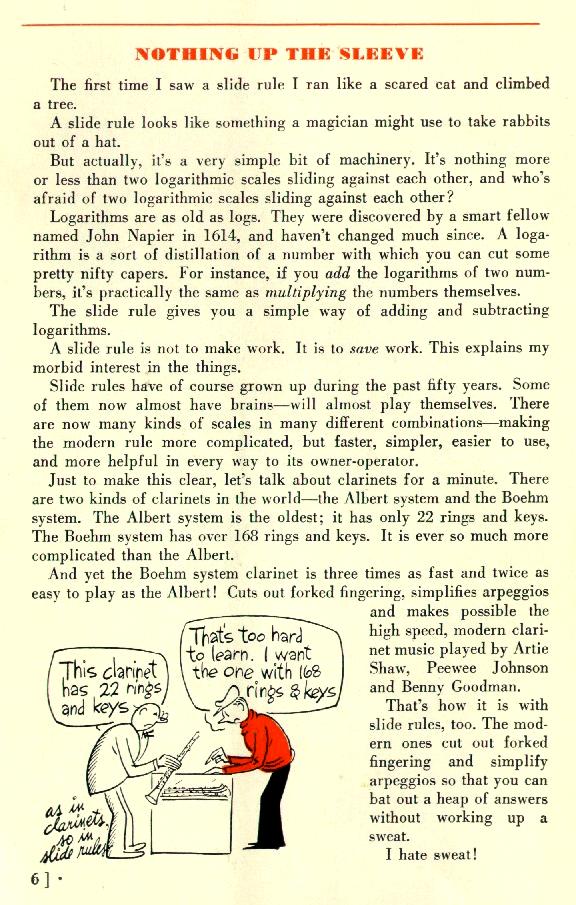
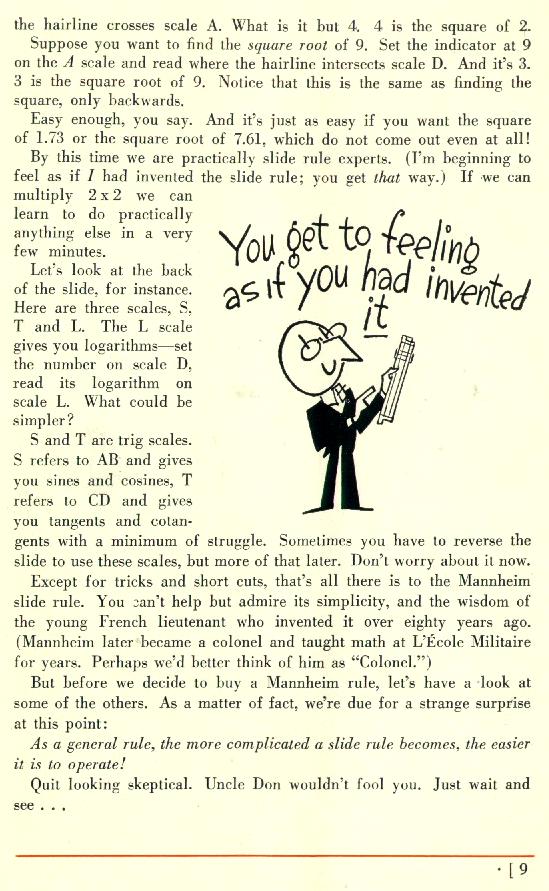
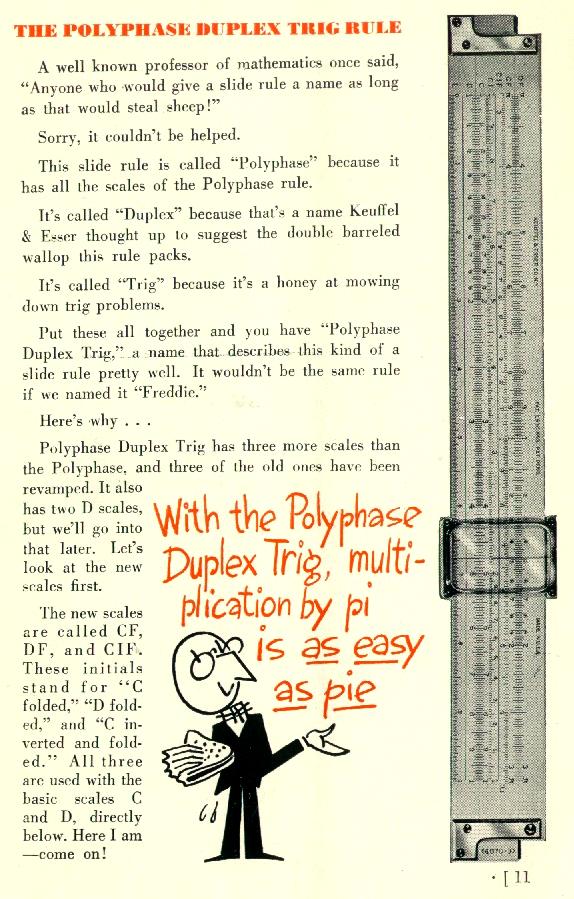
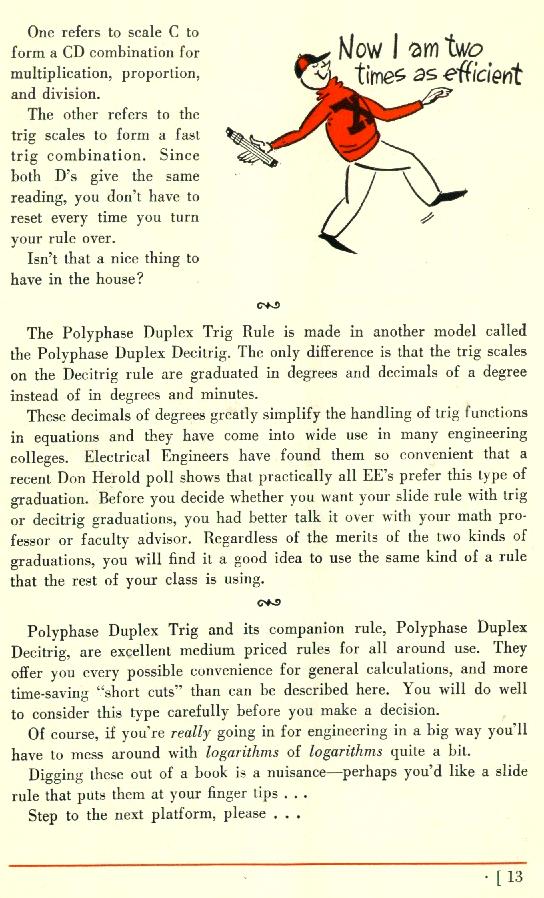
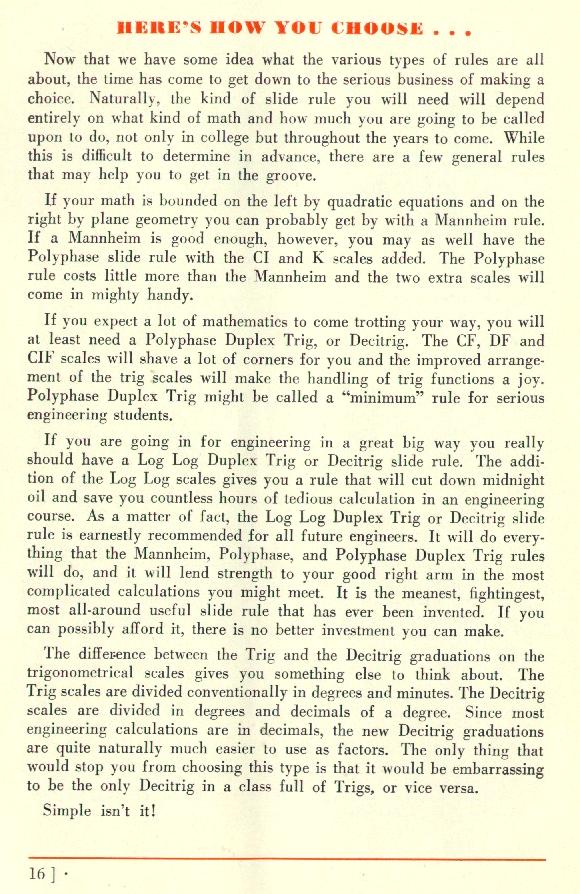
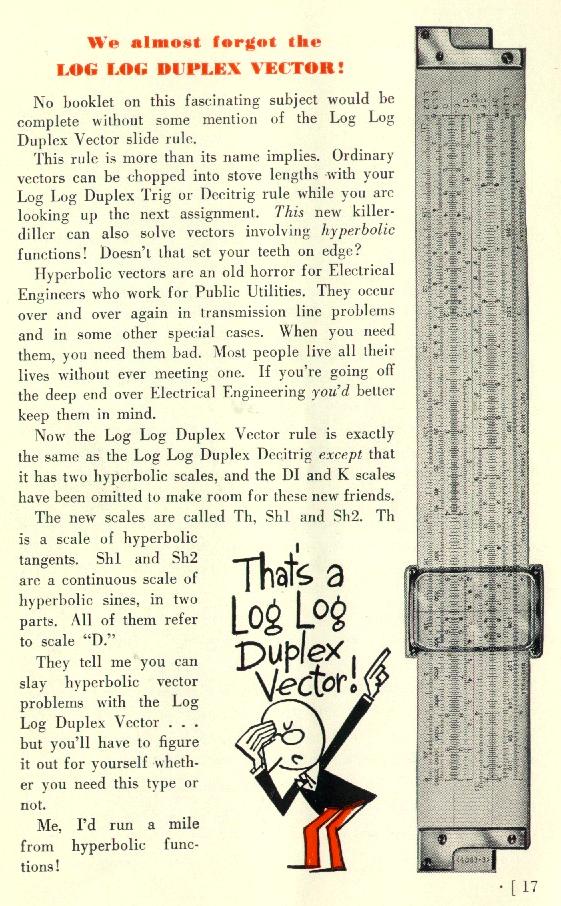
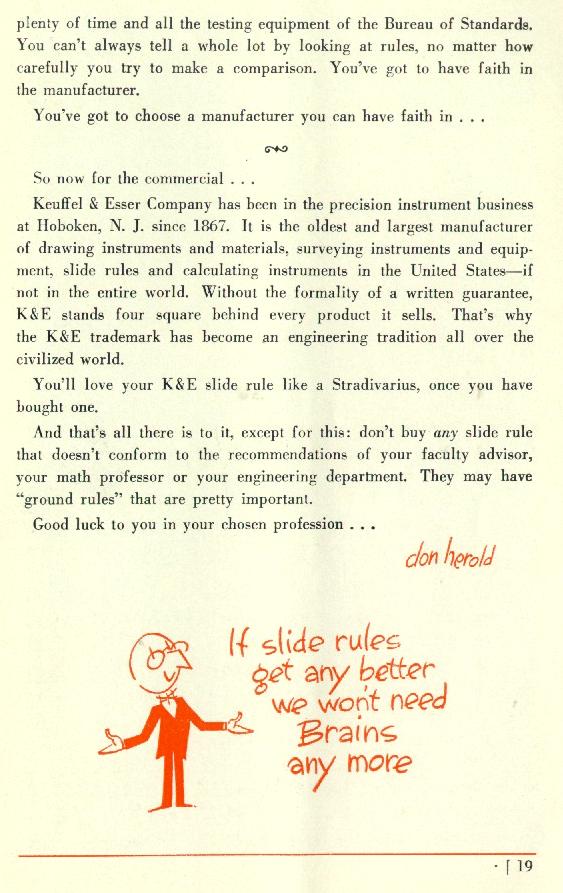
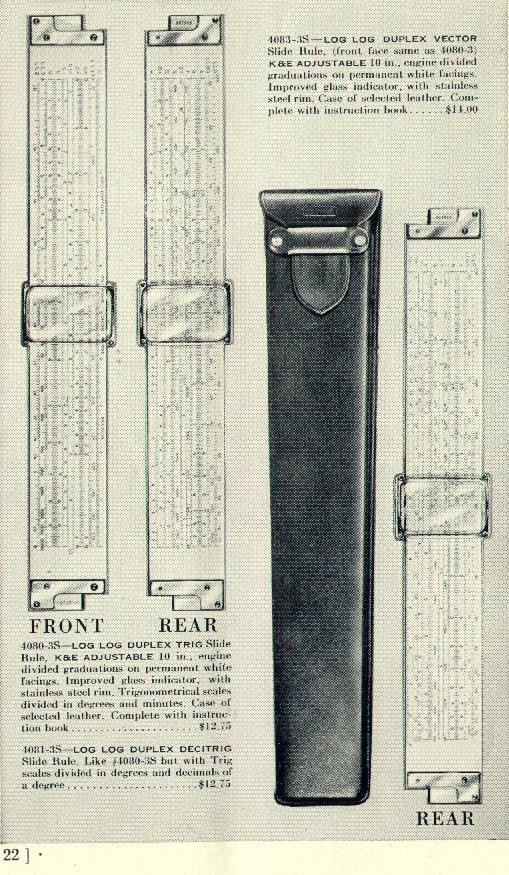
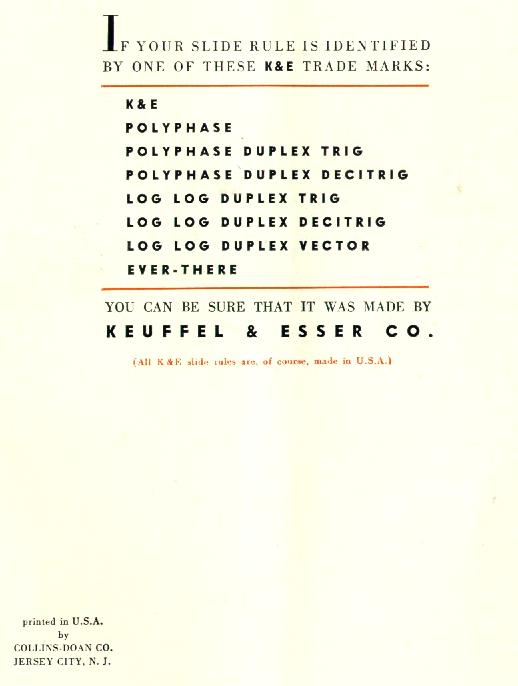
Courtesy of Slide Rule Universe, here’s an advertisement for slide rules from 1940. This is a favorite engagement activity of mine when teaching precalculus (as an application of logarithms) as well as my capstone class for future high school math teachers. I have shown this to hundreds of college students over the years (usually reading out loud the advertising through page 5 and then skimming through the remaining pictures), and this always gets a great laugh. Enjoy.

coverp3p4p5p6p7p8p9p10p11p12p13p14p15p16p17p18p19p20p21p22p23

test

Engaging students: Solving logarithmic equations

In my capstone class for future secondary math teachers, I ask my students to come up with ideas for engaging their students with different topics in the secondary mathematics curriculum. In other words, the point of the assignment was not to devise a full-blown lesson plan on this topic. Instead, I asked my students to think about three different ways of getting their students interested in the topic in the first place.

I plan to share some of the best of these ideas on this blog (after asking my students’ permission, of course).

This student submission again comes from my former student Caitlin Kirk. Her topic: how to engage Algebra II or Precalculus students when solving logarithmic equations.

green line

B. Curriculum: How does this topic extend what your students should have learned in previous courses?

Logarithms are a topic that appears at multiple levels of high school math. In Algebra II, students are first introduced to logarithms when they are asked to identify graphs of parent functions including f (x) = logax. Later in the same class, they learn to formulate equations and inequalities based on logarithmic functions by exploring the relationship between logarithms and their inverses. From there, they can develop a definition of a logarithm.

Solving logarithmic equations extends what students learned about logarithms in Algebra II. Once a proper definition of logarithms has been established, along with a graphical foundation of logs, students learn to solve logarithmic equations.  Properties of logarithms are used to expand, condense, and solve logarithms without a calculator in Pre Calculus. Practical applications of the logarithmic equation also follow from previous skills. Students learn to calculate the pH of a solution, decibel voltage gain, intensity of earthquakes measure on the Richter scale, depreciation, and the apparent loudness of sound using logarithms.

green line

C. Culture: How has this topic appeared in the news?

One application of logarithmic equations is calculating the intensity of earthquakes measured on the Richter scale using the following equation:

R = \log(A/P)

where A is the amplitude of the tremor measured in micrometers and P is the period of the tremor (time of one oscillation of the earth’s surface) measured in seconds.

Reports of earthquake activity appear in the news often and are always accompanied by a measurement from the Richter scale. One such report can be found here: http://www.bbc.co.uk/news/world-asia-20638696. As the story says, a 7.3 magnitude earthquake struck off the coast of Japan in December of 2012, and created a small tsunami. There were six aftershocks of this quake whose Richter scale measurements are also given. The article also explains how Japan has been able to enact an early warning system that predicts the intensity of an earthquake before it causes damage. All of the calculations given in this story, and almost all others involving earthquakes, involves the use of the Richter scale logarithmic equation.

green line

D. History: What are the contributions of various cultures to this topic?

The development of logarithms saw contributions from several different countries beginning with the Babylonians (2000-1600 BC) who developed the first known mathematical tables. They also introduced square multiplication in which they simply but accurately multiplied two numbers using only addition and subtraction. Michael Stifel, of Germany, was the first mathematician to use an exponent in 1544. He developed an early version of the logarithmic table containing integers and powers of 2. Perhaps the most important contribution to logarithms came from John Napier in Scotland in 1619. He, like the Babylonians, was working with on breaking multiplication, division, and root extraction down to only addition and subtraction. Therefore, he created the “logarithm” L of a number N defined as follows:

N = 10^7 (1-10^{-7})^L

for which he wrote \hbox{NapLog}(N) = L.

 Napier’s definition of the logarithm led to the following logarithmic identities that are still taught today:

\hbox{NapLog}(\sqrt{N_1N_2}) = \frac{1}{2} (\hbox{NapLog} N_1 + \hbox{NapLog} N_2)

\hbox{NapLog}(10^{-7} N_1 N_2) = \hbox{NapLog} N_1 + \hbox{NapLog} N_2

\hbox{NapLog} \left( 10^{-7} \displaystyle \frac{N_1}{N_2} \right)= \hbox{NapLog} N_1 - \hbox{NapLog} N_2

Henry Briggs, in England, published his work on logarithms in 1624, which included logarithms of 30,000 natural numbers to the 14th decimal place worked by hand! Shortly after, back in Germany, Johannes Kepler used a logarithmic scale on a Cartesian plane to create a linear graph the elliptical shape of the cosmos.  In 1632, in Italy, Bonaventura Cavalieri published extensive tables of logarithms including the logs of trig functions (excluding cosine).  Finally, Leonhard Euler made one of the most commonly known contributions to logarithms by making the number e = 2.71828\dots the base of the natural logarithm (which was also developed by Napier). While it is untrue, as is commonly believed, that Euler invented the number 2.71828\dots, he did give it the name e. He was interested in the number because he wanted to calculate the amount that would result from continually compounded interested on a sum of money and the number 2.71828\dots kept appearing as a constant in his equation. Therefore he tied e to the natural logarithm that was not as widely used because it did not have a base.

Logarithms were developed as a result of the contributions of many cultures spanning Europe and beyond, dating back over 4000 years.

Why does x^0 = 1 and x^(-n) = 1/x^n? (Part 2)

I distinctly remember when, in my second year as a college professor, a really good college student — with an SAT Math score over 650 — asked me why x^0 = 1 and x^{-n} = \displaystyle \frac{1}{x^n}. Of course, he knew that these rules were true and he could apply them in complex problems, but he didn’t know why they were true. And he wanted to have this deeper knowledge of mathematics beyond the ability to solve routine algebra problems.

He also related that he had asked his math teachers in high school why these rules worked, but he never got a satisfactory response. So he asked his college professor.

Looking back on it, I see that this was one of the incidents that sparked my interest in teacher education. As always, I never hold a grudge against a student for asking a question. Indeed, I respected my student for posing a really good question, and I was upset for him that he had not received a satisfactory answer to his question.

This is the second of two posts where I give two answers to this question from two different points of view.

Answer #2. This explanation relies on one of the laws of exponents:

x^n \cdot x^m = x^{n+m}

For positive integers n and m, this can be proven by repeated multiplication:

x^n x^m = (x \cdot x \dots \cdot x) \cdot (x \cdot x \dots \cdot x)       repeated n times and m times

x^n x^m = x \cdot x \cdot \dots \cdot x \cdot x \cdot \dots \cdot x       repeated n+m times

x^n \cdot x^m = x^{n+m}

Ideally, x^0 and x^{-n} should be defined so that this rule still holds even if one (or both) of n and m is either zero or a negative integer. In particular, we should define x^0 so that the following rule holds:

x^n \cdot x^0 = x^{n+0}

x^n \cdot x^0 = x^n

In other words, the product of something with x^0 should be the original something. Clearly, the only way to make this work is if we define x^0 = 1.

In the same way, we should define x^{-n} so that the following rule holds:

x^n \cdot x^{-n} = x^{n + (-n)}

x^n \cdot x^{-n} = x^0

Being a good MIT freshman and using previous work, we see that

x^n \cdot x^{-n} = 1

Dividing, we see that

x^{-n} = \displaystyle \frac{1}{x^n}

Why does x^0 = 1 and x^(-n) = 1/x^n? (Part 1)

I distinctly remember when, in my second year as a college professor, a really good college student — with an SAT Math score over 650 — asked me why x^0 = 1 and x^{-n} = \displaystyle \frac{1}{x^n}. Of course, he knew that these rules were true and he could apply them in complex problems, but he didn’t know why they were true. And he wanted to have this deeper knowledge of mathematics beyond the ability to solve routine algebra problems.

He also related that he had asked his math teachers in high school why these rules worked, but he never got a satisfactory response. So he asked his college professor.

Looking back on it, I see that this was one of the incidents that sparked my interest in teacher education. As always, I never hold a grudge against a student for asking a question. Indeed, I respected my student for posing a really good question, and I was upset for him that he had not received a satisfactory answer to his question.

This is the first of two posts where I give two answers to this question from two different points of view.

Answer #1. Let’s recall the definition of x^n for positive integers x:

x^4 = x \cdot x \cdot x \cdot x \cdot x

x^3 = x \cdot x \cdot x

x^2 = x \cdot x

x^1 = x

Starting from the bottom, the exponents increase by 1 with each step up, while an extra x is multiplied with each step up.

Of course, there’s no reason why we can’t proceed downward instead of upward. With each step down, the exponents decrease by 1, while an extra x is divided from the right-hand side. So it makes sense to define

x^0 = \displaystyle \frac{x}{x} = 1.

We can continue decreasing the exponent — into the negative numbers — by continuing to divide by x:

x^{-1} = \displaystyle \frac{1}{x}

x^{-2} = \displaystyle \frac{1/x}{x} = \displaystyle \frac{1}{x^2}

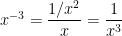
x^{-3} = \displaystyle \frac{1/x^2}{x} = \displaystyle \frac{1}{x^3}

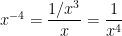
x^{-4} = \displaystyle \frac{1/x^3}{x} = \displaystyle \frac{1}{x^4}

We see that, if n is positive and -n is negative, that x^{-n} = \displaystyle \frac{1}{x^n}.

Technically, this only provides an explanation for this rule for negative integers. However, I haven’t met a student that didn’t believe this rule held for negative rational exponents (or negative irrational exponents) after seeing the above explanation for negative integers.

Unsolved problems: the Collatz conjecture

Students at all levels — elementary, middle, secondary, and college — tend to think that either (1) all the problems in mathematics have already been solved, or else (2) some unsolved problems remain but only an expert can understand even the statement of the problem.

There are plenty of famous unsolved problems in mathematics. And the Collatz conjecture is an easily stated unsolved problem that can be understood by most fourth and fifth graders.

Here’s the statement of the problem.

  • Start with any positive integer.
  • If the integer is even, divide it by 2. If it’s odd, multiply it by 3 and then add 1.
  • Repeat until (and if) you reach 1.

That’s it. From Wikipedia:

For instance, starting with 6, one gets the sequence 6, 3, 10, 5, 16, 8, 4, 2, 1.

Starting with 11, for example, takes longer to reach 1: 11, 34, 17, 52, 26, 13, 40, 20, 10, 5, 16, 8, 4, 2, 1.

The sequence for 27 takes 111 steps, climbing to 9232 before descending to 1: 27, 82, 41, 124, 62, 31, 94, 47, 142, 71, 214, 107, 322, 161, 484, 242, 121, 364, 182, 91, 274, 137, 412, 206, 103, 310, 155, 466, 233, 700, 350, 175, 526, 263, 790, 395, 1186, 593, 1780, 890, 445, 1336, 668, 334, 167, 502, 251, 754, 377, 1132, 566, 283, 850, 425, 1276, 638, 319, 958, 479, 1438, 719, 2158, 1079, 3238, 1619, 4858, 2429, 7288, 3644, 1822, 911, 2734, 1367, 4102, 2051, 6154, 3077, 9232, 4616, 2308, 1154, 577, 1732, 866, 433, 1300, 650, 325, 976, 488, 244, 122, 61, 184, 92, 46, 23, 70, 35, 106, 53, 160, 80, 40, 20, 10, 5, 16, 8, 4, 2, 1

The longest progression for any initial starting number less than 100 million is 63,728,127, which has 949 steps. For starting numbers less than 1 billion it is 670,617,279, with 986 steps, and for numbers less than 10 billion it is 9,780,657,630, with 1132 steps.

Here’s the question: Does this sequence eventually reach 1 no matter the starting value? Or is there a number out there that you could use as a starting value that has a sequence that never reaches 1?

Like I said, this is an easily stated problem that most fourth graders could understand. And no one knows the answer. Every number that’s been tried by computer has produced a sequence that eventually reaches 1. But that doesn’t mean that there isn’t a bigger number out there that doesn’t reach 1.

I’ll refer to the above Wikipedia page (and references therein) for further reading about the Collatz conjecture. Pedagogically, I suggest that casually mentioning this unsolved problem in class might inspire students to play with mathematics on their own, rather than think that all of mathematics has already been solved by somebody.

xkcdcollatz_conjecture

Source: http://www.xkcd.com/710/