I’m guessing that not many people ever blocked time out of their busy schedules to purposefully memorize the decimal representation of a fraction. Nevertheless, in my experience, most math majors and math teachers can immediately convert, from memory, most (but not all — more on this later) fractions of the form into its decimal representation as long as the denominator is less than or equal to . They can also go the other direction, mentally recognizing a decimal expansion as a fraction of this form.
This memorization occurs not because of purposeful study but because these fractions arise so commonly from 6th grade through college that students can’t help but memorize them. They just come up so often that good students almost can’t help but memorize them.
Here are the decimal representations of , where the fraction is in lowest terms and .
Like I said, most (but not all) of these have been memorized by math majors and math teachers. The exceptions, not surprisingly, are the fractions with a denominator of .
When I was a child, I read somewhere the following rule for memorizing the decimal expansion of . I must have been lucky, because I have yet to meet a student that also saw this rule. The following is not a formal proof of the rule, but it does work for the purposes of memorization.
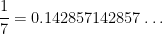
Step 1. Let’s begin with . The decimal expansion can be remembered by repeating “3, 2, 6” along with repeating “up, down.” Repeating both patterns, we get
up 3
down 2
up 6
down 3
up 2
down 6
So,
Start at :
up 3:
down 2:
up 6:
down 3:
up 2:
down 6:
The pattern returns back to , and the digits repeat. That’s the decimal expansion:
Steps 2-6. For , the digits repeat in the same pattern as , just starting at a different place. For example:
For , the second smallest of the digits is . So we’ll drop the first and and start on :
For , the fourth smallest of the digits is . So we’ll drop the first , , , and and start on :
P.S. Plenty of math majors (though perhaps not a majority) have also memorized the decimal expansions of and . For , the rule is multiply by to form the two-digit repeating block. In other words:
, and so
, and so
, and so
For , the only lowest-term fractions are , , , and . To begin, the first should be memorized:
The others are obtained by addition or subtraction:
I'm a Professor of Mathematics and a University Distinguished Teaching Professor at the University of North Texas. For eight years, I was co-director of Teach North Texas, UNT's program for preparing secondary teachers of mathematics and science.
View all posts by John Quintanilla
Published
One thought on “Thoughts on 1/7 and other rational numbers (Part 1)”
















 Mean Green Math
One thought on “Thoughts on 1/7 and other rational numbers (Part 1)”