
I’m trying to understand the economics of youth club sports, without success.
Many families pay lots of money for their children, often as young as 11, to play on select club teams. Often there is the hope that, with this training at a young age, their future college costs will be covered by an athletic scholarship.
Looking at club volleyball teams where I live, the typical price for being on a select club teams is approximately $2,000 for the academic year and perhaps the same amount of money for more intense training over the summer.
That’s $4,000 a year for maybe 8 years, or $32,000. If simply deposited in the bank, that’s enough to cover all or nearly all of 4 years of in-state tuition, room, and board at most public universities… whether or not the child is eventually good enough to play a sport in college.
I’m told that the annual costs of a premier studio for instruction in dance and music are comparable.
My conclusion: if your child loves a sport (and is really good at it), and you can see your child’s character grow through participating, and you have the financial ability for him/her to play on a select team, by all means, feel free to encourage your child in this direction. The intangible benefit of encouraging a child in finding his/her passion (if affordable by the parents) is probably immeasurable strictly in terms of dollars and cents. Just be aware that the total cost of training a future athlete via select club teams is comparable to the cost of going to college in the first place.
(Full disclaimer: growing up as a math nerd with no empirically measurable athletic ability, I had no firsthand contact with club sports when I was young.)
 , apparently targeted toward mathematicians.
 . A valid answer gets 4 points; the smallest answer in the class will get 5 points.” It was basically free extra credit… any positive number would work, but it was a (hopefully) fun way for students to be a little competitive in coming up with small positive numbers, which is the intuitive meaning of
  or
or  . Except for one particularly gutsy student who wrote, “The probability that Dr. Q gets a date on Friday night.” For sheer nerve, he got the 5 points that year.
 be the smallest answer that anyone else wrote. Then
  .” That was especially clever from a calculus student, as that’s the essence of a fairly common technique when writing proofs in real analysis.
 . The inner planets are in the vicinity of Stockholm, while the outer planets, dwarf planets, and distant objects are spread throughout the country.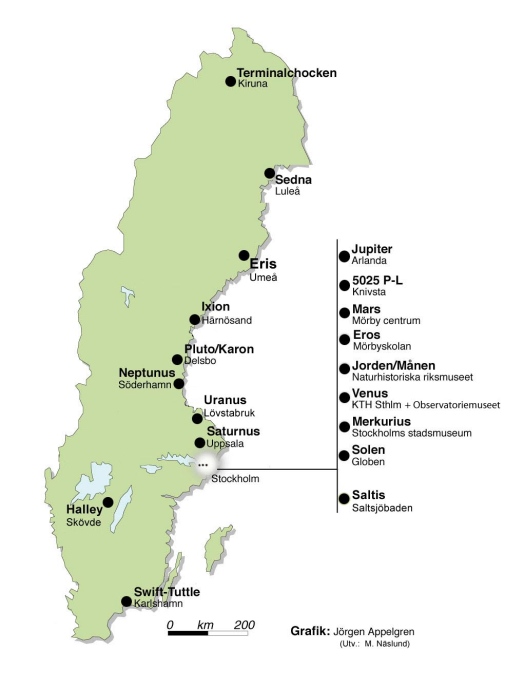

 ). A good formal write-up for why this works, with specific discussion about implementing this in a middle-school classroom, can be found here:
  Mean Green Math