

Source: http://www.xkcd.com/184/
P.S. In case you don’t get the joke… and are wondering why the answer isn’t ![[a_2, -a_1]^T](https://s0.wp.com/latex.php?latex=%5Ba_2%2C+-a_1%5D%5ET&bg=ffffff&fg=000000&s=0&c=20201002)

where 
Source: http://www.xkcd.com/184/
P.S. In case you don’t get the joke… and are wondering why the answer isn’t
where
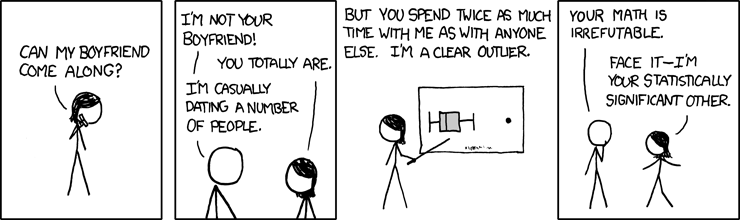
Source: http://www.xkcd.com/539/
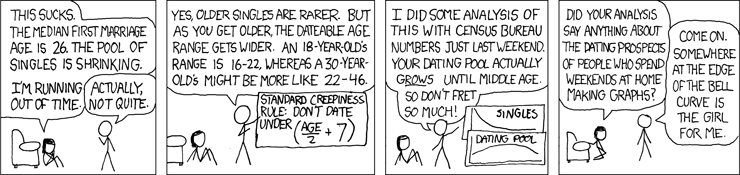
Source: http://www.xkcd.com/314/
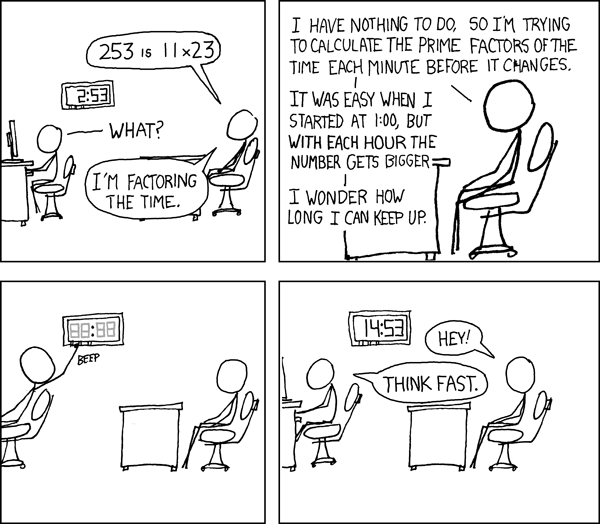
True story: one way that I commit large numbers to (hopefully) short-term memory is by factoring. If I take the time to factor a big number, then I can usually remember it for a little while.
This approach has occasional disadvantages. For example, I now have stuck in my brain the completely useless information that, many years ago, my seat at a Texas Rangers ballgame was somewhere in Section 336 (which is 
Source: http://www.xkcd.com/247/
I’m about to do a series of posts concerning square roots and logarithms. So I thought that this picture would be an appropriate introduction to the topic. (One of these days, I’ll spring for the wall poster version of this picture to hang in my office.)
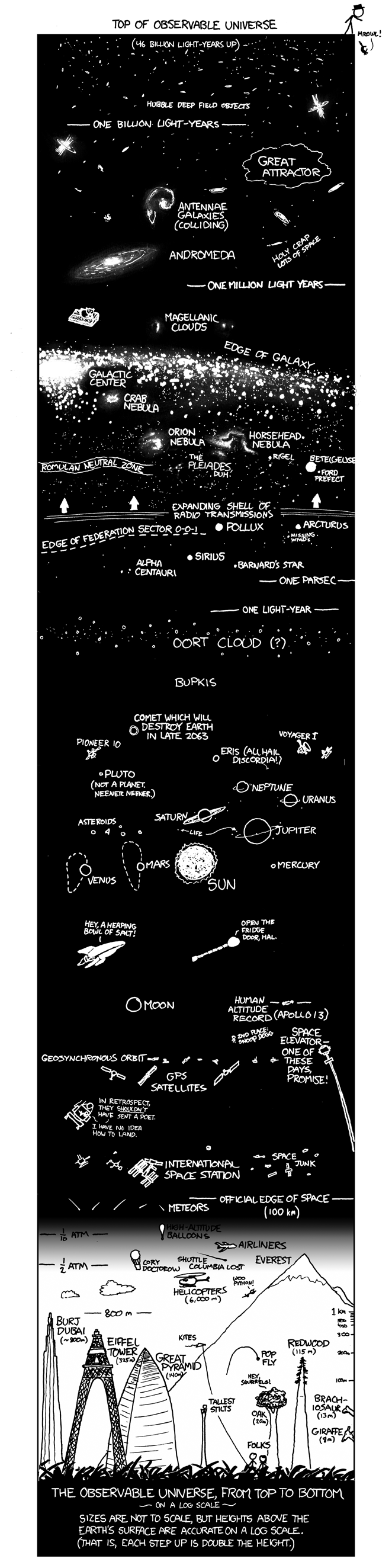
Source: http://www.xkcd.com/482/
Students at all levels — elementary, middle, secondary, and college — tend to think that either (1) all the problems in mathematics have already been solved, or else (2) some unsolved problems remain but only an expert can understand even the statement of the problem.
There are plenty of famous unsolved problems in mathematics. And the Collatz conjecture is an easily stated unsolved problem that can be understood by most fourth and fifth graders.
Here’s the statement of the problem.
 . If it’s odd, multiply it by
  and then add
  ..
..That’s it. From Wikipedia:
For instance, starting with 6, one gets the sequence 6, 3, 10, 5, 16, 8, 4, 2, 1.
Starting with 11, for example, takes longer to reach 1: 11, 34, 17, 52, 26, 13, 40, 20, 10, 5, 16, 8, 4, 2, 1.
The sequence for 27 takes 111 steps, climbing to 9232 before descending to 1: 27, 82, 41, 124, 62, 31, 94, 47, 142, 71, 214, 107, 322, 161, 484, 242, 121, 364, 182, 91, 274, 137, 412, 206, 103, 310, 155, 466, 233, 700, 350, 175, 526, 263, 790, 395, 1186, 593, 1780, 890, 445, 1336, 668, 334, 167, 502, 251, 754, 377, 1132, 566, 283, 850, 425, 1276, 638, 319, 958, 479, 1438, 719, 2158, 1079, 3238, 1619, 4858, 2429, 7288, 3644, 1822, 911, 2734, 1367, 4102, 2051, 6154, 3077, 9232, 4616, 2308, 1154, 577, 1732, 866, 433, 1300, 650, 325, 976, 488, 244, 122, 61, 184, 92, 46, 23, 70, 35, 106, 53, 160, 80, 40, 20, 10, 5, 16, 8, 4, 2, 1
The longest progression for any initial starting number less than 100 million is 63,728,127, which has 949 steps. For starting numbers less than 1 billion it is 670,617,279, with 986 steps, and for numbers less than 10 billion it is 9,780,657,630, with 1132 steps.
Here’s the question: Does this sequence eventually reach
Like I said, this is an easily stated problem that most fourth graders could understand. And no one knows the answer. Every number that’s been tried by computer has produced a sequence that eventually reaches
I’ll refer to the above Wikipedia page (and references therein) for further reading about the Collatz conjecture. Pedagogically, I suggest that casually mentioning this unsolved problem in class might inspire students to play with mathematics on their own, rather than think that all of mathematics has already been solved by somebody.

Source: http://www.xkcd.com/710/

Source: http://www.xkcd.com/263/
When teaching my Applied Statistics class, I’ll often use the following xkcd comic to reinforce the meaning of statistical significance.

The idea that’s being communicated is that, when performing an hypothesis test, the observed significance level 

In practice, statisticians use the Bonferroni correction when performing multiple simultaneous tests to avoid the erroneous conclusion displayed in the comic.
Source: http://www.xkcd.com/882/
 Mean Green Math