In 1990 and 1991, columnist Marilyn vos Savant (who once held the Guinness World Record for “Highest IQ”) set off a small firestorm when a reader posed the famous Monty Hall Problem to her:
Suppose you’re on a game show, and you’re given the choice of three doors. Behind one door is a car, behind the others, goats. You pick a door, say #1, and the host, who knows what’s behind the doors, opens another door, say #3, which has a goat. He says to you, “Do you want to pick door #2?” Is it to your advantage to switch your choice of doors?
She gave the correct answer: it’s in your advantage to switch. This launched an avalanche of mail (this was the early 90’s, when e-mail wasn’t as popular) complaining that she gave the incorrect answer. Perhaps not surprisingly, none of the complainers actually tried the experiment for themselves. She explained her reasoning — in two different columns — and then offered a challenge:
And as this problem is of such intense interest, I’m willing to put my thinking to the test with a nationwide experiment. This is a call to math classes all across the country. Set up a probability trial exactly as outlined below and send me a chart of all the games along with a cover letter repeating just how you did it so we can make sure the methods are consistent.
One student plays the contestant, and another, the host. Label three paper cups #1, #2, and #3. While the contestant looks away, the host randomly hides a penny under a cup by throwing a die until a 1, 2, or 3 comes up. Next, the contestant randomly points to a cup by throwing a die the same way. Then the host purposely lifts up a losing cup from the two unchosen. Lastly, the contestant “stays” and lifts up his original cup to see if it covers the penny. Play “not switching” two hundred times and keep track of how often the contestant wins.
Then test the other strategy. Play the game the same way until the last instruction, at which point the contestant instead “switches” and lifts up the cup not chosen by anyone to see if it covers the penny. Play “switching” two hundred times, also.
You can read the whole exchange here: http://marilynvossavant.com/game-show-problem/
For much more information — and plenty of ways (some good, some not-so-good) of explaining this very counterintuitive result, just search “Monty Hall Problem” on either Google or YouTube.
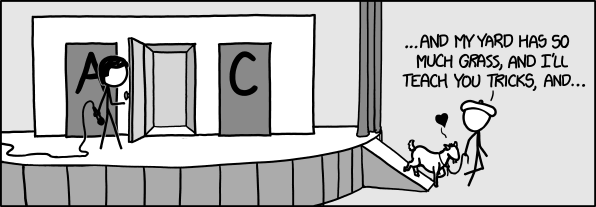
Source: http://www.xkcd.com/1282/


Earth gravity. Hence, Earth’s well is 6,000 km deep.





 Mean Green Math