Inverse functions: Arcsine and SSA (Part 14)

We’ve seen in this series that blinding using the arcsine function on a calculator is insufficient for finding all solutions of an equation like \sin \theta = 0.8. In today’s post, I discuss one of the first places that this becomes practically important: solving the ambiguous case of solving a triangle given two sides and an nonincluded angle.

A note on notation: when solving for the parts of \triangle ABC, a will be the length of the side opposite \angle A, b will be the length of the side opposite \angle B, and c will be the length of the side opposite angle C. Also \alpha will be the measure of \angle A, \beta will be measure of \angle B, and \gamma will be the measure of \angle C. Modern textbooks tend not to use \alpha, \beta, and \gamma for these kinds of problems, for which I have only one response:

philistines

Why does an SSA triangle produce an ambiguous case (unlike the SAS, SSS, or ASA cases)? Here’s a possible problem that has exactly one solution:

Solve \triangle ABC if a = 15, c = 10, and \alpha = 30^\circ.

A student new to the Law of Sines might naively start solving the problem by drawing something like this:

badSSA3

Of course, that’s an inaccurate picture that isn’t drawn to scale. A more accurate picture would look like this:

SSA3

Notice that the red circle intersects the dashed black line at exactly one point. Therefore, we know that there will be exactly one solution for this case. We also note that the circle would have intersected the black dashed line had the dashed line been extended to the left. This will become algebraically clear in the solution below.

Of course, students should not be expected to make a picture this accurately when doing homework. Fortunately, this impossibility naturally falls out of the equation when using the Law of Sines:

\displaystyle \frac{\sin \alpha}{a} = \displaystyle \frac{\sin \gamma}{c}

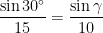
\displaystyle \frac{\sin 30^\circ}{15} = \displaystyle \frac{\sin \gamma}{10}

\displaystyle \frac{1/2}{15} = \displaystyle \frac{\sin \gamma}{10}

\displaystyle \frac{1}{3} = \sin \gamma

At this point, the natural inclination of a student is to pop out the calculator and find \sin^{-1} \frac{1}{3}.

SSAcalc1

This is incorrect logic that, as we’ll see tomorrow, nevertheless leads to the correct conclusion. This is incorrect logic because there are two angles between 0^\circ and 180^\circ with a sine of 1/3. There is one solution in the first quadrant (the unique answer specified by arcsine), and there is another answer in the second quadrant — which is between 90^\circ and 180^\circ and hence not a permissible value of arcsine. Let me demonstrate this in three different ways.

First, let’s look at the graph of y = \sin x (where, for convenience, the units of the x-axis are in degrees). This graph intersects the line y = \frac{1}{3} in two different places between 0^\circ and 180^\circ. This does not violate the way that arcsine was defined — arcsine was defined using the restricted domain [-\pi/2,\pi/2], or [-90^\circ, 90^\circ] in degrees.

sinewaveSSA

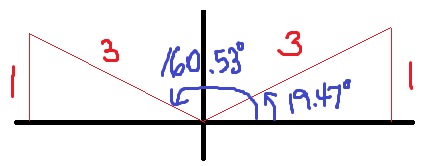
Second, let’s look at drawing angles in standard position. The angle in the second quadrant is clearly the reflection of the angle in the first quadrant through the y-axis.

standardSSA

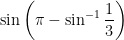
Third, let’s use a trigonometric identity to calculate \sin \left( \pi - \sin^{-1} \displaystyle \frac{1}{3} \right):

\sin \left( \pi - \sin^{-1} \displaystyle \frac{1}{3} \right) = \sin \pi \cos \left( \sin^{-1} \displaystyle \frac{1}{3} \right) - \cos \pi \sin \left( \sin^{-1} \displaystyle \frac{1}{3} \right)

=0 \cdot \cos \left( \sin^{-1} \displaystyle \frac{1}{3} \right) + 1 \cdot \sin \left( \sin^{-1} \displaystyle \frac{1}{3} \right)

= \displaystyle \frac{1}{3}

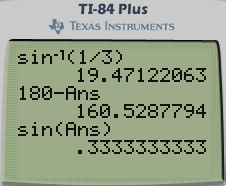
Fourth, and perhaps most convincingly for modern students (to my great frustration), let’s use a calculator:

SSAcalc3

 All this to say, blinding computing \sin^{-1} \frac{1}{3} uses incorrect logic when solving this problem.

green line

Tomorrow, we’ll examine what happens when we try to solve the triangle using these two different solutions for \gamma.

Inverse functions: Arcsine and SSA (Part 13)

We’ve seen in this series that blinding using the arcsine function on a calculator is insufficient for finding all solutions of an equation like \sin \theta = 0.8. In today’s post, I discuss one of the first places that this becomes practically important: solving the ambiguous case of solving a triangle given two sides and an nonincluded angle.

A note on notation: when solving for the parts of \triangle ABC, a will be the length of the side opposite \angle A, b will be the length of the side opposite \angle B, and c will be the length of the side opposite angle C. Also \alpha will be the measure of \angle A, \beta will be measure of \angle B, and \gamma will be the measure of \angle C. Modern textbooks tend not to use \alpha, \beta, and \gamma for these kinds of problems, for which I have only one response:

philistines

Why does an SSA triangle produce an ambiguous case (unlike the SAS, SSS, or ASA cases)? Here’s a possible problem that has exactly one solution:

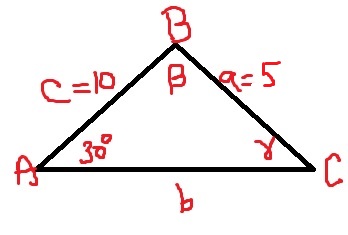
Solve \triangle ABC if a = 5, c = 10, and \alpha = 30^\circ.

A student new to the Law of Sines might naively start solving the problem by drawing something like this:

badSSA2Of course, that’s an inaccurate picture that isn’t drawn to scale. A more accurate picture would look like this:

SSA2

Notice that the red circle intersects the dashed black line at exactly one point. Therefore, we know that there will be exactly one solution for this case.

Of course, the reason that the dashed circle and line intersect at exactly one point is because a = c \sin \alpha, so that the triangle is a right triangle.

Of course, students should not be expected to make a picture this accurately when doing homework. Fortunately, this impossibility naturally falls out of the equation when using the Law of Sines:

\displaystyle \frac{\sin \alpha}{a} = \displaystyle \frac{\sin \gamma}{c}

\displaystyle \frac{\sin 30^\circ}{5} = \displaystyle \frac{\sin \gamma}{10}

\displaystyle \frac{1/2}{5} = \displaystyle \frac{\sin \gamma}{10}

\displaystyle 1 = \sin \gamma

90^\circ = \gamma

The jump to the last step is only possible because there’s exactly one angle between 0^\circ and 90^\circ whose sine is equal to 1. In the next couple posts in this series, we’ll see what happens when we get a step where 0 < \sin \gamma < 1.

Anyway, for the problem at hand, from this point forward it’s easy to solve for the remaining pieces. We begin by finding \beta:

\beta = 180^\circ - \alpha - \gamma = 60^\circ

Then we can use the Law of Sines (or, in this case, the Pythagorean Theorem), to find b:

\displaystyle \frac{\sin \alpha}{a} = \displaystyle \frac{\sin \beta}{b}

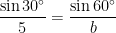
\displaystyle \frac{\sin 30^\circ}{5} = \displaystyle \frac{\sin 60^\circ}{b}

\displaystyle \frac{1/2}{5} = \displaystyle \frac{\sqrt{3}/2}{b}

b = 5\sqrt{3}

green lineIn the next few posts of this series, I’ll consider the other SSA cases — including the case where two solutions are possible.


Inverse functions: Arcsine and SSA (Part 12)

We’ve seen in this series that blinding using the arcsine function on a calculator is insufficient for finding all solutions of an equation like \sin \theta = 0.8. In today’s post, I discuss one of the first places that this becomes practically important: solving the ambiguous case of solving a triangle given two sides and an nonincluded angle.

A note on notation: when solving for the parts of \triangle ABC, a will be the length of the side opposite \angle A, b will be the length of the side opposite \angle B, and c will be the length of the side opposite angle C. Also \alpha will be the measure of \angle A, \beta will be measure of \angle B, and \gamma will be the measure of \angle C. Modern textbooks tend not to use \alpha, \beta, and \gamma for these kinds of problems, for which I have only one response:

philistines

Why does an SSA triangle produce an ambiguous case (unlike the SAS, SSS, or ASA cases)? Here’s a possible problem that has no solution:

Solve \triangle ABC if a = 3, c = 10, and \alpha = 30^\circ.

A student new to the Law of Sines might naively start solving the problem by drawing something like this:

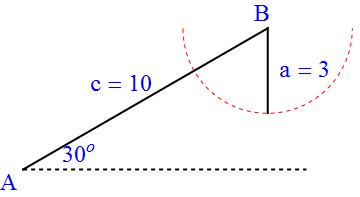
badSSAOf course, that’s an inaccurate picture that isn’t drawn to scale. A more accurate picture would look like this:

SSA1The red dashed circle with center B illustrates the dilemma: “side” BC is simply too short to reach the horizontal dashed line to make the vertex C, dangling limply from the vertex B.

Of course, students should not be expected to make a picture this accurately when doing homework. Fortunately, this impossibility naturally falls out of the equation when using the Law of Sines:

\displaystyle \frac{\sin \alpha}{a} = \displaystyle \frac{\sin \gamma}{c}

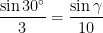
\displaystyle \frac{\sin 30^\circ}{3} = \displaystyle \frac{\sin \gamma}{10}

\displaystyle \frac{1/2}{3} = \displaystyle \frac{\sin \gamma}{10}

\displaystyle \frac{5}{3} = \sin \gamma

Since \sin \gamma must like between 0 and 1 (said another way, \sin^{-1} \frac{5}{3} is undefined), we know that this triangle cannot be solved.

green lineIn the next few posts of this series, I’ll consider the other SSA cases — including the case where two solutions are possible.


Engaging students: Using right-triangle trigonometry

In my capstone class for future secondary math teachers, I ask my students to come up with ideas for engaging their students with different topics in the secondary mathematics curriculum. In other words, the point of the assignment was not to devise a full-blown lesson plan on this topic. Instead, I asked my students to think about three different ways of getting their students interested in the topic in the first place.

I plan to share some of the best of these ideas on this blog (after asking my students’ permission, of course).

This student submission comes from my former student Shama Surani. Her topic, from Precalculus: using right-triangle trigonometry.

green line

How could you as a teacher create an activity or project that involves your topic?
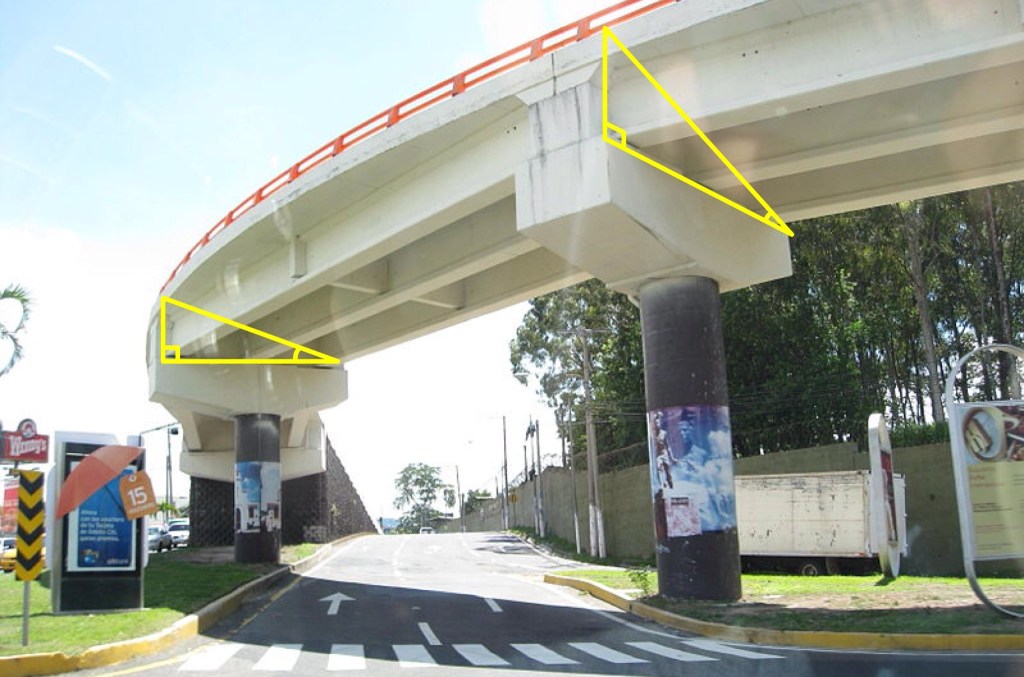
bridge

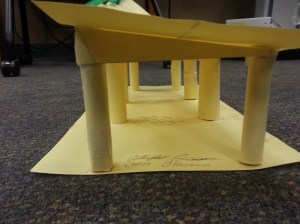
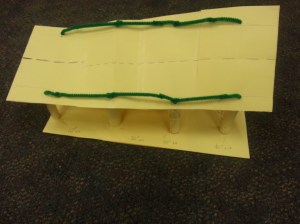
A project that Dorathy Scrudder, Sam Smith, and I did that involves right-triangle trigonometry in our PBI class last week, was to have the students to build bridges. Our driving question was “How can we redesign the bridge connecting I-35 and 635?” The students knew that the hypotenuse would be 34 feet, because there were two lanes, twelve feet each, and a shoulder of ten feet that we provided on a worksheet. As a group, they needed to decide on three to four angles between 10-45 degrees, and calculate the sine and cosine of the angle they chose. One particular group used the angle measures of 10°, 20°, 30°, and 40°. They all calculated the sine of their angles to find the height of the triangle, and used cosine to find the width of their triangle by using 34 as their hypotenuse. The picture above is by Sam Smith, and it illustrates the triangles that we wanted the students to calculate.


The students were instructed to make a scale model of a bridge so they were told that 1 feet = 0.5 centimeters. Hence, the students had to divide all their calculations by two. Then, the students had to check their measurements of their group members, and were provided materials such as cardstock, scissors, pipe cleaners, tape, rulers, and protractors in order to construct their bridges.  They had to use a ruler to measure out what they found for sine and cosine on the cardstock, and make sure when they connected the line to make the hypotenuse that the hypotenuse had a length of 17 centimeters. After they drew their triangles, they had to use a protractor to verify that the angle they chose is what one of the angles were in the triangle. When our students presented, they were able to communicate what sine and cosine represented, and grasped the concepts.

Below are pictures of the triangles and bridges that one of our groups of students constructed. Overall, the students enjoyed this project, and with some tweaks, I believe this will be an engaging project for right triangle trigonometry.
studentbridge3 studentbridge2 studentbridge1

green line

How does this topic extend what your students should have learned in previous courses?


In previous classes, such in geometry, students should have learned about similar and congruent triangles in addition to triangle congruence such as side-side-side and side-angle-side. They should also have learned if they have a right angle triangle, and they are given two sides, they can find the other side by using the Pythagorean Theorem. The students should also have been exposed to special right triangles such as the 45°-45°-90° triangles and 30°-60°-90° triangles and the relationships to the sides. Right triangle trigonometry extends the ideas of these previous classes. Students know that there must be a 45°-45°-90° triangle has side lengths of 1, 1, and \sqrt{2} which the lengths of 1 subtending the 45° angles. They also are aware that a 30°-60°-90° produces side lengths of 1, \sqrt{3} , and 2, with the side length of 1 subtending the 30°, the length of \sqrt{3} subtending the angle of 60°, and the length of 2 subtending the right angle. So, what happens when there is a right angle triangle, but the other two angles are not 45 degrees or 30 and 60 degrees? This is where right triangle trigonometry comes into play. Students will now be able to calculate the sine, cosine, and tangent and its reciprocal functions for those triangles that are right. Later, this topic will be extended to the unit circle and graphing the trigonometric functions as well as their reciprocal functions and inverse functions.


green line

What are the contributions of various cultures to this topic?


Below are brief descriptions of various cultures that personally interested me.


Early Trigonometry


The Babylonians and Egyptians studied the sides of triangles other than angle measure since the concept of angle measure was not yet discovered. The Babylonian astronomers had detailed records on the rising and setting of stars, the motion of planets, and the solar and lunar eclipses.   On the other hand, Egyptians used a primitive form of trigonometry in order to build the pyramids.


Greek Mathematics


Hipparchus of Nicaea, now known as the father of Trigonometry, compiled the first trigonometric table. He was the first one to formulate the corresponding values of arc and chord for a series of angles. Claudius Ptolemy wrote Almagest, which expanded on the ideas of Hipparchus’ ideas of chords in a circle. The Almagest is about astronomy, and astronomy relies heavily on trigonometry.


Indian Mathematics


Influential works called Siddhantas from the 4th-5th centry, first defined sine as the modern relationship between half an angle and half a chord. It also defined cosine, versine (which is 1 – cosine), and inverse sine. Aryabhata, an Indian astronomer and mathematician, expanded on the ideas of Siddhantas in another important work known as Aryabhatiya. Both of these works contain the earliest surviving tables of sine and versine values from 0 to 90 degrees, accurate to 4 decimal places. Interestingly enough, the words jya was for sine and kojya for cosine. It is now known as sine and cosine due to a mistranslation.


Islamic Mathematics


Muhammad ibn Mūsā al-Khwārizmī had produced accurate sine and cosine tables in the 9th century AD. Habash al-Hasib al-Marwazi was the first to produce the table of cotangents in 830 AD. Similarly, Muhammad ibn Jābir al-Harrānī al-Battānī had discovered the reciprocal functions of secant and cosecant. He also produced the first table of cosecants.


Muslim mathematicians were using all six trigonometric functions by the 10th century.  In fact, they developed the method of triangulation which helped out with geography and surveying.


Chinese Mathematics


In China, early forms of trigonometry were not as widely appreciated as it was with the Greeks, Indians, and Muslims. However, Chinese mathematicians needed spherical geometry for calendrical science and astronomical calculations. Guo Shoujing improved the calendar system and Chinese astronomy by using spherical trigonometry in his calculations.


European Mathematics


Regiomontanus treated trigonometry as a distinct mathematical discipline. A student of Copernicus, Georg Joachim Rheticus, was the first one to define all six trigonometric functions in terms of right triangles other than circles in Opus palatinum de triangulis. Valentin Otho finished his work in 1596.


http://en.wikipedia.org/wiki/History_of_trigonometry


Engaging students: Area of a triangle

In my capstone class for future secondary math teachers, I ask my students to come up with ideas for engaging their students with different topics in the secondary mathematics curriculum. In other words, the point of the assignment was not to devise a full-blown lesson plan on this topic. Instead, I asked my students to think about three different ways of getting their students interested in the topic in the first place.

I plan to share some of the best of these ideas on this blog (after asking my students’ permission, of course).

This student submission again comes from my former student Erick Cordero. His topic, from Geometry: finding the area of a triangle.

green line

B1. How can this topic be used in your students’ future courses in mathematics or science?

Students in high school usually take geometry during the first or second year, and after that they might not see it again until college. Three years might be the wait until a student sees geometry again, nevertheless, geometry does come back in the form of trigonometry. Trigonometry is a class taken right before pre-calculus and it is here where students truly see geometry again. The importance of the triangle in geometry is enormous and in fact, there would not be any trigonometry if it were not because of triangles. Students learn in this class different ways of getting the area of a triangle because they are no longer given the height and the length of the base, now students are given angles or other information and they have to somehow find the area. The topic of area is also used throughout college in math classes, although we are not always finding the area of a triangle, we are nonetheless finding the area of something. To make everything even better, those students who decide to become teachers have to take a course called foundations of geometry. Now it is here were the student really understands the triangles and the axiomatic method of doing proofs.

green line

D1. What interesting things can you say about the people who contributed to the discovery and/or the development of this topic?

http://www.britannica.com/EBchecked/topic/194880/Euclid

http://aleph0.clarku.edu/~djoyce/java/elements/toc.html

In ancient Greece, mathematicians did not deal with the concept of area as we do today. In fact, numbers were not used in geometry and mathematicians had other creative ways of expressing algebraic expression. The great mathematician, Euclid, whom was born in 300 BC, would be the person who would unify all the geometry that was around at the time. Euclid’s greatest contributions and perhaps the most famous book in the history of mathematics, The Elements, is a book that for hundreds of years was the standard way of doing geometry. Euclid’s approach is what is referred to as axiomatic geometry in which one proves geometric expression on the basis on a few assumptions that are assumed to be obvious. In many of his proofs, Euclid compares different triangles in order to learn more about the situation or scenario he is trying to prove. Euclid has a nice way of defining the area of a triangle. He first proves that one can construct a parallelogram and then he proves that two triangles fit into this parallelogram, and thus the area of a triangle is half a parallelogram.

Thus, Euclid defines the area of a triangle in terms of parallelograms. He proves this by using the basic properties of a parallelogram, such as the fact the opposite angles and sides are congruent, to prove that in fact two congruent triangles can fit into a parallelogram.

green line

E. How can technology be used to effectively engage students with this topic?

http://aleph0.clarku.edu/~djoyce/java/elements/toc.html

The website above is a great website for high school students to look at, but because of the language (sounds ancient) I would prefer to go and explore this website with the students. This website contains Euclid’s elements and although the students would not be expect to know how to do all the proofs, I would expect them to know how to prove the formula for the area of a triangle using Euclidian methods. I think the history that this website contains is amazing and it also has diagrams of the way Euclid did his proofs and students like pictures, especially with math, so this would be good. The wording on the website could cause students some problems but for the immense knowledge they can learn from visiting this website, I believe its worth it. Students will get introduce to this beautiful way of proving geometric theorems, methods that were developed hundreds of years ago and are still being used in universities today. I believe this is something incredibly amazing and every student in geometry should at least be familiar with this method of proving things. I believe students will enjoy this way of doing proofs because it is new (it is new to them) and it is not so rigid and mechanical as algebra might have seemed to them. Also, I believe it is only right that they get to know, from reading some of the proofs, who this great mathematician that we know as Euclid was and the immense influence he had in the history of mathematics.

Engaging students: Defining the terms acute triangle, right triangle, and obtuse triangle

In my capstone class for future secondary math teachers, I ask my students to come up with ideas for engaging their students with different topics in the secondary mathematics curriculum. In other words, the point of the assignment was not to devise a full-blown lesson plan on this topic. Instead, I asked my students to think about three different ways of getting their students interested in the topic in the first place.

I plan to share some of the best of these ideas on this blog (after asking my students’ permission, of course).

This student submission again comes from my former student Brittney McCash. Her topic, from Geometry: defining the terms acute triangle, right triangle, and obtuse triangle.

green line

D2. How was this topic adopted by the mathematical community?

            As the students are walking into class, I will already have a picture of just a standard (acute) triangle on the board (be it Promethean or white). As class begins, I will pose the question of, “Who can tell me what we are looking at?” Of course, the students will tell me a triangle. I will then proceed to show two more triangles, an obtuse and then a right triangle and ask the same question. The answer will be the same for each. After I show all three, I will put a picture of all three together and ask the students what some of the differences are in each. Once we state the obvious (That there are angles of bigger and smaller sizes in each), I will then post a picture of Euclid. I will ask if anyone knows who this is. More than likely no one will. I will then proceed to tell my students that in 300 BC this man, Euclid, wrote a book called Elements. In this book. We had 4 sub books that consisted of mainly triangles. When telling this fact I will put emphasis on the word “whole” to show how insane that is. By now, the students should be in awe that someone could write so much about triangles. Then I would state that inside this book, Euclid proved that there were 3 different types of triangles. There is obtuse, right, and acute. We could then discuss as a class what we think each triangle presented at the beginning of class is just by sheer guess, and then see if they were right by then going into the actual discussion of the definition of each term. This is a fun and knowledgeable way to bring in some historical background of what they are learning. This shows that it’s just not going to go away, that it has been around for a while, and is still being thoroughly discussed in classrooms, like ours.

green line

A1. What interesting word problems using this topic can your students do now?

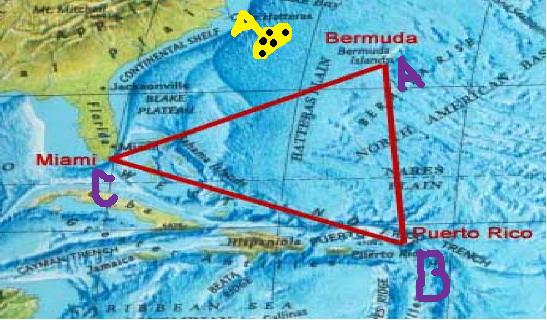
            An interesting topic that is still around today, is the Bermuda Triangle. After a brief introduction of the definition of an obtuse, right, and acute triangle, I will pose this problem: (There will be a picture of the Bermuda triangle with points labeled, (posted below).)

You are captain of the ship Euclid and are sailing straight for the Bermuda triangle. Hearing of all the bad things that can happen inside the “triangle,” you want to avoid it as best as you can. Luckily for you, you have a super power. You are able to shift one point of triangle wherever you would like. Using your super power and the knowledge of triangles we discussed previously in class, decide which point you would move, and into what triangle so that you can sail past smoothly. You will need to draw your final result with a justification of why you chose that triangle and point.

This question is not only engaging, but it makes them think abstractly. They have to use their knowledge of triangles and produce a result that fits our discussion. Then not only do they have to draw it, they will need to discuss it as well. Talking about why they chose the method they did, helps students retain and process the information better. Take into account, there are multiple ways to answer this question.
Bermuda


green line

B1. How can this topic be used in your students’ future courses in mathematics or science?

            Triangles are such a widely used topic, that it is almost guaranteed you will see them again. Not only will you use them later on in our course (Geometry), but you will be using them in pre-calculus and so forth. The main triangle you will work with in the future is the right triangle. That is why it is so important for you to learn the difference now between the triangles. Later, you will be discover the different ways you can solve for sides and angles with a right triangle, you will be discovering the different properties that come with each triangle, and how you can draw them using circles. But before you can do any of that, you have to start with the basics, like knowing which triangle is which and their definitions. I would then go in to explain that now only would triangles be used in classes, but in the real-world as well. They are everywhere we look, literally. Every time we look, we are looking at a specific angle. In the video games we play, we are always making decisions based off of the angles we can use, it’s how we build things; it’s everywhere! To have a basic understanding of something so usable in our world, would be essential to success!

Resources:

http://en.wikipedia.org/wiki/Triangle

http://www.livescience.com/23435-bermuda-triangle.html

Engaging students: Finding the area of a right triangle

In my capstone class for future secondary math teachers, I ask my students to come up with ideas for engaging their students with different topics in the secondary mathematics curriculum. In other words, the point of the assignment was not to devise a full-blown lesson plan on this topic. Instead, I asked my students to think about three different ways of getting their students interested in the topic in the first place.

I plan to share some of the best of these ideas on this blog (after asking my students’ permission, of course).

This student submission again comes from my former student Andrew Wignall. His topic, from Geometry: finding the area of a right triangle.

green lineWhat interesting (i.e., uncontrived) word problems using this topic can your students do now? (You may find resources such as http://www.spacemath.nasa.gov to be very helpful in this regard; feel free to suggest others.)

To introduce the topic of the area of a right triangle early in a lesson, we can first examine the area of a rectangle, which students should already know how to do.

Say you have a large rectangular garden, 60 feet wide and 10 feet long. Home Depot sells sod (which is a pre-grown grass on a net that can be spread on the ground) at a rate of $3/square foot. What is the area of the garden, in square feet? How much sod should you order? How much would it cost to cover the entire garden with sod?

Instead of having the entire garden covered with sod, suppose you wanted to cover part of the garden with sod and leave the rest as soil for planting flowers. To make it more visually interesting, you decide to set the sod as a triangle? The sod triangle will have a base of 60 feet and a height of 10 feet. What is the area of this triangle in relation to the area of the entire garden? What is the area of this triangle? How much sod should you order? How much would it cost to cover the triangular area with sod?

Through this activity, we can investigate a relationship between right triangles and rectangles, and also the relation of the area of a triangle compared to the angle of a rectangle.

green line

How can technology (YouTube, Khan Academy [khanacademy.org], Vi Hart, Geometers Sketchpad, graphing calculators, etc.) be used to effectively engage students with this topic? Note: It’s not enough to say “such-and-such is a great website”; you need to explain in some detail why it’s a great website

One tool to show the area of a right triangle quickly and easily is the Area Tool on Illuminations (http://illuminations.nctm.org/Activity.aspx?id=3567). With trapezoids, parallelograms, and triangles available, you can click and drag the three vertices of a triangle and instantly see how the area is affected. You can create a quick table and keep a running tally of the base, height, and area, so you can recalculate in front of the class.

Illuminations has a sample lesson plan available online for discovering the area of triangles, and integrates this tool into the plan. If not using this tool as part of a similar plan, we must understand that this tool will not be great for introducing the lesson, as there is no button to lock onto a right triangle. However, there is a button to lock the height, so when you move the vertex opposite the base, you can see how the area does not change, see how the height can be outside the triangle, and extend the formula for the area of a right triangle to the area of any triangle. This tool can then be used in further lessons when discussing the area of parallelograms and trapezoids.


green lineHow can this topic be used in your students’ future courses in mathematics or science?

Since triangles are one of the most basic shapes, the area of triangles comes up time and time again. Triangles will also be used to find the area of more complex polygons, such as hexagons and irregular polygons, by breaking down complex shapes into simple triangles and quadrelaterals. Trigonometry uses right (and non-right) triangles extensively; in Precalculus, we will revisit the area of triangles, and learn how to find the area of triangles without explicitly being given the base and height.

Outside the classroom, the area of a triangle is used extensively in architecture, as triangles are strong, and triangular trusses and frames are used in many steel structures. As the inside empty area of the triangle increases, then the stress on the triangle increases, and architects must take this into consideration.

Triangles are also used in 3d computer graphics, as the 3d shapes they design actually consist of lots of little triangles, and they have to fit textures of a certain size (say 512 pixels x 512 pixels) onto a few triangles, so it is important that they know how and where for these textures to lie.


References

Math is Fun, “Activity: Garden Area”. http://www.mathsisfun.com/activity/garden-area.html

Illuminations: Resources for Teaching Math, “Discovering the Area Formula for Triangles”. http://illuminations.nctm.org/Lesson.aspx?id=1874

Illuminations: Resources for Teaching Math, “Area Tool”. http://illuminations.nctm.org/Activity.aspx?id=3567

Home Depot, http://www.homedepot.com/p/StarPro-Greens-Centipede-Southwest-Synthetic-Lawn-Grass-Turf-Sold-by-15-ft-W-rolls-x-Your-L-2-97-Sq-Ft-Equivalent-RGB7/202025213

Math is Fun, “Heron’s Formula”. http://www.mathsisfun.com/geometry/herons-formula.html

Maths in the City, “Most stable shape – triangle”. http://www.mathsinthecity.com/sites/most-stable-shape-triangle

Andre LaMothe, “Texture Mapping Mania”. http://archive.gamedev.net/archive/reference/articles/article852.html


Engaging students: Solving for unknown parts of rectangles and triangles

In my capstone class for future secondary math teachers, I ask my students to come up with ideas for engaging their students with different topics in the secondary mathematics curriculum. In other words, the point of the assignment was not to devise a full-blown lesson plan on this topic. Instead, I asked my students to think about three different ways of getting their students interested in the topic in the first place.

I plan to share some of the best of these ideas on this blog (after asking my students’ permission, of course).

This student submission again comes from my student Brittney McCash. Her topic, from Pre-Algebra: solving for unknown parts of rectangles and triangles.

green line

A2. How could you as a teacher create an activity or project that involves your topic?

As a teacher, I want to do activities that the students would enjoy as much as possible. In doing so, I came up with a festive idea to incorporate my concept. Gingerbread houses. They are fun to build, while at the same time your thinking mathematically without realizing it. My job would be to bring these concepts forth. My engagement for the activity would probably be video on the shapes it takes to build a gingerbread house. Then I would pass out a blueprint of a gingerbread house that has missing angles or sides and have the students solve for them. This allows them to either set up proportions and see the similarities, or to solve for the sides using the characteristics of the shapes given. After the exploration of the blueprint, would come the construction part. I would have pre-cut pieces of graham crackers or other materials I would use, and have the students pick the pieces that match their blueprint; not every student will have the same. This is where the fun part would come. They would get to construct their gingerbread house, but if they made mistakes during their blueprint, their gingerbread house wouldn’t look right. Shapes wouldn’t fit, or maybe the gingerbread house wouldn’t stand because it didn’t have the right support. As these issues come up, I would be there to guide them in their discovery of “What went wrong.” This leads them to see how important having the corrects measurements truly are and how major they can effect the outcomes of things. Depending on the length of class time you have, this would probably be a two day activity.

floorplangreen line

B1. How can this topic be used in your students’ future courses in mathematics or science?

To engage the students with this topic, I would pose a question asking the students, “What would happen if the Eiffel Tower wasn’t congruent on all four sides?” This question alone opens the floor for many different discussions to take place, but my main goal would be to establish what congruent is by definition, and how does that effect shapes and their placement. Through this question we would come to the conclusion that  the tower would either lean, not be sturdy, or maybe not even stand at all if the sides of the Eiffel Tower were not congruent. This shows how important measurements are when building buildings. My next step would be to go over how to solve for sides of triangles or squares if they are congruent. Once this is established, I can pose the question, “Now what if we were not given any angles or measurements? How could we tell if triangles are congruent?” This opens the room up for ideas how this would be done, and I would introduce the Theorems of Side-Angle-Side, Side-Side-Side, Angle-Side-Angle, and Angle-Angle-Side. Without going to extreme detail, I would express how important it is for them to grasp the concepts of solving for unknowns on triangles so that they are able to later, in Geometry, understand and utilize the idea for the theorems.

green line

E1. How can technology, be used to effectively engage students with this topic?

No matter where you go these days, technology is everywhere, so why not embrace it? There are two ways that technology can be useful in the classroom. One with websites or activities online that shed new light to a topic that is being taught, and also by helping students learn skills on technology that they will need later on. There are not many jobs out there, if any that do not use technology, so helping students get a grasp on it sooner rather than later may help them later on. My engagement for this aspect on my topic would be to do an online activity. Depending on the school, this will either be done in the classroom or a computer lab. I’ll have the students log on and open up this website: Cool Math . This website would be terrific in opening up this subject. I believe this because it doesn’t just jump right in to solving for unknowns. It gives you a quick overview of the relationships certain shapes have, then it gives you an odd geometric figure to find the perimeter of. This figure only has so many measurements given to them, and they have to solve for the rest using the relationships and definitions of the shapes involved. Another really interesting attribute I liked about this website, was that each shape had its own color. When it came time to solve for the big oddly shaped geometric figure, each shape involved was colored differently. This is great because I know how hard it is for some students to distinguish shapes from one another, and this might be a way for them to better visual the shape and its encountering partners to help tell what the relationship may be.