
In my capstone class for future secondary math teachers, I ask my students to come up with ideas for engaging their students with different topics in the secondary mathematics curriculum. In other words, the point of the assignment was not to devise a full-blown lesson plan on this topic. Instead, I asked my students to think about three different ways of getting their students interested in the topic in the first place.
I plan to share some of the best of these ideas on this blog (after asking my students’ permission, of course).
This student submission again comes from my former student Allison Myers. Her topic, from Geometry: finding the volume and surface area of spheres..

How could you as a teacher create an activity or project that involves your topic?
Show students pictures of the Personal Satellite Assistant (PSA). Tell students they are going to investigate how the surface area and volume of a sphere change as its radius changes.
Explain that they will also determine how big the PSA is in real life.
Remind students that NASA engineers have created a 30.5-centimeter
(12-inch) diameter model of the PSA, but they want to shrink it to 20 centimeters (8 inches) in diameter.
Use a 30.5-centimeter (12-inch) diameter globe and let students know the globe is roughly the size of the current PSA model.
Ask students how the PSA might look different if its surface area were reduced by half.
Ask how the function of the PSA might be different if its volume were reduced by half.
Ask students what information they need to calculate its surface area and volume.
If they appear confused, draw three circles of different sizes and ask students how to calculate the area of each of the circles.
The only information they need is the radius of the sphere. Review the properties of a sphere.
Ask students what formulas are necessary to calculate the surface area and volume of the sphere. Write these formulas on the board:
Surface Area = 4 x πx radius x radius
Volume = 4/3 x πx radius x radius x radius
Show students a baseball, softball, volleyball, and basketball. Ask them if they think the surface area and volume of a sphere change at equal rates as the spheres increase from the size of a baseball to the size of a basketball.
Ask students how they will verify their hypotheses.
Curriculum
How can this topic be used in your students’ future courses in mathematics or science?
In calculus students will learn that you can revolve a curve about the x or y-axis to generate a solid. For example, a semicircle [f(x) = √(r2-x2)] can be revolved about the x-axis to obtain a sphere with radius r. From this, the different formulas for calculating the volume of a sphere can be derived.
In calculus, students will also learn how to find the surface area of a sphere by integrating about either the x or y axis.
Resource: http://www.math.hmc.edu/calculus/tutorials/volume/
At some point, students may also extend their knowledge of spheres into higher dimensions (hyperspheres), where they will learn how volume changes according the dimensions they are working in.
Resource: http://spacemath.gsfc.nasa.gov/weekly/6Page89.pdf
What interesting (i.e., uncontrived) word problems using this topic can your students do now?
For Volume of a Sphere:
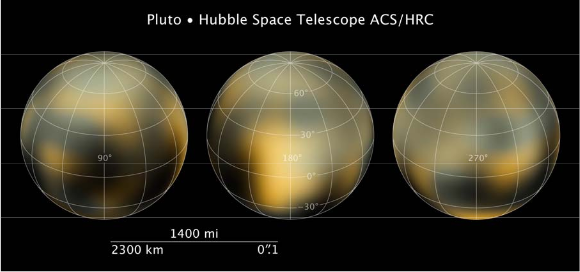
Recent Hubble Space Telescope studies of Pluto have confirmed that its atmosphere is undergoing considerable change, despite its frigid temperatures. The images, created at the very limits of Hubble’s resolving power, show enigmatic light and dark regions that are probably organic compounds (dark areas) and methane or water-ice deposits (light areas). Since these photos are all that we are likely to get until NASA’s New Horizons spacecraft arrives in 2015, let’s see what we can learn from the image!
Problem 1
– Using a millimeter ruler, what is the scale of the Hubble image in kilometers/millimeter?
Problem 2
– What is the largest feature you can see on any of the three images, in kilometers, and how large is this compared to a familiar earth feature or landmark such as a state in the United States?
Problem 3
– The satellite of Pluto, called Charon, has been used to determine the total mass of Pluto. The mass determined was about 1.3 x 10²² kilograms. From clues in the image, calculate the volume of Pluto and determine the average density of Pluto. How does it compare to solid-rock (3000 kg/m3), water-ice (917 kg/m3)?
Inquiry:
Can you create a model of Pluto that matches its average density and predicts what percentage of rock and ice may be present?
Resource: http://spacemath.gsfc.nasa.gov/weekly/6Page143.pdf
![V = \displaystyle \int_{-R}^R \pi \left[ \sqrt{R^2 - x^2} \right]^2 \, dx = \frac{4}{3} \pi R^3](https://s0.wp.com/latex.php?latex=V+%3D+%5Cdisplaystyle+%5Cint_%7B-R%7D%5ER+%5Cpi+%5Cleft%5B+%5Csqrt%7BR%5E2+-+x%5E2%7D+%5Cright%5D%5E2+%5C%2C+dx+%3D+%5Cfrac%7B4%7D%7B3%7D+%5Cpi+R%5E3&bg=ffffff&fg=000000&s=0&c=20201002)
 for a certain pyramid — called a
  .
. Mean Green Math