Engaging students: Solving for unknown parts of triangles and rectangles

In my capstone class for future secondary math teachers, I ask my students to come up with ideas for engaging their students with different topics in the secondary mathematics curriculum. In other words, the point of the assignment was not to devise a full-blown lesson plan on this topic. Instead, I asked my students to think about three different ways of getting their students interested in the topic in the first place.

I plan to share some of the best of these ideas on this blog (after asking my students’ permission, of course).

This student submission comes from my former student Michelle McKay. Her topic, from Algebra I: solving for unknown parts of triangles and rectangles.

green line

A. How could you as a teacher create an activity or project that involves your topic?

There are several different ideas that immediately come to mind on how to center a lesson around solving for unknown parts of rectangles and triangles. I would like to focus on and describe one. For this particular lesson, the student will start by making a prediction of which side(s) of a shape (triangle or rectangle) has the greatest length. Then, with a partner, they will use rulers and a handout to record the dimensions of both shapes. On the handout, they will work to fill out the chart provided. Then, we will reconvene as a class and talk about the discoveries made. For rectangles, I would ask first about what we found to be consistent for every rectangle. Using what we know, how we could find or solve for the length of one side if we only had certain parts of information? Similarly for triangles, I would begin by asking how each side differed from one another. Did the general shapes of the triangles make a difference? What was special about the right triangles? After these questions, I would introduce Pythagorean’s Theorem and have them solve for the side of triangles without rulers, then follow up with using rulers to verify their information.

green line

D. What interesting things can you say about the people who contributed to the discovery and/or the development of this idea?

Pythagoras of Samos: During Pythagoras’ time, math was considered to be a mixture of both religious and scientific beliefs and was often associated with secret societies and only those of very high social standing. As Pythagoras was one of the more influential mathematicians of his time, most details of his life were kept secret until centuries after his death, leaving very little reliable information to be pieced together in form of a biography. It is generally accepted that he was born on the island of Samos, which is now incorporated into the country of Greece. Little is known about his childhood, but most agree that he was very well educated and was acquainted with geometry before he traveled to Egypt. He was known to be almost sacrosanct and divine to those alive during his time and even a few well after his death. He founded a religious, and simultaneously mathematical, movement called Pythagoreanism, which consisted of two schools of thought: the “learners” and the “listeners”.

green line

D. What are the contributions of various cultures to this topic?

Time Period

Civilization

Contribution

Earliest known references:

23rd Century B.C.

Babylonians

–          Had rules for generating Pythagorean triples.

–          Comprehended the relationship of a right triangle’s sides.

–          Discovered the relationship of \sqrt{2}.


500 – 200 B.C.

Chinese

–          Gives a statement and geometrical demonstration of the Pythagorean Theorem (possibly before Pythagoras’ time).


570 – 495 B.C.

Greek

–          Golden rectangles were very vaguely referenced by Plato.

–          Euclid wrote a clear definition of what a rectangle is.

–          Pythagoras discovered a relationship between the sides of right triangles.


Earliest known references:
800 – 600 B.C.

Indian

–          Pythagorean Theorem was utilized in forming the proper dimensions for religious altars.

It is very hard to for historians to pinpoint with exact certainty which civilization was the first to discover what we know now as the Pythagorean Theorem. Many of the civilizations listed above existed during the same time period, but were geographically located on opposite ends of the map. Also due to loss of information from translations, damaged or completely destroyed texts, these dates and the authenticity of certain contributions are still debated to this day.

 Sources
  1. http://www-history.mcs.st-and.ac.uk/Biographies/Pythagoras.html
  2. http://ualr.edu/lasmoller/pythag.html
  3. http://www-history.mcs.st-and.ac.uk/Biographies/Euclid.html
  4. http://plato.stanford.edu/entries/pythagoreanism/

Engaging students: Deriving the distance formula

In my capstone class for future secondary math teachers, I ask my students to come up with ideas for engaging their students with different topics in the secondary mathematics curriculum. In other words, the point of the assignment was not to devise a full-blown lesson plan on this topic. Instead, I asked my students to think about three different ways of getting their students interested in the topic in the first place.

I plan to share some of the best of these ideas on this blog (after asking my students’ permission, of course).

This student submission comes from my former student Michelle McKay. Her topic, from Algebra II: deriving the distance formula.

green line

C. How has this topic appeared in pop culture?

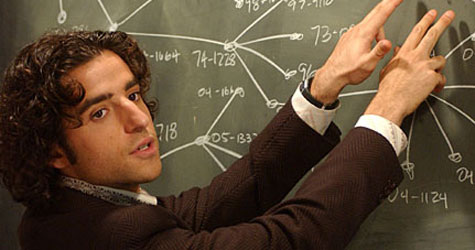
Numb3rs is a relatively popular TV show that revolves around the character Dr. Charlie Eppes, a mathematician. The show’s plot is primarily centralized around Dr. Eppes’ ability to help the FBI solve various crimes by applying mathematics.

Numb3rs

In the pilot episode, Dr. Eppes uses Rossmo’s Formula to help narrow down the current residence of a criminal to a neighborhood. Rossmo’s Formula is a very interesting in that it predicts the probability that a criminal might live in various areas. In the Numb3rs episode, Charlie manipulates the formula and projects the results onto a map to show the hot spot, or rather, the location where the criminal is most likely to be living in.

Rossmo’s Formula, however, would not be complete without including what we know as a Manhattan distance formula, which is just a derivation of the Euclidian distance formula.

green line

From the distance formula we can derive…

The distance formula is a byproduct of Pythagorean’s Theorem. By examining any two points on a two dimensional plane, x and y components could be observed and used to calculate the distance between the points by forming a right triangle and solving for the hypotenuse. Later in time, the distance formula has been adapted to fit many different situations. To name a few, there is distance in Euclidean space and its variations (Euclidean distance, Manhattan or taxicab distance, Chebyshev distance, etc.), distance between objects in more than two dimensions, and distances between a point and a set.

green line

E. Technology

The best way for students to really understand the distance formula is to allow them to make it their discovery. We can handle this in many ways. One of the more obvious explorations is to give them a piece of graph paper and have them plot points. However, this is an instance where technology can serve a great purpose in the classroom.  There are vast amounts of apps online that will allow students to manipulate two points on a grid. After looking at several different apps, I find the one I have listed in the sources to be great for a few reasons. First, students can move two points around a virtual grid. This is a “green” activity and saves paper. Second, while students move the points, a right triangle is automatically drawn for them. Depending on the level of the class, students can make connections between the Pythagorean Theorem and how it leads to the distance formula. Third, above the grid is an interactive equation. It automatically plugs in the values of the points on the grid and finds the distance between them. What is even more impressive is that it solves the equation in steps.

Engaging students: Vectors in two dimensions

In my capstone class for future secondary math teachers, I ask my students to come up with ideas for engaging their students with different topics in the secondary mathematics curriculum. In other words, the point of the assignment was not to devise a full-blown lesson plan on this topic. Instead, I asked my students to think about three different ways of getting their students interested in the topic in the first place.

I plan to share some of the best of these ideas on this blog (after asking my students’ permission, of course).

This student submission comes from my former student Derek Skipworth. His topic, from Precalculus: vectors in two dimensions.

green line

A. How could you as a teacher create an activity or project that involves your topic?

While it may be a cop-out to use this example since I am developing it for an actual lesson plan, I will go ahead and use it because I feel it is a strong activity.  I am developing a series of 21 problems that will be the base for forming the students’ treasure maps.  There will be three jobs: Cartographer, the map maker; Lie Detector, who checks for orthogonality; and Calculator, who will solve the vector problems.  The 21 problems will be broken down into 7 per page, and the students will switch jobs after each page.  The rule is that any vectors that are orthogonal with each other cannot be included in your map.  There are three of these on each page, so each group should end up with a total of 12 vectors on their map.  Once orthogonality is checked by the Lie Detector, the Calculator will do the expressed operations on the vector pairs to come up with the vector to be drawn.  The map maker will then draw the vector, as well as the object the vector leads to.  Each group will have their directions in different orders so that every group has their own unique map.  The idea is for the students to realize (if they checked orthogonality correctly) that, even though every map is different, the sum of all vectors still leads you to the same place, regardless of order.


green line

B. How does this topic extend what your students should have learned in previous courses?

Vectors build upon many topics from previous courses.  For one, it teaches the student to use the Cartesian plane in a new way than they have done previously.  Vectors can be expressed in terms of force in the x and y directions, which result in a representation very similar to an ordered pair.  It gets expanded to teach the students that unlike an ordered pair, which represents a distinct point in space, a vector pair represents a specific force that can originate from any point on the Cartesian Plane.

Vectors also build on previous knowledge of triangles.  When written as \langle x,y \rangle, we can find the magnitude of the vector by using the Pythagorean Theorem.  It gives them a working example of when this theorem can be applied on objects other than triangles.  It also reinforces the students trigonometry skills since the direction of a vector can also be expressed using magnitude and angles.


green line

E. How can technology be used to effectively engage students with this topic?

The PhET website has one of the best tools I’ve seen for basic knowledge of two dimensional vector addition, located at http://phet.colorado.edu/en/simulation/vector-addition.  This is a java-based program that lets you add multiple vectors (shown in red) in any direction or magnitude you want to get the sum of the vectors (shown in green).  Also shown at the top of the program is the magnitude and angle of the vector, as well as its corresponding x and y values.

What’s great about this program is it puts the power in the student’s hands.  They are not forced to draw multiple sets of vectors themselves.  Instead, they can quickly throw them in the program and manipulate them without any hassle.  This effectively allows the teacher to cover the topic quicker and more effectively due to the decreased amount of time needed to combine all vectors on a graph.

Engaging students: Deriving the Pythagorean theorem

In my capstone class for future secondary math teachers, I ask my students to come up with ideas for engaging their students with different topics in the secondary mathematics curriculum. In other words, the point of the assignment was not to devise a full-blown lesson plan on this topic. Instead, I asked my students to think about three different ways of getting their students interested in the topic in the first place.

I plan to share some of the best of these ideas on this blog (after asking my students’ permission, of course).

This student submission again comes from my former student Maranda Edmonson. Her topic, from Geometry: deriving the Pythagorean theorem.

green line

D. History: What are the contributions of various cultures to this topic?

Legend has it that Pythagoras was so happy about the discovery of his most famous theorem that he offered a sacrifice of oxen. His theorem states that “the area of the square built upon the hypotenuse of a right triangle is equal to the sum of the areas of the squares upon the remaining sides.” It is likely, though, that the ancient Babylonians and Egyptians knew the result much earlier than Pythagoras, but it is uncertain how they originally demonstrated the proof. As for the Greeks, it is likely that methods similar to Euclid’s Elements were used. Also, though there are many proofs of the Pythagorean Theorem, one came from the contemporary Chinese civilization found in the Arithmetic Classic of the Gnoman and the Circular Paths of Heaven, a Chinese text containing formal mathematical theories.

http://jwilson.coe.uga.edu/emt669/student.folders/morris.stephanie/emt.669/essay.1/pythagorean.html

green line

E. Technology: How can technology be used to effectively engage students with this topic?

The following link is for a video that not only engages students from the very beginning by playing the Mission: Impossible theme and giving students a mission – “should they choose to accept it” – but that has great information. It begins with a short engagement, as stated before, and goes into a little bit of history about Pythagoras and the Pythagoreans. It then briefly describes what the Pythagorean Theorem is before the commentator says, “Does it have applications in our lives today?” At this point (2:43 in the video), it would be beneficial to stop the video and let students discuss where they could use the theorem. The rest of the video simply shows some examples of how the Pythagorean Theorem is used on sailboats, inclined planes, and televisions. It would be up to the teacher whether or not to show the last five minutes of the video to show students these examples, but they could take notes on these examples as they are worked out on the screen.

http://digitalstorytelling.coe.uh.edu/movie_mathematics_02.html

green line

B. Applications: How can this topic be used in your students’ future courses in mathematics or science?

After students learn the Pythagorean Theorem in their Geometry classes, they will use it throughout their mathematical careers. They will use it specifically in Pre-Calculus when they are learning about the unit circle. The theorem is fundamental to proving the basic identities in Trigonometry. It is also used in some of the trigonometric identities, aptly named the Pythagorean Identities based on the nature of their derivation.

In Physics, the kinetic energy of an object is

\displaystyle \frac{1}{2} (\hbox{mass})(\hbox{velocity})^2.

But, in terms of energy, energy at 500 mph = energy at 300 mph + energy at 400 mph. This equation means that, with the energy used to accelerate something at 500 mph, two other objects could use that same energy to be accelerated to 300 mph and 400 mph. Looks like a Pythagorean triple, right? The theorem is also used in Computer Science with processing time. Other examples are found in the link below.

http://betterexplained.com/articles/surprising-uses-of-the-pythagorean-theorem/